eBook - ePub
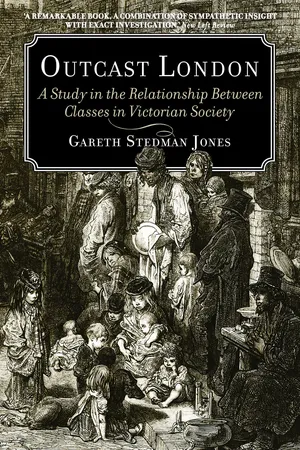
Outcast London
A Study in the Relationship Between Classes in Victorian Society
- 480 pages
- English
- ePUB (mobile friendly)
- Available on iOS & Android
eBook - ePub
About this book
In the second half of the nineteenth century, Victorian middle and upper classes felt increasingly threatened by the masses of "outcast London." Gareth Stedman Jones, working from a mass of statistical and documentary evidence, argues that after 1850 London passed through a crisis of social and economic development. Outcast London is a fascinating and important study of the problem at the center of the crisis: the casual poor and their fraught relations with the labor market, with housing and with middle-class London.
Information
PART I
THE LONDON LABOUR MARKET AND THE CASUAL LABOUR PROBLEM
1
LONDON AS AN INDUSTRIAL CENTRE
THE size and peculiarity of the casual labour problem in nineteenth-century London was intimately connected with the predominant characteristics of London as an industrial centre. It is therefore necessary briefly to describe the prevalent pattern of London employment and the economic consequences that stemmed from it.
Historically, the economic importance of London depended upon three closely related factors: firstly, it was the major port of the English import and trans-shipment trade; secondly, it was by far the largest single consumer market in England;1 and thirdly, as a centre of government and the royal court,2 it was the focal point of conspicuous consumption and its attendant luxury trades. In the period before the Industrial Revolution, because of the predominance of handicraft production, and primitive transportation facilities, these factors encouraged the growth, not merely of finishing and consumer trades, but also of semi-processing and capital goods industries like leather and sugar manufacture, shipbuilding, and silk production. The closeness to the market, the access to raw materials, the close interrelation of city and government, and the presence of a highly skilled labour force gave London an impressive industrial advantage.3
But this situation was substantially modified by the Industrial Revolution. The typical industries of the Industrial Revolution were those relying upon coal as a fuel, and powered by steam-driven machinery.4 London’s great distance from the centres of coal production5 put her at a cost disadvantage compared to her provincial rivals in these forms of industry. A second feature normally associated with such industries was the use of large factories to take full advantage of economies of scale made possible by mechanized production. The rapid development of nineteenth-century London as the commercial and financial centre of the world market, her growth as a centre of imperial government, and her privileged position as a ‘national emporium’ at the heart of the transport and distribution network, greatly intensified the competition for scarce urban land, and resulted in an enormous rise in rents in the central London area.6 This factor, together with the high cost of fuel, made large-scale factory production almost prohibitively expensive unless counterbalanced by very strong compensating advantages.
In fact, the spread of the Industrial Revolution confronted many of London’s old established industries with a critical threat. In finished consumer goods industries like clothing and furniture, or luxury trades like jewellery and carriage building, proximity to the market could still be a decisive advantage.7 But this was not so true in the production of raw materials, semi-finished goods, or heavy capital goods. The factory, with its large demands upon space, its voracious appetite for fuel and its semi-skilled labour force was8 quite inappropriate to London conditions. In the first quarter of the nineteenth century, London had been renowned, among other things, for its textile production (silk), its shipbuilding, and its engineering. But by the 1870s,9 in comparison with other industrial zones, London had become deficient in textiles, heavy engineering, shipbuilding, and more generally in the production of raw materials and semi-finished goods.
In 1861, as table 1 shows,10 the bulk of London’s industrial population (excluding those engaged in building) were employed in five major industries—clothing (including footwear), wood and furniture, metals and engineering, printing and stationery, and precision manufacture (precious metals, watches, scientific instruments, surgical apparatus etc.). Four of these industries were finished goods industries; the other, metals and engineering, forms an apparent exception. But this was not in fact the case. By the 1880s the bulk of engineering in London was concerned with repair.11 Where this was not so, the reasons for the location of a manufacture in London were highly idiosyncratic. As Jesse Argyll wrote,12 ‘either the work is required in a great hurry, or for some other reason must be made on the spot, or else the firm holds a particular patent, or commands, by reason of its long standing and superior work, a practical monopoly in some exceptional class of goods.’ Thus London’s specialities were torpedoes, gas meter making, and specialized printing machines. The same was largely true of metal manufacture. Such iron founding as there was in London,13 was only designed to meet the immediate demands of the building industry. The bulk of the production of brass, copper, tinplate, and pewter work was carried on in Birmingham or Sheffield; London work was either confined to repair14 or to fine finished work like brass sanitary fittings, pewter pots, or bar decorations.
London remained viable as a finishing centre, either because of the over-riding advantage of proximity to the market, or else because trades liable to challenge from the provinces found a ruthless method of adapting London conditions to their own advantage. The first reason was the overwhelming one in the luxury West End bespoke trades, and small highly specialized precision manufactures. Some of these trades underwent a gentle decline15 in the second half of the nineteenth century. But as long as the bulk of London Society wanted clothes, shoes, jewellery, riding gear, and carriages made to its own specifications, and as long as hospitals or technological innovators demanded superior16 handmade, and often new or experimental, precision instruments—surgical cutlery or delicate scientific instruments—there was little chance of real competition from Lancashire, the West Riding, or the Midlands. The second case applied to those consumer goods trades which adapted themselves in the course of the nineteenth century to cater for mass demand—furniture, footwear, and clothing. As Peter Hall has shown,17 there was an industrial revolution in the clothing and furniture industries, but in London it did not engender a factory system. Instead, by the subdivision of production, and by the application of simple and comparatively inexpensive hand driven machinery,18 it was possible to dispense with the services of a skilled labour force in all but a few production processes. Once the technical problems had been solved by the invention of the sewing machine and the bandsaw (1840s–1860s), and the conditions of mass demand for cheap ready-made goods had been established by rising working class prosperity, manufacturers were able to take advantage of a cheap,19 overfilled, unskilled labour pool of women and immigrants who were prepared to work at sub-subsistence wages.
What came to be called sweating20 was really an attempt to reduce London overheads to a minimum. The first of these was wages, but second and equally important was rent. Provincial factory competition in clothing and footwear21 began to be significant from the late 1860s. But competitive factory production was not a viable option in London. The alternative adopted was the reduction of even workshop production to a necessary minimum and a rapid expansion of home work: what in fact Peter Hall calls the22 ‘vertical disintegration of production’. In fact this system was peculiarly well suited to consumer goods production in some of its main branches. The comparatively arbitrary nature of demand, the liability to rush orders and sudden gluts, and quick changes in fashion provided little incentive to the manufacturer to stockpile, but on the other hand gave the entrepreneur employing outworkers very great flexibility in expanding or contracting production23 (at little cost to himself) according to the state of the market. It is significant, for instance, in the footwear industry, that London made no attempt to compete with the provinces in the production of men’s heavy boots,24 where fashions were slow to change and where demand was relatively constant.
Sweating, then, was one radical solution to the problem of provincial factory competition. Temporarily at least, it provided a successful answer to the most pressing problem of the inner London manufacturer—how to offset the disadvantages of high rents, expensive fuel, high wages, and scarce skills in competition with cheaper semi-skilled provincial factory production. In certain old-established London trades, this problem could not be solved except by total or partial removal from London. This was particularly true of the ship-building industry, whose workforce fell dramatically from 27,00025 in 1865 to 9,000 in 1871. Other industries underwent a more gradual, but equally irreversible decline. Silk manufacture in London, unable to turn profitably to factory production, was fatally hit by the Cobden treaty of 1860, and its male labour force declined by 43 per cent in the ensuing 30 years.26 In the leather industry, the processing of raw material—particularly tanning—underwent a similar process of decline,27 and by the 1880s28 the Bermondsey tanyards were in a state of chronic depression from which they never fully recovered. Although more gradual and imperceptible, the decline in London heavy engineering was equally marked. In the first quarter of the nineteen...
Table of contents
- Cover
- About the Author
- Title Page
- Copyright
- Contents
- List of Plates
- List of Tables, Maps, and Figures
- Preface to the 2013 Edition
- Preface to the 1984 Edition
- Preface
- Abbreviations
- Introduction
- Part I: The London Labour Market and the Casual Labour Problem
- Part II: Housing and the Casual Poor
- Part III: Middle-Class London and the Problem of the Casual Poor
- Appendix 1: Notes on the Reclassification of the 1861 and 1891 Censuses Into Social and Industrial Groupings
- Appendix 2: Statistical Tables, Charts, and Figures
- Select Bibliography
Trusted by 375,005 students
Access to over 1.5 million titles for a fair monthly price.
Study more efficiently using our study tools.
Frequently asked questions
Yes, you can cancel anytime from the Subscription tab in your account settings on the Perlego website. Your subscription will stay active until the end of your current billing period. Learn how to cancel your subscription
No, books cannot be downloaded as external files, such as PDFs, for use outside of Perlego. However, you can download books within the Perlego app for offline reading on mobile or tablet. Learn how to download books offline
Perlego offers two plans: Essential and Complete
- Essential is ideal for learners and professionals who enjoy exploring a wide range of subjects. Access the Essential Library with 800,000+ trusted titles and best-sellers across business, personal growth, and the humanities. Includes unlimited reading time and Standard Read Aloud voice.
- Complete: Perfect for advanced learners and researchers needing full, unrestricted access. Unlock 1.5M+ books across hundreds of subjects, including academic and specialized titles. The Complete Plan also includes advanced features like Premium Read Aloud and Research Assistant.
We are an online textbook subscription service, where you can get access to an entire online library for less than the price of a single book per month. With over 1.5 million books across 990+ topics, we’ve got you covered! Learn about our mission
Look out for the read-aloud symbol on your next book to see if you can listen to it. The read-aloud tool reads text aloud for you, highlighting the text as it is being read. You can pause it, speed it up and slow it down. Learn more about Read Aloud
Yes! You can use the Perlego app on both iOS and Android devices to read anytime, anywhere — even offline. Perfect for commutes or when you’re on the go.
Please note we cannot support devices running on iOS 13 and Android 7 or earlier. Learn more about using the app
Please note we cannot support devices running on iOS 13 and Android 7 or earlier. Learn more about using the app
Yes, you can access Outcast London by Gareth Stedman Jones in PDF and/or ePUB format, as well as other popular books in History & 19th Century History. We have over 1.5 million books available in our catalogue for you to explore.