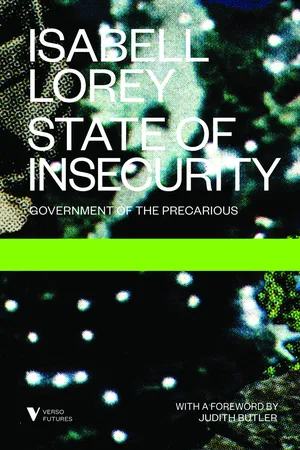
Years of remodelling the welfare state, the rise of technology, and the growing power of neoliberal government apparatuses have established a society of the precarious. In this new reality, productivity is no longer just a matter of labour, but affects the formation of the self, blurring the division between personal and professional lives. Encouraged to believe ourselves flexible and autonomous, we experience a creeping isolation that has both social and political impacts, and serves the purposes of capital accumulation and social control.
In State of Insecurity, Isabell Lorey explores the possibilities for organization and resistance under the contemporary status quo, and anticipates the emergence of a new and disobedient self-government of the precarious.
- 128 pages
- English
- ePUB (mobile friendly)
- Available on iOS & Android
eBook - ePub
About this book
Trusted by 375,005 students
Access to over 1.5 million titles for a fair monthly price.
Study more efficiently using our study tools.
Information
Topic
PhilosophySubtopic
Political PhilosophyChapter 1
Precariousness and Precarity
How can we understand, initially at a theoretical-systematic level, the connection between precarity as a relationship of inequality on the one hand, and existential, social precariousness on the other, the relationship between the first and the second dimension of the precarious? Judith Butler offers some considerations about this in her book Frames of War. Here she continues to pursue the political-philosophical question that was already raised in her book of essays, Precarious Life, as to when a life is considered grievable and therefore liveable. Within only a few pages, in the introduction to Frames of War, Butler introduces a second concept alongside precariousness: that of precarity,1 adopting the neologism that has been used for several years now, especially in political-theoretical and activist discourses on precarization.2
Butler conceptualizes the general precariousness of life, the vulnerability of the body, not simply as a threat or a danger from which we have necessarily to be protected. She argues against reproducing the anxieties of precariousness and thus supporting traditional modern logics of domination, instead positing the lack of recognition of fundamentally precarious life as the starting-point for analysing relations of domination.
‘Precariousness’ as an existential state designates what constitutes life in general – both human and non-human. Butler formulates an ontology that cannot be understood apart from social and political conditions. These conditions enable historically specific modes of being, making it possible for bodies to survive in a certain way, which would not be viable without their being embedded in social, political and legal circumstances. At the same time, however, it is precisely these circumstances that endanger life. For this reason, according to Butler, it is important to focus on the political decisions and social practices through which some lives are protected and others are not.
Precariousness becomes ‘co-extensive’3 at birth, since survival depends from the beginning on social networks, on sociality and the work of others. The fundamental social dependency of a living being due to its vulnerability, due to the impossibility of living a wholly autonomous life, also highlights – going beyond Butler – the eminent significance of reproductive work. Because life is precarious, it is crucially dependent on care and reproduction.
Precariousness relates not to life itself, but rather to the conditions of its existence;4 what is problematized here is not what makes everyone the same, but rather what is shared by all. Precariousness that is shared by all can also be understood as a separating factor: on the one hand it is what we all have in common, but on the other it is what distinguishes and separates us from others. These two aspects of ‘shared/separated’ cannot be sharply differentiated, but should instead be considered in their ambivalence. Sharing and separation have always already been inscribed in general and conditional precariousness: commonality and difference, conjunction and disjunction.
Precariousness is consequently neither an immutable mode of being nor an existential sameness, but rather a multiply insecure constituting of bodies, which is always socially conditioned. As that which is shared, which is at once divisive and connective, precariousness denotes a relational difference, a shared differentness. What is connective is not a pre-existing common good to which one could have recourse; instead it is something that is only engendered in political and social agency.
Shared precariousness is thus a condition that both exposes us to others and makes us dependent on them.5 This social interdependence can express itself both as concern or care and as violence. In other words: because they are precarious and hence finite, bodies are dependent on something outside themselves, ‘on others, on institutions and on sustained and sustainable environments’.6 Without protection, without security, without care no life can survive, and yet at the same time, it always remains exposed to risk and the danger of death. ‘No amount of will or wealth can eliminate the possibilities of illness or accident for a living body’, as Butler says.7
The assumption that life, because it is precarious and endangered, because it is exposed to an existential vulnerability, must be or even could be legally or otherwise entirely protected and secured, is nothing other than a fantasy of omnipotence.8 Although they need protection, living bodies can never be completely protected, specifically because they are permanently exposed to social and political conditions, under which life remains precarious. The conditions that enable life are, at the same time, exactly those that maintain it as precarious. All security retains the precarious; all protection and all care maintain vulnerability; nothing guarantees invulnerability.
Shared precariousness as a relational difference does not exist beyond the social and the political. Therefore it does not exist independently from a second dimension of the precarious, namely that of hierarchizing precarity. This corresponds to a second form of difference: that of classifying and discriminating differentiation. Butler underscores the paradigmatic relationship between precariousness, precarity and domination in Western modernity. She emphasizes the break that Hobbesian state theory signified, conceiving commonly shared precariousness primarily as a threat: being anxious and frightened by others and by the vulnerability shared with them.9 ‘Yet, precisely because each body finds itself potentially threatened by others who are, by definition, precarious as well, forms of domination follow.’10 Domination turns existential precariousness into an anxiety towards others who cause harm, who have to be preventively fended off, and not infrequently even destroyed, in order to protect those who are threatened.11 The precariousness shared with others is hierarchized and judged, and precarious lives are segmented. This segmentation produces, at the same moment, the ‘differential distribution’12 of symbolic and material insecurities, in other words precarity. Precarity as the hierarchized difference in insecurity arises from the segmentation, the categorization, of shared precariousness. The classification of what is ineluctably shared produces inequality. Precarity can therefore be understood as a functional effect arising from the political and legal regulations that are specifically supposed to protect against general, existential precariousness. From this perspective, domination means the attempt to safeguard some people from existential precariousness, while at the same time this privilege of protection is based on a differential distribution of the precarity of all those who are perceived as other and considered less worthy of protection.
1 Butler, ‘Precarious Life, Grievable Life’, in Frames of War, pp. 25–6; for further considerations of precariousness and precarity, see also the interview with Judith Butler and Antke Engel, ‘Politics under Conditions of Precariousness and Violence’, in Marina Gržinić and Rosa Reitsamer, eds, New Feminism: Worlds of Feminism, Queer and Networking Conditions, Vienna: Löcker, 2008, pp. 135–46; Judith Butler, ‘For and Against Precarity’, Tidal. Occupy Theory, Occupy Strategy 1 (December 2011), pp. 12–13, and ‘Precarity Talk: A Virtual Roundtable’, with Lauren Berlant, Judith Butler, Bojana Cvejić, Isabell Lorey, Jasbir Puar and Ana Vujanović, Theatre Drama Review 4 (2012), pp. 165–79.
2 In discussions in the context of the European movement of the precarious (since 2001, the EuroMayDay movement) not only is the term ‘precarization’ (Prekarisierung) used in German, but also – often synonymously, without the differentiation developed here – ‘precarity’ (Prekarität) and ‘precariat’ (Prekariat) (cf. Raunig, A Thousand Machines, pp. 75–90). Even before Butler established the connection to political-theoretical and activist discussions about precarity herself, her concept of precariousness was already linked with precarity. (cf. Brett Neilson and Ned Rossiter, ‘From Precarity to Precariousness and Back Again: Labour, Life and Unstable Networks’, Fibreculture 5 (2005).
3 Butler, ‘Precarious Life, Grievable Life’, p. 14.
4 Cf. ibid., pp. 22–3.
5 ‘Although precarious life is a generalized condition, it is, paradoxically, the condition of being conditioned’ (ibid., p. 23).
6 Ibid.
7 Ibid., p. 30.
8 Cf. ibid., p.18.
9 Cf. also Roberto Esposito, Communitas: The Origin and Destiny of Community, trans. Timothy Campbell, Stanford: Stanford University Press, 2010.
10 Butler, ‘Precarious Life, Grievable Life’, p. 31.
11 Elsewhere I have called this kind of binary confirmation of domination juridical immunity. In this immunizing dynamic, the precarious constructed as threat can be fended off to an ‘outside’. However, the dangerous precarious can also be taken into a political community in the dynamic of biopolitical immunization and thus neutralized in their dangerousness and integrated – this dynamic of the immune corresponds more to normalized governmental precarization (cf. Lorey, Figuren des Immunen).
12 Butler, ‘Precarious Life, Grievable Life’, pp. 25–7.
Chapter 2
Biopolitical Governmentality
In order to develop the third dimension of the precarious, governmental precarization, it is necessary first of all to describe the political-economic framework, which I call ‘biopolitical governmentality’.1 Michel Foucault uses the concept of ‘governmentality’ to designate the structural entanglement between the government of a state and the techniques of self-government in modern Western societies. This entanglement between state and population-subjects can be regarded as the political and economic paradigm shift towards Western modernity.
What had been developing since the sixteenth century first came to fruition in the course of the eighteenth: a new governing technique, more precisely the lines of force of modern governing techniques up to the present. Neither the traditional sovereign, for which Foucault cites the sixteenth-century figure of Machiavelli’s Principe as a prototype, nor Hobbes’ voluntary community of subjects bound by contract, in the seventeenth century, were interested in leading the people for their own sake, but primarily in ruling them for the sake of the sovereign.2 It was only in the course of the eighteenth century, as liberalism and the bourgeoisie became hegemonic, that the population came into the focus of power, and with this a mode of governing oriented to bettering the life of the people. For the strength of the state now no longer depended on the size of its territory or on the mercantilist and authoritative regimentation of subjects,3 but rather on the ‘happiness’ of the population.4
Methods of governing continued ...
Table of contents
- Cover
- Title Page
- Copyright
- Contents
- Foreword by Judith Butler
- The Government of the Precarious: An Introduction
- 1. Precariousness and Precarity
- 2. Biopolitical Governmentality
- 3. Welfare State and Immunization
- 4. Precarization as an Instrument of Governing
- 5. Virtuosity and the Post-Fordist Public Sphere
- 6. Care Crisis and Care Strike
- 7. Exodus and Constituting
- Acknowledgements
- References
Frequently asked questions
Yes, you can cancel anytime from the Subscription tab in your account settings on the Perlego website. Your subscription will stay active until the end of your current billing period. Learn how to cancel your subscription
No, books cannot be downloaded as external files, such as PDFs, for use outside of Perlego. However, you can download books within the Perlego app for offline reading on mobile or tablet. Learn how to download books offline
Perlego offers two plans: Essential and Complete
- Essential is ideal for learners and professionals who enjoy exploring a wide range of subjects. Access the Essential Library with 800,000+ trusted titles and best-sellers across business, personal growth, and the humanities. Includes unlimited reading time and Standard Read Aloud voice.
- Complete: Perfect for advanced learners and researchers needing full, unrestricted access. Unlock 1.5M+ books across hundreds of subjects, including academic and specialized titles. The Complete Plan also includes advanced features like Premium Read Aloud and Research Assistant.
We are an online textbook subscription service, where you can get access to an entire online library for less than the price of a single book per month. With over 1.5 million books across 990+ topics, we’ve got you covered! Learn about our mission
Look out for the read-aloud symbol on your next book to see if you can listen to it. The read-aloud tool reads text aloud for you, highlighting the text as it is being read. You can pause it, speed it up and slow it down. Learn more about Read Aloud
Yes! You can use the Perlego app on both iOS and Android devices to read anytime, anywhere — even offline. Perfect for commutes or when you’re on the go.
Please note we cannot support devices running on iOS 13 and Android 7 or earlier. Learn more about using the app
Please note we cannot support devices running on iOS 13 and Android 7 or earlier. Learn more about using the app
Yes, you can access State of Insecurity by Isabell Lorey, Aileen Derieg in PDF and/or ePUB format, as well as other popular books in Philosophy & Political Philosophy. We have over 1.5 million books available in our catalogue for you to explore.