The all-encompassing embrace of world capitalism at the beginning of the twenty-first century was generally attributed to the superiority of competitive markets. Globalization had appeared to be the natural outcome of this unstoppable process. But today, with global markets roiling and increasingly reliant on state intervention to stay afloat, it has become clear that markets and states aren't straightforwardly opposing forces.
In this groundbreaking work, Leo Panitch and Sam Gindin demonstrate the intimate relationship between modern capitalism and the American state. The Making of Global Capitalism identifies the centrality of the social conflicts that occur within states rather than between them. These emerging fault lines hold out the possibility of new political movements that might transcend global markets.
eBook - ePub
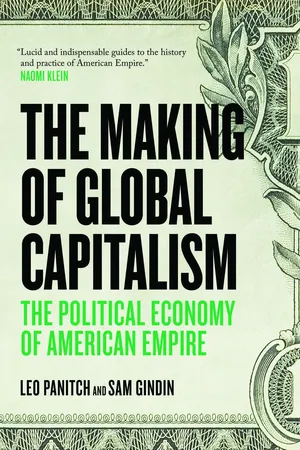
The Making of Global Capitalism
The Political Economy of American Empire
- 464 pages
- English
- ePUB (mobile friendly)
- Available on iOS & Android
eBook - ePub
About this book
Information
I
PRELUDE TO THE NEW
AMERICAN EMPIRE
PRELUDE TO THE NEW
AMERICAN EMPIRE
1
The DNA of American Capitalism
The DNA of American Capitalism
The role that the United States came to play in the making of global capitalism was not inevitable, but nor was it accidental. The American empire did not appear from nowhere. But comparing it with empires of the past—usually beginning with Rome’s, and ending with Britain’s—tends to miss precisely what is distinctive about the American empire. When the new Republic of the United States was founded, the term “empire” was quite often used to describe it—George Washington was not the only Founding Father to do so when he spoke of it ambitiously as “a rising empire”—but proponents of American power gradually ceased to use the word.1 Unlike previous empires, the new American empire was primarily built without colonies. The early articulation of dynamic capitalist development at home with the Monroe Doctrine abroad involved building the continental territorial expansion of the republic directly into the American state structure, while at the same time trying to contain, and finally sweep out, the colonies established in the Western hemisphere by the European powers. This laid the foundation, despite the few colonies the US took over from Spain at the beginning of the twentieth century, for the eventual global reach of the informal American empire.
Writing a few years before World War I, Karl Kautsky observed, “the United States shows us our social future within capitalism.”2 Insofar as this turned out to be true, it was because of the way American capitalism and its worldwide appeal—“the attractive power of US models of production and culture”—emerged out of “the particular matrix of its own social history.” As Perry Anderson goes on to say, the “unencumbered property rights, untrammeled litigation, the invention of the corporation” that distinguished the US in the nineteenth century was part and parcel of the US’s remarkable economic dynamism in the twentieth, leading to “what Polanyi most feared, a juridical system disembedding the market as far as possible from ties of custom, tradition or solidarity, whose very abstraction from them later proved—American firms like American films—exportable and reproducible across the world, in a way that no other competitor could quite match.” Combined here were, on the one hand, the invention in the US of the modern corporate form, “scientific management” of the labor process, and assembly-line mass production; and on the other, Hollywood-style “narrative and visual schemas stripped to their most abstract,” thereby not only appealing to and aggregating successive waves of immigrants, but ensuring that US consumption patterns were widely emulated abroad. But the role of the state in this could not be ignored: “The steady transformation of international merchant law and arbitration in conformity with US standards is witness to the process.”3
An appreciation of how centrally US capitalism figures in the general development of capitalism in the hundred years before World War II is key to understanding what impelled the American state to assume its new imperial role. But we also need to understand what made it capable of “conjugating” (to borrow Anderson’s apt term) its “particular power with the general task of coordination” in the making of global capitalism. Anderson’s view is that US constitutional structures lacked the “carrying power” of its economic and cultural ones, being “moored to eighteenth century arrangements”;4 while Michael Hardt and Antonio Negri, in sharp contrast, see the US constitution as having conferred a new kind of “network power” well adapted to the creation and management of globalization.5 While this is an important insight, it underplays not only the considerable power the US Constitution gave the federal state to police the regime against insurrection, to make war, to promote trade, and especially to expand the Union territorially, but also the room it provided for the federal state to superintend the development of an informal empire.
Abundant land and resources and access to large foreign pools of British capital and European labor privileged capitalist development in the US, but it is the way in which these came to be combined through its distinctive class relations, first in the independent commodity-producing farm economy and then in the modern corporate economy, that lies at the roots of the uniquely dynamic nature of American capitalist development.6 Pivotal to this was the American state. Though often characterized as particularly weak and “laissez-faire,” its activism sustained the conditions for the successes of US capitalism, and imprinted those successes with its own distinctive characteristics. Although he could not have imagined what this would actually look like two centuries later, it thereby fulfilled Thomas Jefferson’s boast that “no constitution was ever before as well-calculated for extensive empire and self-government.”7
The Dynamic Economy
A key characteristic of American economic development was the use of leading-edge technologies to deepen domestic capital accumulation through intensive growth, while an unprecedented extensive growth was facilitated by the state’s expansion of the territory within its sovereign control (from Ohio to Texas to California to Oregon), as well as by widening access to both proximate and far-flung international markets in a variety of ways. The small-scale family farming which engaged most white citizens, as independent commodity producers, in competitive commercial agriculture spawned a process of agro-industrialization, first in the Northern Atlantic states and then, and especially, in the new Midwest states. Once the farmers were “let loose on a fertile plain,” this system of agriculture “quickly generated huge surpluses for disposal elsewhere, revolutionized production methods across a wide range of agro-processing industries, and . . . built an immense urban system to support and sustain the bare bones of production.”8 Moreover, as early as the 1850s workers in the new cities and towns became significant mass consumers of standardized goods, adding another key element in the distinctive socio-economic matrix of American development: a relatively high-wage proletariat. The fact that by mid-century wages in the US were more than double those in Britain contributed strongly to pulling in the vast pools of labor that were simultaneously being pushed out by unemployment in Europe.9
In fact, an industrial working class had begun to emerge in the US by the time de Tocqueville wrote Democracy in America, and he already discerned tensions emerging between it and the “new oligarchy” of factory owners.10 The shortage, and the mobility, of skilled labor was a key background factor here, reinforced by the bargaining power that an abundance of land and the possibility of starting a family farm gave to workers in the labor market, at least initially. By placing limits on the degree of exploitation employers could impose, in spite of the high rate of immigration of new workers, this spurred more capital-intensive production; it also provided levels of income that allowed some craftsmen to start their own factories, and forced factory owners to promote the development of labor-saving innovations in machine technology and factory organization. Two other factors reinforced this trend. One was the system of protective tariffs that, in spite of Northern merchant and Southern planter opposition, was in place from the 1820s onwards. Another was the initiation and coordination by the federal government, acting through the War Department’s federal armory, of new production methods using interchangeable parts, precision gauges, specialist machines operated by relatively unskilled labor, and management control information systems—the “American System of Manufacturing” so much admired in Europe by the middle of the nineteenth century.11
After the defeat of the plantocracy in the Civil War, the vast inland domain stretching to the Pacific provided unparalleled space for industrial capitalism’s expansion in what was already emerging as the largest domestic market in the world. Outside of the core Southern states (which until after World War II remained primarily a low-wage, staples-producing region), American capitalist growth in the last third of the nineteenth century—building directly on the previous phase of agro-industrialization—was both qualitatively and quantitatively spectacular. Until the mid 1890s, industrial growth was more or less internally financed, while financial capital concerned itself with the sale of securities to fund the public debt (which had grown enormously during the Civil War), and with handling the inflow of foreign capital that funded the extension of the railway system and the telegraph lines along every track—“probably the largest and most sustained construction program in world history to that time.”12 By 1890, railroads—the first really big US businesses—accounted for half of all capital nation-wide, and they had greatly stimulated further industrial production, as well as the emergence of the first bond-rating agencies, S&P and Moody’s. At the same time, the massive over-investment in railroads, and the crises this spawned, led financial capital to turn increasingly towards the development of securities markets to raise funds for manufacturing industry, whose growth had by then begun to outstrip its capacity to fund all its own capital requirements.
The tremendous concentration and centralization of capital that took place in this period (almost 30 percent of the companies that made up the Fortune 500 list in the 1990s were founded between 1880 and 1910)13 established a distinctive pattern of accumulation. Many of these large corporations had emerged out of capitalist firms that had begun small and then diversified and competed to build nation-wide markets. In the last three decades of the nineteenth century, capital invested per worker almost tripled—a fact made all the more impressive in light of the enormous population growth at the time, including the more than 15 million immigrants who entered the country between 1870 and 1913. The result was that, whereas in 1870 US productivity was some 14 percent lower than the UK’s, by the end of the century it was 7 percent greater, and by 1913 it was 20 percent greater still, and more than twice that of France and Germany. The US share of world production, already 23 percent in 1870, reached 30 percent by 1900 and 36 percent by 1913. This was more than the UK and Germany combined, and not far from the share the US would hold in 1950.14
In spite of high tariffs which limited competition from abroad, the country’s increasingly large firms remained intensely competitive with one another within the giant domestic market; to characterize the US economy of this time as uncompetitive or “monopoly” capitalism is a mistake. These firms’ relationship with the financial sector was fundamentally different from that of companies in countries with the kind of centralized banking systems that initially funded and then came to control industrial firms.15 This was in good part the legacy of the farmers’ populist struggles against bank concentration. Moreover, the institutions created to organize and run the sale of agricultural produce (the commodity “exchanges”), with the state playing a crucial role in setting the legal framework for this, would eventually give birth to today’s financial derivatives markets.16 The links between US industry and finance were increasingly mediated by the stock market and the investment banks that handled the corporations’ sale of their own stocks and bonds.
The huge strength and expansive dynamism of the US economy was momentarily obscured by an economic crisis that began in 1893, leading to severe unemployment and falling agricultural prices, prompting intense worker militancy and farmer populism, and seeming to confirm Frederick Jackson Turner’s thesis, articulated in the same year, on the dark consequences of “the closing of the American frontier.” Corporate leaders and business economists argued vociferously that the domestic market was no longer able to sustain the enormous productive capacity of the corporations or provide sufficient outlets for the capital they had accumulated. Their claims were, of course, soon to prove wildly wrong. By 1898 the recession had ended and home markets continued to dwarf exports. The frontier may have been filled territorially, but accumulation within it was only in its very early stages when Turner identified its “closing.”17
Ironically, these misleading American business notions of surplus capital also went on to influence the development in Europe of the theory of “finance capital”—the institutional combination of industry and banking under the dominance of the latter to limit competition at home while aggressively advancing it abroad.18 Yet this theory seriously misinterpreted the kind of capitalism developing in the United States. The merger boom at the turn of the century (epitomized by J.P. Morgan’s takeovers in the steel industry) proved quite short-lived.19 To be sure, the tremendous growth in the industrial bond and stock markets (their combined value rose from $500 million in 1893 to $7 billion in 1903) created a huge new intermediary role for New York investment banks, in particular, and was accompanied by the growth of interlocking directorships across finance and industry. Nevertheless, the generally decentralized and fragmented nature of American finance remained, and, as Konings has shown, it was largely because of this feature that the US financial system “held together by intricate networks of domestically grown institutional relations . . . [and] a complex set of linkages between banks and the stock market . . . was marked by capacities for liquidity creation and a degree of dynamism that had never been available to British banks.”20 Although this distinctive kind of financial intermediation would leave the US economy more prone to financial crises and initially limit the international role of the dollar, it would prove important for the eventual global dominance of US finance.
American capital had in fact begun to invest and accumulate abroad long before the 1890s, although the banks played a very small part in this, at least until World War I. Even before the Civil War, the US had become the world leader in machine tools, guns, reapers, and sewing machines (all already linked with mass production), and the decades after the war spawned a new communications revolution worldwide with the telegraph, the telephone, the phonograph, and the microphone. With the completion of the continental railway and the new communications technology, American companies had moved from local, state, or regional sales to marketing their products nation-wide, and soon also began marketing and producing internationally too. As Mira Wilkins has demonstrated, “the American companies with national sales plans and unique products . . . discovered the attractions of doing business abroad and were the first to be successful in undertaking such activities.”21 Singer, Edison, Westinghouse, Eastman Kodak, General Electric, National Cash Register, Otis Elevator, and International Harvester—not to mention Standard Oil—were among the first multinational corporations, spreading the inventions, technologies, and commodities of the American industrial revolution abroad.
The evolution of the corporate form as a legal personality evolved earlier and more fully in the US than anywhere else, and this laid the basis for the modular twentieth-century corporate form, and the multinational corporation.22 The remarkable explosion of mergers in the late nineteenth century was especially closely associated with legal innovations at the state level allowing for incorporation “for any lawful business or purpose whatever”—and, ironically enough, also as a way of avoiding federal anti-trust legislation advanced by populist forces antagonistic to “Big Business.” As Thomas McCraw notes, “[N]othing like this sudden concentration of economic power had occurred anywhere in the First Industrial Revolution . . . [nor] had it happened dur...
Table of contents
- Cover
- Title Page
- Dedication
- Contents
- Preface
- INTRODUCTION
- PART I: PRELUDE TO THE NEW AMERICAN EMPIRE
- PART II: THE PROJECT FOR A GLOBAL CAPITALISM
- PART III: THE TRANSITION TO GLOBAL CAPITALISM
- PART IV: THE REALIZATION OF GLOBAL CAPITALISM
- PART V: THE RULE OF GLOBAL CAPITALISM
- PART VI: THE GLOBAL CAPITALIST MILLENNIUM
- CONCLUSION
- NOTES
- Index
- Copyright
Trusted by 375,005 students
Access to over 1.5 million titles for a fair monthly price.
Study more efficiently using our study tools.
Frequently asked questions
Yes, you can cancel anytime from the Subscription tab in your account settings on the Perlego website. Your subscription will stay active until the end of your current billing period. Learn how to cancel your subscription
No, books cannot be downloaded as external files, such as PDFs, for use outside of Perlego. However, you can download books within the Perlego app for offline reading on mobile or tablet. Learn how to download books offline
Perlego offers two plans: Essential and Complete
- Essential is ideal for learners and professionals who enjoy exploring a wide range of subjects. Access the Essential Library with 800,000+ trusted titles and best-sellers across business, personal growth, and the humanities. Includes unlimited reading time and Standard Read Aloud voice.
- Complete: Perfect for advanced learners and researchers needing full, unrestricted access. Unlock 1.5M+ books across hundreds of subjects, including academic and specialized titles. The Complete Plan also includes advanced features like Premium Read Aloud and Research Assistant.
We are an online textbook subscription service, where you can get access to an entire online library for less than the price of a single book per month. With over 1.5 million books across 990+ topics, we’ve got you covered! Learn about our mission
Look out for the read-aloud symbol on your next book to see if you can listen to it. The read-aloud tool reads text aloud for you, highlighting the text as it is being read. You can pause it, speed it up and slow it down. Learn more about Read Aloud
Yes! You can use the Perlego app on both iOS and Android devices to read anytime, anywhere — even offline. Perfect for commutes or when you’re on the go.
Please note we cannot support devices running on iOS 13 and Android 7 or earlier. Learn more about using the app
Please note we cannot support devices running on iOS 13 and Android 7 or earlier. Learn more about using the app
Yes, you can access The Making of Global Capitalism by Leo Panitch,Sam Gindin in PDF and/or ePUB format, as well as other popular books in History & North American History. We have over 1.5 million books available in our catalogue for you to explore.