- 288 pages
- English
- ePUB (mobile friendly)
- Available on iOS & Android
eBook - ePub
About this book
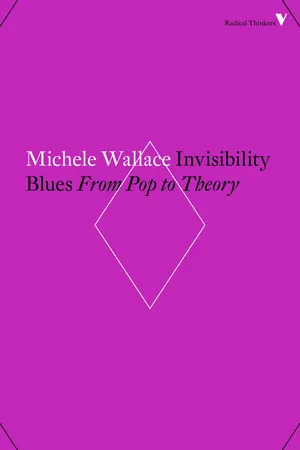
First published in 1990, Michele Wallace's Invisibility Blues is widely regarded as a landmark in the history of black feminism. Wallace's considerations of the black experience in America include recollections of her early life in Harlem; a look at the continued underrepresentation of black voices in politics, media, and culture; and the legacy of such figures as Zora Neale Hurston, Toni Cade Bambara, Toni Morrison,and Alice Walker. Wallace addresses the tensions between race, gender, and society, bringing them into the open with a singular mix of literary virtuosity and scholarly rigor. Invisibility Blues challenges and informs with the plain-spoken truth that has made it an acknowledged classic.
Information
PART I
Black Feminism/Autobiography
1
Memories of a 60s Girlhood:
the Harlem I Love
All my life I’ve dreaded being labeled ‘one of dem niggas what claims to be somethin’ dey ain’t’. So let’s get this straight from the git, as even those of us on the fringe say uptown. I live in Harlem and have always lived there. My mother was born and raised in Harlem, and my grandmother’s family migrated there from Jacksonville, Florida, when she was in her early teens (like many Harlemites my line is best traced through the women). But I’ve never seen a rat outside of a cage. My mother was never a domestic nor was any other woman in my family since slavery (they claim they were too ‘proud’). I’ve never been raped behind the stairs, never been evicted, never played much in the streets except one month in the spring of ’63 before the fun we were having was discovered and my sister and I were shuttled off to the tiresome safety of Oaks Bluff (the Harlem of Martha’s Vineyard). I’ve never worn a doorkey around my neck, never seen my father hit my mother, was twenty when I ate my first pigfoot, and I never went to what my mother contemptuously refers to as ‘P.S. 2’.
So, ecstatic fans of ‘Harlem on My Mind’ and ‘Down These Mean Streets’, you may not get what you expected! But then Harlem isn’t what you think it is anyway. Harlem is mink coats and two-car families, the pathetic humor of the Amsterdam News society column and junior executives with Playboy Club keys, as well as no hot water and welfare checks. Harlem is generations old, as well as just off the boat and just up from down south. Harlem is not merely one seething ghetto but a place where people, black people of all different sorts, actually live and choose to live.
When I was a little girl, I was terrified of Harlem, of the incredible poverty that would spring out at me all at once as I turned some unknown corner, of the other girls my own age who, it seemed, were always twice my size, their socks held up by rubber bands, their braids sticking out every which way, just waiting to catch my eye on one of those rare occasions when I raised them: ‘What you lookin’ at girl?’
There simply wasn’t any right answer, just the personal matter of which I considered more humiliating: being pushed down in the snow or having my blouse torn over my nonexistent bosom in front of everybody in a fight that the neighborhood boys would be giggling about for weeks. But I reserved my most violent trembling for getting lost on the subway, getting off at the wrong stop, 116th and Lenox, for example, wandering through what I never then doubted were the devil’s own angels, the world’s maddest men and women of all ages just standing in the streets, some of them slobbering drunk, some of them junkies, their bodies bent so low in a nod, their noses almost touching the ground, some of them screaming and fighting, any one of them likely to flash a razor at a moment’s notice.
Other fears of my early youth included the possibility of being beaten beyond recognition for my grocery money, of being held down while someone forced a needle into my arm – instant junkie. And then there was the constant threat of somehow ending up with ten babies on relief with rats as big as fire hydrants for front room boarders, of ending up a whore out on the street trying to eke out a living for me and my man. These are the kinds of things I spent a considerable amount of time speculating about when I was a kid. After all, I was looking in the neighborhood pimp’s face every day on my way home from school. He was right across the street and anytime I wanted to sign up…
However, none of these things ever happened. My childhood was sheltered, eventless, like most American childhoods. On crisp Sunday mornings we would walk down Seventh Avenue (now renamed Adam Clayton Powell Jr Boulevard) with my grandmother. All along our way to the opulence of Abyssinian Baptist Church, the old men would tip their hats and old women in mink stoles and smart black suits would stop to say hello. We lived on Edgecombe Avenue when I was very little. It was a quiet and clean residential street where gossipy neighbors posted themselves on the benches of the parkside keeping tabs on everyone’s comings and goings. When I was a bit older we moved to the big, new apartment house on 145th Street with doormen, two bathrooms, and the safest stairwells in town. There we met our two best friends, sisters like us. We all shared a cab to school in the mornings: they were going to Eron, we to New Lincoln. They later told us they hated us because we were always talking about our trip to Europe. We hated them because they got $5.00 allowance apiece, every day.
At some point or another it seemed as though everyone was coming out – our two cousins, our two rich friends whose parents owned a chain of beauty parlors, every female I knew who was old enough to wear sheer stockings and heels. I was missing out on it all – the clubs and societies like Jack and Jill, and Hansel and Gretel, the cotillions, the gauzy white dresses, the visits to the beauty parlor, the boys in tuxedos, cameras flashing, a mention in the Amsterdam News. I finally asked my mother why.
‘You’re already out,’ she said. ‘A woman once asked me if you could join Jack and Jill but when she told me what they did – give parties and teas – I told her no.’ The first washcloth I ever had was designed to look like a book. My mother subscribed to the school of thought that said anything that didn’t have an educational value didn’t have any value at all. So, my sister and I saw the Uffizi, the Louvre, the Metropolitan, and the Guggenheim, but we missed the cotillions, the social clubs, the afternoon teas, the dancing lessons, and the Sunday school graduations.
Meanwhile, dope addiction reached epidemic proportions in Harlem in the 60s, and the clean sunlit streets of Harlem’s Sugar Hill (as opposed to the valley – all of us hill dwellers knew that the valley was the real ghetto) were becoming more treacherous.
From what I can gather, when my grandmother was coming up, Harlem used to be a much safer and a more congenial place to live. ‘If it was hot, you could lay out on the roof all night long, and nobody’d bother you,’ she tells me. They had the Savoy with two bands playing every night: the Renaissance, the Lafayette Theatre with plays ‘as good as downtown. Nobody had any money so people just had to stick together.’ If someone got a relief package, the contents were shared with next-door neighbors. ‘If your feet were about to fall clean off – you didn’t go nowhere you couldn’t walk – you didn’t take a bus. Adam Clayton Powell said “Not till they get a black driver”.’
The entire family went to the dances, not because the girls needed chaperons, but because, my grandmother says, ‘young people didn’t have anything to hide from older people like they do now’. A whole gang of them would go roller skating on Sundays after church – Bradhurst was the avenue. Zoom! right down the center of it. The cars used some other street till Monday.
In my mother’s youth, Nipsey Russell, Pigmeat Markham and Redd Foxx played Harlem clubs. Duke Ellington lived right around the comer and so did Max Roach. People would beg Harry Belafonte not to bring his guitar to parties, and Sonny Rollins drove the neighbors crazy practicing his scales. The world’s best music was a short walk and a drink away – the Club Baron, the Baby Grand, Mintons, Count Basie’s. Of course your life might depend on you being able to remember how the territory was divided, what gang’s turf you were on now – the Lords? the Comanches? the Royals? And my mother tells me they meant something entirely different when they talked about crashing a party. It meant the party got turned out, there was a fight, someone might die.
Jail was somewhere you never admitted anyone you knew had gone, especially not anyone in your family. History books report that the Great Depression ended in the 40s but in Harlem it continued right through the 50s. Money was something people in the movies had. My mother, an art student, and my father, a musician, both unemployed most of the time, tell me they lived very comfortably on $15 a week when they were first starting out.
Harlem today is something else again, although some things never change, like corrupt politicians and leaders, like the never-ending quest for ‘what the figure is today’, like mile-long Cadillacs double-parked in front of tenements. There are the innumerable funeral parlors, always the most sumptuous structures in the community, the churches on every block, and the bars on every corner. There’s Eighth Avenue, the likes of which I have never seen anywhere in the world. If Eighth Avenue were emptied, you would think no one had lived there in years but, as it is, the streets are extremely crowded twenty-four hours per day with young men, very few women, standing around a fire made in a garbage can, waiting for what I’m not entirely sure. For those who think blacks are really going places, these are the backs they rode on.
But there are also the limousines outside the Lenox Terrace waiting to drive our various public officials to work. There are the doctors, lawyers, and various Indian chiefs, all in Brooks Brothers uniforms, who wear the leather thin on the stools at Jock’s (Seventh Avenue) talking money and the pros and cons of black power. There are the neighborhood merchants, mostly black, who never sell rotten meat but who sell for outrageous prices, who know you by name, who discuss the weather and the foolishness of youth as though they were proprietors of general stores in Wisconsin.
But Harlem has changed drastically in my own lifetime, and that’s been due to two things which may or may not be related: the prevalence of dope addiction and the fact that Harlemites are no longer victimized only by ‘The Man’ but also by a complicated network of crooks, hustlers, politicians, and ‘leaders’ who come from their own ranks.
Dope addiction has meant that the streets are now much more dangerous – that’s true for all of New York. Old people never leave their homes at night. Most businesses close around six. By seven any commercial street is completely deserted, and has donned its night-time mask – impenetrable fortress of gates, metal walls, and padded locks. An able-bodied adult male without dependence on dope, wine, or hustling flesh or drugs is a rare sight in certain sections of Harlem.
The higher visibility of the black oppressor has meant that the squalor and poverty is that much more senseless and maddening, that there is a greater sense of hopelessness and despair among impoverished Harlemites, and that self-hatred has returned, feeding upon the unkept promises of the 60s, with roots thicker and deeper than before.
With very little encouragement, anyone who lives in Harlem is likely to get highly emotional on the subject simply because our solutions seem so close at hand, so obvious, so easy, and yet so confoundingly unattainable. Harlem’s story is a difficult dose to swallow – the people who could do something won’t and if they did they wouldn’t be the people who could do something anymore.
(1975)
2
Anger in Isolation: A Black
Feminist’s Search for Sisterhood
When I was in the third grade I wanted to be president. I can still remember the stricken look on my teacher’s face when I announced it in class. By the time I was in the fourth grade I had decided to be the president’s wife instead. It never occurred to me that I could be neither because I was black. Growing up in a dreamy state of mind not uncommon to the offspring of the black middle class, I was convinced that hatred was an insubstantial emotion and would certainly vanish before it could affect me. I had the world to choose from in planning a life.
On rainy days my sister and I used to tie the short end of a scarf around our scrawny braids and let the rest of its silken mass trail to our waists. We’d pretend it was hair and that we were some lovely heroine we’d seen in the movies. There was a time when I would have called that wanting to be white, yet the real point of the game was being feminine. Being feminine meant being white to us.
One day when I was thirteen on my bus ride home from school I caught a brief but enchanting glimpse of a beautiful creature – slender, honey brown, and she wore her hair natural. Very few people did then, which made her that much more striking. This was a look I could imitate with some success. The next day I went to school with my hair in an Afro.
On my way out of my building people stared and some complimented me, but others, the older permanent fixtures in the lobby, gaped at me in horror. Walking the streets of Harlem was even more difficult. The men on the corners who had been only moderately attentive before, now began to whoop and holler as I came into view. Becoming exasperated after a while, I asked someone why. ‘They think you’re a whore, sugar.’ I fixed my hair and was back to normal by the next morning. Letting the world in on the secret of my native naps appealed to my proclivity for rebellion, but having people think I was not a ‘nice girl’ was The War already and I was not prepared for it. I pictured myself in a police station trying to explain how I’d been raped. ‘Come on, baby, you look like you know your way around,’ sneered an imaginary policeman.
In 1968 when I was sixteen and the term black consciousness was becoming popular, I started wearing my hair natural again. This time I ignored my ‘elders’. I was too busy reshaping my life. Blackness, I reasoned, meant that I could finally be myself. Besides recognizing my history of slavery and my African roots, I began a general housecleaning. All my old values, gathered from ‘playing house’ in nursery school to Glamour magazine’s beauty tips, were discarded.
No more makeup, high heels, stockings, garter belts, girdles. I wore T-shirts and dungarees, or loose African print dresses, sandals on my feet. My dust-covered motto, ‘Be a nice well-rounded colored girl so that you can get yourself a nice colored doctor husband’, I threw out on the grounds that it was another remnant of my once ‘whitified’ self. My mind clear now, I was starting to think about being someone again, not something – the presidency was still a dark horse but maybe I could be a writer. I dared not even say it aloud: my life was my own again. I thanked Malcolm and LeRoi – wasn’t it their prescription that I was following?
It took me three years to fully understand that Stokely was serious when he’d said my position in the movement was ‘prone’, three years to understand that the countless speeches that all began ‘the black man …’ did not include me. I learned. I mingled more and more with a black crowd, attended the conferences and rallies and parties and talked with some of the most loquacious of my brothers in blackness, and as I pieced together the ideal that was being presented for me to emulate, I discovered my newfound freedoms being stripped from me, one after another. No, I wasn’t to wear makeup, but yes, I had to wear long skirts that I could barely walk in. No, I wasn’t to go to the beauty parlor, but yes, I was to spend hours controlling my hair. No, I wasn’t to flirt with or take shit off white men, but yes, I was to sleep with and take unending shit off black men. No, I wasn’t to watch television or read Vogue or Ladies’ Home Journal, but yes, I should keep my mouth shut. I would still have to iron, sew, cook, and have babies.
Only sixteen, I decided there were a lot of things I didn’t know about black male/female relationships. I made an attempt to fill myself in by reading – Soul on Ice, Native Son, Black Rage – and by joining the National Black Theatre. In the theatre’s brand of a consciousness-raising session I was told of the awful ways in which black women, me included, had tried to destroy the black man’s masculinity; how we had castrated him; worked when he didn’t work; made money when he made none; spent our nights and days in church praying to a jive white boy named Jesus while he collapsed into alcoholism, drug addiction, and various forms of despair; how we’d always been too loud and domineering, too outspoken.
We had much to make up for by being gentle in the face of our own humiliation, by being soft-spoken (ideally to the point where our voices could not be heard at all), by being beautiful (whatever that was), by being submissive – how often that word was shoved at me in poems and in songs as something to strive for.
At the same time one of the brothers who was a member of the theatre was also a paraprofessional in the school where my mother then taught. My mother asked him what he liked about the theatre. Not knowing that I was her daughter, he answered without hesitation that you could get all the pussy you wanted. NBT was a central institution in the black cultural movement. Much time was spent reaching for the ‘godlike’ in one another, the things beyond the ‘flesh’ and beyond all the ‘whitewashing’. And what it boiled down to was that now the brother could get more pussy. If that was his revolution, what was mine?
So I was again obsessed with my appearance, worried about the rain again – the black woman’s nightmare – for fear that my huge, full Afro would shrivel up to my head. (Despite blackness, black men still didn’t like short hair.) My age was one thing I had going for me. ‘Older black women are too hard,’ my brothers informed me as they looked me up and down.
The message of the black movement was that I was being watched, on probation as a black woman, that any signs of aggressiveness, intelligence, or independence would mean I’d be denied even the one role still left open to me as ‘my man’s woman’, keeper of house, children, and incense burners. I grew increasingly desperate about slipping up – they, black men, were threatening me with being deserted, with being alone. Like any ‘normal’ woman, I eagerly grabbed at my own enslavement.
After all, I’d heard the horror stories of educated black women who had to marry ditchdiggers and get their behinds kicked every night. I had thought the black movement would offer me much better. In 1968 I had wanted to become an intelligent hu...
Table of contents
- Cover Page
- Halftitle Page
- Title Page
- Copyright Page
- Dedication
- Contents
- Acknowledgements
- New Introduction
- Part I: Black Feminism/Autobiography
- Part II: Pop
- Part III: Culture/History
- Part IV: Theory
- Notes
- Index
Trusted by 375,005 students
Access to over 1.5 million titles for a fair monthly price.
Study more efficiently using our study tools.
Frequently asked questions
Yes, you can cancel anytime from the Subscription tab in your account settings on the Perlego website. Your subscription will stay active until the end of your current billing period. Learn how to cancel your subscription
No, books cannot be downloaded as external files, such as PDFs, for use outside of Perlego. However, you can download books within the Perlego app for offline reading on mobile or tablet. Learn how to download books offline
Perlego offers two plans: Essential and Complete
- Essential is ideal for learners and professionals who enjoy exploring a wide range of subjects. Access the Essential Library with 800,000+ trusted titles and best-sellers across business, personal growth, and the humanities. Includes unlimited reading time and Standard Read Aloud voice.
- Complete: Perfect for advanced learners and researchers needing full, unrestricted access. Unlock 1.5M+ books across hundreds of subjects, including academic and specialized titles. The Complete Plan also includes advanced features like Premium Read Aloud and Research Assistant.
We are an online textbook subscription service, where you can get access to an entire online library for less than the price of a single book per month. With over 1.5 million books across 990+ topics, we’ve got you covered! Learn about our mission
Look out for the read-aloud symbol on your next book to see if you can listen to it. The read-aloud tool reads text aloud for you, highlighting the text as it is being read. You can pause it, speed it up and slow it down. Learn more about Read Aloud
Yes! You can use the Perlego app on both iOS and Android devices to read anytime, anywhere — even offline. Perfect for commutes or when you’re on the go.
Please note we cannot support devices running on iOS 13 and Android 7 or earlier. Learn more about using the app
Please note we cannot support devices running on iOS 13 and Android 7 or earlier. Learn more about using the app
Yes, you can access Invisibility Blues by Michele Wallace in PDF and/or ePUB format, as well as other popular books in Social Sciences & African American Studies. We have over 1.5 million books available in our catalogue for you to explore.