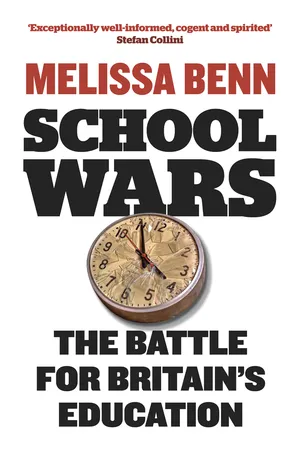
School Wars tells the story of the struggle for Britain's education system. Established during the 1960s and based on the progressive ideal of good schools for all, the comprehensive system has over the past decades come under sustained attack from successive governments.
From the poorest comprehensives to the most well-resourced independent schools, School Wars takes a forensic look at the inequalities of our current system, the damaging impact of spending cuts, the rise of "free schools" and the growth of the private sector in education. Melissa Benn explores, too, the dangerous example of US education reform, where privatization, punitive accountability and the rise of charter schools have intensified social, economic and ethnic divisions.
The policies of successive British governments have been muddled and confused, but one thing is clear: that the relentless application of market principles signals a fundamental shift from the ideal of quality education as a public good, to education as market-controlled commodity. Benn ends by outlining some key principles for restoring strong educational values within a fair, non-selective public education system.
- 276 pages
- English
- ePUB (mobile friendly)
- Available on iOS & Android
eBook - ePub
About this book
Information
III
THE WAY WE LEARN NOW
THE WAY WE LEARN NOW
Chapter Four
The Politics of Selection
A grey Wednesday morning off the Fulham Road, West London, and I am on my way to meet a group of primary-school mothers, long-time campaigners in their home borough of Hammersmith and Fulham for a good, mixed, community school—a secondary equivalent to the primary schooling that they have so appreciated for their children, and which led them to form the Parental Alliance for Secondary Schools (PASS). Their strategy was ingenious and hands-on: to get involved with several local secondary schools by approaching them as a ‘free advertising agency’ to the primary community they were part of. The mothers became governors at Hurlingham and Chelsea school, Fulham Cross school, Henry Compton school, Phoenix School and William Morris Sixth Form Academy—all schools with rapidly rising results, good or outstanding Ofsted reports and strong and dynamic leaders. They hoped that with support, hard work, and building on their inside knowledge, the schools could attract a greater mix of local parents.
Now it’s crunch time for these campaigners as parents, as their children come up for secondary transfer. The process has aroused painfully mixed feelings. Their close involvement with a number of local schools has profoundly impressed and changed them: they speak with respect and admiration of the excellent heads, exceptionally committed staff and impressive students they have met and worked with, in the kind of schools that many middle-class people dismiss out of hand. One mother laments, ‘There’s so much ignorance among people, even my friends, the ones who go private. I mean, the way they talk about these schools and these children. We start having arguments and I just can’t bear what they say, the ignorance. I have to get up and leave the table. But that’s exactly why social cohesion is so important. To break down that ignorance.’
But the school they longed to help create and where they dreamed of sending their own children, the secondary school with a genuine social mix, has still not materialised. In wealthy Hammersmith and Fulham, according to 2008 figures, over a quarter of parents use private education, and over half of parents who choose state schools educate their children outside borough boundaries. There are three oversubscribed CofE single-sex faith schools for which, in the wry words of one mother around the table, ‘you have to have been baptised at three months’. In the north of the borough, the renowned Phoenix school draws almost all of its intake from the nearby White City estate.
This leaves a series of community schools and newly established academies, with varying results and reputations. ‘I went round one,’ says one of the mothers, of a single-sex boys comprehensive, one of her nearest schools. ‘The kids were polite, there was great artwork on the wall, the head was nice. What these staff do is phenomenal.’ But her anxious demeanour tells another story as she explains that the school has a ‘terrible local reputation’—a child from the school was recently murdered in an inter-school brawl at Victoria Station—and she is frightened of how her two boys would fare in such an environment. Another mother, a Christian, talks of a single-sex school in the south of the borough. It got an outstanding Ofsted report, but its intake is 80 per cent Muslim. What about Hurlingham and Chelsea, I ask? Results continue to rise year by year: the head teacher, Phil Cross, has brought about astonishing changes in behaviour, atmosphere and aspiration at the school. And yet the middle classes still aren’t going there. Its reputation of five-plus years ago continues to stick. As one mother says, ‘It’s as if there’s an unshakeable class-driven agenda swirling around and we can’t beat it.’
These might seem the kind of parents that London’s chief adviser for schools, David Woods, was referring to when he talked about families who, ‘while perfectly prepared to buy into state primary education, have an innate prejudice against their local state secondary school. Despite what you hear from the chattering classes—by which I mean the dinner parties of Islington—London’s state secondary schools are doing very well. Almost a quarter have been judged outstanding. There are parents who, given a very good state school on their doorstep, would not send their children there because they have an innate prejudice against it. Why don’t they go in and spend a day there? Parents have a perfect right to make their own decisions, but I think sometimes it is done on the basis of prejudice.’
The PASS group do not fit this stereotype. Woods’s complaint was against parents with too little knowledge, not too much. These PASS parents fear not the schools—the heads, the staff, or the quality of the work—but something different, the vicious circle of modern inner-city secondary schools: unbalanced intakes, perceived collective low aspirations and rough reputations. While each is left wrestling with an individual decision concerning their own children’s future, they have discovered over time how the so-called choice agonies of the modern parent connect, directly, and at every level, to local and national politics: from the silence that surrounds a highly divisive private sector, to the selective admissions of faith schools or the machinations of a local council, too often more interested in privatisation than in meeting the needs of the local community.
Like thousands of families around the country, these mothers have come up against the byzantine, bewildering realities of our school system. Parents in England today are supposedly offered increasing diversity and choice. In fact, many face a ‘dizzyingly steep hierarchy of institutions’—to use Professor Tim Brighouse’s memorable phrase—in which schools consistently reflect and reinforce existing social divisions. In many ways, not much has changed since R. H. Tawney wrote, in 1931, that the ‘hereditary curse upon English education is its organization upon lines of social class’.1
How does our school system really work? Both Scotland, which has 374 secondary schools and 2,128 primaries, and Wales, with 223 secondary schools and 1,462 primaries, have a comprehensive system. Northern Ireland, with 219 secondary schools and 886 primaries, is in the prolonged and painful throes of phasing out selection. England has a multi-tiered schooling system offering a vast and confusing array of official school types. Among England’s 3,333 secondary schools and 16,971 primary schools we find community, foundation, trust, voluntary-aided, and voluntary controlled institutions; add to these the state-funded ‘independents’, directly funded by central government, the academies, City Technology Colleges, and soon, the free schools.2 By the end of Labour’s term of office, there were 203 academies. The new ‘conversion academies’ have brought that number up to 600 within a year, with hundreds and possibly thousands more, including many primaries, predicted to convert over the next few years.
Politicians like to pretend that parents choose schools; most education experts would agree that, on the whole, schools choose pupils. Despite being officially phased out over forty-five years ago, selection still defines and moulds our education system. Every piece of legislation over the past twenty-five years has resulted in more, rather than less, selection, covert or overt, including the Academies Act of 2010. Academic selection has been compounded by social selection, and, increasingly, selection on grounds of faith. The eleven-plus may have been abolished in most parts of the country but schools still find multiple ways to filter applicants, manage their intake and develop niche identities. Not for nothing has intake—the word that most troubled the PASS parents—become one of the most significant terms in the educational lexicon.
So how does the pyramid of provision take shape? At the top, private schools select firstly by parental wealth and then by entrance tests of varying rigour, thus creaming off up to 7 per cent of the country’s most affluent children; the figure is much higher in certain areas, such as wealthy city boroughs. The country’s remaining 164 grammars retain use of the eleven-plus. Selection still operates in 36 of the 152 English local authorities; 15 operate a fully selective system, and 21 have varying numbers of grammar schools.
Like a stone thrown into a pool, academic selection has a significant ripple effect. Thousands of children are rejected by grammar schools every year, an experience that can leave a lifelong mark on their self-confidence. The ‘creaming off’ of the most accomplished pupils by grammar schools has a knock-on effect on surrounding schools; it has been estimated that 500 schools are affected in this way. Then, in selective areas, some other schools still partially select on grounds of ability.
And while the number of grammars has remained steady over the past few decades, the number of children educated at grammar schools increased by almost 30,000 between 1997 and 2007, and the overall percentage of pupils in selective schools grew from 4.2 to 4.7 per cent during this same period—rising to 4.9 per cent in 2009.3 In Northern Ireland, falling pupil rolls have meant that grammar schools, while defying government demands that they become non-selective, have filled up their places with pupils from a wide range of ability, making them in effect all-ability intakes, causing some to question why they need to remain selective at all.4 Yet Northern Ireland’s grammar schools continue to test ten- and eleven-year-olds in a process that many other school leaders have called an ‘annual charade’. In May 2011, the Catholic Principals Association, which claims to represent the majority of Catholic primary and secondary schools, criticised grammar schools for continuing to select their pupils; it said they should not ‘pick and choose’ students, but embrace a genuinely inclusive system.5
In general, grammars have increasingly become the preserve of the better-off, with intensive tutoring for the eleven-plus. According to an article in the Observer, ‘competition is now so fierce that children often need to score in excess of 90% in entrance exams to have any chance of winning a place. In the most extreme cases, 20 children or more are battling for each place—and increasingly, private tuition is seen as the difference between a pass and a fail.’6 There is now a thriving tuition industry in parts of the country where grammars still exist. Parents are prepared to spend thousands of pounds on private tutoring, and primary-age children spend hours each day going over practice questions and exam papers. One newspaper feature on the private coaching industry opened with the journalist accompanying a Year 6 child to her lesson, beginning at five a.m. It has been reported that Buckinghamshire local authority has not yet published an educational psychologist’s report it commissioned into the impact of coaching, because it fears challenge to selection on the grounds that unless every child has access to the same private tuition, it is impossible to judge the test results fairly.
There is now clear and consistent evidence that grammar schools educate very few children from poor homes. According to the most recent figures, only 0.6 per cent of pupils known to be eligible for and claiming free school meals, and only 2.3 per cent of children of black ethnicity, were attending grammar schools in Year 7 in 2010.7 In a considered speech in 2007, David Willetts (then Tory front-bench spokesman on education and employment) bravely broke with his party’s consensus view that grammars promote social mobility, concluding that
the evidence is overwhelming. Children from poorer families are more likely than average to end up at their local school if it is very bad, and less likely to end up there if it is very good … research shows poor children are half as likely to go to good academic schools as other children … giving schools powers over their own admissions has not spread opportunity either. We have to do better … We must break free from the belief that academic selection is any longer the way to transform the life chances of bright poor kids [my italics]. This is a widespread belief, but we just have to recognise that there is overwhelming evidence that such academic selection entrenches advantage, it does not spread it.8
Willetts’s speech remains a seminal moment in the political history of UK education. When David Cameron publicly defended Willetts, the resultant storm became known as Cameron’s ‘Clause Four’ moment.
Of course, the vast majority of children in selective areas are educated in secondary moderns. Despite the outstanding work that many of these schools do, a fair number qualified for the last government’s National Challenge programme, which aimed to lift the results of low-performing schools; others have been converted into academies, in an attempt to give them a new identity and a fresh start. But, of course, all this structural tinkering completely failed to address the fundamental problem, which is that they are part of an institutionally divided system.
Becky Mathews, a veteran parent campaigner against the eleven-plus in Kent, has lobbied successive prime ministers on this issue and states the problem succinctly.
If you are a child in Kent, you will be labelled by a test at ten years old, you will be educated in a school exclusively populated by middle-class prosperous children, or you will be educated in a school populated by children who have failed, probably with a disproportionate number of Special Educational Needs students and emotional and behavioural difficulties, with little or no sixth form and second-rate facilities. These outcomes are largely determined by social class.9
Beyond the overtly selective schools, different methods are used to ‘top up’ pupil numbers with motivated and high-achieving pupils. Any school with a specialism can select 10 per cent of their schools by aptitude; experts agree that the difference between aptitude and ability is almost impossible to identify. However, if a school can attract a key percentage of high-attaining, ambitious students, it can make the difference between success and stasis, or worse. Other schools use opaque admissions procedures to ‘cream-skim’ pupils and maximise league table results. Among the biggest offenders are some voluntary-aided (church) schools which often use absurdly complex admission criteria, and favour parents who can undertake regular activities to support the church.
Ensuring fair admissions, however, is rather like solving an endlessly recurring series of minor crimes; it takes persistence and a fair degree of inside knowledge to work out whether a school is sticking to the letter or the spirit of its admissions policies. While researching this book, I asked parents, teachers and other school leaders to pass on common admissions tricks they had observed. These included: branding the school in a way that can actively discourage certain kinds of families from applying (the West London Free School’s trumpeting of Latin as a core subject would be a good example of this); filling up ‘lower-ability’ bands with siblings of students whom you have to admit anyway, which means you can gather a fresh crop of ‘higher-ability’ students from a wider pool; selectively picking the right sort of family and pupil from the waiting list; bringing in talented students in the years above Year 7 (often including transfers from private schools: so-called sector shifters); selectively promoting the school in certain areas by means of leafleting; prioritising attendance at one particular church; and holding banding tests on school premises, perhaps on a Saturday morning—which inevitably attracts the more motivated families—rather than holding the tests in local primary schools, which would inevitably include all children eligible for a school place. Some schools practise ‘ghosting’, where parents of troublesome children are quietly persuaded to leave.
All schools where the governing body is the admissions authority, which includes voluntary-aided, foundation, and now academies and free schools, are given the right to draw their own catchment area, enabling them, should they wish, to include more affluent areas and exclude residential pockets of deprivation. The PASS group were very critical of the way that the new Hammersmith Academy in their area had drawn its proposed catchment area around all the smart middle-class wards that surround it, as if deliberately excluding the local poor. One mother said, ‘Their Open evenings were held at the highly desirable St Paul’s girls school and the Lyric Theatre—it was clear who they were hoping to attract.’
* * *
The overall effect of this cumulative selection is twofold. It forces the label of ‘comprehensive’ on many schools that are, to all intents and purposes, secondary moderns, and impedes the development of honest public discussion about how to achieve a more equal system. In human terms, the main losers in this highly segregated pyramid are poor pupils. Barnardo’s, the children’s charity, point to a Sutton Trust report that shows that Britain’s top-performing secondary schools take on average only 5 per cent of pupils entitled to free school meals, while half of all children on free school meals are concentrated in just a quarter of our schools. Barnardo’s also found ‘clear evidence’ that schools which control their own admissions, such as faith schools, are more socially selective than those that do not. Further, ‘middle-class parents tend to be strongly engaged in getting the best results from the admissions process—even to the extent of moving house’, while disadva...
Table of contents
- Cover
- Title Page
- Dedication
- Contents
- Also by Melissa Benn
- Introduction: A View from the Ground
- I. The Present Threat
- II. How We Got Here
- III. The Way We Learn Now
- IV. What Next?
- Afterword
- Acknowledgements
- Notes
- Index
- About the Author
- Praise for School Wars
- Copyright
Trusted by 375,005 students
Access to over 1.5 million titles for a fair monthly price.
Study more efficiently using our study tools.
Frequently asked questions
Yes, you can cancel anytime from the Subscription tab in your account settings on the Perlego website. Your subscription will stay active until the end of your current billing period. Learn how to cancel your subscription
No, books cannot be downloaded as external files, such as PDFs, for use outside of Perlego. However, you can download books within the Perlego app for offline reading on mobile or tablet. Learn how to download books offline
We are an online textbook subscription service, where you can get access to an entire online library for less than the price of a single book per month. With over 1.5 million books across 990+ topics, we’ve got you covered! Learn about our mission
Look out for the read-aloud symbol on your next book to see if you can listen to it. The read-aloud tool reads text aloud for you, highlighting the text as it is being read. You can pause it, speed it up and slow it down. Learn more about Read Aloud
Yes! You can use the Perlego app on both iOS and Android devices to read anytime, anywhere — even offline. Perfect for commutes or when you’re on the go.
Please note we cannot support devices running on iOS 13 and Android 7 or earlier. Learn more about using the app
Please note we cannot support devices running on iOS 13 and Android 7 or earlier. Learn more about using the app
Yes, you can access School Wars by Melissa Benn in PDF and/or ePUB format, as well as other popular books in Didattica & Politiche educative. We have over 1.5 million books available in our catalogue for you to explore.