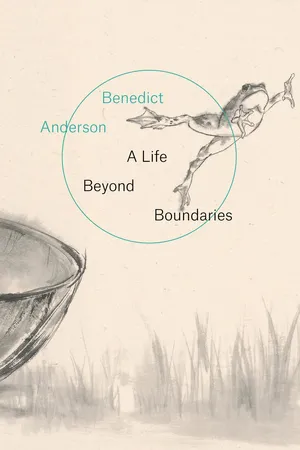
Benedict Anderson was one of the most respected thinkers on the history of nationalism. His acclaimed Imagined Communities is one of the most cited works in social science.
In A Life Beyond Boundaries, Anderson recounts a life spent open to the world. Born in China, he spent his childhood in California and Ireland, was educated in England and finally found a home at Cornell University, where he immersed himself in the growing field of Southeast Asian studies.
Here he reveals the joys of learning languages, the importance of fieldwork, the pleasures of translation, the influence of the New Left on global thinking, the satisfactions of teaching, and a love of world literature. He discusses the ideas and inspirations behind his best-known works.
- 224 pages
- English
- ePUB (mobile friendly)
- Available on iOS & Android
eBook - ePub
About this book
Information
Chapter 1
Shifting Youth
I was born on 26 August 1936, in Kunming, on the eve of the massive Japanese invasion of northern China, and just three years before the Second World War broke out in Europe. In the summer of 1941, just before my fifth birthday, my ailing father decided to take the family back to neutral Ireland via the United States.
After our ship docked in San Francisco, however, my father realized that the intensive submarine warfare in the Atlantic Ocean made a return home impossible. So we stayed in California and, later, Colorado till Nazi Germany was defeated. Then, in the summer of 1945, we sailed to Ireland on a ship still mostly filled with American soldiers heading for Europe. I was almost nine years old. My father died the following year; my English mother nonetheless decided that we would stay in Ireland.
The years during which I attended primary school, high school and (undergraduate level) college were those of the Cold War and the rapid collapse of the once vast British Empire. So far as I can remember, the Cold War did not then affect me much. But if I had not been lucky enough to reside in Ireland, I could have been conscripted at the age of eighteen (1954) to fight for the dying Empire in Malaya, Kenya or Cyprus, and might have been killed or gravely wounded.
I also grew up in the age before television. We did, however, listen a lot to the radio – a medium that allows for some entertainment while doing household chores, tackling homework, and playing cards or chess. In the evenings, we would regularly tune in to the BBC, where great novels were serially read aloud by very good actors, so that our imaginations were filled with figures like Anna Karenina, the Count of Monte Cristo, Lord Jim, Uriah Heep, Tess of the D’Urbervilles and so on.
Travelling theatre groups were also very important to us, and Ireland was full of excellent performers. We got to see not only many Shakespeare plays (before we read them as textbooks), but also the works of world-famous Irish playwrights like Shaw, Wilde, Sheridan, O’Casey and others. American popular culture came to us only marginally, in the westerns and Disney cartoons shown at the local cinema.
It could easily all have been otherwise. If my father had delayed leaving China till the Pacific War broke out, we might have ended up in a Japanese internment camp, and perhaps died there. Had my father not been Irish, I might have been raised in England and fought overseas for the Empire. If I had been born later, I could have become addicted to the television set, and too lazy to go the local theatre.
Both my father and my mother were excellent parents, warm-hearted, interesting and broad-minded human beings to whom I, along with my younger brother, Rory, (today very well known as Perry) and my little sister Melanie, were deeply attached. I could say that we were very lucky to have such parents.
My father, Seamus (James) O’Gorman Anderson, was the product of a remarkable mixture of lineages. His mother’s male ancestors were Irish, as their family name, O’Gorman, indicates. They had a long history of political activism against English imperialism and colonialism in Ireland: two O’Gorman brothers, my great-great-grandfather and his younger brother, were involved in the United Irishmen rebellion of 1798, which was inspired by the French Revolution. They spent time in prison for their pains. In the 1820s, both were key members of Daniel O’Connell’s Catholic Association, which worked hard to end more than a century of legal, political and economic discrimination against the Irish Catholic majority. A nephew of theirs joined the failed uprising of 1848, which took place in the middle of the ‘Irish Potato Famine’, fled to Paris and Ottoman Istanbul, and then migrated to America, where eventually he became a member of the New York State Supreme Court.
My father’s maternal grandfather, Major Purcell O’Gorman, was elected to the House of Commons in 1874, sitting for the small city of Waterford, and becoming an important member of the Home Rule for Ireland bloc led by Charles Parnell. (He is said to have weighed more than 300 pounds and been the fattest man in the Mother of Parliaments.) But he married a Protestant Englishwoman. In those tolerant days, which would soon disappear under the reign of Pope Pius IX, the problems of mixed marriages across religious lines were sensibly solved by the local rule that sons followed the religion of their fathers, and daughters that of their mothers. So my grandmother was a Protestant, though her elder brother was a Catholic.
The lineage of my father’s father was almost the opposite. It was ‘Anglo-Irish’, referring to the Protestant descendants of the seventeenth-century Scottish and English invaders who seized the lands of the indigenous Irish, settled down as local gentry, and over many generations came to feel themselves to be rather Irish. There were many military officers in the lineage of my paternal grandfather, some of whom fought in the Napoleonic wars, served in Afghanistan and Burma, or were stationed in Hong Kong and India as the British Empire expanded.
My Anglo-Irish grandfather, who died long before I was born, also made his career in the British Imperial Army. (In those days an Anglo-Irish first-born son inherited the father’s properties, and younger sons usually became clergymen or military officers.) He was schooled at the Royal Military Academy at Woolwich, which specialized in creating engineers, and served in India, Burma and Malaya. In Penang, where my father was born, he built a clean-water reservoir which still functions today, as well as an up-to-date port. Today, one can still observe on the Penang Heights the remnants of the little Irish-style house he designed for his wife, daughter of Purcell O’Gorman, and my grandmother. He was among the first to become interested in cryptography, and during the Great War successfully headed the War Office’s secret code service. Sometimes I wonder if I inherited my lifelong addiction to crossword puzzles from his genes.
Much of this ancestral history I discovered only in the mid-1960s, when I began to ponder over which citizenship to choose for myself and, finally, decided to apply for Irish citizenship. During my childhood, I had travelled abroad on my mother’s British passport and later on my own British one without much thinking about it. In growing up, it was understood that we had soul and character, yet we were seldom troubled with identity. Identity was mainly connected with mathematics or the forensic investigation of a corpse.
There were political as well as personal reasons for my choice of Irish citizenship. The Vietnam War was raging, and in nearby Indonesia the anti-communist army had seized power and massacred about half a million communists and their sympathizers. These events hardened my leftist sentiments. The other reason was more personal. My brother and sister had already decided to maintain their British citizenship. I felt that I owed it to my father, who on my birth gave me the ‘tribal’ O’Gorman name, to apply for Eire citizenship.
Irish citizenship could have been easily achieved if I could prove that at least one of my parents or grand-parents had been born in the country. (My father was born in Penang, where my grandfather was stationed, and my mother in London.) Unfortunately, during the Easter Uprising of 1916, in which Irish nationalists revolted against the British, the rebels burned down the building where the Irish birth records were kept. Luckily, however, my mother had a friend whose hobby was researching the genealogy of families in the County of Waterford, and he dug up most of the information mentioned above. I took it to our local member of parliament and gained his help. So, in 1967, I received my first Irish passport.
My father was a restless, intelligent youngster. In 1912, at the age of twenty-one and before finishing his time at Cambridge, he volunteered to join the strange institution known as the Chinese Maritime Customs Service (CMCS). Originally set up by the British and French imperialists, it was designed to make sure that the Ch’ing dynasty paid the huge indemnities imposed on it after the ‘successful’ assault on Peking in 1860 during the Second Opium War. In effect it took control over the taxation of imperial China’s maritime trade with the outside world. Over time, it diversified its membership to include Russians, Germans and even Japanese. Gradually, too, its outlook changed, so that it increasingly tried to serve what it saw as China’s real interests, especially after the fall of the Ch’ing dynasty in 1911 and the onset of the age of the warlords.
My father proved to be a first-class linguist and was always top of his class in the rigorous program the CMCS created to ensure its employees were fluent in spoken and written Chinese. He became very attached to China and the ordinary Chinese, if not to their governments. He also read widely in Chinese literature. After he died, my rather prudish mother was shocked to find among his books a set of volumes, with pictures, published by the first generation of (radical) Chinese sexologists, rebelling against forced prostitution and the miserable status of many Chinese women.
In 1920, after the Great War was over, he met the impressive figure of Stella Benson, a determined feminist, as well as a gifted modernist writer of novels, short stories and travel accounts. She had come to China in order to work at a school and a hospital set up by missionaries. They married while on leave in London, and for their honeymoon decided to drive across America. My father was especially fascinated by American history. From there they sailed to China, which in turn fascinated Stella.
Stella died in China in 1933, aged only forty-one, leaving my father devastated. In 1935, however, he met my mother in London, married her, and took her back with him to China. My father hated sitting in big-city offices, so chose to spend most of his service years in remote posts where he could be his own energetic boss. From Amoy he had commanded a small fleet of speedboats to intercept cunning South Chinese smugglers. But now he had to face Yunnan’s local warlord, who controlled the production and sale of opium. My mother enjoyed telling us children about the hills and mountains near Kunming covered with bright pink Oriental poppies. I like to think that it was the Irish in my father that made him so independent-minded and adventurous. My memories of him only go back to the time when he was already very ill, and in and out of hospitals. But he was always warm, loving and very amusing.
My English mother, neé Veronica Bigham, was also an unusual woman, from a successful upper-middle-class professional background. Her paternal grandfather, John Bigham, came from a Lancaster merchant family, but made a very successful career as a jurist, specializing in commercial and maritime law. He became briefly famous as the judge who presided over the inquiry into the sinking of the Titanic. About that time he was made a baronet for his services and was titled Lord Mersey.
Her father, Trevor Bigham, was a studious ‘second son’ who won a scholarship to Eton College, England’s most well-known ‘public school’ (actually, a boys-only private school), practised law, and then joined the Metropolitan Police. He eventually became the no. 2 man at Scotland Yard and received a knighthood, but he disliked the job and retired early. I remember him as a rather stiff, formal man, who did, however, teach me to do the harder crossword puzzles, for which one had to be widely read. He was married to Frances Tomlin, a semi-bohemian and a fine pianist. My sense is that the marriage was not very happy, and she died of cancer in 1927 when still quite young.
Her death may have been the main reason why my mother suffered from severe anorexia, so ill-understood at that time that she was removed from school to be tutored at home. In those days it was still fairly rare for a girl to go to Oxford or Cambridge. Late in her life she often said how unlucky she was to be born in 1905. If she had come into the world fifteen years later she would almost surely have become an Oxbridge student and had an independent career of her own. But she was a great reader of all kinds of books, and fluent in both French and German.
It would not be correct to say that my parents were intellectuals in any strict sense, but they jointly gave their children a home library unequalled in the town where we lived. They also encouraged in us the habit of reading about the lives, experiences and thoughts of people who spoke other languages, inhabited different classes and regions, and came from different historical periods. I remember reading, quite fascinated, my father’s copies of English translations by Arthur Waley of the Tale of Genji and the Pillow Book of Sei Shonagon when I was about fourteen or fifteen.
The habits of our house were unusual in Ireland in those days. We ate rice more than we ate the national vegetable, potatoes. We were served fish as often as meat, while our neighbours ate fish only on Fridays when Catholicism told them to suffer a bit for Jesus. The house was full of Chinese scrolls, pictures, clothes and costumes, which we would often dress up in for fun. I remember how appalled I was when my mother showed me a beautifully embroidered cloth shoe smaller than my hand, and explained that it was worn by Chinese women, whose feet were agonizingly bound from childhood. My parents were both keen photographers, so the house had many albums of pictures taken especially in China, and in French-colonial Vietnam, where they would go for occasional holidays. One day, pointing to a photo of a very beautiful little Chinese girl about two years old, my mother said, ‘This is Celia Chen, your first best friend.’
After I was born, it was decided to hire an amah to look after me. They found a young Vietnamese girl, with a small boy of her own, who had left an unpleasant arranged marriage to find work in Kunming. She became very close to my mother and was taken to Ireland when the family went home on leave. Years later, the locals remembered her very well. She, a Catholic who spoke French, always wore elegant traditional Vietnamese clothes, with a black turban, teeth carefully lacquered, and a wonderful smile. She used to go to church on Sundays in this attire. My mother once told me that the first words I spoke were Vietnamese, not English. It is sad that children, so quick to pick up languages, also quickly forget them.
When my father decided to take us all home in 1941, this young Vietnamese woman, whose name was Ti-hai (Miss no. 2 said her parents, concerned mainly with sons), was all set to go with us, because she enjoyed seeing the world. But California, our landing point, was drumming up racist anti-Asian policies, and the American consulate in Shanghai refused to give her a visa, so she had to return to Vietnam. After the war, my mother tried to find her through diplomatic channels, but without success.
My first memory of schooling dates from about 1942. My father was in and out of hospitals in San Francisco, and my baby sister was born in 1943. My mother was too exhausted caring for her husband and the new baby to cope with two energetic little boys who, at that time, quarrelled constantly. So we were packed off to The Country School, a boarding school run by two grim Scandinavian women outside Los Gatos, at the edge of present-day Silicon Valley. The school is still there, but the town has become so big that today it’s near the centre. America was quite unfamiliar to us, we missed our parents badly, and we were often physically punished. I had the misfortune to wet my bed, and the school rules forced me almost every day to miss a class so I could wash my sheets, for which I was mercilessly teased and bullied. I do not remember learning anything there.
After the family returned to Waterford and managed to buy a house at the edge of the town, my brother and I were put into a Quaker primary school. Cars were then a rarity in our town, so we went to school in a donkey-cart driven by my mother’s elderly and extremely kind gardener. I had my first experience of a traffic accident when I rushed out of the school gate and ran into just such a donkey-cart which happened to be passing by. Had it been a car I would probably have been killed, but as it was, I only broke my shoulder-bone.
When we boys were given bicycles to go to school, we were introduced to the class struggle and religious conflict. We had to ride down through a Catholic neighbourhood of relatively poor people. The boys there took us to be snobby, half-English and Protestant, and were usually ready for a fight. The way down was not that bad, as we could ride very fast and arm ourselves with hockey-sticks. But going home uphill was when we ‘got it’ from these lads. At the time I did not understand why we were hated, but it was a useful lesson in the effects of religious, class and racial bigotry. Today, I don’t remember much about the Quaker school except that I was so afraid of a red-faced mathematics teacher that I often played truant, lying to mother. I was also a member of a little gang headed by a tough, athletic girl called Fiona.
The most important piece of luck for me was another key decision made by my mother. Irish law made it compulsory for small children to start learning either Irish (nationalism) or Latin (Catholicism). My mother saw no point in my learning a nearly extinct language spoken fluently only in the far west of the country, so Latin it was. She found a private tutor for me, Mrs Webster, a wonderful middle-aged woman who was the best teacher I have ever had. It may be hard to believe, but she made me fall in love with Latin, and realize that I had, from the start, a gift for languages.
Later I asked my mother: ‘Why Latin? It is even more extinct than Irish.’ Though she did not know Latin herself, she knew the right answer: ‘Latin is the mother of most Western European languages – French, Spanish, Portuguese and Italian – so if you know Latin, you will find all these languages easy. Besides, Latin has a great literature which every well-educated person should know.’
It turned out, however, that my mother had another reason for her decision. She believed that Irish schools of those days were not very good, and she wanted her two boys to go to a fine boarding-school in England which might help them get into a good ‘public school’ and later a university. In these educational institutions, Latin (and Greek) were essential elements in the curriculum.
So off we went, myself first and my younger brother a year later. It was quite an experience to go to England. We had to take a steamship for seven hours across the notoriously rough Irish Sea, with people vomiting all over the place. We would land at the little Welsh seaport, Fishguard, at about 2 a.m., trying to keep warm with cups of hot cocoa or Marmite, and then leave by the 4 a.m. train for London, getting there around ten o’clock. After a day or two at grandfather’s house, we would be sent by train to Scaitcliffe, our little school southeast of London.
I was only at this new school for two years, but they were intense because it specialized in ‘cramming’ little boys to get into the top ‘public schools’. The pressure also came from my mother, who told us that since she was a widow living mainly on a pension, we would not be able to go to one of these elite schools unless we could win scholarships. I duly took the nationally competitive exam for thirteen vacant scholarships at Eton (where my maternal grandfather had also won a scholarship towards the end of the nineteenth century), and to general astonishment came in at no. 12. My younger brother, more energetic and competitive, took the examination later and did much better than I.
Eton was a strange place for me. The vast majority of the pupils came from the English aristocracy and very rich business or banking families, with a scattering of brown-skinned ‘princes’ from the ex-colonies and the living protectorates. The scholarship boys mostly came from middle-class families; they lived together in a separate building, ate together, and had a special ‘medieval’ outfit they were obliged to wear. The majority, who lived in handsome ‘Houses’, we met only in class. Th...
Table of contents
- Cover Page
- Halftitle Page
- Title Page
- Copyright Page
- Contents
- Preface
- Chapter 1: Shifting Youth
- Chapter 2: Area Studies
- Chapter 3: Fieldwork
- Chapter 4: Frameworks of Comparison
- Chapter 5: Interdisciplinary
- Chapter 6: Retirement and Liberation
- Afterword
- On the Typeface
- Index
Trusted by 375,005 students
Access to over 1.5 million titles for a fair monthly price.
Study more efficiently using our study tools.
Frequently asked questions
Yes, you can cancel anytime from the Subscription tab in your account settings on the Perlego website. Your subscription will stay active until the end of your current billing period. Learn how to cancel your subscription
No, books cannot be downloaded as external files, such as PDFs, for use outside of Perlego. However, you can download books within the Perlego app for offline reading on mobile or tablet. Learn how to download books offline
Perlego offers two plans: Essential and Complete
- Essential is ideal for learners and professionals who enjoy exploring a wide range of subjects. Access the Essential Library with 800,000+ trusted titles and best-sellers across business, personal growth, and the humanities. Includes unlimited reading time and Standard Read Aloud voice.
- Complete: Perfect for advanced learners and researchers needing full, unrestricted access. Unlock 1.5M+ books across hundreds of subjects, including academic and specialized titles. The Complete Plan also includes advanced features like Premium Read Aloud and Research Assistant.
We are an online textbook subscription service, where you can get access to an entire online library for less than the price of a single book per month. With over 1.5 million books across 990+ topics, we’ve got you covered! Learn about our mission
Look out for the read-aloud symbol on your next book to see if you can listen to it. The read-aloud tool reads text aloud for you, highlighting the text as it is being read. You can pause it, speed it up and slow it down. Learn more about Read Aloud
Yes! You can use the Perlego app on both iOS and Android devices to read anytime, anywhere — even offline. Perfect for commutes or when you’re on the go.
Please note we cannot support devices running on iOS 13 and Android 7 or earlier. Learn more about using the app
Please note we cannot support devices running on iOS 13 and Android 7 or earlier. Learn more about using the app
Yes, you can access A Life Beyond Boundaries by Benedict Anderson in PDF and/or ePUB format, as well as other popular books in Politics & International Relations & Political Biographies. We have over 1.5 million books available in our catalogue for you to explore.