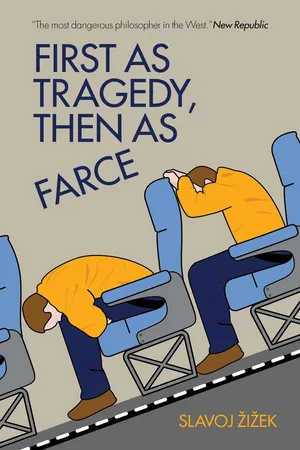
Billions of dollars were hastily poured into the global banking system in a frantic attempt at financial stabilisation. So why has it not been possible to bring the same forces to bear in addressing world poverty and environmental crisis? In this take-no-prisoners analysis, Slavoj Zizek frames the moral failures of the modern world in terms of the epoch-making events of the first decade of this century. What he finds is the old one-two punch of history: the jab of tragedy, the right hook of farce. In the attacks of 9/11 and the global credit crunch, liberalism dies twice: as a political doctrine and as an economic theory. The election of Donald Trump only confirms the bankruptcy of a liberal order on its last legs.
First as Tragedy, Then as Farce is a call for the left to reinvent itself in the light of our desperate historical situation. The time for liberal, moralistic blackmail is over.
- English
- ePUB (mobile friendly)
- Available on iOS & Android
eBook - ePub
First as Tragedy, Then as Farce
About this book
Information
Topic
PhilosophySubtopic
Ethics & Moral Philosophy1 It’s Ideology, Stupid!
Capitalist Socialism?
The only truly surprising thing about the 2008 financial meltdown is how easily the idea was accepted that its happening was an unpredictable surprise which hit the markets out of the blue. Recall the demonstrations which, throughout the first decade of the new millennium, regularly accompanied meetings of the IMF and the World Bank: the protesters’ complaints took in not only the usual anti-globalizing motifs (the growing exploitation of Third World countries, and so forth), but also how the banks were creating the illusion of growth by playing with fictional money, and how this would all have to end in a crash. It was not only economists such as Paul Krugman and Joseph Stiglitz who warned of the dangers ahead and made it clear that those who promised continuous growth did not really understand what was going on under their noses. In Washington in 2004, so many people demonstrated about the danger of a financial collapse that the police had to mobilize 8,000 additional local policemen and bring in a further 6,000 from Maryland and Virginia. What ensued was tear-gassing, clubbing and mass arrests—so many that police had to use buses for transport. The message was loud and clear, and the police were used literally to stifle the truth.
After this sustained effort of wilful ignorance, it is no wonder that, when the crisis did finally break out, as one of the participants put it, “No one really [knew] what to do.” The reason being that expectations are part of the game: how the market will react depends not only on how much people trust this or that intervention, but even more so on how much they think others will trust them—one cannot take into account the effects of one’s own choices. Long ago, John Maynard Keynes rendered this self-referentiality nicely when he compared the stock market to a silly competition in which the participants have to pick several pretty girls from a hundred photographs, the winner being the one who chooses girls closest to the average opinion: “It is not a case of choosing those which, to the best of one’s judgment, are really the prettiest, nor even those which average opinion genuinely thinks the prettiest. We have reached the third degree where we devote our intelligence to anticipating what average opinion expects the average opinion to be.”1 So, we are forced to choose without having at our disposal the knowledge that would enable a qualified choice, or, as John Gray put it: “We are forced to live as if we were free.”2
At the height of the meltdown, Joseph Stiglitz wrote that, in spite of the growing consensus among economists that any bail-out based on US Treasury Secretary Henry Paulson’s plan would not work,
it is impossible for politicians to do nothing in such a crisis. So we may have to pray that an agreement crafted with the toxic mix of special interests, misguided economics, and right-wing ideologies that produced the crisis can somehow produce a rescue plan that works—or whose failure doesn’t do too much damage.3
He is correct, since markets are effectively based on beliefs (even beliefs about other people’s beliefs), so when the media worry about “how the markets will react” to the bail-out, it is a question not only about its real consequences, but about the belief of the markets in the plan’s efficacy. This is why the bail-out may work even if it is economically wrong-headed.4
The pressure “to do something” here is like the superstitious compulsion to make some gesture when we are observing a process over which we have no real influence. Are not our acts often such gestures? The old saying “Don’t just talk, do something!” is one of the most stupid things one can say, even measured by the low standards of common sense. Perhaps, rather, the problem lately has been that we have been doing too much, such as intervening in nature, destroying the environment, and so forth. . . Perhaps it is time to step back, think and say the right thing. True, we often talk about something instead of doing it; but sometimes we also do things in order to avoid talking and thinking about them. Such as throwing $700 billion at a problem instead of reflecting on how it arose in the first place.
In the ongoing confusion, there is certainly sufficient material to cause us to think things through. Back on July 15, 2008, Republican Senator Jim Bunning attacked Fed Chairman Ben Bernanke, claiming that his proposal showed how “socialism is alive and well in America”: “Now the Fed wants to be the systemic risk regulator. But the Fed is the systemic risk. Giving the Fed more power is like giving the neighborhood kid who broke your window playing baseball in the street a bigger bat and thinking that will fix the problem.”5 On September 23, he struck again, calling the Treasury’s plan for the biggest financial bailout since the Great Depression “un-American”:
Someone must take those losses. We can either let the people who made bad decisions bear the consequences of their actions, or we can spread that pain to others. And that is exactly what the Secretary proposes to do—take Wall Street’s pain and spread it to the taxpayers. . . . This massive bailout is not the solution, it is financial socialism, and it is un-American.
Bunning was the first to publicly outline the contours of the reasoning behind the Republican Party revolt against the bail-out plan, which climaxed in the rejection of the Fed’s proposal on September 29. The argument deserves a closer look. Note how Republican resistance to the bail-out project was formulated in “class warfare” terms: Wall Street versus Main Street. Why should we help those on “Wall Street” responsible for the crisis, while asking ordinary mortgage-holders on “Main Street” to pay the price? Is this not a clear case of what economic theory calls “moral hazard,” defined as “the risk that somebody will behave immorally because insurance, the law, or some other agency will protect them against any loss that his or her behavior might cause”—if I am insured against fire, say, I will take fewer fire precautions (or, in extremis, even set fire to my fully insured but loss-generating premises)? The same goes for the big banks: are they not protected against big losses and able to keep their profits? No wonder that Michael Moore wrote a letter to the public decrying the bail-out plan as the robbery of the century.
It is this unexpected overlapping of the views of the Left with those of conservative Republicans which should give us pause for thought. What the two perspectives share is their contempt for the big speculators and corporate managers who profit from risky decisions but are protected from failures by “golden parachutes.” Recall the cruel joke from Lubitsch’s To Be or Not to Be: when asked about the German concentration camps in occupied Poland, the responsible Nazi officer “concentration camp Erhardt” snaps back: “We do the concentrating, and the Poles do the camping.” Does the same not hold for the Enron bankruptcy scandal of January 2002, which can be interpreted as a kind of ironic commentary on the notion of the risk society? Thousands of employees who lost their jobs and savings were certainly exposed to risk, but without having had any real choice in the matter—the risk appeared to them as blind fate. On the contrary, those who did have some insight into the risks involved, as well as the power to intervene in the situation (namely, the top managers), minimized their risks by cashing in their stocks and options before the bankruptcy. It is indeed true that we live in a society of risky choices, but it is one in which only some do the choosing, while others do the risking . . .
Is the bail-out plan really a “socialist” measure then, the birth of state socialism in the US? If it is, it is a very peculiar form: a “socialist” measure whose primary aim is not to help the poor, but the rich, not those who borrow, but those who lend. In a supreme irony, “socializing” the banking system is acceptable when it serves to save capitalism. Socialism is bad— except when it serves to stabilize capitalism. (Note the symmetry with China today: in the same way, the Chinese Communists use capitalism to enforce their “Socialist” regime.)
But what if “moral hazard” is inscribed into the very structure of capitalism? That is to say, there is no way to separate the two: in the capitalist system, welfare on Main Street depends on a thriving Wall Street. So, while Republican populists who resist the bail-out are doing the wrong thing for the right reasons, the proponents of the bail-out are doing the right thing for the wrong reasons. To put it in more sophisticated terms, the relationship is non-transitive: while what is good for Wall Street is not necessarily good for Main Street, Main Street cannot thrive if Wall Street is feeling sickly, and this asymmetry gives an a priori advantage to Wall Street.
Recall the standard “trickle-down” argument against egalitarian redistribution (through high levels of progressive taxation, etc.): instead of making the poor richer, it makes the rich poorer. Far from being simply anti-interventionist, this attitude actually displays a very accurate grasp of economic state intervention: although we all want the poor to become richer, it is counter productive to help them directly, since they are not the dynamic and productive element in society. The only kind of intervention needed is that which helps the rich get richer; the profits will then automatically, by themselves, diffuse amongst the poor . . . Today, this takes the form of the belief that if we throw enough money at Wall Street it will eventually trickle down to Main Street, helping ordinary workers and homeowners. So, again, if you want people to have money to build homes, don’t give it to them directly, but to those who will in turn lend them the cash. According to the logic, this is the only way to create genuine prosperity; otherwise, it will just be a case of the state distributing funds to the needy at the expense of the real wealth-creators.
Consequently, those who preach the need for a return from financial speculation to the “real economy” of producing goods to satisfy real people’s needs, miss the very point of capitalism: self-propelling and self-augmenting financial circulation is its only dimension of the Real, in contrast to the reality of production. This ambiguity was made clear in the recent meltdown when we were simultaneously bombarded by calls for a return to the “real economy” and by reminders that financial circulation, a sound financial system, is the lifeblood of our economies. What strange lifeblood is this which is not part of the “real economy”? Is the “real economy” in itself like a bloodless corpse? The populist slogan “Save Main Street, not Wall Street!” is thus totally misleading, a form of ideology at its purest: it overlooks the fact that what keeps Main Street going under capitalism is Wall Street! Tear that Wall down and Main Street will be flooded with panic and inflation. Guy Sorman, an exemplary ideologist of contemporary capitalism, is thus indeed correct when he claims: “There is no economic rationale for distinguishing ‘virtual capitalism’ from ‘real capitalism’: nothing real has ever been produced without first being financed . . . even in a time of financial crisis, the global benefits of the new financial markets have surpassed their costs.”6
While financial meltdowns and crises are obvious reminders that the circulation of Capital is not a closed loop which can fully sustain itself—that it presupposes an absent reality where actual goods that satisfy people’s needs are produced and sold—their more subtle lesson is that there can be no return to this reality, pace all the rhetoric of “let us return from the virtual space of financial speculation to real people who produce and consume.” The paradox of capitalism is that you cannot throw out the dirty water of financial speculation while keeping the healthy baby of real economy.
It is all too easy to dismiss this line of reasoning as a hypocritical defense of the rich. The problem is that, insofar as we remain in a capitalist order, there is a truth within it: namely, that kicking at Wall Street really will hit ordinary workers. This is why the Democrats who supported the bail-out were not being inconsistent with their Leftist leanings. They would have been inconsistent only if they had accepted the premise of the Republican populists: that (true, authentic) capitalism and the free market economy are a popular, working-class affair, while state intervention is an upper-class elite strategy designed to exploit hard-working ordinary folks. “Capitalism versus socialism” thus becomes ordinary hard-working people versus the upper-class strata.
But there is nothing new with regard to strong state intervention in the banking system or in the economy in general. The recent meltdown itself is a result of such intervention: when, in 2001, the dotcom bubble (which expressed the very essence of the problem of “intellectual property”) burst, it was decided to make credit easier in order to redirect growth into housing. (The ultimate cause of the 2008 meltdown was thus, from this point of view, the deadlock of intellectual property.) And, if we broaden our horizon to encompass global reality, we see that political decisions are weaved into the very texture of international economic relations. A couple of years ago, a CNN report on Mali described the reality of the international “free market.” The two pillars of Mali economy are cotton in the south and cattle in the north, and both are in trouble because of the way Western powers violate the very rules they try to impose on impoverished Third World nations. Mali produces cotton of top quality, but the problem is that the financial support the US government gives to its own cotton farmers amounts to more than the entire state budget of Mali, so it is no surprise they cannot compete. In the north, the culprit is the European Union: Malian beef cannot compete with heavily subsidized European milk and beef. The EU subsidizes every single cow with around 500 Euros per year—more than the per capita GDP in Mali. As the Malian minister for the economy put it: we don’t need your help or advice or lectures on the beneficial effects of abolishing excessive state regulation; please, just stick to your own rules about the free market and our troubles will basically be over . . . So where are the Republican defenders of the free market here? The collapse of Mali demonstrates the reality of what it means for the US to put “country first.”
What all this clearly indicates is that there is no such thing as a neutral market: in every particular situation, market configurations are always regulated by political decisions. The true dilemma is thus not “Should the state intervene?” but “What kind of state intervention is necessary?” And this is matter for real politics: namely, the struggle to define the basic “apolitical” coordinates of our lives. All political issues are in a way non-partisan; they concern the question: “What is our country?” So the debate about the bail-out is precisely true politics, to the extent that it deals with decisions about the fundamental features of our social and economic life, and even, in the process, mobilizes the ghosts of class struggle. There is no “objective,” expert position simply waiting to be applied here; one just has to take one side or the other, politically.
There is a real possibility that the main victim of the ongoing crisis will not be capitalism but the Left itself, insofar as its inability to offer a viable global alternative was again made visible to everyone. It was the Left which was effectively caught out. It is as if recent events were staged with a calculated risk in order to demonstrate that, even at a time of shattering crisis, there is no viable alternative to capitalism. “Thamzing” is a Tibetan word from the time of Cultural Revolution, with ominous reverberations for liberals: it means a “struggle session,” a collective public hearing and criticism of an individual who is aggressively questioned in order to bring about his political re-education through the confession of his or her mistakes and sustained self-criticism. Perhaps today’s Left needs one long “thamzing” session?
Immanuel Kant countered the conservative motto “Don’t think, obey!” not with the injunction “Don’t obey, think!” but rather “Obey, but think!” When we are transfixed by events such as the bail-out plan, we should bear in mind that since this is actually a form of blackmail we must resist the populist temptation to act out our anger and thus wound ourselves. Instead of such impotent acting-out, we should control our fury and transform it into an icy determination to think— to think things through in a really radical way, and to ask what kind of a society it is that renders such blackmail possible.
Crisis As Shock Therapy
Will the financial meltdown be a sobering moment, then, the awakening from a dream? It all depends on how it comes to be symbolized, on what ideological interpretation or story imposes itself and determines the general perception of the crisis. When the normal run of things is traumatically interrupted, the field is then opened up for a “discursive” ideological competition—as happened, for example, in Germany in the early 1930s, when, invoking the Jewish conspiracy, Hitler triumphed in the competition over which narrative best explained the causes for the crisis of the Weimar Republic and offered the best way to escape from that crisis. Likewise, in France in 1940 it was Marshal Pétain’s narrative which won out in the struggle to explain the reasons for France’s defeat. Any naive Leftist expectation that the current financial and economic crisis necessarily opens up a space for the radical Left is thus without doubt dangerously short-sighted. The primary immediate effect of the crisis will not be the rise of a radical emancipatory politics, but rather the rise of racist populism...
Table of contents
- Cover
- Title
- Copyright
- Contents
- Introduction: The Lessons of the First Decade
- 1. It’s Ideology, Stupid!
- 2. The Communist Hypothesis
- Notes
Trusted by 375,005 students
Access to over 1.5 million titles for a fair monthly price.
Study more efficiently using our study tools.
Frequently asked questions
Yes, you can cancel anytime from the Subscription tab in your account settings on the Perlego website. Your subscription will stay active until the end of your current billing period. Learn how to cancel your subscription
No, books cannot be downloaded as external files, such as PDFs, for use outside of Perlego. However, you can download books within the Perlego app for offline reading on mobile or tablet. Learn how to download books offline
Perlego offers two plans: Essential and Complete
- Essential is ideal for learners and professionals who enjoy exploring a wide range of subjects. Access the Essential Library with 800,000+ trusted titles and best-sellers across business, personal growth, and the humanities. Includes unlimited reading time and Standard Read Aloud voice.
- Complete: Perfect for advanced learners and researchers needing full, unrestricted access. Unlock 1.5M+ books across hundreds of subjects, including academic and specialized titles. The Complete Plan also includes advanced features like Premium Read Aloud and Research Assistant.
We are an online textbook subscription service, where you can get access to an entire online library for less than the price of a single book per month. With over 1.5 million books across 990+ topics, we’ve got you covered! Learn about our mission
Look out for the read-aloud symbol on your next book to see if you can listen to it. The read-aloud tool reads text aloud for you, highlighting the text as it is being read. You can pause it, speed it up and slow it down. Learn more about Read Aloud
Yes! You can use the Perlego app on both iOS and Android devices to read anytime, anywhere — even offline. Perfect for commutes or when you’re on the go.
Please note we cannot support devices running on iOS 13 and Android 7 or earlier. Learn more about using the app
Please note we cannot support devices running on iOS 13 and Android 7 or earlier. Learn more about using the app
Yes, you can access First as Tragedy, Then as Farce by Slavoj Zizek in PDF and/or ePUB format, as well as other popular books in Philosophy & Ethics & Moral Philosophy. We have over 1.5 million books available in our catalogue for you to explore.