An urgent and provocative account of the modern 'militant', a transformative figure at the front line of emancipatory politics. Around the world, recent events have seen the creation of a radical phalanx comprising students, the young, workers and immigrants. It is Badiou's contention that the politics of such militants should condition the tasks of philosophy, even as philosophy clarifies the truth of our political condition.
To resolve the conflicts between politics, philosophy and democracy, Badiou argues for a resurgent communism - returning to the original call for universal emancipation and organizing for militant struggle.
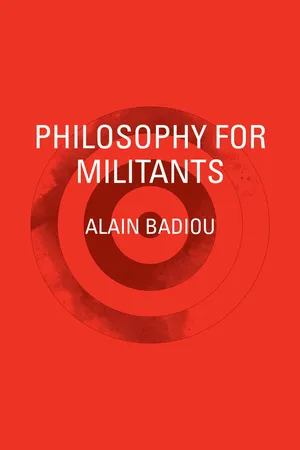
- 96 pages
- English
- ePUB (mobile friendly)
- Available on iOS & Android
eBook - ePub
Philosophy for Militants
About this book
Information
Chapter One
The Enigmatic Relationship between Philosophy and Politics
Before broaching the paradoxical relationship between philosophy and politics, I would like to raise a few simple questions about the future of philosophy itself.
I will begin with a reference to one of my masters, Louis Althusser. For Althusser, the birth of Marxism is not a simple matter. It depends on two revolutions, on two major intellectual events. First, a scientific event, namely, the creation by Marx of a science of history, the name of which is ‘historical materialism’. The second event is philosophical in nature and concerns the creation, by Marx and some others, of a new tendency in philosophy, the name of which is ‘dialectical materialism’.1 We can say that a new philosophy is called for to clarify and help with the birth of a new science. Thus, Plato’s philosophy was summoned by the beginning of mathematics, or Kant’s philosophy by Newtonian physics. There is nothing particularly difficult in all this. But in this context it becomes possible to make a few small remarks about the future of philosophy.
We can begin by considering the fact that this future does not depend principally on philosophy and on its history, but on new facts in certain domains, which are not immediately philosophical in nature. In particular, it depends on facts that belong to the domain of science: for example, mathematics for Plato, Descartes or Leibniz; physics for Kant, Whitehead or Popper; history for Hegel or Marx; biology for Nietzsche, Bergson or Deleuze.
I am perfectly in agreement with the statement that philosophy depends on certain nonphilosophical domains, which I have proposed to call the ‘conditions’ of philosophy. I merely want to recall that I do not limit the conditions of philosophy to the comings and goings of science. I propose a much vaster ensemble of conditions, pertaining to four different types: science, to be sure, but also politics, art and love. Thus, my work depends, for instance, on a new concept of the infinite, but also on new forms of revolutionary politics, on the great poems by Mallarmé, Rimbaud, Pessoa, Mandelstam or Wallace Stevens, on the prose of Samuel Beckett, and on the new figures of love that have emerged in the context of psychoanalysis, as well as on the complete transformation of all questions concerning sexuation and gender.
We could thus say that the future of philosophy depends on its capacity for progressive adaptation to the changing of its conditions. And, if this is indeed the case, we could say that philosophy always comes in the second place; it always arrives après-coup, or in the aftermath, of nonphilosophical innovations.
It is true that this is also Hegel’s conclusion. For him philosophy is the bird of wisdom, and the bird of wisdom is the owl. But the owl takes flight only towards the end of the day. Philosophy is the discipline that comes after the day of knowledge, after the day of real-life experiments – when night falls. Apparently, our problem concerning the future of philosophy is thereby solved. We can imagine two cases. First case: a new dawn of creative experiments in matters of science, politics, art or love is on the verge of breaking and we will have the experience of a new evening for philosophy. Second case: our civilisation is exhausted, and the future that we are capable of imagining is a sombre one, a future of perpetual obscurity. The future of philosophy will thus lie in dying its slow death at night. Philosophy will be reduced to what we can read at the beginning of that splendid text by Samuel Beckett, Company: ‘A voice comes to one in the dark’.2 A voice with neither meaning nor destination.
And, in fact, from Hegel to Auguste Comte, all the way to Nietzsche, Heidegger or Derrida, without forgetting Wittgenstein and Carnap, we find time and again the philosophical idea of a probable death of philosophy – in any case the death of philosophy in its classical or metaphysical form. Will I, as someone who is well-known for his contempt for the dominant form of our time and his staunch criticism of capitalo-parliamentarianism, preach the necessary end and overcoming of philosophy? You know that such is not my position. Quite the contrary, I am attached to the possibility that philosophy, as I already wrote in my first Manifesto for Philosophy, must take ‘one more step’.3
This is because the widespread thesis about the death of metaphysics, the postmodern thesis of an overcoming of the philosophical element as such by way of novel, more hybridised, and more mixed, less dogmatic intellectualities – this thesis runs into a whole series of difficulties.
The first difficulty, which is perhaps overly formal, is the following: for a long time now the idea of the end of philosophy has been a typically philosophical idea. Moreover, it is often a positive idea. For Hegel, philosophy has reached its end because it is capable of grasping what is absolute knowledge. For Marx, philosophy, as interpretation of the world, may be replaced by a concrete transformation of this same world. For Nietzsche, negative abstraction represented by the old philosophy must be destroyed to liberate the genuine vital affirmation, the great ‘Yes!’ to all that exists. And the analytical tendency, the metaphysical phrases, which are pure nonsense, must be deconstructed in favour of clear propositions and statements, under the paradigm of modern logic.
In all these cases we see how the great declarations about the death of philosophy in general, or of metaphysics in particular, are most likely the rhetorical means to introduce a new path, a new aim, within philosophy itself. The best way to say ‘I am a new philosopher’ is probably to say with great emphasis: ‘Philosophy is over, philosophy is dead! Therefore, I propose that with me there begins something entirely new. Not philosophy, but thinking! Not philosophy, but the force of life! Not philosophy, but a new rational language! In fact, not the old philosophy, but the new philosophy, which by some amazing chance happens to be mine.’
It is not impossible that the future of philosophy always takes the form of a resurrection. The old philosophy, like the old man, is dead; but this death is in fact the birth of the new man, of the new philosopher.
However, there exists a close relationship between resurrection and immortality, between the greatest imaginable change, the passage from death to life, and the most complete absence of change imaginable, when we place ourselves in the joy of salvation.
Perhaps the repetition of the motif of the end of philosophy joined with the repeated motif of a new beginning of thought is the sign of a fundamental immobility of philosophy as such. It is possible that philosophy must always place its continuity, its repetitive nature, under the rubric of the dramatic pair of birth and death.
At this point, we can come back to the work of Althusser. It is Althusser who argues that philosophy depends on science, all the while making an extremely strange argument, namely, that philosophy has no history at all, that philosophy is always the same thing. In this case, the problem of the future of philosophy in fact becomes a simple one: the future of philosophy is its past.
It boggles the mind to see Althusser, the great Marxist, become the last defender of the old scholastic notion of a philosophia perennis, of a philosophy as the pure repetition of the same, a philosophy in the Nietzschean style as eternal return of the same.
But what does this ‘same’ really mean? What is this sameness of the same that is equivalent to the ahistorical destiny of philosophy? This question obviously brings us back to the old discussion on the true nature of philosophy. Roughly, we can distinguish two tendencies in this debate. For the first tendency, philosophy is essentially a reflexive mode of knowledge: the knowledge of truth in the theoretical domain, the knowledge of values in the practical domain. And we must organise the process whereby these two fundamental forms of knowledge are acquired and transmitted. Thus, the form that is appropriate for philosophy is that of the school. The philosopher then is a professor, like Kant, Hegel, Husserl, Heidegger and so many others, myself included. The philosopher organises the reasoned transmission and discussion of questions concerning truth and values. Indeed, it belongs to philosophy to have invented the form of the school, since at least the Greeks.
The second possibility holds that philosophy is not really a form of knowledge, whether theoretical or practical. Rather, it consists in the direct transformation of a subject, being a radical conversion of sorts – a complete upheaval of existence. Consequently, philosophy comes very close to religion, even though its means are exclusively rational; it comes very close to love, but without the violent support of desire; very close to political commitment, but without the constraint of a centralised organisation; very close to artistic creation, but without the sensible means of art; very close to scientific knowledge, but without the formalism of mathematics or the empirical and technical means of physics. For this second tendency, philosophy is not necessarily a subject-matter belonging to the school, to pedagogy, to professors and the problem of transmission. It is a free address of someone to someone else. Like Socrates addressing the youth in the streets of Athens, like Descartes writing letters to Princess Elisabeth of Bohemia, like Jean-Jacques Rousseau writing his Confessions; or like the poems of Nietzsche, the novels and plays of Jean-Paul Sartre; or, if you allow me this touch of narcissism, like my own theatrical or novelistic works, as well as the affirmative and combative style that infuses, I believe, even the most complex of my philosophical writings.
In other words, we can conceive of philosophy, to speak like Lacan, as a form of the discourse of the University, an affair for philosophers and students in reasonable institutions. This is the perennially scholastic vision of Aristotle. Or else we can conceive of philosophy as the most radical form of the discourse of the Master, an affair of personal commitment in which the combative affirmation comes first (above all against the sophists and against the doubts of the sages who honour the University).
In this second view of things, philosophy is no more knowledge than it is knowledge of knowledge. It is an action. We could say that what identifies philosophy are not the rules of a discourse but the singularity of an act. It is this act that the enemies of Socrates designated as ‘corrupting the youth’. And, as you know, this is the reason why Socrates was condemned to death. ‘To corrupt the youth’ is, after all, a very apt name to designate the philosophical act, provided that we understand the meaning of ‘corruption’. To corrupt here means to teach the possibility of refusing all blind submission to established opinions. To corrupt means to give the youth certain means to change their opinion with regard to social norms, to substitute debate and rational critique for imitation and approval, and even, if the question is a matter of principle, to substitute revolt for obedience. But this revolt is neither spontaneous nor aggressive, to the extent that it is the consequence of principles and of a critique offered for the discussion of all.
In Rimbaud’s poetry we find the strange expression: ‘logical revolts’.4 This is probably a good definition of the philosophical act. It is not by chance that my old friend–enemy, the remarkable antiphilosopher Jacques Rancière, created in the 1970s a very important journal, which carried precisely the title Les Révoltes logiques.5
But if the true essence of philosophy consists in being an act, we understand better why, in the eyes of Louis Althusser, there exists no real history of philosophy. In his own work, Althusser proposes that the active function of philosophy consists in introducing a division among opinions. To be more precise, a division among the opinions about scientific knowledge – or, more generally, among theoretical activities. What kind of division? It is ultimately the division between materialism and idealism. As a Marxist, Althusser thought that materialism was the revolutionary framework for theoretical activities and that idealism was the conservative framework. Thus, his final definition was the following: philosophy is like a political struggle in the theoretical field.6
But, independently of this Marxist conclusion, we can make two remarks:
1. The philosophical act always takes the form of a decision, a separation, a clear distinction. Between knowledge and opinion, between correct and false opinions, between truth and falsity, between Good and Evil, between wisdom and madness, between the affirmative position and the purely critical position, and so on.
2. The philosophical act always has a normative dimension. The division is also a hierarchy. In the case of Marxism, the good term is materialism and the bad one, idealism. But, more generally, we see that the division introduced among the concepts or experience...
Table of contents
- Cover Page
- Halftitle Page
- Title Page
- Copyright Page
- Contents
- Translator’s Foreword
- Chapter One: The Enigmatic Relationship between Philosophy and Politics
- Chapter Two: The Figure of the Soldier
- Chapter Three: Politics as a Nonexpressive Dialectics
- Sources
- Appendix: Reflections on the Crisis in Quebec
- Suggested Further Reading
Trusted by 375,005 students
Access to over 1.5 million titles for a fair monthly price.
Study more efficiently using our study tools.
Frequently asked questions
Yes, you can cancel anytime from the Subscription tab in your account settings on the Perlego website. Your subscription will stay active until the end of your current billing period. Learn how to cancel your subscription
No, books cannot be downloaded as external files, such as PDFs, for use outside of Perlego. However, you can download books within the Perlego app for offline reading on mobile or tablet. Learn how to download books offline
Perlego offers two plans: Essential and Complete
- Essential is ideal for learners and professionals who enjoy exploring a wide range of subjects. Access the Essential Library with 800,000+ trusted titles and best-sellers across business, personal growth, and the humanities. Includes unlimited reading time and Standard Read Aloud voice.
- Complete: Perfect for advanced learners and researchers needing full, unrestricted access. Unlock 1.5M+ books across hundreds of subjects, including academic and specialized titles. The Complete Plan also includes advanced features like Premium Read Aloud and Research Assistant.
We are an online textbook subscription service, where you can get access to an entire online library for less than the price of a single book per month. With over 1.5 million books across 990+ topics, we’ve got you covered! Learn about our mission
Look out for the read-aloud symbol on your next book to see if you can listen to it. The read-aloud tool reads text aloud for you, highlighting the text as it is being read. You can pause it, speed it up and slow it down. Learn more about Read Aloud
Yes! You can use the Perlego app on both iOS and Android devices to read anytime, anywhere — even offline. Perfect for commutes or when you’re on the go.
Please note we cannot support devices running on iOS 13 and Android 7 or earlier. Learn more about using the app
Please note we cannot support devices running on iOS 13 and Android 7 or earlier. Learn more about using the app
Yes, you can access Philosophy for Militants by Alain Badiou, Bruno Bosteels in PDF and/or ePUB format, as well as other popular books in Politica e relazioni internazionali & Filosofia politica. We have over 1.5 million books available in our catalogue for you to explore.