Ethical questions dominate current political and academic agendas. While government think-tanks ponder the dilemmas of bio-ethics, medical ethics and professional ethics, respect for human rights and reverence for the Other have become matters of broad consensus.
Alain Badiou, one of the most powerful voices in contemporary French philosophy, explodes the facile assumptions behind this recent ethical turn. He shows how our prevailing ethical principles serve ultimately to reinforce an ideology of the status quo, and fail to provide a framework for an effective understanding of the concept of evil.
In contrast, Badiou summons up an "ethic of truths" which is designed both to sustain and inspire a disciplined, subjective adherence to a militant cause (be it political or scientific, artistic or romantic), and to discern a finely demarcated zone of application for the concept of evil. He defends an effectively super-human integrity over the respect for merely human rights, asserts a partisan universality over the negotiation of merely particular interests, and appeals to an "immortal" value beyond the protection of mortal privileges.
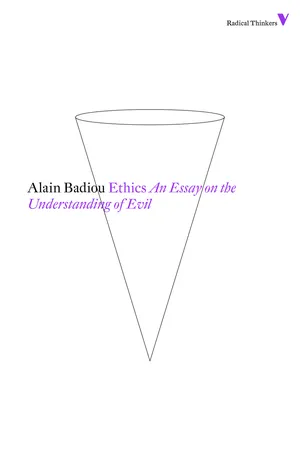
- 224 pages
- English
- ePUB (mobile friendly)
- Available on iOS & Android
eBook - ePub
About this book
Information
Topic
FilosofíaSubtopic
Ética y filosofía moral
According to the way it is generally used today, the term ‘ethics’ relates above all to the domain of human rights, ‘the rights of man’ – or, by derivation, the rights of living beings.
We are supposed to assume the existence of a universally recognizable human subject possessing ‘rights’ that are in some sense natural: the right to live, to avoid abusive treatment, to enjoy ‘fundamental’ liberties (of opinion, of expression, of democratic choice in the election of governments, etc.). These rights are held to be self-evident, and the result of a wide consensus. ‘Ethics’ is a matter of busying ourselves with these rights, of making sure that they are respected.
This return to the old doctrine of the natural rights of man is obviously linked to the collapse of revolutionary Marxism, and of all the forms of progressive engagement that it inspired. In the political domain, deprived of any collective political landmark, stripped of any notion of the ‘meaning of History’ and no longer able to hope for or expect a social revolution, many intellectuals, along with much of public opinion, have been won over to the logic of a capitalist economy and a parliamentary democracy. In the domain of ‘philosophy’, they have rediscovered the virtues of that ideology constantly defended by their former opponents: humanitarian individualism and the liberal defence of rights against the constraints imposed by organized political engagement. Rather than seek out the terms of a new politics of collective liberation, they have, in sum, adopted as their own the principles of the established ‘Western’ order.
In so doing, they have inspired a violently reactionary movement against all that was thought and proposed in the 1960s.
I The death of Man?
In those years, Michel Foucault outraged his readers with the declaration that Man, in the sense of constituent subject, was a constructed historical concept peculiar to a certain order of discourse, and not a timelessly self-evident principle capable of founding human rights or a universal ethics. He announced the end of this concept’s relevance, once the kind of discourse which alone had made it meaningful became historically obsolete.
Likewise, Louis Althusser declared that history was not, as Hegel had thought, the absolute development [devenir] of Spirit, nor the advent of a subject-substance, but a rational, regulated process which he called a ‘process without a subject’, and which could be grasped only through a particular science, the science of historical materialism. It followed that the humanism of human rights and ethics in the abstract sense were merely imaginary constructions – ideologies – and that we should develop, rather, what he called a ‘theoretical antihumanism’.
At the same time, Jacques Lacan strove to disentangle psychoanalysis from all its psychological and normative tendencies. He demonstrated how it was essential to distinguish the Ego, a figure of only imaginary unity, from the Subject. He showed that the subject had no substance, no ‘nature’, being a function both of the contingent laws of language and of the always singular history of objects of desire. It followed that any notion of analytic treatment as a means for the reinstatement of a ‘normal’ kind of desire was a fraud, and that, more generally, there existed no norm that could ground the idea of a ‘human subject’, a norm whose rights and duties it would have been the task of philosophy to articulate.
What was contested in this way was the idea of a natural or spiritual identity of Man, and with it, as a consequence, the very foundation of an ‘ethical’ doctrine in today’s sense of the word: a consensual law-making concerning human beings in general, their needs, their lives, and their deaths – and, by extension, the self-evident, universal demarcation of evil, of what is incompatible with the human essence.
Is this to say, then, that Foucault, Althusser and Lacan extol an acceptance of the status quo, a kind of cynicism, an indifference to what people suffer? Thanks to a paradox which we will explain in what follows, the truth is exactly the opposite: all three were – each in his own way, and far more than those who uphold the cause of ‘ethics’ and ‘human rights’ today – the attentive and courageous militants of a cause. Michel Foucault, for example, maintained a particularly rigorous commitment [engagement] to a revision of the status of prisoners, and devoted to this question much of his time and the whole of his immense talent as an organizer and an agitator. Althusser’s sole purpose was to redefine a genuinely emancipatory politics. Lacan himself – beyond the fact that he was a ‘total’ clinical analyst who spent the best part of his life listening to people – conceived of his struggle against the ‘normative’ orientation of American psychoanalysis, and the degrading subordination of thought to the ‘American way of life’,1 as a decisive commitment [engagement]. For Lacan, questions of organization and polemic were always of a piece with questions of theory.
When those who uphold the contemporary ideology of ‘ethics’ tell us that the return to Man and his rights has delivered us from the ‘fatal abstractions’ inspired by ‘the ideologies’ of the past, they have some nerve. I would be delighted to see today so constant an attention paid to concrete situations, so sustained and so patient a concern for the real [le réel], so much time devoted to an activist inquiry into the situation of the most varied kinds of people – often the furthest removed, it might seem, from the normal environment of intellectuals – as that we witnessed in the years between 1965 and 1980.
In reality, there is no lack of proof for the fact that the thematics of the ‘death of man’ are compatible with rebellion, a radical dissatisfaction with the established order, and a fully committed engagement in the real of situations [dans le réel des situations], while by contrast, the theme of ethics and of human rights is compatible with the self-satisfied egoism of the affluent West, with advertising, and with service rendered to the powers that be. Such are the facts.
To elucidate these facts, we must examine the foundations of today’s ‘ethical’ orientation.
II The foundations of the ethic of human rights
The explicit reference of this orientation, in the corpus of classical philosophy, is Kant.2 Our contemporary moment is defined by an immense ‘return to Kant’. In truth, the variety and the detail of this return are labyrinthine in their complexity; here I will concern myself only with the ‘average’ version of the doctrine.
What essentially is retained from Kant (or from an image of Kant, or, better still, from theorists of ‘natural law’) is the idea that there exist formally representable imperative demands that are to be subjected neither to empirical considerations nor to the examination of situations; that these imperatives apply to cases of offence, of crime, of Evil; that these imperatives must be punished by national and international law; that, as a result, governments are obliged to include them in their legislation, and to accept the full legal range of their implications; that if they do not, we are justified in forcing their compliance (the right to humanitarian interference, or to legal interference).
Ethics is conceived here both as an a priori ability to discern Evil (for according to the modern usage of ethics, Evil – or the negative – is primary: we presume a consensus regarding what is barbarian), and as the ultimate principle of judgement, in particular political judgement: good is what intervenes visibly against an Evil that is identifiable a priori. Law [droit] itself is first of all law ‘against’ Evil. If ‘the rule of law’ [Etat de droit] is obligatory, that is because it alone authorizes a space for the identification of Evil (this is the ‘freedom of opinion’ which, in the ethical vision, is first and foremost the freedom to designate Evil) and provides the means of arbitration when the issue is not clear (the apparatus of judicial precautions).
The presuppositions of this cluster of convictions are clear.
1. We posit a general human subject, such that whatever evil befalls him is universally identifiable (even if this universality often goes by the altogether paradoxical name of ‘public opinion’), such that this subject is both, on the one hand, a passive, pathetic [pathétique], or reflexive subject – he who suffers – and, on the other, the active, determining subject of judgement – he who, in identifying suffering, knows that it must be stopped by all available means.
2. Politics is subordinated to ethics, to the single perspective that really matters in this conception of things: the sympathetic and indignant judgement of the spectator of the circumstances.
3. Evil is that from which the Good is derived, not the other way round.
4. ‘Human rights’ are rights to non-Evil: rights not to be offended or mistreated with respect to one’s life (the horrors of murder and execution), one’s body (the horrors of torture, cruelty and famine), or one’s cultural identity (the horrors of the humiliation of women, of minorities, etc.).
The power of this doctrine rests, at first glance, in its self-evidence. Indeed, we know from experience that suffering is highly visible. The eighteenth-century theoreticians had already made pity – identification with the suffering of a living being – the mainspring of the relation with the other. That political leaders are discredited chiefly by their corruption, indifference or cruelty was a fact already noted by the Greek theorists of tyranny. That it is easier to establish consensus regarding what is evil rather than regarding what is good is a fact already established by the experience of the Church: it was always easier for church leaders to indicate what was forbidden – indeed, to content themselves with such abstinences – than to try to figure out what should be done. It is certainly true, moreover, that every politics worthy of the name finds its point of departure in the way people represent their lives and rights.
It might seem, then, that we have here a body of self-evident principles capable of cementing a global consensus, and of imposing themselves strongly.
Yet we must insist that it is not so; that this ‘ethics’ is inconsistent, and that the – perfectly obvious – reality of the situation is characterized in fact by the unrestrained pursuit of self-interest, the disappearance or extreme fragility of emancipatory politics, the multiplication of ‘ethnic’ conflicts, and the universality of unbridled competition.
III Man: Living animal or immortal singularity?
The heart of the question concerns the presumption of a universal human Subject, capable of reducing ethical issues to matters of human rights and humanitarian actions.
We have seen that ethics subordinates the identification of this subject to the universal recognition of the evil that is done to him. Ethics thus defines man as a victim. It will be objected: ‘No! You are forgetting the active subject, the one that intervenes against barbarism!’ So let us be precise: man is the being who is capable of recognizing himself as a victim.
It is this definition that we must proclaim unacceptable – for three reasons in particular:
1. In the first place, because the status of victim, of suffering beast, of emaciated, dying body, equates man with his animal substructure, it reduces him to the level of a living organism pure and simple (life being, as Bichat says, nothing other than ‘the set of functions that resist death’).3 To be sure, humanity is an animal species. It is mortal and predatory. But neither of these attributes can distinguish humanity within the world of the living. In his role as executioner, man is an animal abjection, but we must have the courage to add that in his role as victim, he is generally worth little more. The stories told by survivors of torture4 forcefully underline the point: if the torturers and bureaucrats of the dungeons and the camps are able to treat their victims like animals destined for the slaughterhouse, with whom they themselves, the well-nourished criminals, have nothing in common, it is because the victims have indeed become such animals. What had to be done for this to happen has indeed been done. ...
Table of contents
- Cover
- Title Page
- Copyright
- Contents
- Translator’s Introduction
- Notes on the Translation
- Preface to the English Edition
- Introduction
- 1. Does Man Exist?
- 2. Does the Other Exist?
- 3. Ethics as a Figure of Nihilism
- 4. The Ethic of Truths
- 5. The Problem of Evil
- Conclusion
- Appendix: Politics and Philosophy: An Interview with Alain Badiou
- Bibliography
- Index
Trusted by 375,005 students
Access to over 1.5 million titles for a fair monthly price.
Study more efficiently using our study tools.
Frequently asked questions
Yes, you can cancel anytime from the Subscription tab in your account settings on the Perlego website. Your subscription will stay active until the end of your current billing period. Learn how to cancel your subscription
No, books cannot be downloaded as external files, such as PDFs, for use outside of Perlego. However, you can download books within the Perlego app for offline reading on mobile or tablet. Learn how to download books offline
Perlego offers two plans: Essential and Complete
- Essential is ideal for learners and professionals who enjoy exploring a wide range of subjects. Access the Essential Library with 800,000+ trusted titles and best-sellers across business, personal growth, and the humanities. Includes unlimited reading time and Standard Read Aloud voice.
- Complete: Perfect for advanced learners and researchers needing full, unrestricted access. Unlock 1.5M+ books across hundreds of subjects, including academic and specialized titles. The Complete Plan also includes advanced features like Premium Read Aloud and Research Assistant.
We are an online textbook subscription service, where you can get access to an entire online library for less than the price of a single book per month. With over 1.5 million books across 990+ topics, we’ve got you covered! Learn about our mission
Look out for the read-aloud symbol on your next book to see if you can listen to it. The read-aloud tool reads text aloud for you, highlighting the text as it is being read. You can pause it, speed it up and slow it down. Learn more about Read Aloud
Yes! You can use the Perlego app on both iOS and Android devices to read anytime, anywhere — even offline. Perfect for commutes or when you’re on the go.
Please note we cannot support devices running on iOS 13 and Android 7 or earlier. Learn more about using the app
Please note we cannot support devices running on iOS 13 and Android 7 or earlier. Learn more about using the app
Yes, you can access Ethics by Alain Badiou, Peter Hallward in PDF and/or ePUB format, as well as other popular books in Filosofía & Ética y filosofía moral. We have over 1.5 million books available in our catalogue for you to explore.