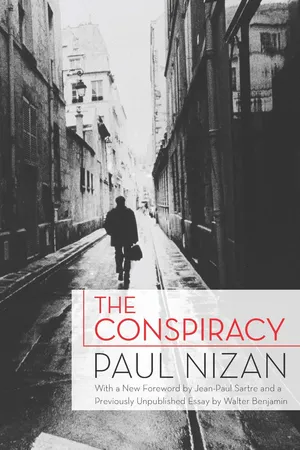
The Conspiracy is the last and most acclaimed novel by French writer and activist Paul Nizan, who died two years after its publication fighting the Germans at the Battle of Dunkirk. Hailed by Jean-Paul Sartre as Nizan's masterpiece, the book centers upon the figure of Bertrand Rosenthal, a misguided philosophy student studying in pre-war Paris. Eager to foment a revolution and having little grasp of his own motives, Rosenthal draws a small group of disciples into a conspiracy both fatuous and deadly. Simultaneously, he plunges into a forbidden-and ultimately tragic-love affair as the intertwined plots move inexorably toward their twin destinations of betrayal and death.
The Conspiracy won the coveted Prix Interalli? in 1938. This new edition includes Walter Benjamin's critique of the book, available here for the first time in English.
- 272 pages
- English
- ePUB (mobile friendly)
- Available on iOS & Android
eBook - ePub
The Conspiracy
About this book
Information
Part One
The Conspiracy
I
— Well, said Rosenthal, we might name the journal Civil War . . .
— Why not? said Laforgue. It’s not a bad title, and it says what we mean all right. Are you sure it hasn’t already been taken?
— Civil war’s an idea that must be in the public domain, said Rosenthal. It’s not something you could copyright.
It was a July evening, at that hour after dusk when the sweat dries on your skin and all the dust of the day has finally settled like the ash from a spent conflagration. A broad expanse of sky stretched above the gardens, which were merely a small enclosure of parched trees and sickly grass, but which nonetheless, there amid the stone hills of Paris, gave as much pleasure as a meadow.
In the apartments of Rue Claude-Bernard, which Laforgue and his friends sometimes spied on for hours as though they harboured important secrets, people were beginning to get ready for the night. A bare arm or shoulder could vaguely be discerned passing in front of a lamp: women were undressing, but they were too far away for one to be able to make out whether they were beautiful. They were not. Actually they were middle-aged ladies, removing corsets, girdles and suspender-belts like pieces of armour. The younger female inmates of these dwellings – those whose songs would sometimes well forth from the recesses of a kitchen – slept in garrets where they could not be seen.
Loudspeakers spewed forth from their maws in a confused babble strains of music, speeches, lessons, advertisements; every now and then you could hear the screech of a bus at the stop in Rue des Feuillantines; yet there were moments when a kind of vast, marine silence swirled lazily over the reefs of the city.
Rosenthal was speaking. He always spoke a lot, since he had the voice of a prophet and thought its timbre gave him powers of persuasion. His companions, as they listened to him, contemplated the raspberry shimmer of Paris above their heads; but they were thinking confusedly about the women readying themselves for bed and addressing mechanical words to their husbands and lovers – or, perhaps, phrases overflowing with hatred, passion or obscenity.
They were five young men, all at that awkward age between twenty and twenty-four. The future awaiting them was blurred, like a desert filled with mirages, pitfalls and vast lonely spaces. On that particular evening, they gave it little thought: they were merely longing for the advent of the summer vacation and for the examinations to be over.
— All right then, said Laforgue, we’ll manage to publish this journal next term, since philanthropists can be found naive enough to entrust us with funds they’ll not see again. We’ll publish it, and after a certain time it will fold . . .
— Of course, said Rosenthal. Is any one of you so depraved as to imagine we’re working for eternity?
— Journals always fold, said Bloyé. That’s a simple empirical fact.
— If I knew, Rosenthal continued, that any undertaking of mine would involve me for life and pursue me like some kind of ball-and-chain or faithful dog, I’d sooner go and jump in the river. To know what you’re going to be is to live like the dead. Just imagine us forty years from now, with ugly ageing mugs, editing an aged Civil War like Xavier Léon and his Revue de Métaphysique! A splendid life would be one in which architects built houses for the pleasure of knocking them down and writers wrote books only in order to burn them. You’d have to be pure enough, or brave enough, not to require things to last . . .
— You’d have to be freed entirely, said Laforgue, from the fear of death.
— Cut out the romanticism, said Bloyé, and the metaphysical anguish. We’re making plans for a journal, and we’re having high-faluting discussions because we haven’t got either women or money – there’s nothing to get excited about. Anyway, one has to do things, and we’re doing them. It won’t always be journals.
— How about going for a drink, said Pluvinage.
— Let’s go, said Jurien.
They left the gardens to go drinking and had all the cafés that lie between Place du Panthéon and the Jardin des Plantes to choose from. They went down Rue Claude-Bernard then up Avenue des Gobelins till they arrived at the Canon des Gobelins, which still stands at the corner of the Avenue and Boulevard Saint-Marcel. The café’s pavement seats were full of people shattered by work and the heat, who mumbled absurd, truncated conversations or told each other insulting truths, as they waited until it was time to go off and sleep two by two in damp beds hidden away in wretched rooms; there were also a few showy pieces with watchful eleven-o’clock eyes, one of them a rather buxom young woman whose tight curls were faintly repulsive, reminiscent of an armpit or a pubis, but she had handsome knees that gleamed like black stones.
They sat down and looked at the drinkers around them, but it was too hot to get very excited about other people’s existence or even convince oneself very easily that they were anything but images, projections, reflected forms. Laforgue was more interested in the woman with curly hair and eventually she rose from her chair and went inside the café; Laforgue followed her to the cloakroom in the basement. The cloakroom lady said:
— We’ve still got fine weather ahead: the glass is set fair.
— But it’s thundery, said the young woman. I don’t know if you’re like me, Madame Lucienne, but it makes a person all tense. If you ran a hand through my hair, it would crackle like the fur on a cat’s back.
Laforgue asked for a telephone number that did not exist.
— There’s no reply, said the cloakroom lady.
— That doesn’t surprise me, said Laforgue.
The woman had applied powder, rouge and – after spitting on a little brush – mascara. She smiled at Laforgue and started off ahead of him; on the steps of the narrow, winding staircase she asked him:
— Is tonight the night, then?
Laforgue was standing three steps below her and, at the level of his eyes, could see a belly which bulged slightly beneath the black crêpe-de-Chine of her dress.
— That’s just what I was wondering, he replied. But we’d better make it some other day, the weather’s not right, the glass is set too fair.
— It’s a shame, she said, we’d have been good together. You’ll regret it, and as for me, I’ll have been downstairs for nothing.
— You’ll have a drink all the same, won’t you? said Laforgue.
They sat down at a table in the café’s deserted interior: the percolator hissed over the till-lady’s head, the waiter was nodding – they woke him up. Through the open window they could see a row of necks that told a lot about their owners’ faces. The woman drank green peppermint cordial and began talking, and since he had followed her for the sake of one action alone, Laforgue began to caress her knees; then he rose and rejoined his companions.
— You were hitting it off? asked Bloyé.
— As you say, replied Laforgue. She was a woman with a thirst, especially for affection; she was tender; she was just getting round to making plans for the future. One Sunday, she was saying, we might go and see my little daughter, she’s with a wet-nurse near Feucherolles, perhaps you know it, you get out at Saint-Nom-la-Bretèche, beyond Marly-le-Roi, you must like children. A fine Sunday was in the making – for someone fond of children, canaries and cats.
When it was almost midnight Rosenthal left, since his home was far away from that neighbourhood, at La Muette, where people live in over-large stone shells, on streets as clean as the avenues in cemeteries where plots are leased in perpetuity.
Rosenthal, as he stood on the platform of the AX carrying him from the Jardin des Plantes towards the Gare de Passy, was thinking furiously about the potent domain of families. Since he had been breathing that La Muette air (no match for the breeze wafting at midnight over the paulownias of Parc Montsouris, but still . . .) for twenty-three years now, he had the wherewithal to fill the time of his homeward journeys with childhood memories: the gatherings of nannies and nurses on the lawns of La Muette, round perambulators drawn up in a circle like the wagons of nomads none too sure about the darkness; the games with the children in the Bois who play in white gloves, who play without disarranging their silken hair; and later, after a day at Janson, the walks in Allée des Acacias or Allée de Longchamp thinking about Odette de Crécy, and the Sunday-morning girls beneath the flowering chestnuts on the avenue in the Bois when everything is redolent of spring, petrol, horses and women.
There is more than one Jewish quarter in Paris. The 16th arrondissement was not the one where Bernard Rosenthal would most readily have chosen to live, but each time he thought of Rue Cloche-Perce and Rue du Roi-de-Sicile, that was not possible either: the corkscrew ringlets of the latest immigrants from Galicia did not strike him as much less revolting than the Charitable Works of the Rothschild family; and he did not think a leap from the twentieth century and La Muette into the sixteenth century and Vilna or Warsaw was such a brilliant solution.
When a young French bourgeois like Laforgue is seized by a desire to rebel against the condition his class imposes upon him, he experiences less complex problems in making the break: the race and its mythologies, the complicities of church, clan and charity, do not long mask from him society’s true contours. A deviation from the path traced for him, like the reaction of a foal that takes fright and shies; the rift with paternal allegiances: these are enough to cast him back into the midst of a human space bereft of history, or which history scarcely trammels. Everything sorts itself out quite speedily: if, in an attempt to find his bearings, he seeks a bit of posthumous advice from his peasant forebears, they are never far away. Disloyal to his father who has done so much for him and, by God, makes no bones about telling him so, he can console himself by exclaiming that he is at least loyal to his grandfather: nothing threatens bourgeois stability more fundamentally than this constant interchange of compensatory betrayals, which are simply the normal consequences of the celebrated stages of democracy.
Rosenthal really did not know which way to jump, whom to be loyal to. His rabbi forebears were no joke, and in Paris what use was their advice full of Zohar and Talmud? He had too much self-esteem not to admit to himself – in spite of that human respect which does so much for the defence of lost causes – that the humblest of his relatives disgusted him no less than the richest and most triumphant; than those who had ended up acquiring an astonishing security like that of Catholics – as if Heaven and Hell belonged to them too. The pathetic synagogues on the first floor of some fissured building in the Saint-Paul neighbourhood, from which on Saturdays such unkempt old men would descend; the kosher inscriptions on the butchers’ windows; that incense-laden aroma of the East you can inhale only two hundred metres away from the Hôtel de Ville emporium and the church of Saint-Gervais; the tall girls, somewhat too pale-skinned and disdainful, beside a bowler-hatted father on the threshold of a tailor’s shop; the little gangs of pickpockets in the Polish bars; the white silk scarfs woven with threads in the hues of twilight and the moon – Bernard could no more put up with all this than with his cousins’ grand weddings in the temple on Rue de la Victoire or Rue Copernic, with the top-hats in a ring round the hupa and the ladies’ fur coats in the left bay; with tales of contango and backwardation, of outside market and official market; with the young girls who, when he met them at his beautiful sister-in-law Catherine’s, would speak to him in careless tones with the hint of an English accent of their holiday cruises to Spitzbergen or in the Cyclades, for which the fashion was then beginning. Bernard had no desire to exchange prisons.
Nor were the impassioned fur-trade workers’ meetings, in the little hall on Rue Albouy, any great help to him: the speakers held forth almost exclusively in Yiddish, he did not know a word of it. In his family, no one uttered a word of the forgotten language any more without laughing, ever since they had forsworn poverty, exile and anger. He did not in any case believe Jews had the right to a special liberation, a new act of alliance with God: he saw their liberation as submerged in a general emancipation, wherein their names, their misfortune and their vocation would disappear all at once. Besides, Bernard still wished only to be freed – he gave little thought to freeing anybody else.
It was quite hard actually for Rosenthal to forget that he was Jewish: his name sometimes inspired him with a kind of shame, which he considered ignoble and blushed for; it inspired him also with pride, and among his friends he would sometimes begin a senten...
Table of contents
- Cover
- About the Author
- The Conspiracy
- Copyright
- Contents
- Translator's Note
- Foreword: On The Conspiracy
- Part One
- Part Two
- Part Three
- Appendix
- Notes
Trusted by 375,005 students
Access to over 1.5 million titles for a fair monthly price.
Study more efficiently using our study tools.
Frequently asked questions
Yes, you can cancel anytime from the Subscription tab in your account settings on the Perlego website. Your subscription will stay active until the end of your current billing period. Learn how to cancel your subscription
No, books cannot be downloaded as external files, such as PDFs, for use outside of Perlego. However, you can download books within the Perlego app for offline reading on mobile or tablet. Learn how to download books offline
Perlego offers two plans: Essential and Complete
- Essential is ideal for learners and professionals who enjoy exploring a wide range of subjects. Access the Essential Library with 800,000+ trusted titles and best-sellers across business, personal growth, and the humanities. Includes unlimited reading time and Standard Read Aloud voice.
- Complete: Perfect for advanced learners and researchers needing full, unrestricted access. Unlock 1.5M+ books across hundreds of subjects, including academic and specialized titles. The Complete Plan also includes advanced features like Premium Read Aloud and Research Assistant.
We are an online textbook subscription service, where you can get access to an entire online library for less than the price of a single book per month. With over 1.5 million books across 990+ topics, we’ve got you covered! Learn about our mission
Look out for the read-aloud symbol on your next book to see if you can listen to it. The read-aloud tool reads text aloud for you, highlighting the text as it is being read. You can pause it, speed it up and slow it down. Learn more about Read Aloud
Yes! You can use the Perlego app on both iOS and Android devices to read anytime, anywhere — even offline. Perfect for commutes or when you’re on the go.
Please note we cannot support devices running on iOS 13 and Android 7 or earlier. Learn more about using the app
Please note we cannot support devices running on iOS 13 and Android 7 or earlier. Learn more about using the app
Yes, you can access The Conspiracy by Paul Nizan, Quintin Hoare in PDF and/or ePUB format, as well as other popular books in Literature & Literature General. We have over 1.5 million books available in our catalogue for you to explore.