- 160 pages
- English
- ePUB (mobile friendly)
- Available on iOS & Android
eBook - ePub
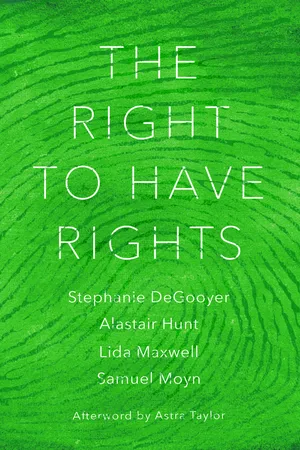
The Right to Have Rights
About this book
Sixty years ago, the political theorist Hannah Arendt, an exiled Jew deprived of her German citizenship, observed that before people can enjoy any of the "inalienable" Rights of Man-before there can be any specific rights to education, work, voting, and so on-there must first be such a thing as "the right to have rights". The concept received little attention at the time, but in our age of mass deportations, Muslim bans, refugee crises, and extra-state war, the phrase has become the centre of a crucial and lively debate. Here five leading thinkers from varied disciplines-including history, law, politics, and literary studies-discuss the critical basis of rights and the meaning of radical democratic politics today.
Information
Chapter 1
The Right …
When a person holds a right, they are entitled to a specific good or experience. They have a claim to a tangible object or objective: to health care, to shelter, to an attorney, to remain silent. What, then, was Hannah Arendt referring to when she spoke of a “right to have rights”? This, it turns out, is an extremely vexing question. The first right in Arendt’s phrase appears to be less a right that can be possessed than a means by which to possess a right—a kind of “super right” or what Frank Michelman calls an “acquisition right.”1 Why would Arendt, who was famously critical of the humanist framework of human rights, promote the idea of such a right?
In the autumn of 1949, amidst celebration of the Universal Declaration of Human Rights, newly proclaimed by the recently formed United Nations, Arendt averred that human rights offer no special protection for individuals who have lost the institutional protection of a nation-state.2 Human rights might seem to operate without the need for special memberships such as citizenship, but as millions of refugees and stateless persons had discovered in the postwar world, these rights were functionally void without a country to enforce them. Arendt concluded that in order for human rights to be anything more than citizenship rights, they require an additional right as their condition. This right she calls the “right to have rights.” “We become aware of the existence of a right to have rights,” she posits,
(and that means to live in a framework where one is judged by one’s actions and opinions) and a right to belong to some kind of organized community only when millions of people emerge who had lost and could not regain these rights because of the new global political situation.3
The “right to have rights” is distinguished by two critical features. It is a supplemental right and, more cryptically, it is a lost right. It is a right that provides the framework for human rights in general (and is thus separate from them), but it is also a right that comes into existence only when it has already disappeared, “only when millions of people emerge who [have lost it].” The “right to have rights” is therefore doubly paradoxical: it is a right that emerges as a precondition for human rights, but it is also a right that comes into view “only” with the realization that human rights have already failed. It is therefore what I would call an a posteriori right, a “postright” that makes itself known only when the possibility of its arrival has already disappeared.4
In what sense, then, is it possible to understand the first right in the “right to have rights” as separate from rights that accrue only to citizens of nation-states? Does the doubling of “right” in Arendt’s phrase merely restate and reinforce the tautological relationship between citizen and universal rights that Arendt identifies in her critique of human rights? Or is Arendt proposing the “right to have rights” as some sort of solution to a conceptual impasse between human and citizen rights, with the first “right” of her formulation providing a new vision of rights and political order? Indeed, how can Arendt speak of a right for millions of stateless persons to belong to a political community without, at the same time, claiming a transcendental source for rights, precisely the kind of right she wearily critiqued in her analysis of human rights?
Much scholarly work has been done to try to straighten out these inconsistencies.5 In what follows, however, I want to attend less to the philosophical quandaries of the “right to have rights” than to its function within the ninth chapter of The Origins of Totalitarianism. This chapter marked the second, and final, time that Arendt used the phrase. The first usage occurs in an essay written two years previously for the Modern Review. In this earlier article, Arendt describes the “right to have rights” as a right that might be recovered. By the time of Origins, however, she betrays a new skepticism about the ability of any right to repair the damage caused by the disintegration of the nation-state system in the postwar period. The theoretical aporia of the “right to have rights” is actualized in the plight of the stateless refugee whose situation reveals that the bare right to other rights carries little or no weight with any nation that has forced that person into this predicament. The citizens of nation-states can take the privilege of the “right to have rights” for granted, but those who have been stripped of their citizenship know that such a right is not enough to recover their loss.
A focus on the “right to have rights” in its final appearance in Arendt’s work compels us, I think, to revise certain scholarly understandings of the “right to have rights” as a moral foundation or anarchic agent. Yet as much as I want to complicate a phrase that people have taken as self-evidently meaningful, I also want to show how Arendt stops short of the conservative cynicism of Edmund Burke, who takes this paradox as proof that no universal human rights can exist outside of the rights of the citizens of particular countries. I argue that even if the “right to have rights” has proved impossible to put into practice as a coherent model of revolutionary change, for Arendt it is a powerful historical diagnostic tool, a way of focusing on the acts of dispossession and disen-franchisement that are inevitable corollaries of the rise of human rights.
I
By and large, there have been two dominant critical interpretations of the “right to have rights.” The first is what might be called the normative interpretation. Normative readings of the “right to have rights,” such as the one made famous by political scientist Seyla Benhabib, parse the first “right” in the phrase as a moral (rather than legal) foundation for the possibility of human rights. This is a right that tells us that we ought to have legal rights, such as a right to water or a right to health care, and that this right is universal for all human beings. The second interpretation of the “right to have rights” is to understand it as a performative right. This interpretation, made popular by theorists such as Judith Butler, looks to the fundamental groundlessness of the first right, its lack of authority or substantiation in law, to act as the catalyst for the invention of new rights. A claim to a “right to have rights” is made, for example, when bodies appear in assembly to call into question an exclusionary hegemonic practice.
Benhabib is the most important proponent of the normative reading of the “right to have rights.” The first right in the phrase, she argues, is a moral claim in the Kantian sense of the regulative ideal. It is premised on “the proposition that we ought to consider each human being qua human being as a person entitled to basic human rights and not because they are a national or a citizen.”6 While Benhabib acknowledges that Arendt does not explicitly offer a philosophical justification in her writing for a normative foundation in her political philosophy, she nevertheless asserts that Arendt’s position presupposes an “anthropological universalism” in which the human condition is one of equality of all members of the species.7 The “right to have rights,” she says, is built on the idea of humanity: “The first use of the term right [in the phrase] is addressed to humanity as such and enjoins us to recognize membership in some human group.”8
Benhabib’s interpretation of the “right to have rights” produces several ambiguities, however. Who is making the claim of a “right to have rights” and who is recognizing this claim? In response to this question, Benhabib adopts the philosophical language of deconstruction, suggesting that “the identity of the other(s) to whom the claim to be recognized as a rights-bearing person is addressed remains open and indeterminate.”9 Despite the openness of the recipient of the rights claim presented here, elsewhere Benhabib credits the power of realizing and enforcing the moral foundation of the “right to have rights” to international institutions and national and extranational legal institutions, a practice she dubs, in homage to Jacques Derrida, “democratic iteration.”10 Over time, and through repetition, national and international institutions will progressively come to safeguard rights for individuals. This progression in Benhabib’s interpretation, however, is somewhat forced. Derrida argues that “iteration” is the capacity for a citation or repetition to go astray. In keeping with the nondirectionality inherent to the word “astray,” he does not assign a positive or negative value to this movement.11 Benhabib, by contrast, outlines what we must think of as an affirmative deconstruction. She believes that certain ambiguously conceived cosmopolitan bodies (“public bodies of legislatives” and “weak publics of civil society associations and the media”) will increasingly come to act in the best interest of stateless persons and refugees and that contemporary institutions, particularly legal ones, will have ethical ends.
Benhabib is something of an optimist, to say the least.12 In her interpretation of the “right to have rights,” the two rights are easily divided. The singular “right” and the plural “rights” belong to different orders of existence. The first right is a moral entitlement based in human nature, while the latter rights are the legally recognized entitlements of citizens. The repetition of right in the phrase becomes merely a rhetorical flourish for “a right to belong to some kind of organized community,” “the right to belong to humanity,” or “the right of men to citizenship.” Benhabib presents the “right to have rights” as an incontestable sovereign entitlement already possessed by all human beings who merely need to clothe it in the institutions of law. She uncovers an implied normative foundation that allows the right to serve a function, if not as a legal one then as a moral one. With this interpretation, we have not gotten beyond Arendt’s paradox. In hastening to ground the right to citizenship in the quality of being human, Benhabib roots it in precisely the form that Arendt has not only shown is by itself incapable of generating any rights, but has also critiqued as a monstrous evasion of the plurality that is the condition of politics. For Arendt, appeals to human nature as a ground of rights amount to a naive or ideological avoidance of the difficult task of figuring out how to live together according to rules of justice.
The other dominant understanding of the “right to have rights” is an interpretation that takes the formulation’s weakness, its lack of authority, as the very place—or nonplace—of political possibility. It is the phrase’s groundlessness, says Étienne Balibar, that makes the invention of new rights possible: “[Arendt] finds a means of lodging a paradoxical principle of anarchy—of “nonpower” or the contingency of authority—at the very heart of arche, or the authority of the political.”13 Another way of putting this is that the “right to have rights” is a performative right, a right brought into being through the very statement of articulating it. Performativity, a theory advanced in the 1950s by the linguist J. L. Austin, is the linguistic power of language to bring into existence a new set of effects or a new situation. Classic examples of performative utterances include: “I now declare you man and wife,” or “I hereby christen this boat …” Performativity is useful for thinking about the problem of authority with the “right to have rights.” Not only does it capture what is effected by the utterance of “right to have rights,” which is to posit a right to community from a place where there is none, it also suggests why Arendt may have spent so little space explaining its existence. Judith Butler, for example, suggests that “Arendt is establishing through her very claim the right to have rights, and there is no ground for this claim outside the claim itself.”14 Simply by saying the phrase at the end of her chapter she brings its existence into reality.
While I do not fundamentally disagree with performative interpretations of the “right to have rights,” I find these readings, like the normative reading, too forcefully affirmative. The performative emphasis on the groundlessness of new rights must still reckon with the full significance of the phrase’s weakness in Arendt’s analysis. The performance of a right to membership in a community requires an audience: it needs an existing community that will recognize and validate its claim of belonging. In the absence of such an audience, a rights claim is incoherent, it is noise, an action without reception. It can be performed, certainly (as it has been performed countless times and in different configurations by rights claimants the world over), but to be successful it must be more than a repeated claim: it must be recognized by an external power, such as a nation-state. In 2014, for example, residents of Detroit, Michigan filed a lawsuit against the city government after it shut off running water for thousands of people unable to pay their water bill. The judge ruled against those filing the suit, arguing that although “water is a necessary ingredient to sustaining life,” there is no “enforceable right” to water. In response, the residents called on representatives of the United Nations to intercede, claiming their right to water as a human right.15 Arendt would undoubtedly recognize the polemical value of this claim for human rights. But while the claim certainly garnered publicity for the residents’ cause, it had no force to produce a right to water in US law. The appeal to human rights in this case merely reinforces the lack of enforceable right in the civic-national context. The United Nations could make recommendations and initiate a “fact-finding” mission, but it could not validate the claim of a right to water.
Furthermore, just as a performance of right can make something happen or appear, it can also fail to make something happen—an asylum seeker’s claim could go unrecognized by a state, or require repeating, perhaps again without ever being heard.16 The need for a validating community is an instance of what Michelman calls the “self-referential bind” of the “right to have rights” or what Thomas Keenan insists is its “sad fact.”17 In order for a claim to membership in a community to be recognized, an individual must already be included in a community. The very right to inclusion has inclusion as its precondition.
Despite their commitment to an emancipatory outcome, neither of these interpretations of the “right to have rights” adequately address the recursive logic of the way in which membership in a political community must be the condition for the rights of humanity. It is because of this bind that it is difficult to conceive political subjectification for the rightless in Arendt’s account. To be without a community, she argues, is to have no rights at all. To make a performative claim to be part of a community requires a performance of right not recognized by law. The biggest problem for both normative and performative readings of the “right to have rights” then is that they avoid the active uncertainty in Arendt’s thinking about how the rightless can lay claim to a community from which they have been willfully excluded. There is no guarantee that a performative claim to rights will be validated, especially if the community that the claimant seeks entrance into is itself responsible for the loss of rights. This Arendt knew deeply from her experience as a denationalized subject of Nazi Germany’s Nuremberg laws, which made all nationals of “alien blood” second-class citizens without political rights. After fleeing a detention center in France, Arendt did not seek re-entry into Germany by staking a claim to her “right to have rights,” but rather escaped to America on a forged visa. The country of her birth, the community on which she might stake a claim of inclusion, was also the country actively vested in keeping her and other Jews outside the borders of its community.
The problem for the rightless, in Arendt’s estimation, is not simply that they have no community. It is that their membership in a community has been forcefully taken away by the state’s “insisting on its sovereign right of expulsion” through acts of denationalization.18 Before she ever articulates the “right to have rights,” Arendt is dedicated to the task of making her readers aware of the diff...
Table of contents
- Cover Page
- Title Page
- Copyright Page
- Contents
- Introduction: The Right to Have Rights
- Chapter 1: The Right … Stephanie DeGooyer
- Chapter 2: … to Have … Lida Maxwell
- Chapter 3: … Rights … Samuel Moyn
- Chapter 4: … of Whom? Alastair Hunt
- Afterword(s) Astra Taylor
- Acknowledgments
- Notes
Trusted by 375,005 students
Access to over 1.5 million titles for a fair monthly price.
Study more efficiently using our study tools.
Frequently asked questions
Yes, you can cancel anytime from the Subscription tab in your account settings on the Perlego website. Your subscription will stay active until the end of your current billing period. Learn how to cancel your subscription
No, books cannot be downloaded as external files, such as PDFs, for use outside of Perlego. However, you can download books within the Perlego app for offline reading on mobile or tablet. Learn how to download books offline
Perlego offers two plans: Essential and Complete
- Essential is ideal for learners and professionals who enjoy exploring a wide range of subjects. Access the Essential Library with 800,000+ trusted titles and best-sellers across business, personal growth, and the humanities. Includes unlimited reading time and Standard Read Aloud voice.
- Complete: Perfect for advanced learners and researchers needing full, unrestricted access. Unlock 1.5M+ books across hundreds of subjects, including academic and specialized titles. The Complete Plan also includes advanced features like Premium Read Aloud and Research Assistant.
We are an online textbook subscription service, where you can get access to an entire online library for less than the price of a single book per month. With over 1.5 million books across 990+ topics, we’ve got you covered! Learn about our mission
Look out for the read-aloud symbol on your next book to see if you can listen to it. The read-aloud tool reads text aloud for you, highlighting the text as it is being read. You can pause it, speed it up and slow it down. Learn more about Read Aloud
Yes! You can use the Perlego app on both iOS and Android devices to read anytime, anywhere — even offline. Perfect for commutes or when you’re on the go.
Please note we cannot support devices running on iOS 13 and Android 7 or earlier. Learn more about using the app
Please note we cannot support devices running on iOS 13 and Android 7 or earlier. Learn more about using the app
Yes, you can access The Right to Have Rights by Stephanie DeGooyer,Samuel Moyn,Alastair Hunt,Astra Taylor in PDF and/or ePUB format, as well as other popular books in Politics & International Relations & 20th Century History. We have over 1.5 million books available in our catalogue for you to explore.