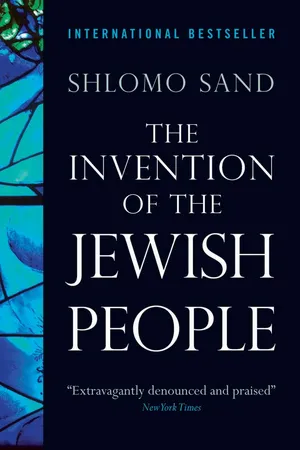
A historical tour de force, The Invention of the Jewish People offers a groundbreaking account of Jewish and Israeli history. Exploding the myth that there was a forced Jewish exile in the first century at the hands of the Romans, Israeli historian Shlomo Sand argues that most modern Jews descend from converts, whose native lands were scattered across the Middle East and Eastern Europe.
In this iconoclastic work, which spent nineteen weeks on the Israeli bestseller list and won the coveted Aujourd'hui Award in France, Sand provides the intellectual foundations for a new vision of Israel's future.
- English
- ePUB (mobile friendly)
- Available on iOS & Android
eBook - ePub
The Invention of the Jewish People
About this book
Information
CHAPTER ONE
Making Nations: Sovereignty and Equality
No nation possesses an ethnic base naturally, but as social formations are nationalized, the populations included within them, divided up among them or dominated by them, are ethnicized—that is, represented in the past or in the future as if they formed a natural community.—Étienne Balibar, “The Nation Form: History and Ideology”Nationalism was the form in which democracy appeared in the world, contained in the idea of the nation as a butterfly in a cocoon.—Liah Greenfeld, Nationalism: Five Roads to Modernity
Thinkers and scholars have struggled for more than a hundred years with the issue of nationalism but have not come up with an unambiguous and universally accepted definition. A widely accepted description will probably be achieved only after the age of the nation has ended, when Minerva’s owl takes flight and we see past this overarching collective identity that so powerfully shapes modern culture.1
But it is only proper that a historical work, particularly one likely to cause controversy, should begin its explorations with a look, however brief, at the basic concepts that it will employ. In any event, this is sure to be a challenging, even exhausting, voyage, but a lexicon that consists of explanations of the conceptual apparatus employed in this book may prevent superfluous wandering and frequent stumbling.
European languages use the term “nation,” which derives from the late Latin natio. Until the twentieth century, this term denoted mainly human groups of various sizes and with internal connections. For example, in ancient Rome it commonly referred to aliens (as well as to species of animals). In the Middle Ages it could denote groups of students who came from afar. In England at the start of the modern era it denoted the aristocratic strata. Now and then it was used in reference to populations of a common origin, sometimes a group speaking a particular language. The term was used in diverse ways throughout the nineteenth century, and its precise significance remains a subject of controversy to this day.
The great French historian Marc Bloch said that “to the great despair of historians, men fail to change their vocabulary every time they change their customs.”2 We might add that one source of anachronism in historiographical research (though not the only one) is human laziness, which naturally affects the creation of terminology. Many words that have come down to us from the past and, in a different guise, continue to serve us in the present are sent back, charged with a new connotation. In that way, distant history is made to look similar, and closer, to our present-day world.
A close reading of historical and political works, or even of a modern European dictionary, reveals a constant migration of meanings within the boundaries of terms and concepts, especially those devised to interpret changing social reality.3 We can agree that the word “stone,” for instance, though context-dependent, does correspond more or less to a specific and agreed object. Like many other abstract terms, however, concepts such as “people,” “race,” ethnos, “nation,” “nationalism,” “country,” and “homeland” have, over the course of history, been given countless meanings—at times contradictory, at times complementary, always problematic. The term “nation” was translated into modern Hebrew as le’om or umah, both words derived, like so many others, from the rich biblical lexicon.4 But before taking the discussion to the crucial “national” issue, and trying to define “nation,” which still very reluctantly submits to an unequivocal definition, we should stop to consider two other problematic concepts that keep tripping up the clumsy feet of professional scholars.
LEXICON: “PEOPLE” AND ETHNOS
Almost all history books published in Israel use the word am (people) as a synonym for le’om (nation). Am is also a biblical word, the Hebrew equivalent of the Russian Narod, the German Volk, the French peuple, and the English “people.” But in modern Israeli Hebrew, the word am does not have a direct association with the word “people” in a pluralistic sense, such as we find in various European languages; rather it implies an indivisible unity. In any case, the am in ancient Hebrew, as well as in other languages, is a very fluid term, and its ideological use, which has unfortunately remained very sloppy, makes it difficult to include it in any meaningful discourse.5
The best way to define a concept is to follow its history, but as it is not possible to expand on the evolution of the term am in such a short chapter, the present discussion will confine itself to a number of comments on the history of the meanings it acquired in the past.
Most of the agrarian societies that preceded the rise of modern society in eighteenth-century Europe developed statewide supercultures that influenced their surroundings and gave rise to various collective identities among the elite. Yet in contrast to the image that a good many history books continue to peddle, these monarchies, principalities and grand empires never sought to involve all the “people” in their administrative superculture. They neither needed such participation nor possessed the necessary technological, institutional or communications systems with which to foster it. The peasants, the absolute majority in the premodern world, were illiterate, and continued to reproduce their local, unlettered cultures without hindrance. Where they resided in or near a ruling city, their dialects more closely resembled the central administrative language. These subjects represented what was then called “the people,” but for those who cultivated the soil in outlying regions, far from the political centre, the connection between their dialects and the language of the central administration was quite weak.6
So long as human societies were dominated by the principle of divine kingship, rather than by the will of the people, rulers did not need their subjects’ love. Their principal concern was to ensure they had enough power to keep people afraid. The sovereign had to secure the loyalty of the state’s administration in order to preserve the continuity and stability of the government, but the peasants were required simply to pass along the surplus agricultural produce and sometimes to provide the monarchy and nobility with soldiers. Taxes were of course collected by force, or at any rate by its constant implicit threat, rather than by persuasion or efforts at consensus. Nevertheless, it must not be forgotten that the existence of this power also gave the valued producers of food a physical security, an added value granted them by the very presence of authority.
The state apparatuses, occupied in collecting taxes and recruiting troops, subsisted mainly thanks to the integrated interests of the upper strata—the nobility and the politically powerful. The continuity and relative stability of these apparatuses—not only the crowning of a sovereign, but the invention of dynastic monarchies—had already been achieved by means of certain ideological measures. The religious cults that flourished around the centers of government reinforced the loyalty of the upper levels of the hierarchy through unearthly legitimation. This is not to say that the polytheistic or, later, the monotheistic religions came into being as direct functions of government (the circumstances of their rise were more complex), for otherwise they would have been unnecessary, but that they almost always, though not invariably, served to reproduce power.
The consolidation of belief around the ruling power created a slender, though important, social stratum that grew within the administrative apparatus, sometimes merging with it and later competing with it. This stratum, composed of priests, court scribes, and prophets—and later clergymen, bishops, and the ulema—was dependent on the political centers but acquired its most important symbolic capital through both its privileged connections and its direct dialogues with the deity. In early agrarian societies its power and its methods of organizing the religion varied in time and place, but since its principal strength sprang from belief, it constantly sought to widen the demographic base of its following. Like the administrative state apparatuses, it did not have the means to create a broad, homogeneous mass culture, but it did develop a strong ambition to reach an ever-growing number of convinced subjects, and it succeeded in this aim.
Neither the strategy of creating dominant collectives around the apparatuses of state power in agrarian societies nor the sophisticated technology employed by religious institutions resembled the identity politics that began to develop with the rise of nation-states at the end of the eighteenth century. However, as stated before, laziness in coining new terms, along with the ideological and political interests that paralleled this terminological slackness, completely blurred the profound differences between past and present, between the ancient agrarian universes and the new commercial, industrial worlds in which we still live.
In premodern writings, historical and otherwise, the term “people” was applied to a variety of groups. They might be powerful tribes, populations of tiny kingdoms or principalities, religious communities of various sizes, or low strata that did not belong to the political and cultural elites (in Hebrew these were called, in antiquity, “the people of the land”). From the “Gallic people” in late antiquity to the “Saxon people” in the Germanic area at the start of the modern era; from “the people of Israel” when the Bible was written to “God’s people” or the peuple de Dieu in medieval Europe; from peasant communities speaking a particular dialect to rebellious urban masses—the term “people” was casually attached to human groups whose identity profile was elusive and far from stable. In fifteenth-century Western Europe, with the rise of the city and the beginning of more advanced forms of transportation and communication, firmer boundaries began to appear between broad linguistic groups, and the term “people” began to be applied mainly to these.
With the rise of nationalism at the end of the eighteenth and early nineteenth centuries, this ideology and overarching identity, which in modern times embraces all cultures, has made constant use of the term “people,” especially to stress the antiquity and continuity of the nationality it sought to construct. Since the fundamentals of nation building almost always included some cultural components, linguistic or religious, that survived from earlier historical phases, clever engineering contrived to make them into hooks on which the history of nations could be skillfully hung. The people became a bridge between past and present, thrown across the deep mental chasm created by modernity, a bridge on which the professional historians of all the new nation-states could comfortably parade.
To complete the analysis of the term “people,” it is necessary to add some caveats. In the nineteenth century, national cultures often tied the soft “people” to the rigid and problematic “race,” and many regarded the two words as intersecting, supporting, or complementary. The homogeneous collective origin of “the people”—always, of course, superior and unique, if not actually pure—became a kind of insurance against the risks represented by fragmentary though persistent subidentities that continued to swarm beneath the unifying modernity. The imagined origin also served as an efficient filter against undesirable mixing with hostile neighboring nations.
The murderous first half of the twentieth century having caused the concept of race to be categorically rejected, various historians and other scholars enlisted the more respectable concept of ethnos in order to preserve the intimate contact with the distant past. Ethnos, meaning “people” in ancient Greek, had served even before the Second World War as a useful alternative to, or a verbal intermediary between, “race” and “people.” But its common, “scientific” use began only in the 1950s, after which it spread widely. Its main attraction lies in its blending of cultural background and blood ties, of a linguistic past and a biological origin—in other words, its combining of a historical product with a fact that demands respect as a natural phenomenon.7
Far too many authors have used this concept with intolerable ease, sometimes with astonishing intellectual negligence, though some of them do apply it to some premodern historical entity, some mass of shared cultural expressions from the past, that despite its dissolution persists in a different form. The ethnic community is, after all, a human group with a shared cultural-linguistic background, not always well defined but capable of providing crucial materials for a national construction. Yet a good many other scholars cling to ethnos as though to bring in by the back door the essential primevalism, the racial concept that in the nineteenth and twentieth centuries bolstered the promoters of the fragile national identity.
Thus ethnos has become not merely a historical and cultural unit but an ambiguous entity of ancient origin, at whose heart lies a subjective sense of closeness that it inspires in those who believe in it, much as race did in the nineteenth century. Committed scholars argue that this identity belief should not be challenged, because it carries a powerful sense of origin that should not only be taken into account during critical analysis and dissection—a legitimate, even essential process—but should even be adopted as a whole, and as a positive historical fact that need not be questioned. These scholars admit that the idea that the modern nation sprang from the ethnos may be unverifiable. Nevertheless, we have no choice but to live with it; attempting to question it is pointless and ultimately undesirable.
Blurring the categories of ancient social groupings, as these scholars have helped to do, apparently seemed to them a necessary condition for the preservation of unstable identities in the present. Anthony D. Smith, who became one of the most active scholars in the field of nation studies, made a significant contribution to this process. At a relatively late stage in his work, he decided to grant the ethnic principle a decisive role in his research, and even described his approach as “ethno-symbolic.” The term “symbolic” helps soften the essentialist resonance of the phrase while supplying the desired ambiguity. For Smith, “an ethnic group, then, is distinguished by four features: the sense of unique group origins, the knowledge of a unique group h...
Table of contents
- Cover
- Title
- Copyright
- Dedication
- Contents
- Preface to the English-Language Edition
- Preface to the 2020 Edition: Ten Years Later
- Introduction: Burdens of Memory
- 1. Making Nations: Sovereignty and Equality
- 2. Mythistory: In the Beginning, God Created the People
- 3. The Invention of the Exile: Proselytism and Conversion
- 4. Realms of Silence: In Search of Lost (Jewish) Time
- 5. The Distinction: Identity Politics in Israel
- Afterword
- Acknowledgments
- Index
Trusted by 375,005 students
Access to over 1.5 million titles for a fair monthly price.
Study more efficiently using our study tools.
Frequently asked questions
Yes, you can cancel anytime from the Subscription tab in your account settings on the Perlego website. Your subscription will stay active until the end of your current billing period. Learn how to cancel your subscription
No, books cannot be downloaded as external files, such as PDFs, for use outside of Perlego. However, you can download books within the Perlego app for offline reading on mobile or tablet. Learn how to download books offline
Perlego offers two plans: Essential and Complete
- Essential is ideal for learners and professionals who enjoy exploring a wide range of subjects. Access the Essential Library with 800,000+ trusted titles and best-sellers across business, personal growth, and the humanities. Includes unlimited reading time and Standard Read Aloud voice.
- Complete: Perfect for advanced learners and researchers needing full, unrestricted access. Unlock 1.5M+ books across hundreds of subjects, including academic and specialized titles. The Complete Plan also includes advanced features like Premium Read Aloud and Research Assistant.
We are an online textbook subscription service, where you can get access to an entire online library for less than the price of a single book per month. With over 1.5 million books across 990+ topics, we’ve got you covered! Learn about our mission
Look out for the read-aloud symbol on your next book to see if you can listen to it. The read-aloud tool reads text aloud for you, highlighting the text as it is being read. You can pause it, speed it up and slow it down. Learn more about Read Aloud
Yes! You can use the Perlego app on both iOS and Android devices to read anytime, anywhere — even offline. Perfect for commutes or when you’re on the go.
Please note we cannot support devices running on iOS 13 and Android 7 or earlier. Learn more about using the app
Please note we cannot support devices running on iOS 13 and Android 7 or earlier. Learn more about using the app
Yes, you can access The Invention of the Jewish People by Shlomo Sand, Yael Lotan in PDF and/or ePUB format, as well as other popular books in History & Jewish History. We have over 1.5 million books available in our catalogue for you to explore.