The historiography of modern India is largely a pageant of presumed virtues: harmonious territorial unity, religious impartiality, the miraculous survival of electoral norms in the world's most populous democracy. Even critics of injustices within Indian society still underwrite such claims. But how well does the 'Idea of India' correspond to the realities of the Union?
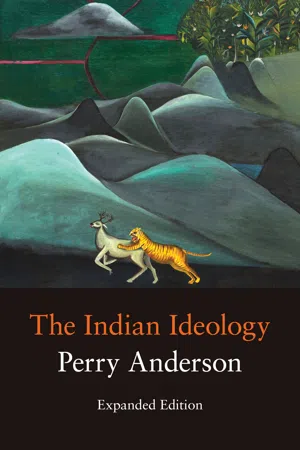
In an iconoclastic intervention, Marxist historian Perry Anderson provides an unforgettable reading of the Subcontinent's passage through Independence and the catastrophe of Partition, the idiosyncratic and corrosive vanities of Gandhi and Nehru, and the close interrelationship of Indian democracy and caste inequality.
The Indian Ideology caused uproar on first publication in 2012, not least for breaking with euphemisms for Delhi's occupation of Kashmir. This new, expanded edition includes the author's reply to his critics, an interview with the late Praful Bidwai of the Indian weekly Outlook, and a postscript on India under the rule of Narendra Modi. Anderson considers whether his regime is as much of a break with the practices and thought processes of Congress rule as is generally supposed.
- 192 pages
- English
- ePUB (mobile friendly)
- Available on iOS & Android
eBook - ePub
The Indian Ideology
About this book
Information
PART I
1
INDEPENDENCE
INDEPENDENCE
‘Astonishing thought: that any culture or civilization should have this continuity for five or six thousand years or more; and not in a static or unchanging sense, for India was changing and progressing all the time’ marvelled the country’s future ruler, a few years before coming to power. There was ‘something unique’ about the antiquity of the subcontinent, and its ‘tremendous impress of oneness’ making its inhabitants ‘throughout these ages distinctively Indian, with the same national heritage and the same set of moral and mental qualities’ he mused. Indeed, a ‘dream of unity has occupied the mind of India since the dawn of civilization’.1
In patriotic reveries of this kind, today’s admirers of Nehru, even some of his critics, are not to be outdone. For Manmohan Singh, his current successor in Delhi, India’s struggle for independence has ‘no parallel in history’, culminating in a constitution that is ‘the boldest statement ever of social democracy’.2 With no obligation to official bombast, scholars fall over themselves in tributes to their native land. For Meghnad Desai, the ‘success story’ of modern India in combining unity with diversity is ‘nothing short of a miracle’. For Ramachandra Guha, the ‘humdrum manifestation of the miracle of India’ crinkles in its very banknotes, with Gandhi on one side and their denomination in seventeen languages on the other, its radiance anticipating ‘by some fifty years, the European attempt to create a multilingual, multireligious, multiethnic, political and economic community’. For its part, Indian democracy – Pratap Bhanu Mehta declares – is ‘a leap of faith for which there was no precedent in human history’. ‘Especially fortunate’ in its millenial traditions of ‘public arguments, with toleration of intellectual heterodoxy’, according to Amartya Sen, ‘independent India became the first country in the non-Western world to choose a resolutely democratic constitution’ – founding an adventure that, in the eyes of Sunil Khilnani, represents ‘the third moment in the great democratic experiment launched at the end of the eighteenth century by the American and French revolutions’, which ‘may well turn out to be the most significant of them all, partly because of its sheer human scale, and partly because of its location, a substantial bridgehead of effervescent liberty on the Asian continent’. This is ‘the most interesting country in the world’, even the lesser of whose aspects are entitled to their garlands: after Independence, its absorption of princely states a ‘stupendous achievement’, its foreign policy ‘a staggering performance’. Nehru himself, ‘in the hearts and minds of his countrymen’ is ‘George Washington, Lincoln, Roosevelt and Eisenhower rolled into one’.3
All countries have fond images of themselves, and big countries, inevitably, have bigger heads than others. Striking in this particular cornucopia of claims, however, is the standing of their authors: names among the most distinguished Indian intellectuals of the age. Nor are any of the works from which these tributes come – respectively, The Rediscovery of India, India after Gandhi, The Burden of Democracy, The Argumentative Indian, The Idea of India, Makers of Modern India – either casual or uncritical about their subject. All are eminently serious studies, required for an understanding of the country. What they indicate, however, is something that they share with the rhetoric of the state itself, from Nehru to Singh, the centrality of four tropes in the official and intellectual imaginary of India. Telegraphically, these can be termed the couplets of: antiquity–continuity; diversity–unity; massivity–democracy; multi-confessionality–secularity. Issuing from an independence struggle perceived as without equal in scale or temper, each has in its way become a touchstone of – in a now consecrated phrase – the ‘idea of India’. Though by no means every mind of note subscribes to the full bill of particulars, they enjoy what in Rawlsian diction might be called an overlapping consensus. What realities do they correspond to?
For the nationalist movement against the rule of the British, it was an article of faith in the Congress Party that, in Gandhi’s words, ‘India was one undivided land made by nature’, in which ‘we were one nation before they came to India’ – ancestrally, indeed, ‘fired with an idea of nationality unknown in other parts of the world. We Indians are one as no two Englishmen are.’4 Nehru’s claim of an ‘impress of oneness’, going back six thousand years, persisted from pre-war writings like The Unity of India to his final dispute with China, in which the Mahabharata could be invoked by his foreign office as proof that the North-East Frontier Agency had been part of Mother India from time immemorial, rather as if the Niebelunglied were to clinch German diplomatic claims to Morocco. Such notions have not gone away. The facts gainsay them. The subcontinent as we know it today never formed a single political or cultural unit in pre-modern times. For much the longest stretches of its history, its lands were divided between a varying assortment of middle-sized kingdoms, of different stripes. Of the three larger empires it witnessed, none covered the territory of Nehru’s Discovery of India. Maurya and Mughal control extended to contemporary Afghanistan, ceased below the Deccan, and never came near Manipur. The area of Gupta control was considerably less. Separated by intervals of five hundred and a thousand years, there was no remembered political or cultural connexion between these orders, or even common religious affiliation: at its height, the first of these Buddhist, the second Hindu, the third Muslim. Beneath a changing mosaic of mostly regional rulers, there was more continuity of social patterns, caste – the best claimant to a cultural demarcation – attested very early, but no uniformity. The ‘idea of India’ was essentially a European, not a local invention, as the name itself makes clear. No such term, or equivalent, as India existed in any indigenous language. A Greek coinage, taken from the Indus river, it was so exogenous to the subcontinent that as late as the sixteenth century, Europeans could define Indians simply as ‘all natives of an unknown country’, and so call the inhabitants of the Americas.5
When the British arrived, it was the sprawling heterogeneity of the area that allowed them to gain such relatively swift and easy control of it, using one local power or population against the next, in a series of alliances and annexations that ended, over a century after Plassey, with the construction of an empire extending further east and south, if not north-west, than any predecessor. ‘India’s segmented society and denationalized governments did not constitute a serious challenge to the British’, one leading native historian has written: ‘Indian troops conquered the country for the British.’6 There is a touch of exaggeration, and anachronism, in the judgement. But it delivers a basic truth. Foreign conquerors were no novelty in the subcontinent, whose northern plains had known successive waves of them from the tenth century onwards. For many, the British were not necessarily more alien than previous rulers. The latest invaders would, of course, always require their own soldiers too. But if the British could gain and keep a firm grip on such a vast land mass, it was because they could count on its multiple fragmentations – ethnic, linguistic, dynastic, social, confessional.
For a century after the seizure of Bengal, sepoys in the command of the East India Company outnumbered whites six to one. The Mutiny of 1857, which came as a severe shock, altered the mixture.7 Thereafter, the policy of the Raj was to hold the ratio at two to one, and make sure that native detachments developed no common identity. Wood, secretary of state for India under Palmerston, made no bones about the objective: ‘I wish to have a different and rival spirit in different regiments, so that Sikh may fire into Hindoo, Goorkha into either, without any scruple in case of need.’8 Or, as the Eden Commission (1879) would subsequently explain: ‘As we cannot do without a large Native army in India, our main object is to make that army safe: and next to the grand-counterpoise of a sufficient European force, comes the counterpoise of Natives against Natives’ – for example ‘that distinctiveness which is so valuable and which, while it lasts, makes the Muhammedan of one country [note the term] despise, fear or dislike the Muhammedan of another’.9 The mutineers in Delhi having sought restoration of Mughal power, Muslims were suspect as recruits thereafter, becoming the exception in an Army based on particularist identities – no all-Muslim units were ever allowed within it. The key groups on whom the British came to rely most were, as Wood indicated, Sikhs and Gurkhas, both relatively small communities, joined later by Pathans and Punjabis. Recruits came from among the least literate groups in the countryside, with a preference for poor peasants attached to a scrap of land.10 No natives could become officers, as they could in French colonial armies, until the aftermath of the Great War.
Comprising a peacetime strength of some 200,000–250,000, the Indian Army was the largest employer in the Raj, and always absorbed a third to a half of its revenue. Regularly deployed overseas, it constituted in Salisbury’s famous words, ‘a British barrack in the Oriental Seas from which we may draw any number of troops without paying for them’. Its services included provision of soldiers for imperial expansion in the Middle East, Africa and South-East Asia, and cannon fodder on a heroic scale in the First World War, when 1.3 million mustered for Asquith and Lloyd George. But its primary function remained domestic intimidation, the maintenance of British rule by threat or exercise of force. Laid out across the country, its cantonments were a permanent reminder of what power was master in the land. In the north-west, along the marches with Afghanistan, border fighting and fantasms of Russian invasion kept large forces in the field. But internal security was always the top priority, requiring the use of British troops in greater numbers than native levies, the reverse of deployment on the frontier; Gurkhas – aliens too – assisting as ‘praetorians of last resort’.11 A large police apparatus, already 150,000 regulars by the 1880s, operated as the forward screen of repression. Down to the end, the Raj remained a garrison state, as its Viceroy pointedly reminded the Cabinet in 1942: ‘India and Burma have no natural association with the Empire, from which they are alien by race, history and religion, and for which as such neither of them have any natural affection, and both are in the Empire as conquered countries which had been brought in by force, kept there by our controls, and which hitherto it has suited to remain under our protection’.12 Attlee, scandalized like any good social-democrat at the utterance of such truths, complained that this was ‘an astonishing statement to be made by a Viceroy’, sounding like ‘an extract from anti-imperialist propaganda speech’.13
Coercion, of course, never sufficed on its own: it always required its complement of collaboration. That came from two principal supports. Two-fifths of the territory of the Raj, and a fifth of its population, were left in the hands of princes, mostly Hindu, under the watchful guidance of British residents: feudatories owing the preservation of their wealth and power to the overlord. In the rest of the subcontinent under direct British rule, landlords – Muslim or Hindu – were beneficiaries of the colonial regime, not a few having originally acquired their properties through its good offices, and all enjoying its protection in their exploitation of tenants and labourers beneath them. These forces were natural subordinates of the Raj. Less so were merchants and manufacturers, who came over time to form the nucleus of an industrial bourgeoisie, harmed rather than helped by an imperial economic system designed to give British exports control of Indian markets. Without tariff protection, many came to have as much resentment as loyalty to the Empire. Yet ambivalence was rooted in the conditions of their growth, since it was British railways, binding the subcontinent together geographically, that extended their potential fields of profitable operations, and British rule of law that assured them stable rights of possession and mechanisms of transaction.
Nor, of course, was the modernizing force of the Raj limited to its locomotives and law books. It was official policy to produce a native elite educated to metropolitan standards, or as Macaulay famously put it, ‘a class of persons, Indian in blood and colour, but English in taste, in opinions, in morals, and in intellect’. The confident prescription overlooked the fact that common among such opinions were liberal verities capable of being inconvenient in the Oriental Sea. Two generations later, a layer of articulate professionals – lawyers, journalists, doctors and the like – had emerged, the seedbed of Congress nationalism. The British had taken over the subcontinent with such relative ease because it was politically and socially so tangled and fractured, but in imposing a common infrastructural, juridical and cultural grid on it, they unified it as an administrative and ideological reality for the first time in its history. The idea of India was theirs. But once it took hold as a bureaucratic norm, subjects could turn it against rulers, and the nimbus of empire dissolve into the charisma of nation.14
The capsizal was gradual. Congress, founded in the 1880s by a group of lawyers whose leading light was an Englishman, remained for some time a pressure group of notables seeking no more than colonial self-government. The first outbreak of more radical nationalist agitation, prompted by Hindu anger at Curzon’s division of the province of Bengal, came two decades later. To check it, the Liberal government elected in 1906 introduced a carefully calibrated representative element into the provincial and central legislative machinery of the Raj, allowing for a minority of members in each to be elected on a complex franchise of some 2 per cent of the population. The aim of the Morley-Minto Reforms of 1909 was prophylactic. As Delhi cabled London: ‘we anticipate that the aristocratic elements in society and the moderate men, for whom at present there is no place in Indian politics, will range themselves on the side of the Government and will oppose any further shifting of the balance of power and any attempt to democratise Indian institutions’.15 Congress, while regretting provision for separate Muslim representation, welcomed the changes as a liberal constitutional reform, and expressed its loyalty to the emperor when George V arrived for the durbar of 1911. Three years later, it gave unstinting support to the Empire in the Great War.
This was the stage onto which Gandhi stepped on his arrival in Bombay in 1914, after twenty-one years in South Africa. Though preceded by his reputation as a fearless spokesman for the Indian community there, he had no experience of political life in the subcontinent, and initially confined himself to study tours and setting up an ashram in Ahmedabad. But by the end of the war, his active support of local struggles by indigo-labourers in Bihar, farmers and textile-workers in Gujarat, bringing tactics he had developed in South Africa to each, had given him a country-wide reputation. Within another two years, he had transformed Indian politics, leading the first mass movement to rock British power since the Mutiny, and remaking Congress as a popular political force. After the upheaval of 1919–21, he twice again launched campaigns, in 1930–31 and 1942–43, in size each bigger than the last, challenging the authority of the Raj in successive landmarks of a struggle for national liberation.
In orchestrating these great movements, Gandhi displayed a rare constellation of abilities in a political leader. Charismatic mobilization of popular feeling was certainly foremost among these. In the countryside, adoring crowds treated him as semi-divine. But, however distinctive and spectacular in his case, this is largely a given in any nationalist movement. What set Gandhi apart was its combination with three other skills. He was a first-class organizer and fund-raiser – diligent, efficient, meticulous – who rebuilt Congress from top to bottom, endowing it with a permanent executive at national level, vernacular units at provincial level, local bases at district level, and delegates proportionate to population, not to speak of an ample treasury. At the same time, though temperamentally in many ways an autocrat, politically he did not care about power in itself, and was an excellent mediator between different figures and groups both within Congress and among its variegated social supports. Finally, though no great orator, he was an exceptionally quick and fluent communicator, as the 100 volumes of his articles, books, letters, cables (far exceeding the output of Marx or Lenin, let alone Mao) testify. To these political gifts were added personal qualities of a ready warmth, impish wit and iron will. It is no surprise that so magnetic a force would attract such passionate admiration, at the time and since.
But Gandhi’s achievements also came at a huge cost to the cause which he served. The twentieth century saw quite a few leaders of national movements who were men of religion – the Grand Mufti and the Abbé Youlou, Archbishop Makarios and Ayatollah Khomeini, among others. For most, their faith was subordinate to their politics, an instrument or adornment of essentially earthly ends. In a few cases, like that of Khomeini, there was no significant distinction between the two – religious and political goals were one, and there could be no conflict between them. Within this gallery, Gandhi hangs apart. For him alone, religion mattered more than politics, which did not coincide with, but subjoined it. There was a further difference. Not only did he hold no religious office, but his religion was to a peculiar extent home-made, unlike any existing belief-system at the time. Quite how strange a pot-pourri this was, will not be found in the industry of glozing commentary that has grown up around his ideas, adjusting them for contemporary usage in much the same way as the Pentateuch becomes a blueprint for universalism and the Quran all but a trailer for feminism. We owe the first scrupulous account of it to Kathryn Tidrick’s Gandhi: A Political and Spiritual Life, which came out five years ago, to a deafening silence, not only in India – that was perhaps to be expected, if not quite the performance of its best periodical, the Economic and Political Weekly, whose scant evasive...
Table of contents
- Cover Page
- Halftitle Page
- Title Page
- Copyright Page
- Contents
- Foreword
- Part I
- Part II
- Notes
- Index of Names
- Index of Authorities
Trusted by 375,005 students
Access to over 1.5 million titles for a fair monthly price.
Study more efficiently using our study tools.
Frequently asked questions
Yes, you can cancel anytime from the Subscription tab in your account settings on the Perlego website. Your subscription will stay active until the end of your current billing period. Learn how to cancel your subscription
No, books cannot be downloaded as external files, such as PDFs, for use outside of Perlego. However, you can download books within the Perlego app for offline reading on mobile or tablet. Learn how to download books offline
We are an online textbook subscription service, where you can get access to an entire online library for less than the price of a single book per month. With over 1.5 million books across 990+ topics, we’ve got you covered! Learn about our mission
Look out for the read-aloud symbol on your next book to see if you can listen to it. The read-aloud tool reads text aloud for you, highlighting the text as it is being read. You can pause it, speed it up and slow it down. Learn more about Read Aloud
Yes! You can use the Perlego app on both iOS and Android devices to read anytime, anywhere — even offline. Perfect for commutes or when you’re on the go.
Please note we cannot support devices running on iOS 13 and Android 7 or earlier. Learn more about using the app
Please note we cannot support devices running on iOS 13 and Android 7 or earlier. Learn more about using the app
Yes, you can access The Indian Ideology by Perry Anderson in PDF and/or ePUB format, as well as other popular books in History & Indian & South Asian History. We have over 1.5 million books available in our catalogue for you to explore.