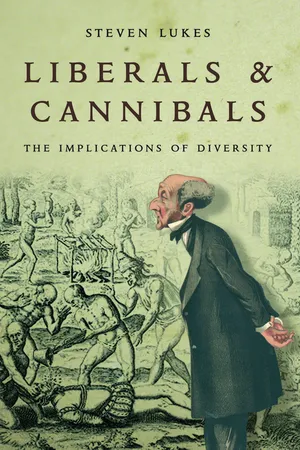
Can the tension between relativism and the moral universalism current in contemporary politics be resolved within the framework of liberalism? How is liberal society to interpret the diversity of morals? Is pluralism the appropriate response? How does pluralism differ from the widely condemned ethnocentric relativism-"liberalism for the Liberals, cannibalism for the cannibals"?
Confronting liberal thought with its own limitations, Steven Lukes' work is more relevant than ever. While recognizing the dangers of moral imperialism, Lukes argues that a relativist position based on identifying clearly distinct cultural and moral communities is incoherent. Drawing on work in anthropology and philosophy, he examines the nature of social justice, the politics of identity and human rights theory.
- 192 pages
- English
- ePUB (mobile friendly)
- Available on iOS & Android
eBook - ePub
About this book
Trusted by 375,005 students
Access to over 1.5 million titles for a fair monthly price.
Study more efficiently using our study tools.
Information
Topic
PhilosophySubtopic
Political Philosophy1
Moral Diversity and Relativism
How should we react to the diversity of morals? What theoretical and practical conclusions should we draw from the ever more visible contrasts between ways of life – between different practices and customs, between divergent perspectives on life and judgements about what makes it valuable, between divergent ways of responding to common problems that generate countless misunderstandings and conflicts that can end in wars?
This question has not always seemed puzzling. As I shall suggest below, the perception of moral diversity goes back at least to Antiquity, whereas the question of how to respond to it is rather modern. John Locke, for example, observed that ‘there is scarce that Principle of Morality to be named, or Rule of Virtue to be thought on (those only excepted, that are absolutely necessary to hold Society together, which commonly too are neglected betwixt distinct Societies) which is not, somewhere or other, slighted and condemned by the general Fashion of whole societies of Men’.1 Yet Locke did not in consequence doubt that moral principles dictating right action and good government were discoverable, requiring ‘Reasoning and Discourse, and some Exercise of the Mind, to discover the Certainty of their Truth.’2 And when Pascal observed that ‘what is truth on one side of the Pyrenees is error on the other’,3 he did not for one moment suppose that this observation required him to put in question the truths delivered by Christianity. ‘Mahomet does not prophesy; Jesus prophesies,’ he wrote: ‘No religion other than ours has taught that man is born in sin, no sect of philosophers has said it: none has therefore spoken the truth.’4
Religious faith is, indeed, one obvious basis on which the answer to the question I have asked will not seem puzzling or difficult but obvious. Another is that kind of Enlightenment rationalism, of when Locke was a forerunner, according to which the principles of morality can be discerned by the light of Reason, once Humanity has emerged from the darkness of dogma and removed the shadows of superstition. But in our time, when both religious and rationalist certainties are put in doubt, the very fact of moral diversity – both across the world and within our increasingly ‘pluralistic’ societies – becomes disturbing. Can moral judgements be made across cultural boundaries? Do moral principles apply across divergent ways of life? Do ‘our’ principles apply to ‘them’? Must moral criticism always be internal to a way of life? Is the very idea of a universal morality a pre-postmodern illusion?
Let me begin this inquiry by quoting a well-known passage from Herodotus, which is a favourite reference point in discussions of this set of issues. According to Herodotus, Darius, King of the Persians, took a wisely tolerant view of his subject peoples:
When Darius was King of Persia, he summoned the Greeks who happened to be present at his court, and asked them what they would take to eat the dead bodies of their fathers. They replied that they would not do it for any money in the world. Later, in the presence of the Greeks and through an interpreter (so that they could understand what was said) he asked some Indians, of the tribe called Callatiae, who do in fact eat their parents’ dead bodies, what they would take to burn them. They uttered a cry of horror and forbade him to mention such a dreadful thing. One can see by this what custom can do, and Pindar, in my opinion, was right when he called it ‘king of all’.5
Several morals may be drawn from this familiar story. One I have already indicated: the fact of moral diversity is a very old story. Yet it does now appear differently – and in contradictory ways. On the one hand, it is ever more perceptible and indeed omnipresent. Mass travel and modern mass communications make us all aware, on a daily basis, of the manifold differences between cultures across the world, and of clashes between them – through television documentaries, plays and films and the mere reporting of the news. Mass immigration, trade and professional mobility across frontiers have made our societies ever more heterogeneous and polyglot – Babels of languages, cuisines and customs. Yet we often see these developments through lenses that are themselves shaped by social and political processes. The differences are very often seen as lying between nationally or ethnically or racially defined communities, with the accompanying implication that their cultures are ‘wholes’, coherent internally and distinct from one another. Many parties have collaborated in shaping this perception: imperialist powers, the politicians and officials of host countries, nationalist movements, populist leaders and intellectuals and, it must be added, social anthropologists in need of unified and uncontaminated objects of study. The idea that cultures are wholes, rather than clusters or assemblages of heterogeneous elements with varying origins is a systematic exercise in the reduction of complexity based on mythical thinking. Of course, cultures do differ but, as Mary Midgley has very well put it, ‘they differ in a way which is much more like that of climactic regions or ecosystems than it is like the frontiers drawn with a pen between nation states.’6
The second moral to be drawn from Herodotus’s story is that the various parties involved – the Greeks, the interpreter, the Callatiae, Darius, Herodotus and the reader – all have access to the differences in custom that the story is about. Everyone can understand, from their own point of view, that these are different ways of honouring the dead. The Greeks and the Callatiae regard their respective ways of doing this as sacred and the other’s way as shocking. Darius, apparently, takes a lofty, detached, sophisticated view of the clash between their views. Yet, as Midgley points out, this is only an appearance, for the Persians ‘knew very well that they had solved the problem of disposal in the only right way, namely by putting corpses on high towers and letting the vultures eat them’.7 The reader’s view is likely to be similarly tied to conscious or unacknowledged assumptions about how the dead should be honoured – or, at least, to assumptions that are prevalent in his or her society, even if such a reader does not share them. Herodotus, we may assume, took the Greek view of the matter. About the interpreter, sadly, we know nothing.
Third, I believe that this shows that all the parties mentioned above are, in different ways, ethnocentric. Everyone is making sense of the practices in question from their own local point of view. The Greeks and the Callatiae are, it seems, doing so unreflectively. They each simply assume that theirs is the only right way and that the others are deeply and shockingly wrong in what they do. Darius, tolerating these eccentric customs like all wise imperialists, understands them as wrong-headed ways of doing what the Persians know how to do properly. The modern reader will understand the eating or burning of one’s parents’ dead bodies as bizarre and exotic analogues of modern burial practices. If the reader is an anthropologist, he or she is likely to bring them under the category of ‘ritual’ and render them intelligible by comparing them with other funeral rites. In all these cases, the familiar is our point of access to the unfamiliar: eating or burning is ‘their’ way of paying respect to the dead.
The fourth moral is that making sense of these practices is making rational sense of them: that is to say, understanding them as being performed for reasons. Herodotus, following Pindar, says that custom is king of all. It is not entirely clear exactly what he meant. Montaigne said a similar thing in his famous essay ‘On Custom’. He wrote that the effect of custom was
to seize and grip us so firmly, that we are scarce able to escape from its grasp, and to regain possession of ourselves sufficiently to discuss and reason out its commands. In truth, since we imbibe them with our mother’s milk, and the world shows the same face to our infant eyes, we seem to be born to follow this same path; and the common ideas that we find around us, and infused into our souls with the seed of our fathers, appear to be general and natural. Whence it comes that what is off the hinges of custom we believe to be off the hinges of reason: God knows how unreasonably for the most part.8
Jon Elster has recently given a similar account of apparently irrational customs or social norms as ‘to a large extent blind and compulsive, mechanical and even unconscious’.9 If Herodotus meant something like this, then he was wrong, just as Montaigne and Elster are.10 Of course people often follow customs (norms) blindly, even compulsively and without reasoning about what they do. But the fact that they don’t reason does not mean that they don’t have reasons. Perhaps, after all, Herodotus’s metaphor of custom as king is apposite. When we obey it, custom, like the king, has authority over us: that is, we comply because the norm requires us to do so and we assume there is good reason to do so but do not judge or question it.
Making sense of these ritual practices of the Greeks and the Callatiae is to understand why they do what they do. That must involve grasping their beliefs – about the meaning of death, the powers of ancestors, the powers of the dead over the living and many other cognate matters. Indeed really to understand what is going on will require a pretty comprehensive understanding of their world views or cosmologies. The moral I seek to draw here is that understanding what they do involves judging what reasons they have for doing what they do – that is to say, judging it to be rational. But there are various possibilities here. We may judge their actions to be rational, given what they believe. Or we may judge their actions, given what they believe, to be rational in the light of their purposes or interests or needs which they would acknowledge were they to reflect on these. Or we may interpret or ‘decode’ their beliefs in such a way as to show them to have good reasons from our perspective: an example of this approach is Robin Horton’s interpretation of traditional African medicine, invoking spiritual agencies, as being a sort of protoscientific explanation appealing to intervening variables.11 Or we may judge their actions, given what they believe to be rational in the light of some objective standard, such as, say, the requirements of hygiene.
But – and this is the fifth moral – moral matters are not like matters of hygiene. There is no objective point of view or ‘view from nowhere’ such that all reasonable persons (from all cultural backgrounds) can be brought to agree on, say, how the dead should be honoured or, indeed, whether they should be honoured at all, or on the importance of respecting ancestors or on what are fit objects of reverence and admiration or indignation and outrage. In this sense, the right way to honour one’s dead parents is relative to culture and context.
I now want to address the question asked at the beginning more generally by suggesting that there are three kinds of answer to it – the ethnocentric, the rationalist and the relativist. My view is that there is, in principle, a reasonable and convincing version of each and that these may be combined into a single plausible answer to the question we are discussing. I shall not address a fourth possible answer – that which appeals to religious faith – partly because I have nothing useful to say about it, and partly because I believe that it in part overlaps with the first answer.
The ethnocentric reaction to moral diversity can take several forms. The Greeks and the Callatiae in Herodotus’s story stand for the straightforward, simple, unreflective variety: our beliefs and practices are sacred; the rest of the world is either damned or to be saved. In the modern world religious sects are inclined to this embattled view. I suppose it is also characteristic of what is called ‘fundamentalism’. Darius perhaps stands for the imperialist variety: keep the barbarians in their places.
There are many other, more reflective variants. The history of social anthropology, for example, is replete with arguments about how to construe the divide between modern, Western societies and non-modern, non-Western ones, or indeed about whether there is such a divide. In these discussions it is standard practice to label as ethnocentric those writers who assume modern, Western superiority in one or another sphere – cognitive, technical, moral and so on. The evolutionist and intellectualist anthropologists of the nineteenth century assumed that the ‘savages’ or, later, ‘primitive’ societies failed by ‘our’ standards: their magic was failed or proto-science, their religions were nature or animistic myths or a kind of proto-sociology, as Durkheim thought. But there has been another, closely related debate, among anthropologists and elsewhere, that has its origins in the eighteenth century. Do the differences between the moralities or ‘mœurs’ of different societies or cultures go deep or do they simply mark superficial differences that mask an unchanging set of human capacities and dispositions? Was Hume right in thinking that ‘mankind is much the same in all times and places’? This remains a deep question: how and where to identify ‘human nature’ across the diversity of cultures. Rousseau pinpointed this problem most acutely when he observed that
for all the three or four hundred years that the inhabitants of Europe have inundated other parts of the world and ceaselessly published new accounts of voyages and relations, I am persuaded that when we learn about men we are learning about Europeans.12
The task, he thought, was to ‘cast away the yoke of national prejudices, learn to understand men by their conformities and their differences and learn to acquire universal knowledge that is not that of one century or one country exclusively’. To study men, one must ‘look close by’; to study man one must ‘learn to adopt the view from afar: one must first observe the differences in order to discover (his) properties’.13
The ‘yoke of national prejudices’ is a good description of ethnocentrism and in matters of morality it must, of course, be cast away, so far as is possible, when we are seeking to understand and to live with those who live by other moralities than our own. Yet there is, I think, a sense in which ethnocentricity is inescapable, to which I have already alluded in discussing Herodotus’s story. We can, in the end, only understand the unfamiliar by analogy with the familiar. The important thing is to extend the range of the latter and to discipline the processes of understanding by the use of rigorous and relevant comparative methods.
The ‘rationalist’ reaction to moral diversity is essentially the idea that it is possible through ratiocination, through reasoning and discourse and some exercise of the mind, to arrive at firm conclusions about the right and the good that will be universally valid, applicable to all mankind and acceptable to all reasonable persons after due reflection. It is an old dream which has, many argue, led in practice to many real nightmares. In modern times it is instantiated in both the Kantian and the Utilitarian traditions of moral theory. In its strong and pure version, just stated, it is hard to accept today.
The rationalist reaction need not necessarily be ethnocentric, though it very often is. It is entirely possible to hold that rational principles of moral and political life have been most closely incarnated in some past or remote present society or in some imagined future. In the eighteenth and nineteenth centuries it tended to take an evolutionist form, as in the thought of Condorcet or Saint-Simon and Comte, Bentham and Mill. It is hard to believe any longer in such theories of moral progress, even if they incorporate some notion of the ‘cunning of reason’ that takes regressive bypasses that lead nevertheless in the end to the perfect social and moral order.
Rationalism in the present age must needs be sceptical. It is, to say the least, no longer fashionable to proclaim with Condorcet that one seeks ‘a form of government that is good by its very nature, founded on principles that are sure, absolute, universal, independent of times and places’.14 Foundationalism, absolutes and claims to moral universality have become suspect in virtually all departments of contemporary culture.
Nevertheless, it is neither easy nor wise to allow justified suspicions to lead one into moral nihilism. It is not easy once one reflects that moral thinking is, in large part, moral reasoning, and reasoning involves invoking and giving reasons. Reasons are available to all who can reason and cannot be completely internal to a particular way of life or culture. In any case, as suggested above, cultures are not seamless wholes and incorporate within them practices of criticism and reasoning. And morality is itself a way of reasoning through which customs are maintained, developed and sometimes rejected or abandoned. It is not wise, since to abandon the idea that moral reasoning can lead to conclusions that can convince the reasonable is to abandon the very practice of moral criticism which is an inherent feature of our own moral tradition: it is thus to cease to take our own morality seriously. What survives of the rationalist response is, I believe, the project of responding to moral diversity (which John Rawls calls the ‘fact of pluralism’) by moral and political argument that takes as little for granted as is possible and that does not assume the value of any particular way of life or the justice of any particular set of social and political arrangements.
The standard contemporary objection to such a response underlies the third kind of reaction to moral diversity I wish to mention: the relativist reaction. This is the view that moral principles and judgements are only valid internally within particular cultures. Once again, there are different versions. There is the doctrine favoured by the school of thought called ‘cultural relativi...
Table of contents
- Cover Page
- Halftitle Page
- Title Page
- Copyright Page
- Dedication
- Contents
- Preface
- 1. Moral Diversity and Relativism
- 2. Is Universalism Ethnocentric?
- 3. Liberalism for the Liberals; Cannibalism for the Cannibals
- 4. Different Cultures, Different Rationalities?
- 5. On Comparing the Incomparable: Trade-offs and Sacrifices
- 6. The Singular and the Plural
- 7. Must Pluralists Be Relativists?
- 8. An Unfashionable Fox
- 9. Social Justice: The Hayekian Challenge
- 10. Humiliation and the Politics of Identity
- 11. The Communitarian Voice
- 12. Five Fables about Human Rights
- 13. The Last Word on the Third Way
- Notes
- Index
Frequently asked questions
Yes, you can cancel anytime from the Subscription tab in your account settings on the Perlego website. Your subscription will stay active until the end of your current billing period. Learn how to cancel your subscription
No, books cannot be downloaded as external files, such as PDFs, for use outside of Perlego. However, you can download books within the Perlego app for offline reading on mobile or tablet. Learn how to download books offline
We are an online textbook subscription service, where you can get access to an entire online library for less than the price of a single book per month. With over 1.5 million books across 990+ topics, we’ve got you covered! Learn about our mission
Look out for the read-aloud symbol on your next book to see if you can listen to it. The read-aloud tool reads text aloud for you, highlighting the text as it is being read. You can pause it, speed it up and slow it down. Learn more about Read Aloud
Yes! You can use the Perlego app on both iOS and Android devices to read anytime, anywhere — even offline. Perfect for commutes or when you’re on the go.
Please note we cannot support devices running on iOS 13 and Android 7 or earlier. Learn more about using the app
Please note we cannot support devices running on iOS 13 and Android 7 or earlier. Learn more about using the app
Yes, you can access Liberals and Cannibals by Steven Lukes in PDF and/or ePUB format, as well as other popular books in Philosophy & Political Philosophy. We have over 1.5 million books available in our catalogue for you to explore.