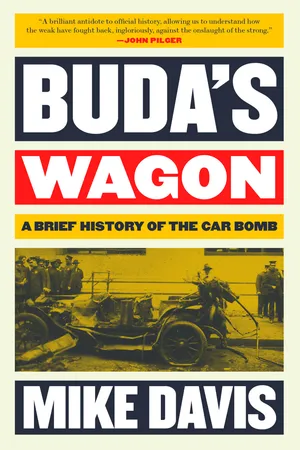
On a September day in 1920, an angry Italian anarchist named Mario Buda exploded a horse-drawn wagon filled with dynamite and iron scrap near New York's Wall Street, killing 40 people. Since Buda's prototype the car bomb has evolved into a "poor man's air force," a generic weapon of mass destruction that now craters cities from Bombay to Oklahoma City.
In this provocative history, Mike Davis traces the its worldwide use and development, in the process exposing the role of state intelligence agencies-particularly those of the United States, Israel, India, and Pakistan-in globalizing urban terrorist techniques. Davis argues that it is the incessant impact of car bombs, rather than the more apocalyptic threats of nuclear or bio-terrorism, that is changing cities and urban lifestyles, as privileged centers of power increasingly surround themselves with "rings of steel" against a weapon that nevertheless seems impossible to defeat.
- 240 pages
- English
- ePUB (mobile friendly)
- Available on iOS & Android
eBook - ePub
About this book
Information
1
Wall Street 1920
You have shown no pity to us! We will do likewise. We will dynamite you!Anarchist warning (1919)1
On a warm September day in 1920, a few months after the arrest of his comrades Nicola Sacco and Bartolomeo Vanzetti (“the best friends I have in America’’), a vengeful Italian immigrant anarchist named Mario Buda parked his horse-drawn wagon near the corner of Wall and Broad streets, next to the new federal Assay Office and directly across from J.P. Morgan and Company. The Morgan partners, including the great Thomas Lamont and Dwight Morrow (Charles Lindbergh’s future father-in-law), were discussing weighty financial matters in a lower-floor conference room. Perhaps Buda tipped his cap in the direction of the unsuspecting robber barons before he nonchalantly climbed down and disappeared unnoticed into the lunchtime crowd. A few blocks away, a startled letter-carrier found strange, crudely printed leaflets warning: “Free the Political Prisoners or it Will Be Sure Death for All of You!’’ They were signed: “American Anarchist Fighters.’’
Buda, aka “Mike Boda,’’ was a veteran supporter of Luigi Galleani, anarchist theorist and editor of Cronaca Sovversiva (“Subversive Chronicle’’) which the Department of Justice in 1918 had condemned as “the most dangerous newspaper in this country.’’ The Galleanisti (probably never more than 50 or 60 hardcore activists) were chief suspects in various dynamite plots, including the notorious Preparedness Day bombing in San Francisco in 1916 (for which union organizers Tom Mooney and Warren Billings were framed) and the letter bombs sent to prominent members of the Wilson administration as well as J.P. Morgan and John D. Rockefeller in June 1919. The Cronaca Sovversiva reading circles that met in the shadows of Paterson silk factories and Youngstown steel mills – not unlike certain contemporary Quran study groups in gritty neighborhoods of Brooklyn and south London – were lightning rods for immigrant alienation; an alienation that grew into rage in the face of wartime anti-foreign hysteria, which resulted in the so-called Palmer Raids in 1919 against radicals of all denominations. When Attorney General A. Mitchell Palmer signed Galleani’s deportation order in February 1919, anonymous flyers appeared in New England factories promising to “annihilate” the deporters “in blood and fire.’’
As Buda, who had appointed himself the avenging angel of the imprisoned and deported anarchists, made his escape from Wall Street, the bells of nearby Trinity Church began to toll noon. Before they had stopped, the wagon packed with high explosive (probably blasting gelatin stolen from a tunnel construction site) and iron slugs erupted in a huge ball of fire, leaving a large crater in Wall Street. Windows exploded in the faces of office workers, pedestrians were mowed down by metal shrapnel or scythed by shards of glass, building awnings and parked cars caught fire, and a suffocating cloud of smoke and debris enshrouded Wall Street. Skyscrapers quickly emptied. Panicked crowds fled past crumpled bodies on the sidewalks, some of them writhing in agony. On the treeless street, green leaves bearing presidents’ portraits – some of the estimated $80,000 in cash abandoned by terrified or wounded bank messengers – fluttered with each choking gust of wind and ash. No one knew whether more explosions would follow, and frightened authorities suspended trading at the Stock Exchange for the first time in history.
An attack on Wall Street, of course, was immediately construed as a national emergency. One hundred regular soldiers, rifles loaded and bayonets fixed, were sent quickly from Governor’s Island to guard the badly damaged Assay Office and adjacent Subtreasury, while America’s chief sleuth, William Flynn, the head of the (federal) Bureau of Investigation, was dispatched from Washington on the first available train. Over the next few days, the NYPD’s Detective Bureau assembled the grotesque remains of an “infernal machine’’: a horse’s head, some severed hoofs, and the twisted metal of a wagon axle. Anarchists, the IWW, and the new-fangled Bolsheviki all automatically became suspect and the New York Times soon screamed “Red Plot Seen in Blast.’’ While police and federal investigators focused on ‘celebrity’ Reds such as labor-organizer Carlo Tresca, Buda quietly made his way home to Italy. (It is unknown whether other Galleanisti participated in the organization of the bombing or whether Buda was an astonishing one-man show.)
Meanwhile, the coroner was counting 40 dead (some mangled beyond recognition), with more than 200 injured including Equitable Trust’s president Alvin Krech and J. P. Morgan Jr’s son Junius. Joseph P. Kennedy, walking in the street, was badly shaken but unharmed. Buda was undoubtedly disappointed when he learned that “Jack” Morgan himself was away in Scotland at his hunting lodge, and that his partners Lamont and Morrow were unscathed. Nonetheless, a poor immigrant with some stolen dynamite, a pile of scrap metal, and an old horse had managed to bring unprecedented terror to the inner sanctum of American capitalism.
2
Poor Man’s Air Force
A complex weapon makes the strong stronger, while a simple weapon – so as long as there is no answer to it – gives claws to the weak.George Orwell1
Buda’s Wall Street bomb (perhaps inspired by the infamous horse-cart device that almost killed Napoleon in the Rue Saint Nicaise in Paris in 1800)2 was the culmination of a half-century of anarchist fantasies about blowing up kings and plutocrats. But it was also an invention, like Charles Babbage’s Difference Engine, far ahead of the imagination of its time. The truly radical potential of the “infernal machine’’ would be fully realized only after the barbarism of strategic bombing had become commonplace, and after air forces routinely pursued insurgents into the labyrinths of poor cities. Buda’s wagon, in essence, was the prototype car bomb: the first modern use of an inconspicuous vehicle, anonymous in almost any urban setting, to transport large quantities of high explosive into precise range of a high-value target.
Despite some improvisations (mostly failed) in the 1920s and 1930s, the car bomb was not fully conceptualized as a weapon of urban warfare until January 12, 1947, when rightwing Zionist guerrillas, the Stern Gang, drove a truckload of explosives into a British police station in Haifa, Palestine, killing 4 and injuring 140. The Stern Gang, soon joined by the paramilitaries of the Irgun from whom they had split back in 1940, would subsequently use truck and car bombs to kill Palestinians as well: a creative atrocity that was immediately reciprocated by British deserters fighting on the Arab side. (Fifty years later, jihadis training in Al Qaeda camps in Afghanistan would study Menachem Begin’s Revolt, a memoir of the Irgun, as a classic handbook of successful terrorism.)3
Vehicle bombs thereafter were employed sporadically: producing notable massacres in Saigon (1952), Algiers and Oran (1962), Palermo (1963), and again in Saigon (1964–66). But the gates of hell were not truly opened until four undergraduates, protesting campus collaboration with the Vietnam War, exploded the first ammonium nitrate-fuel oil (ANFO) car bomb in front of the University of Wisconsin’s Army Mathematics Research Center in August 1970. Two years later (“Bloody Friday,” July 21, 1972) the Provisional IRA devastated the business center of Belfast with a series of such devices. These new-generation bombs, requiring only ordinary industrial ingredients and synthetic fertilizer, were cheap to fabricate and astonishingly powerful: they elevated urban terrorism from the artisan to the industrial level and made possible sustained blitzes against entire city centers as well as causing the complete destruction of ferro-concrete skyscrapers and residential blocks.
The car bomb, in other words, suddenly became a semi-strategic weapon that under certain circumstances was comparable to airpower in its ability to knock out critical urban nodes and headquarters as well as terrorize populations of entire cities. Indeed, the suicide truck bombs that devastated the US embassy and Marine barracks in Beirut in 1983 prevailed over the combined firepower of the fighter-bombers and battleships of the US Sixth Fleet and forced the Reagan administration to undertake a humiliating retreat from Lebanon. Other suicide car-bombings played a crucial role in dislodging the supposedly all-powerful Israeli Defense Forces from the Shiite-majority region of southern Lebanon.
Hezbollah’s ruthless and brilliant use of car bombs in Lebanon in the 1980s to counter the advanced military technology of the United States and Israel soon emboldened a dozen other groups to bring their insurgencies and jihads home to the metropolis. Many of the new-generation car bombers were graduates of the sabotage and explosives courses set up by the CIA and Pakistani Inter-Services Intelligence (ISI), with Saudi financing, in the mid-1980s to train mujahedin to terrorize the Russians then occupying Kabul. Others learned their skills at training camps sponsored by other governments (India and Iran, especially), or simply cribbed the requisite formulas from explosives manuals in widespread circulation in the United States.
The result has been the irreversible globalization of car-bombing know-how. Like an implacable virus, once vehicle bombs have entered the DNA of a host society and its contradictions, their use tends to reproduce indefinitely. Between 1992 and 1999, 25 major vehicle bomb attacks in 22 different cities killed 1337 people and wounded nearly 12,000. More importantly from a geopolitical standpoint, the Provisional IRA and a Brooklyn cell of the Egyptian Islamist group, al-Gama’a al-Islamiyya, inflicted billions of dollars of damage on the two leading control-centers of the world economy – the City of London (1992, 1993, and 1996) and lower Manhattan (1993), respectively – and forced a reorganization of the global reinsurance industry.4
In the new millennium, almost 90 years after that first massacre on Wall Street, car bombs have become as generically global as i-Pods and HIV/AIDS, cratering the streets of cities from Bogotá to Mumbai and frightening tourists away from many of the world’s most famous islands and resorts. Car bombers are currently or recently active in at least 23 countries, while another 35 nations have suffered at least one fatal car-bombing during the last quarter-century.5 In sheer number, the historical total of all car-bombings in Western Europe is probably neck and neck with that of the Middle East, followed at some distance by South Asia, then South America, North Africa, sub-Saharan Africa, and North America. (East Asia, uniquely, has been so far immune to exploding Toyotas and booby-trapped Datsuns.) Suicide truck bombs, once the exclusive signature of Hezbollah, now have been franchised to Sri Lanka, Chechnya/Russia, Saudi Arabia, Turkey, Egypt, Kuwait, Palestine, Indonesia, and Afghanistan. On any graph of urban terrorism, the curve representing car bombs is rising steeply, almost exponentially.
US-occupied Iraq, of course, has become the global epicenter: a savage inferno with more than 9000 casualties – mainly civilian – attributed to vehicle bombs in the two-year period between July 2003 and June 2005. Since then, the frequency of car-bomb attacks has dramatically increased: there were 140 per month in fall 2005 and 13 in Baghdad on New Year’s Day 2006 alone. 6 If roadside mines remain the most effective device against American armored vehicles, car bombs are the weapon of choice for slaughtering Shiite civilians in front of mosques and markets and thus instigating an endless cycle of sectarian warfare. Although the car-bomb factories of Baghdad and Fallujah will undoubtedly sustain their record outputs for some time to come, the most rapid increase in the incidence of car-bombings has occurred in Afghanistan since early 2006. In country where the mujahedin formerly eschewed such suicide tactics, kamikaze car-bomb attacks on NATO convoys or police loyal to the regime of President Hamid Karzai are now almost daily events.
Under siege from weapons indistinguishable from ordinary traffic, the core apparatuses of administration and finance are retreating inside “rings of steel” and “Green Zones,” but the larger challenge of the car bomb remains patently intractable. Stolen nukes, sarin gas, and anthrax may be the sum of our fears, just as malevolent “net-wars” and “swarming” are the abstract icons of postmodern strategic theory,7 but vehicle bombs are the brutal hardware and quotidian workhorses of urban terrorism. It is the car bombers’ incessant blasting-away at t...
Table of contents
- Cover Page
- Title Page
- Copyright Page
- Dedication
- Contents
- List of Illustrations
- 1. Wall Street 1920
- 2. Poor Man’s Air Force
- 3. Preliminary Detonations
- 4. Oranges for Jaffa
- 5. Our Man in Saigon
- 6. Festivals de Plastique
- 7. Demon Seeds
- 8. Welcome to Bombsville
- 9. “The Black Stuff’
- 10. Laughing at the Dead
- 11. Hell’s Kitchen
- 12. The Beirut Hilton
- 13. Car-Bomb University
- 14. The Suicide Tigers
- 15. Soft Targets
- 16. Los Coches Bomba
- 17. Cities under Siege
- 18. Form Follows Fear
- 19. Killing Bush, Bombing Oklahoma
- 20. Planet Jihad
- 21. The King of Iraq
- 22. The Gates of Hell
- Notes
- Index
Trusted by 375,005 students
Access to over 1.5 million titles for a fair monthly price.
Study more efficiently using our study tools.
Frequently asked questions
Yes, you can cancel anytime from the Subscription tab in your account settings on the Perlego website. Your subscription will stay active until the end of your current billing period. Learn how to cancel your subscription
No, books cannot be downloaded as external files, such as PDFs, for use outside of Perlego. However, you can download books within the Perlego app for offline reading on mobile or tablet. Learn how to download books offline
Perlego offers two plans: Essential and Complete
- Essential is ideal for learners and professionals who enjoy exploring a wide range of subjects. Access the Essential Library with 800,000+ trusted titles and best-sellers across business, personal growth, and the humanities. Includes unlimited reading time and Standard Read Aloud voice.
- Complete: Perfect for advanced learners and researchers needing full, unrestricted access. Unlock 1.5M+ books across hundreds of subjects, including academic and specialized titles. The Complete Plan also includes advanced features like Premium Read Aloud and Research Assistant.
We are an online textbook subscription service, where you can get access to an entire online library for less than the price of a single book per month. With over 1.5 million books across 990+ topics, we’ve got you covered! Learn about our mission
Look out for the read-aloud symbol on your next book to see if you can listen to it. The read-aloud tool reads text aloud for you, highlighting the text as it is being read. You can pause it, speed it up and slow it down. Learn more about Read Aloud
Yes! You can use the Perlego app on both iOS and Android devices to read anytime, anywhere — even offline. Perfect for commutes or when you’re on the go.
Please note we cannot support devices running on iOS 13 and Android 7 or earlier. Learn more about using the app
Please note we cannot support devices running on iOS 13 and Android 7 or earlier. Learn more about using the app
Yes, you can access Buda's Wagon by Mike Davis in PDF and/or ePUB format, as well as other popular books in Politics & International Relations & Geopolitics. We have over 1.5 million books available in our catalogue for you to explore.