eBook - ePub
The Letters of Rosa Luxemburg
- 656 pages
- English
- ePUB (mobile friendly)
- Available on iOS & Android
eBook - ePub
The Letters of Rosa Luxemburg
About this book
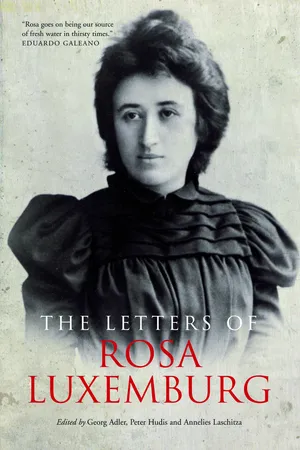
The most comprehensive collection of letters by Rosa Luxemburg ever published in English, this book includes 190 letters written to leading figures in the European and international labor and socialist movements-Leo Jogiches, Karl Kautsky, Clara Zetkin and Karl Liebknecht-who were among her closest friends, lovers and colleagues. Many of these letters appear for the first time in English translation; all help to illuminate the inner life of this iconic revolutionary, who was at once an economic and social theorist, a political activist and a lyrical stylist. Her political concerns are revealed alongside her personal struggles within a socialist movement that was often hostile to independently minded women. This collection will provide readers with a newer and deeper appreciation of Luxemburg as a writer and historical figure.
Information
Topic
HistoireSubtopic
Biographies de sciences socialesTO NADINA1 AND BORIS KRICHEVSKY2
Geneva, July 17, 1891
Hello, my dears!
Recently I would have liked very much to go [on foot to] visit my dear friends (I see the way you’re smiling wickedly at how small I am, I see it [i.e., too small for such a walk]). But since walking from Geneva to Zurich is rather hard (especially on the purse) one must content oneself with a handshake in writing, which, however, is meant no less sincerely from the heart. —I hope that you are both in good health and that all your affairs are in good order. By the way I have heard some stories about events in Zurich, but people say they have a bad smell to them, and I have no desire whatever to learn the particulars. And you know, it makes an unpleasant and peculiar impression on a person who is at a distance when an entire mass of serious and intelligent people keep themselves busy for weeks on end to the point of obsession with someone else’s dirty linen, don’t you agree? At any rate that’s the impression made on me by the letters of my friends, who apparently have forgotten everything else in the world except this craziness, and at the same time you yourself write that it is an entirely personal matter.
I will not write to you about Geneva in general. You know the place yourself. It pleases me (1) as a beautiful city with a European look to it, and (2) by the absence of anything in the nature of Oberstrass.3 On the whole, things are going very well for me here—I’m working hard and making the acquaintance of interesting people. Only on Sundays do my “thoughts filled with longing” turn to Oberstrass and toward evening I “accompany” all of you, my dears, to the Axelrods—for kefir and herring. —Seriously, sometimes I would very much like to see my Oberstrass again, but in general I am quite content to be living here alone and am not complaining. Actually, I have now completely grown up, my dears, and am proud of that.
I was in Mornex,4 but I won’t go there again, although I’d like to see them. I won’t go there again because Plekhanov is too highly developed for me, or more exactly, is too highly educated. What can a conversation with me offer him? He knows everything better than I do, and such original, “spontaneous” ideas, you know, I can’t come up with them, and to tell you the truth I don’t even consider them of very great value. At the Axelrods I observed Plekhanov from the corner, [and] simply to watch the way he talks, how he moves, and to observe his face—that was extraordinarily pleasant for me. But to go to Mornex, and to sit in the corner and admire him, that just won’t do. —Vera [Zasulich] can’t talk at all, but she’s a splendid person.
Of the people here, I am in closest contact with a splendid young Bulgarian and with Sarchi; also, I have two or three Polish women friends here from Warsaw, and besides that, Romanowski, who was in Zurich briefly for a few days.
Yes, I did like Plekhanov’s wife very, very much—her outward appearance, the way she walked, her voice. But I didn’t get to know her any better—I was only there twice and now I [do not] want to go back there. In addition of course I know Lurye and Selitrenny, but for some reason no friendship has been struck up between us.
“Today we have cookies and cakes!” which means: some dear people are coming to visit me today from Zurich on their vacation. Ooh, perhaps that means a soldier will come to visit you! Well, my dears, I must stop, because I’m beginning to talk nonsense.
Keep healthy and happy and be sure to give a thought sometimes to your dear friend,
R. Luxemburg
In case it occurs to you to make me happy by sending greetings this is my address: 627 Rue de Lancy.
Heartfelt greetings to Mrs. Axelrod
TO LEO JOGICHES
[Clarens, Switzerland, March 20, 1893] Monday
Ciucia, my golden one! I just now (around 4 p.m.) received your letter and the card. So, two more days of waiting! And I was already at the station today at 3 p.m., and had the intention of going back again at 8:20 this evening.
Today it’s been quite gray, ever since morning—for the first time. But not a trace of rain. The whole sky is covered with clouds of different sizes and different shadings and has the look of a deep, stormy sea. The lake [Lake Geneva] glistens with smooth surface areas the color of steel. The mountains are shrouded in mist and look sad, and as for the Dent du Midi range, it’s like seeing it through a fog. The air is mild and fresh and filled with the fragrance of apple trees and grasses. There is stillness all around, and the birds chirp softly and steadily—as if asleep. I’m sitting near the house in the grass, under a tree, by the small path that leads to the well. The grass is growing quite luxuriantly. There are flowers in abundance, especially those large yellow ones. The bees are buzzing around them in such massive numbers that I’m surrounded by sploshnóye zhuzhzhánie.5
There’s also a smell of honey. Over there now and then a huge bumblebee flies by, droning loudly. I’m in a melancholy mood, and at the same time I’m in very good spirits, because I love such quiet, pensive weather immensely. The only thing that’s too bad is that it puts me in the mood for dreaming rather than for work. Dziodzio, hurry up!
You won’t even come on Wednesday, most likely. In the card you started to add the word or [ili]. That means what you already have in mind is—Thursday! See here, Dziodziu, we must get away from here as soon as possible. […]
Enclosed I’m sending you a letter from home [i.e., from Poland or Lithuania] again. Today a thick package of newspapers came, also from your people in Wilno.6
So there’s still this evening [to get through], and then all day tomorrow, and half a day more the day after tomorrow! How empty it feels here all by myself. The truth is, we were together here for not even three weeks. We’re still going out in a rowboat, aren’t we? And taking a long hike in the mountains, isn’t that right? So hurry, my precious Gold, as quick as you can, back to yours.
Don’t forget to bring the Chartism [book].7
Somebody’s voice woke me up last night. I listened—but it was I myself who had been muttering. […] Awakened by my own voice, I realized I had been dreaming and I became aware of the sad reality that my Dziodzio is far, far away and I am utterly alone. But the very next moment someone was going loudly up the stairs. Still under the influence of the dream, I conjectured that it was you going upstairs, that you had come on the last train at 1 a.m. (in the dream I changed the train schedule a little), and that, in order not to wake me, you had gone to your room upstairs to sleep, planning to surprise me in the morning. I smiled with satisfaction and went back to sleep. Today I got up early and flew upstairs to you, and—came to see that my nighttime conjectures were only a dream. So if you don’t arrive Wednesday, I’ll come bounding to Geneva on the early train. You’ll see!
TO BORIS KRICHEVSKY
[Zurich, November 27, 1893]8
Worthy comrade!
I thank you for asking about my health—it is satisfactory. The issue [of Sprawa Robotnicza] is almost finished and will soon be available to you.9
I would like to have an exchange with you about some pleasant pieces of news. First, I received news from home. You have probably heard that we had a setback at the beginning of the month in which seven persons were involved and which threatened to become an epidemic. Now, in a letter of the 18th, they write that for the time being there has been nothing further and that the work is proceeding successfully. Invariably people are waiting with impatience for the Sprawa [Robotnicza], especially the workers—imagine that!—and especially for the report to the congress10 (and they got that issue immediately after it was published).
But the most interesting thing is this: In Wilno (but this is top secret) at present there is a strike by tailors [i.e., garment workers], which has been going on for a long time. They appealed to our people in Warsaw through a Muscovite and asked for a loan of 30 rubles. This was explained to the workers [in Warsaw] at a meeting and they decided unanimously not to lend the sum, but to give it to them, and beyond that, they expressed the desire to establish permanent ties with the Wilno people and with the Russians in general. A gratifying development, no? But don’t even think of telling anyone except Fenya11 (not even Rayechka,12 because she does like to chatter all day long).
The second piece of news is that yesterday I received a letter from Mr. WL [Wilhelm Liebknecht, editor] of Vorwärts, who writes that my article will go in, but only if I “allow him to make a few editorial comments,” in which connection he “hopes nevertheless” that I will be “satisfied with that.” This is something you didn’t expect, right? Are you ready to start believing once more that the truth sometimes finds its way even to Katzbach Street?13 Now the comments of Mr. L are quite interesting. By the way, I don’t know why he addresses me as a man, calling me Genosse14 (after all, I did sign with my first name). He explains the delay until now by the fact that he “had to deal beforehand with some matters about the opportuneness of publishing this” [“hatte noch vorher einiges über die Opportunität der Veröffentl(ichung) zu verhandeln”]. We conclude from this that he consulted with authoritative circles and that someone there was against the article—possibly Bebel.
Nevertheless the article has come through.15 Grosowski16 told me that an item from your dissertation will be reprinted in Neue Zeit.17 That is interesting. But still, you are not resourceful [enough], it is, after all, much more in keeping with the times nowadays to write about the customs duty on tobacco [Tabaksteuer], or about the elections to state assemblies [Landtagswahlen], or at least about the superiority of the political struggle to that in the factories and workshops. In this connection, our [SPD] Executive finds it necessary for Berfus of the Polish-German party to explain in Vorwärts that, in his view, trade unions are not at all possible in German Poland, but only a political organization is possible.18 (Do you understand? In a region where the masses are completely downtrodden and indifferent, where they can be brought into motion only by appealing to their most immediate interests, [such as] the the fight for higher wages [Lohnkampf]! And thus German Poland represents a classic justification for the views of His Majesty Bebel! —But after my article in Vorwärts they will probably notice that all this bootlicking …19 with the German Executive will not help them.
For now, fare thee well, I send kisses to Fenya and Rayinka.20 How is your health? I firmly clasp your hand, worthy comrade [werter Genosse].
R.
TO LEO JOGICHES
[Paris, March 11, 1894] Sunday
My most precious, beloved child!
At last I can write you. It’s now 11 o’clock at night. I just returned from Adolf [Warski]’s and am sitting in my little room on the fifth floor. Considering the conditions here [in Paris], the room isn’t bad. But that’s beside the point. I wanted only to write to you and about you now, but my head is drooping from exhaustion. Undoubtedly you’ll notice that more and more often as this letter goes on.
Precious gold, my Ciucia! My Dziodzio! My little mite! What are you doing now? No doubt you’re lying in bed, with the lamp on the table next to you, and you’re reading or scribbling something and puffing clouds of smoke from your cigarette. My only one, my Bobo! When will I see you? I miss you so much that my soul is simply thirsting! Do you know what, my gold? It’s soon going to be midnight, but down below [on the streets] all around there’s noise and shouting, paper boys crying out—just like at noontime.
What did I do today? Nothing. I slept for about three hours. Then Morek [Warszawski] came to Adolf’s, and also a worker, another Pole. So I wasn’t able to get anything done. Besides I had such a racket in my head that I wasn’t fit for anything. Ah, my gold, if only I had you here with me! Anyhow, later [today] we went by streetcar to the Bois du Boulogne and came back. I saw the Trocad...
Table of contents
- Cover
- Title Page
- Copyright
- Contents
- Introduction: Rediscovering Rosa Luxemburg: by Peter Hudis
- Introduction from the Editor of the German Edition: by Annelies Laschitza
- Translator’s Note
- The Letters, July 17, 1891–January 11, 1919
- A Glossary of Personal Names
- Selected List of Publications
- Abbreviations
- Archive Locations of the Letters
Trusted by 375,005 students
Access to over 1.5 million titles for a fair monthly price.
Study more efficiently using our study tools.
Frequently asked questions
Yes, you can cancel anytime from the Subscription tab in your account settings on the Perlego website. Your subscription will stay active until the end of your current billing period. Learn how to cancel your subscription
No, books cannot be downloaded as external files, such as PDFs, for use outside of Perlego. However, you can download books within the Perlego app for offline reading on mobile or tablet. Learn how to download books offline
Perlego offers two plans: Essential and Complete
- Essential is ideal for learners and professionals who enjoy exploring a wide range of subjects. Access the Essential Library with 800,000+ trusted titles and best-sellers across business, personal growth, and the humanities. Includes unlimited reading time and Standard Read Aloud voice.
- Complete: Perfect for advanced learners and researchers needing full, unrestricted access. Unlock 1.5M+ books across hundreds of subjects, including academic and specialized titles. The Complete Plan also includes advanced features like Premium Read Aloud and Research Assistant.
We are an online textbook subscription service, where you can get access to an entire online library for less than the price of a single book per month. With over 1.5 million books across 990+ topics, we’ve got you covered! Learn about our mission
Look out for the read-aloud symbol on your next book to see if you can listen to it. The read-aloud tool reads text aloud for you, highlighting the text as it is being read. You can pause it, speed it up and slow it down. Learn more about Read Aloud
Yes! You can use the Perlego app on both iOS and Android devices to read anytime, anywhere — even offline. Perfect for commutes or when you’re on the go.
Please note we cannot support devices running on iOS 13 and Android 7 or earlier. Learn more about using the app
Please note we cannot support devices running on iOS 13 and Android 7 or earlier. Learn more about using the app
Yes, you can access The Letters of Rosa Luxemburg by Rosa Luxemburg, Annelies Laschitza,Georg Adler,Peter Hudis, George Shriver in PDF and/or ePUB format, as well as other popular books in Histoire & Biographies de sciences sociales. We have over 1.5 million books available in our catalogue for you to explore.