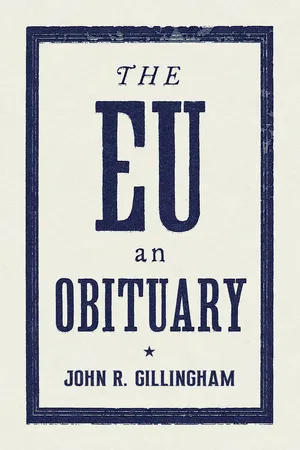
With Britain leaving the EU, now is the time for an obituary for the EU as an institution. In this short, rigorously argued book, updated after Brexit, John R. Gillingham tells the history of an idea that has soured and withered away.
He reveals the failures from its postwar origins to set out what the EU was; the role that Delors played in creating the neoliberal monster it is today, and the contemporary - crises; refugees, Brexit, the Euro - that the current institution fails to deal with.
- 288 pages
- English
- ePUB (mobile friendly)
- Available on iOS & Android
eBook - ePub
About this book
Information
PART I
__________
MYTH AS METHOD
__________
The most appealing, persuasive, and oft-repeated defence made in praise of the European Union is unambiguous and twofold. It credits the EU with the peace and prosperity enjoyed by Europe since 1945. It is a sweeping claim, all the more powerful in light of the catastrophic first half of the twentieth century. To challenge it is to cast doubt on accepted certitudes about our own era. The EU is still considered by many to be the greatest historical achievement of the present age. This judgement should not be accepted uncritically. To know where one is headed, one should know where one has come from. An examination of the formative years of the European institutions can promise few conclusive answers but might at least raise serious questions about the EU which, if troubling, provide clues as to how past and present problems have arisen. It may even contribute something to their solution.
It took more than bricks and mortar to rebuild Europe after World War II. Faith was also needed – in a better future and in a roadmap leading to it, and, to sustain such faith, a founders’ myth. To track down the historical origins of present problems one must take a close look at the setting in which the EU came to life, the motives that led to its creation, the short-term consequences of the choices then made, and the long-term problems that grew out of them. We will find that Jean Monnet, the iconic George Washington of the integration process, launched his big projects against a background of Cold War politics in order to deal, as a Frenchman, with the German Problem. Military security was his foremost concern. The institutions he designed were hierarchical, centralized bureaucracies, unaccountable to the public but outfitted with the trappings of representative democracy. The results were less than optimal, and had certain of his plans succeeded they could have been disastrous. Nonetheless, Monnet left a legacy of hope and expectation that remains alive even today.
Monnet did not have the integration field to himself. He shared it with other architects of the new Europe, a group of like-minded senior civil servants representing France, Germany, and the Benelux countries. Their purpose in coming together was to strengthen commercial ties with a resurgent West Germany, a sensible aim in line with long-term economic trends and consistent with peacetime requirements. Yet the institution they built, the customs union christened as the European Economic Community (EEC), was not the only or necessarily even the best vehicle for the ends they sought.
It might have been possible both to organize a broader economic union and reduce political risk. The EEC included an executive authority vested with ill-defined powers that opened the door to trouble. The struggle that soon broke out between this office and the six founder members of the EEC would result in gridlock lasting for years. Even as political integration became stuck in its tracks, economic progress continued. Europe enjoyed a twenty-year recovery boom, which resulted in industrial modernization and the rise of the consumer economy. Although the European Economic Community contributed little to this remarkable growth, the claim that it did so went unchallenged, and the EEC became indelibly associated in the public mind with prosperity. Another myth had been born. Meanwhile, underlying political problems persisted in Brussels. The most serious of these was the elitist and undemocratic character of the new European institutions. Monnet’s successors would fail to deal with this legacy.
CHAPTER 1
A Complicated Early History
To appreciate the full significance of the epochal Schuman Plan announcement of 9 May 1950 – in retrospect the harbinger of the better days to come – one must begin with a reminder of the condition of Europe at the time. World War II had, of course, ended five years earlier, but memories of it were very much alive. Loss of life, destruction of property, material deprivation, physical dislocation, and general disruption shaped public outlooks everywhere on the European continent; a profound lack of confidence was their hallmark, and fear and frustration their expression. Accompanying such attitudes was a deep longing for personal security and an eagerness to return to normal peacetime conditions, as well as a desperate hope for a better future.
Robert Schuman’s eloquent words, delivered in a radio address of 9 May 1950, promised a dramatic breakthrough. Warning that ‘Europe will not be made at once, or according to a single plan … but through concrete achievements’, he proposed the creation of a new international authority to manage as a single unit, and independent of national control, the heavy industry of France, Germany, and the rest of Western Europe. Thus conceived, the European Coal and Steel Community (ECSC) was founded the following year. It marks the official origin of the integration process.1
Jean Monnet and the Postwar Years
The Schuman Plan – indeed the very text in which it was announced – was the handiwork of the most remarkable and now controversial figure in the history of the EU, Jean Monnet. Much of the subsequent course of the integration process is associated, for better or worse, with his memory. Central to it is the notion of the so-called ‘Monnet Method’, which initially was deemed consistent with the theory of functionalism, as developed behind the scenes by Ernst Haas and a team of Monnet’s close collaborators. As is often the case with other protean figures, his legacy has been co-opted, complicated, obscured, and confused by devoted admirers, who all too often invoke his name to sanction policies of their own. The ‘Monnet Method’ has thus been debased to a meaningless catch-all that in practice has become a by-word for advocacy of technocratic governance.2 Yet the myth of Monnet-as-Seer survives. What – exactly – then, did Monnet want to accomplish? How should one assess his successes and failures or imagine what might have happened had he brought his plans to fruition?3
Monnet was partly responsible for creating the cult surrounding his memory. Contrary to the image projected of him as a modest, even unassuming man, who worked selflessly day and night from behind the scenes, inching the integration process forward one step at a time towards the Promised Land – he spared no effort to establish his reputation as a titan of public life, power-broker extraordinaire, and visionary. His influential Memoirs – actually the collective labour of a carefully selected group of favoured academics and associates – describe a career characterized by an unbroken string of triumphs; setbacks almost never entered the picture. Lest this message be forgotten, he set up a private foundation in Lausanne, Switzerland – the Archives Jean Monnet pour l’Europe – to house his papers. They consist of the documentation used in his memoirs, from which was carefully culled evidence inconsistent with its central thesis. For those who want to find it, the French national archives is the place to look.4
Monnet’s greatest creations – the European Coal and Steel Community and the French Plan de Modernisation et d’Équipement – depended upon his having disciples at the summits of power in the public administrations of the United States, Britain, France, West Germany, and elsewhere, whom, by force of vision and will, he engaged in the service of his ideas. Their successors would long remain guardians of the flame, act in his name, and preserve his memory.5
To take the measure of Monnet’s achievement, one must recall the special conditions obtaining in postwar Europe that made him the indispensable man. American power was overwhelming and few other Europeans had either the personal connections or the know-how to tap directly into it. But there were limits to what he could accomplish. His projects did not hold the field alone, and some would prove unworkable. This was by no means necessarily a bad thing. Monnet viewed democratic decision-making as a hindrance to technocratic efficiency. In the new atomic age, this opened the door to a host of potential evils, many of which, thanks to the unviability of his plans, never materialized.
A sound claim can be made that it was the founding of the European Economic Community (EEC) in 1958 rather than the 1949 Schuman Plan announcement that marks the real beginning of the European project, and not just, as was described at the time and since, its ‘re-launch’. The enduring value of the EU dates from the 1958 event. The nature of the new EEC – its configuration, methods, and rationale – represents a rejection of Monnet’s design for European institutions. It was strategic in conception and centred on the security of France. Contrary to conventional wisdom, politics and economics, at least in the civilian sense, were only of secondary interest to him. Monnet’s schemes reflected the experience and threat of war. In contrast, the EEC’s organizers were concerned primarily with the material welfare of Europe and thus their work remains germane to the problems facing the EU today.6
How, if realized, might Monnet’s plans have altered the subsequent course of European history? The projects he devised and promoted – the European Defence Community (EDC), Euratom, and the Multilateral Force (MLF) – though today almost forgotten – were extraordinarily ambitious and very reckless. Monnet proposed nothing less than integrating Europe around the nucleus of what would have become a military industrial complex twinned to the one then developing in the United States. Much in play during the Eisenhower and Kennedy years, these failed endeavours damaged American Cold War policy. Had they succeeded, the consequences would have been dire.
Washington’s Grand Design Confronts European Reality
President Roosevelt had a definite vision of the postwar world. It was an image, writ large, of America under the New Deal. He foresaw an international order governed under law, with open markets and a close relationship between state and economy. A future United Nations – policed by the Big Four of the US, UK, USSR, and China – would provide a framework of world government. An International Monetary Fund would restore currency convertibility, and a free trade organization promote commerce in a world without tariffs. Supporting such global architecture would be restored nation states resting on mutually reinforcing relationships between government and economy.
Such a vision would, of course, never materialize. For one thing, FDR did not foresee a Cold War; nor did he take sufficient account of what was happening in China. Nevertheless, his basic ideas, at least those dealing with economics, not only framed policy in the aftermath of World War II but, as modified over time, provided the essential structures for the new capitalistic era of freedom and prosperity that eventually opened up in the West. In the short term, however, the American plans for the future confronted two main obstacles. One was the defeated former enemy, the other the prospective future one. This called for a policy of ‘double containment’.7
Within this mix, Germany was, for good reasons, a French obsession. Jean Monnet said openly what all Frenchmen feared: that another war with the dreaded enemy would end France’s history as a great power. Monnet knew whereof he spoke, and he had the experience and connections needed to take corrective action. Back in World War I Monnet had represented France on the Allied agencies that were set up to regulate world trade in grains, minerals, and shipping. In the 1920s he operated at the interface of finance and government as a bond underwriter representing Wall Street in Europe. An early advocate of preparedness in the 1930s, Monnet left his homeland before the Fall of France, but instead of joining the Free French under De Gaulle, served as British representative in the US Lend-Lease programme. He also became the official planner of the (chiefly propagandistic) American ‘Victory Program’, and, crucially, later took charge of economic affairs for the provisional French government in Algiers. In this capacity he provided a conduit for US military assistance to the government of the Fourth Republic. The American connection was the source of his influence in France. Thanks to his access to well-placed Washington policy-makers, he could not only influence American policy from the outside, but shape it from within.8
After the war, Monnet headed the French Plan, whose design and methods of operation were inspired by the US war economy. He was subsequently the de facto negotiator of the Blum Loan of 1946 and, more important still, served as French delegate to the Marshall Plan, which he influenced at the top level. It was no accident that the famous aid programme required the establishment of analogues of the French Plan in the other beneficiary nations. Nor was it by chance that the Plan received about half of France’s Marshall Plan aid, something that did not necessarily endear Monnet to jealous French political operatives.
Within the parameters of France’s security policy, Monnet, a political realist, was a voice of moderation. Initially, the French hoped to carve up the ex-Reich into medium, bite-sized states like those Napoleon once organized for the Confederation of the Rhine. With the advent of the Cold War, the beginnings of recovery, and the growing likelihood of German revival, French aims focused increasingly on the Ruhr, home to the coal and steel trusts thought in France to be the mainspring of the Reich’s economic and political power. French policy had two specific goals: to restrict German steel production and to pre-empt the coal supply needed to fuel their economy, especially the planned modernization of the nationalized metallurgical industry.
In 1947 the three Western occupation governments therefore set up the International Ruhr Authority (IRA) with these ends in mind. The IRA set limits to German recovery. The American decision to restore sovereignty to the new Federal Republic once made, Monnet determined that France should maintain control over the Ruhr but exercise it not by means of the occupation statutes but ‘in the name of Europe’. Once the ex-enemy had regained respectability, and France bolstered its strength, a relationship could be established on the basis of equality. The Schuman Plan organization, the eventual European Coal and Steel Community, was to be the vehicle of this transition.9
Long before any such stage had been reached in the negotiations, a totally unexpected event occurred in a faraway place, the former Hermit Kingdom, that threatened to wreck them. To Washington, the June 25 invasion of South Korea by the Communist government in the North made no sense except as a feint to divert American attention away from Europe. It thus triggered a snap decision to begin re-arming the young Federal Republic immediately, and accelerated a second one already made to station 200,000 US troops in Europe under the auspices of the North Atlantic Treaty Organization (NATO).
To rescue the coal–steel negotiations from certain failure, Monnet came up with an even bolder proposal than the Schuman Plan. This was the Pleven Plan announced on 24 October 1950, named after the prime minister du jour, a long-standing associate of his. In the name of France, Pleven called for nothing less than the organization of a future European armed force of 100,000 men composed of European units integrated nationally down to the lowest feasible level of organization, presumably the brigade. It was to be called the European Defence Community (EDC). Consistent with French views, it was to be officered by the French themselves until the completion of German rearmament at some remote date, and provisioned by a modernized French munitions industry. The proposed armed force would not, however, be able to act independently; it was to be incorporated into NATO strategy and command.
The Pleven Plan initiative saved the Schuman Plan negotiations. The coal–steel authority opened for operation in June 1952. By then, however, EDC had eclipsed the ECSC in Allied diplomacy. The coal–steel pool retreated into the background. The ECSC provided the means by which Germany could regain control of industry in the Ruhr and thus to end the occupation. In that sense, it was a diplomatic triumph for Germany. Otherwise the ECSC barely got off the ground. Contrary to expectations, it had little impact on either the conduct of business in heavy industry or in the balance of power between Germany and France. Trust-busting did not take place. Producer relations in coal and steel had not been competitive for many years, but, from the producer standpoint, were regulated satisfactorily by private laws and conventions – cartels – in a tradition dating from the 1920s that had remained intact during the recent war. In 1953 an international steel cartel was revived.10
The big problem facing the managers of mine and mill was that business itself was no longer very good; nor was heavy industry still the lead sector in the armaments field. The era of coal and steel had already given way to an atomic age with higher and quite different strategic requirements. Economically as well, the days of the big trusts were numbered. Cheaper fuel could be shipped to Rotterdam from Virginia than delivered locally from the Ruhr. Henceforth European steel mills would all be built near ports to access cheap overseas supplies. In the meantime, oil and electrical power rapidly displaced coal in traditional markets. By 1955 the mining industry of Western Europe was in the throes of mortal crisis. A few years later the steel producers would be in the same boat. The ECSC would eventually be folded into the EEC.11 It was not, as is often still maintained, an integration model.
The European Defence Community and Euratom
Although the European Defence Community (EDC) project, the outgrowth of the Pleven Plan, eventually collapsed, the massive diplomatic campaign set in motion to advance it became a focal point of Cold War thinking. The failure of the EDC project was definitive. Nothing on such a scale has ever been undertaken under EU auspices. Until now, Europe has lacked an armed force of its own and depended on NATO and the American nuclear umbrella. The EDC was, as conceived, not intended to play more than a supporting role in NATO, yet the p...
Table of contents
- Cover Page
- Halftitle Page
- Title Page
- Dedication
- Copyright Page
- Contents
- Preface: Stumbling through a Minefield
- Introduction: A Re-examination of the European Union
- Part I: Myth as Method
- Part II: Behind the Curve
- Part III: Lost in the Future
- Postscript
- Afterword 2018: The European Union in the Pax Technica
- Notes
- Index
Trusted by 375,005 students
Access to over 1.5 million titles for a fair monthly price.
Study more efficiently using our study tools.
Frequently asked questions
Yes, you can cancel anytime from the Subscription tab in your account settings on the Perlego website. Your subscription will stay active until the end of your current billing period. Learn how to cancel your subscription
No, books cannot be downloaded as external files, such as PDFs, for use outside of Perlego. However, you can download books within the Perlego app for offline reading on mobile or tablet. Learn how to download books offline
Perlego offers two plans: Essential and Complete
- Essential is ideal for learners and professionals who enjoy exploring a wide range of subjects. Access the Essential Library with 800,000+ trusted titles and best-sellers across business, personal growth, and the humanities. Includes unlimited reading time and Standard Read Aloud voice.
- Complete: Perfect for advanced learners and researchers needing full, unrestricted access. Unlock 1.5M+ books across hundreds of subjects, including academic and specialized titles. The Complete Plan also includes advanced features like Premium Read Aloud and Research Assistant.
We are an online textbook subscription service, where you can get access to an entire online library for less than the price of a single book per month. With over 1.5 million books across 990+ topics, we’ve got you covered! Learn about our mission
Look out for the read-aloud symbol on your next book to see if you can listen to it. The read-aloud tool reads text aloud for you, highlighting the text as it is being read. You can pause it, speed it up and slow it down. Learn more about Read Aloud
Yes! You can use the Perlego app on both iOS and Android devices to read anytime, anywhere — even offline. Perfect for commutes or when you’re on the go.
Please note we cannot support devices running on iOS 13 and Android 7 or earlier. Learn more about using the app
Please note we cannot support devices running on iOS 13 and Android 7 or earlier. Learn more about using the app
Yes, you can access The EU by John R. Gillingham III in PDF and/or ePUB format, as well as other popular books in Politics & International Relations & Political Economy. We have over 1.5 million books available in our catalogue for you to explore.