The more we know about the catastrophic implications of climate change, the more fossil fuels we burn. How did we end up in this mess?
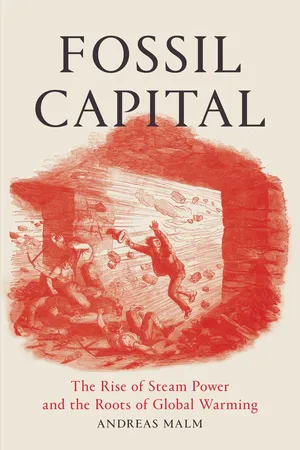
In this masterful new history, Andreas Malm claims it all began in Britain with the rise of steam power. But why did manufacturers turn from traditional sources of power, notably water mills, to an engine fired by coal? Contrary to established views, steam offered neither cheaper nor more abundant energy-but rather superior control of subordinate labour. Animated by fossil fuels, capital could concentrate production at the most profitable sites and during the most convenient hours, as it continues to do today. Sweeping from nineteenth-century Manchester to the emissions explosion in China, from the original triumph of coal to the stalled shift to renewables, this study hones in on the burning heart of capital and demonstrates, in unprecedented depth, that turning down the heat will mean a radical overthrow of the current economic order.
- 496 pages
- English
- ePUB (mobile friendly)
- Available on iOS & Android
eBook - ePub
About this book
Information
CHAPTER 1
In the Heat of the Past:
Towards a History of the
Fossil Economy
In those spacious halls the benignant power of steam summons around him his myriads of willing menials, and assigns to each the regulated task, substituting for painful muscular effort on their part, the energies of his own gigantic arm, and demanding in turn only attention and dexterity to correct such little aberrations as casually occur in workmanship.
Andrew Ure, The Philosophy of Manufactures (1835)
The chemical changes which thus take place are constantly increasing the atmosphere by large quantities of carbonic acid [i.e. carbon dioxide] and other gases noxious to animal life. The means by which nature decomposes these elements, or reconverts them into a solid form, are not sufficiently known.
Charles Babbage, On the Economy of
Machinery and Manufactures (1835)
Machinery and Manufactures (1835)
Besides, what has your steam engine and your cast iron done for us? Not to mention the gas, whose frequent explosions threaten one day to blow up Babylon itself.
Anonymous worker in The Metropolitan,
‘Imprisonment for debt’ (May 1834)
‘Imprisonment for debt’ (May 1834)
Global warming is the unintended by-product par excellence. A cotton manufacturer of early nineteenth-century Lancashire who decided to forgo his old waterwheel and invest in a steam engine, erect a chimney and order coal from a nearby pit did not, in all likelihood, entertain the possibility that this act could have any kind of relationship to the extent of Arctic sea ice, the salinity of Nile Delta soil, the altitude of the Maldives, the frequency of droughts on the Horn of Africa, the diversity of amphibian species in Central American rain forests, the availability of water in Asian rivers or, for that matter, the risk of flooding along the Thames and the English coastline. Nonetheless, sporadic forebodings appear in the literature of the time. One notable flash of apprehension about the atmospheric consequences of employing steam power in factories can be found in the first chapter of Charles Babbage’s classic treatise On the Economy of Machinery and Manufactures. Babbage is credited with being the father of the modern computer; his book is considered the first to introduce ‘the factory into the realm of economic analysis’.1 He made his fleeting remark some three decades before John Tyndall explained the greenhouse effect and some six decades before Svante Arrhenius first calculated the rise in surface temperature on the earth following an increase in emissions of carbon dioxide (called ‘carbonic acid’ by Arrhenius as well).2
But the environmentally concerned enquiry of the pioneer economist was instantly truncated, due to sheer lack of knowledge. Babbage was verging on uncharted territory. Instead, his book continued as one long encomium to the wonders of machinery – first and foremost ‘the check which it affords against the inattention, the idleness, or the dishonesty of human agents’.3 In that turn of phrase, Babbage articulated a leitmotif of bourgeois thinking corresponding to the operating procedures of manufacturers, who fought the annoying idiosyncrasies of human workers precisely by installing ever more machinery impelled by ever more powerful steam engines, unsuspecting of any particular noxious effects. Those on the receiving end of that machinery had more reason to be afraid.
Now They Know What They Do
By now the science of the by-product is perfectly clear. It has been so, in its basic outlines, for roughly as long as capitalism has been free of really existing adversaries: in 1990, the Intergovernmental Panel on Climate Change (IPCC) submitted its first report on the likely fate of a warming world. The facts and projections served as the basis for the United Nations Framework Convention on Climate Change (UNFCCC), signed at the Earth Summit in Rio de Janeiro in 1992 and ratified by all UN members, who pledged to ‘prevent dangerous anthropogenic interference with the climate system’ by cutting their emissions of greenhouse gases, chief among them carbon dioxide. Yet in 2012, global CO2 emissions were 58 percent higher than in 1990.4 By that time, the IPCC was preparing its fifth report – each edition more certain of the disastrous implications of ‘business-as-usual’ than the previous one – as a permanent hailstorm of scientific warnings rained down on humanity. A random pick from some leading journals in the years 2012–14: hurricanes in all ocean basins are becoming markedly stronger due to higher temperatures; North American butterfly populations have embarked on a perilous journey north to escape the rising heat; Arctic ecosystems are fast approaching a whole range of tipping points; the threshold beyond which the Greenland ice sheet will plunge into irreversible melting – raising sea levels by six meters – is a warming of 1.6°C rather than 3.1°C as previously thought; the retreat of glaciers in Tien Shan is accelerating, primarily in areas where they are most essential for irrigation in summertime, some rivers having already shrunk to tiny rivulets; since the mid-1980s, the vegetation of Congolese rain forests has browned, dried out and declined; climate change could wipe out the equivalent of the entire present yield of maize, soybeans, wheat and rice in key producing regions by the end of the century; the old target of keeping global warming below 2 degrees – widely regarded as obsolete, due to the already painful impacts of a mere 0.85 degrees – is rapidly slipping out of reach: and on it goes.5 Everybody knows it. Whether one chooses to ignore, suppress, deny or agonise over the knowledge of what is happening, it is there, in the air, heavier by the year. And yet the descendants of the Lancashire manufacturers, whose dominion now span the globe, are taking decisions on a daily basis to invest in new oil wells, new coal-fired power plants, new airports, new highways, new liquefied natural gas facilities, new machines to replace human workers, so that emissions are not only continuing to grow but doing so at a higher speed. In the 1990s, the annual increase in global CO2 emissions stood at an average 1 percent; since 2000, the figure has been 3.1 percent – a tripled growth rate, exceeding the worst-case scenarios developed by the IPCC and expressing a trend that still does not show any sign of reversal: the more knowledge there is of the consequences, the more fossil fuels are burnt.6
How did we get caught up in this mess?
History under a Heavy Sky
In the first pages of his acclaimed textbook Political Ecology, Paul Robbins travels to Yellowstone National Park to observe what lies behind its veneer of pristine wilderness. To an untrained eye, the iconic features of the landscape might appear perfectly natural. In fact they are intensely produced. The native hunters that once roamed the land have been removed by fiat; wolves were first extinguished and then reintroduced. Managing authorities have alternated between culling elk populations and allowing them to explode, suppressing fires and permitting them to rip through the valleys and leave their mark on the biota. At every step, walking through forests and along rivers, sighting some animals and not others, Robbins discerns the effects of power struggles that have raged over the park: between the state and the native population, between hunters and environmentalists, hoteliers and scientists. Out of the raw material at hand, political actors have created the ecology of Yellowstone, often with chains of unintended consequences.7
A traveller along the frontiers of climate change today – not to speak of tomorrow – might encounter a landscape even more thoroughly shaped by humans with power. Weather conditions, types of vegetation, entire biomes, even the sea itself might have fallen into place as a fallout of the combustion of fossil fuels. But where Robbins is able to trace a certain property of the Yellowstone landscape to a specific decision made in the past – the absence of natives to their historical removal – the climate change traveller can, by the nature of things, see no such straight lines. A submerged islet has born the full weight of a history lacking differentiation. No single decision, no emission of one tonne of greenhouse gases can be connected to this particular scene: the burning of this barrel of Texas oil cannot be pinned down as the cause of this Levantine drought. Every impact of anthropogenic climate change carries the imprint of every human act with a radiative forcing, such that they are infinitesimal representatives of two moving aggregates – the aftermath and the source – intimately coupled yet strangely disconnected from each other. Eyes gazing on abruptly transformed ecosystems are forced to turn back towards human society to understand what has happened – but where should they look? Only a totality can be the object of interest. We shall call it, provisionally, ‘the fossil economy’.
Seen from another angle, global warming is a sun mercilessly projecting a new light onto history. Only now is it becoming apparent what it really meant to burn coal and send forth smoke from a stack in Manchester in 1842. When natural scientists discovered global warming, they passed on a discovery to historians yet to be made on anything like a comprehensive scale: these things were there for two centuries, invisible up to the present. Now is the time to turn over a thousand stones, to unearth the climatic implications of innumerable actions – not merely because the smallest puff of smoke in Manchester in 1842 released a quantity of CO2 which then lingered in the atmosphere, playing a microscopic part in the creation of the current climate, but also, and more importantly, because the fossil economy was established, entrenched and expanded in the process. It is as though a novel dimension has been suddenly revealed in modern history. Just think, in this light, of the building of the railway networks, the construction of the Suez Canal, the introduction of electricity, the discovery of oil in the Middle East, the rise of suburbia, the CIA coup against Mohammad Mossadeq, the opening of the Chinese economy by Deng Xiaoping, the American invasion of Iraq … As a series of moments in the historical totality of the fossil economy – deepening its channels, adding ever-greater volumes of fossil fuels to the fire – these events are retroactively suffused with a new significance, calling for a return to history, eyes wide open.
Would such a history be environmental? Most traditional concerns in the field – say, deforestation, air pollution, species extinction through hunting or overfishing, pathogen movement through trade or invasion – exhibit some kind of historical immediacy: the cutting down of a forest is deforestation. In his The Chimney of the World: A History of Smoke Pollution in Victorian and Edwardian Manchester, Stephen Mosley points out that ‘smoke could be easily perceived by four of the five senses: one could see it, smell it, touch it, and it could be tasted.’8 He is obviously engaging in an environmental history, writing of how the natural world in and around Manchester was transformed through the explosive spread of dense black clouds in the nineteenth century. But the burning of coal in that town also had another ramification, which did not, as it were, touch down in the environment until much later, after a whole series of biogeochemical and social mediations. The writing of that history should be a central task, and yet it is bound to have an odd quality of detachment from environmental repercussions. Insofar as we are interested in the fossil economy as the instigator of climate change, its ecological dimensions must be placed within the brackets of posterity in a way that hardly applies to any other problem of environmental history: even nuclear waste, whose fallout is comparable to global warming in duration, is immediately constituted and handled as such. Anthropogenic climate change – this is part of its very definition – has its roots outside the realm of temperature and precipitation, turtles and polar bears, inside a sphere of human praxis that could be summed up in one word as labour.
At the intersection of climate and history, most scholarly traffic has so far moved in the other direction. The search for meteorological causes of past events is currently undergoing a spectacular renaissance: climatic fluctuations are said to have had a finger or two in everything from the collapse of the Mayan civilisation and the conquests of the Vikings to the witch hunts and the French Revolution. Promising analogues for the future, this endeavour uses data on temperature and precipitation to explain crisis, war, persecution, upheaval and other social affairs – explanations well worth pursuing for their own sake (albeit with certain well-known pitfalls) but not particularly appropriate in constructing the historiography of global warming. Here it is a matter of searching not for climate in history, but for history in climate. Data on factory legislation or free-trade policy should be brought to bear on rainfall and ice, rather than the other way around; in a warming world, causation runs, at least initially, from company to cloud. It is that leap across ontological divides that calls for reconstruction.
The Revenge of Time
Over the past decades, critical theory has moved towards space, away from time as the long-favoured dimension, the classical vessel of structure, causation, rupture, possibility. Within historical materialism, this ‘spatial turn’ has generated the meteoric rise of critical geography, now equalling or surpassing the time-honoured discipline of history in innovativeness and influence: the star of David Harvey shines brighter than that of any Marxist historian. Another adept in the field, Neil Smith, hymns the victory of space over time in Uneven Development: Nature, Capital, and the Production of Space, quoting approvingly such one-liners as ‘we are in the epoch of simultaneity’; ‘the present epoch will perhaps be above all the epoch of space’; ‘prophecy now involves a geographical rather than historical projection’ (whatever that could possibly mean) – even endorsing Francis Fukuyama’s infamous thesis of the ‘end of history’ by asserting that ‘indeed historical time would seem to be over’.9 Global warming should put such fantasies to rest.
Floors below the desk where these words are written, people travel to work in cars, go on visits and vacations in cars, drive their shopping lists and shopping bags back and forth in cars: nowhere is simultaneity to be seen. Cars, to begin with, run on fossil energy, a legacy of photosynthesis originating hundreds of millions of years ago. The vehicles were not invented just now; they spread in the twentieth century. The choice to travel in them rather than in trams or buses or on bicycles is conditioned by a vast infrastructure of oil terminals, petroleum refineries, asphalt plants, road networks, gasoline stations – not to speak of the film industry, the lobbying groups, the billboards – which did not fall from the sky in this moment but was built up over time, eventually amassing such weight and inertia that other modes of transportation are now excluded, or at least prevented from rising to predominance. This is what some refer to as ‘carbon lock-in’: a cementation of fossil fuel–based technologies, deflecting alternatives and obstructing policies of climate change mitigation: a poisoned fruit of history.10 Furthermore, there is reason to suspect that the heat wave and drought plaguing this part of the country, sending residents to seek relief by leaving the town in cars, has some connection to climate change – signs of a future to come, a state-of-weather-in-the-making – and if that suspicion is at least partly correct, not even the weather belongs fully to the moment. It is a product of past emissions. The emissions produced by the cars running to and fro, meanwhile, will have their greatest impact on generations not yet born: they are so many invisible missiles aimed at the future.
Wherever we look at our changing climate, we find ourselves in the grip of the flow of time. The transfer of carbon from geological reserves to fireplaces and thence to the atmosphere, into the running carbon cycle from which it was locked away for ages and eras, sets the process in motion. But the effects are always delayed. It takes time before a certain quantity of CO2 emissions is realised as a corresponding amount of warming, and before that warming takes its full toll on the ecosystems. For every emission added to past output, the atmospheric concentration of the gas increases, its effect further augmented in accordance with ‘the fundamental tenet of climate science: emissions are cumulative’.11 The release of one tonne of CO2 would not be so dangerous were it not for the billions of tonnes already out there; it is the total accumulation that pushes temperatures upwards, and the more that has been emitted, the smaller the prospect of limiting the ongoing rise. If humanity wishes to avoid a certain temperature threshold – say, 2 degrees Celsius – only a certain amount can be emitted – roughly one trillion tons – and for every year emissions continue (not to speak of increase) that budget is progressively squandered.12 If one t...
Table of contents
- Cover Page
- Halftitle Page
- Title Page
- Copyright Page
- Dedication
- Contents
- Chapter 1: In the Heat of the Past: Towards a History of the Fossil Economy
- Chapter 2: Scarcity, Progress, the Nature of the Human Species? Theories of the Rise of Steam
- Chapter 3: The Long Life of the Flow: Industrial Energy Before Coal
- Chapter 4: ‘There Are Mighty Energies in those Masses’: Mobilising Power in a Time of Crisis
- Chapter 5: Puzzles of the Transition: The Lasting Advantages of Water
- Chapter 6: Fleeing the Flowing Commons: The Expansion of Waterpower That Never Happened
- Chapter 7: A Ticket to the Town: Advantages of Steam in Space
- Chapter 8: A Force to Count On: Advantages of Steam in Time
- Chapter 9: ‘No Government but Fuel’: The Derivation of Power from Coal in Bourgeois Ideology
- Chapter 10: ‘Go and Stop the Smoke!’: The Moment of Resistance against Steam
- Chapter 11: A Long Trail of Smoke: The Fossil Economy Consummated
- Chapter 12: The Myth of the Human Enterprise: Towards a Different Theory
- Chapter 13: Fossil Capital: The Energy Basis of Bourgeois Property Relations
- Chapter 14: China as Chimney of the World: Fossil Capital Today
- Chapter 15: A Return to the Flow? Obstacles to the Transition
- Chapter 16: Time to Pull the Plugs: On CO2 as an Effluent of Power
- Acknowledgements
- List of Abbreviations
- Notes
- Index
Trusted by 375,005 students
Access to over 1.5 million titles for a fair monthly price.
Study more efficiently using our study tools.
Frequently asked questions
Yes, you can cancel anytime from the Subscription tab in your account settings on the Perlego website. Your subscription will stay active until the end of your current billing period. Learn how to cancel your subscription
No, books cannot be downloaded as external files, such as PDFs, for use outside of Perlego. However, you can download books within the Perlego app for offline reading on mobile or tablet. Learn how to download books offline
Perlego offers two plans: Essential and Complete
- Essential is ideal for learners and professionals who enjoy exploring a wide range of subjects. Access the Essential Library with 800,000+ trusted titles and best-sellers across business, personal growth, and the humanities. Includes unlimited reading time and Standard Read Aloud voice.
- Complete: Perfect for advanced learners and researchers needing full, unrestricted access. Unlock 1.5M+ books across hundreds of subjects, including academic and specialized titles. The Complete Plan also includes advanced features like Premium Read Aloud and Research Assistant.
We are an online textbook subscription service, where you can get access to an entire online library for less than the price of a single book per month. With over 1.5 million books across 990+ topics, we’ve got you covered! Learn about our mission
Look out for the read-aloud symbol on your next book to see if you can listen to it. The read-aloud tool reads text aloud for you, highlighting the text as it is being read. You can pause it, speed it up and slow it down. Learn more about Read Aloud
Yes! You can use the Perlego app on both iOS and Android devices to read anytime, anywhere — even offline. Perfect for commutes or when you’re on the go.
Please note we cannot support devices running on iOS 13 and Android 7 or earlier. Learn more about using the app
Please note we cannot support devices running on iOS 13 and Android 7 or earlier. Learn more about using the app
Yes, you can access Fossil Capital by Andreas Malm in PDF and/or ePUB format, as well as other popular books in Politics & International Relations & Environment & Energy Policy. We have over 1.5 million books available in our catalogue for you to explore.