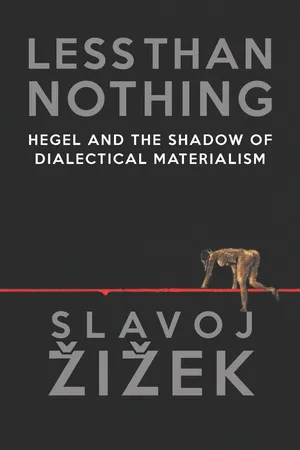
For the last two centuries, Western philosophy has developed in the shadow of Hegel, an influence each new thinker struggles to escape. As a consequence, Hegel's absolute idealism has become the bogeyman of philosophy, obscuring the fact that he is the defining philosopher of the historical transition to modernity, a period with which our own times share startling similarities.
Today, as global capitalism comes apart at the seams, we are entering a new period of transition. In Less Than Nothing, the product of a career-long focus on the part of its author, Slavoj Zizek argues it is imperative we not simply return to Hegel but that we repeat and exceed his triumphs, overcoming his limitations by being even more Hegelian than the master himself. Such an approach not only enables Zizek to diagnose our present condition, but also to engage in a critical dialogue with the key strands of contemporary thought-Heidegger, Badiou, speculative realism, quantum physics, and cognitive sciences. Modernity will begin and end with Hegel.
- English
- ePUB (mobile friendly)
- Available on iOS & Android
eBook - ePub
About this book
Information
Topic
PhilosophySubtopic
Aesthetics in PhilosophyPart I
THE DRINK BEFORE
CHAPTER 1
“Vacillating the Semblances”
WHAT CANNOT BE SAID MUST BE SHOWN
The famous last proposition of Wittgenstein’s Tractatus—“Whereof one cannot speak, thereof one must be silent”—involves an obvious paradox: it contains a superfluous prohibition, since it prohibits something which is already in itself impossible.1 This paradox faithfully reproduces the predominant attitude towards the aesthetic representation of the Holocaust: it shouldn’t be done, because it can’t be done. Jorge Semprún’s Spanish-Catholic origins play a crucial role in his reversal of this prohibition: for Semprún, it is not poetic fiction but prosaic documentary which is impossible after Auschwitz. For Elie Wiesel, by contrast, there can be no novel about the Holocaust: any text claiming to be such is either not about the Holocaust or is not a novel. Rejecting this claim that literature and the Holocaust are incommensurable, Semprún argues that the Holocaust can only be represented by the arts: it is not the aestheticization of the Holocaust which is false, but its reduction to being the object of a documentary report. Every attempt to “reproduce the facts” in a documentary way neutralizes the traumatic impact of the events described—or as Lacan, another atheist Catholic, put it: truth has the structure of a fiction. Almost no one is able to endure, still less to enjoy, a snuff film showing real torture and killing, but we can enjoy it as a fiction: when truth is too traumatic to be confronted directly, it can only be accepted in the guise of a fiction. Claude Lanzmann was right to say that if by chance he were to stumble upon some documentary footage showing the actual murder of inmates in Auschwitz, he would destroy it immediately. Such a documentary would be obscene, disrespectful towards the victims even. When considered in this way, the pleasure of aesthetic fiction is not a simple form of escapism, but a mode of coping with traumatic memory—a survival mechanism.
But how are we to avoid the danger that the aesthetic pleasure generated by fiction will obliterate the proper trauma of the Holocaust? Only a minimal aesthetic sensitivity is needed to recognize that there would be something false about an epic novel on the Holocaust, written in the grand style of nineteenth-century psychological realism: the universe of such novels, the perspective from which they are written, belongs to the historical epoch that preceded the Holocaust. Anna Akhmatova encountered a similar problem when, in the Soviet Union of the 1930s, she tried to depict the atmosphere of the Stalinist terror. In her memoirs she describes what happened when, at the height of the Stalinist purges, she was waiting in a long queue outside the Leningrad prison to learn the fate of her arrested son Lev:
One day somebody in the crowd identified me. Standing behind me was a young woman, with lips blue from the cold, who had of course never heard me called by name before. Now she started out of the torpor common to us all and asked me in a whisper (everyone whispered there), “Can you describe this?” And I said, “I can.” Then something like a smile passed fleetingly over what had once been her face.2
What kind of description is intended here? Surely it is not a realistic description of the situation, but a description which extracts from the confused reality its own inner form, in the same way that, in his atonal music, Schoenberg extracted the inner form of totalitarian terror. At this level, truth is no longer something that depends on the faithful reproduction of facts. One should introduce here the difference between (factual) truth and truthfulness: what makes a report of a raped woman (or any other narrative of a trauma) truthful is its very factual unreliability, confusion, inconsistency. If the victim were able to report on her painful and humiliating experience in a clear way, with all the data arranged into a consistent order of exposition, this very quality would make us suspicious. The same holds for the unreliability of the verbal reports given by Holocaust survivors: a witness who was able to offer a clear narrative of his camp experience would thereby disqualify himself. In a Hegelian way, the problem is here part of the solution: the very deficiencies of the traumatized subject’s report on the facts bear witness to the truthfulness of his report, since they signal that the reported content has contaminated the very form in which it is reported.3
What we are dealing with here is, of course, the gap between the enunciated content and the subjective position of enunciation. G. K. Chesterton wrote apropos of Nietzsche that he “denied egoism simply by preaching it”: “To preach anything is to give it away. First, the egoist calls life a war without mercy, and then he takes the greatest possible trouble to drill his enemies in war. To preach egoism is to practice altruism.”4 The medium here is not the message, quite the opposite: the very medium that we use—the universal intersubjectivity of language—undermines the message. It is not only that we should, therefore, denounce the particular position of enunciation that sustains the universal enunciated content—the white, wealthy male subject who proclaims the universality of human rights, for example. It is far more important to unearth the universality that sustains, and potentially undermines, his particular claim. The supreme case here, as noted by Bertrand Russell, is that of the solipsist trying to convince others that he alone really exists. Could one extend this argument to the problem of tolerance or intolerance? Perhaps not altogether, although there is a similar catch involved in preaching tolerance: it (presup)poses its presupposition—that is, the subject deeply “bothered” by the Neighbor—and thus only reasserts it. Did Paul Claudel not get it right in his famous reply to Jules Renard: “Mais la tolérance?” “Il y a des maisons pour ça!” (une maison de tolérance is one French expression for a brothel)? And did not Chesterton, as was so often the case, also get it right with his famous quip, “Tolerance is the virtue of the man without convictions”?
The aesthetic lesson of this paradox is clear. The horror of the Holocaust cannot be represented; but this excess of represented content over its aesthetic representation has to infect the aesthetic form itself. What cannot be described should be inscribed into the artistic form as its uncanny distortion. Perhaps a reference to Wittgenstein’s Tractatus can again be of some help here. According to the Tractatus, language depicts reality by virtue of sharing a logical form in common with it.
4.121 Propositions cannot represent logical form: it is mirrored in them. What finds its reflection in language, language cannot represent. What expresses itself in language, we cannot express by means of language. Propositions show the logical form of reality. They display it.
We know that a picture of a sunset represents a sunset because both the picture and the sunset share a similar “pictorial form.” Similarly, a proposition and what it represents share a similar “logical form”: a proposition depicts a fact, and just as a fact can be analyzed into independent states of affairs, a proposition can be analyzed into independent elementary propositions. Wittgenstein here draws a distinction between saying and showing: while a proposition says that such-and-such fact is the case, it shows the logical form by virtue of which this fact is the case. The upshot of this distinction is that we can only say things about facts in the world; logical form cannot be spoken about, only shown: “4.1212 What can be shown, cannot be said.” If we read this proposition together with the final proposition (“Whereof one cannot speak, thereof one must be silent.”), the conclusion is that what we cannot speak about can be shown, that is, directly rendered in/by the very form of speaking. In other words, Wittgenstein’s “showing” should be understood not merely in a mystical sense, but as inherent to language, as the form of language. Let us return to our example of trauma: we cannot directly talk about or describe it, but the traumatic excess can nevertheless be “shown” in the distortion of our speech about the trauma, in its elliptic repetitions and other distortions. In his novel Le grand voyage, Semprún invented just such a new form—a “logical form” of narrative that would be adequate to the trauma of the Holocaust by way of “showing” what cannot be directly described.5
The narrative of Semprún’s novel unfolds during a journey in a cramped and squalid boxcar carrying 120 resistance fighters from Compiègne to Buchenwald; Gérard, the first-person narrator of the story, is one of these prisoners. The narrative only fleetingly remains in the boxcar: in sudden temporal switches Gérard’s narration lurches back and forth from the time before the war to the moment of liberation in 1945, to two, three, sixteen, or an unspecified number of years later. These switches are rendered as moments within Gérard’s fractured stream of consciousness; as he undergoes the ordeal of the journey in the present, he remembers and “fore-members” (remembers-imagines the future), since the experience has fragmented him into a splintered self. Details of his life in the past, present, and future flow through his mind like multiple currents in an unimpeded stream: he is simultaneously a partisan in the French resistance, a deported prisoner of the Germans, and a survivor of Buchenwald. By recreating Gérard’s consciousness as an intersection of three time zones, Semprún renders the fluid timeless ordeal of the camp inmate who has lost his sense of life as a chronological passage from yesterday through today into tomorrow.
The topic of the “death of the subject,” of its dispersal in a pandemonium of conflicting and fragmented narrative lines, is usually seen as a result of elitist artistic reflections, divorced from the real concerns of real people; Semprún’s unique achievement is to establish the link between this modernist revolution in writing and our most traumatic historical experience. The true focus of Le grand voyage is not what really happened on the way to Buchenwald, but how such a terrible event affects the very identity of the subject: its elementary contours of reality are shattered, the subject no longer experiences himself as part of a continuous flow of history which devolves from the past towards the future. Instead, his experience moves in a kind of eternal present in which present, past, and future, reality and fantasy, directly interact. In his theory of relativity, Einstein proposes to interpret time as a fourth dimension of space in which past and future are all “now,” already here; because of our limited perception, we just cannot see them, we can only see the present. In Semprún’s novel, it is as if, after going through the nightmare of the life in a camp, our perception widens and we can see all three dimensions of time simultaneously—time becomes space, giving us an uncanny freedom to move back and forth along it just as we wander around in an open space, with past and future as different paths that we can take at will. There is, however, a price to be paid for this freedom, a blind spot in this field of spatialized time: we can see everything except the present of the camp itself. This prohibited present is, of course, death—being alive after Buchenwald is not the same as having survived it intact: the shadow of death taints Gérard’s memories of innocent prewar friendships—he learns later that many of his friends have been killed—and poisons his postwar life. Life in the camp is thus not so much the ultimate referent of his memories as the distorting screen which taints and spoils them all. Semprún juxtaposes Gérard’s pleasure at reading the childhood memories offered in Proust with the painful and deferred memory of his arrival at the Buchenwald concentration camp—his “madeleine” is the strange smell that recalls the crematory oven:
And suddenly, borne on the breeze, the curious odor: sweetish, cloying, with a bitter and truly nauseating edge to it. The peculiar odor that would later prove to be from the crematory oven … The strange smell would immediately invade the reality of memory. I would be reborn there; I would die if returned to life there. I would embrace and inhale the muddy, heady odor of that estuary of death.6
What resuscitates the trauma are not merely the immediate painful associations of the details which recall the camp, but, even more, the power of these recent memories to “color” and thus spoil the more ancient, gentle memories. Robert Antelme, in his testimony L’espèce humaine, evokes a similar case of overdetermination: the pleasurable memory of a lover ringing the doorbell has been indelibly colored by the painful memory of the Gestapo ringing the same bell at the moment of one’s arrest.7 Both in this instance and in Semprún’s use of Proust’s ringing garden bell, the survivors find that memory has been colonized by the experience of the Holocaust: there is no way to retrieve the pleasant memory of a lover waiting at the door without simultaneously triggering the corruption of that memory by the trauma.
The same shift from linear narrative time to the fragmented synchronicity of different times characterizes French vanguard cinema of the late 1950s and early 1960s, most visibly in the work of Alain Resnais, whose first film, the documentary Night and Fog, also deals with the Holocaust. Resnais’s masterpiece, Last Year in Marienbad, is about a couple whose affair is told in temporal slices the order of which is never clear: the time structure of the narrative exists as a synchronic mass wherein past, present, and future are all equally available, and can potentially all be present. The script for Marienbad was written by Alain Robbe-Grillet, the leading author of the French nouveau roman who also directed films. No wonder Semprún collaborated with Resnais: apart from writing two scenarios for him, he was an unacknowledged contributor to Resnais’s Je t’aime, je t’aime. In discussing this film, Gilles Deleuze introduced the concept of the “sheet of time”—a traumatic point in time, a kind of magnetic attractor which tears moments of past, p...
Table of contents
- Cover
- Copyright
- Dedication
- Contents
- Part I: The Drink Before
- Part 2: The Thing Itself: Hegel
- Part III: The Thing Itself: Lacan
- Part IV: The Cigarette After
- Conclusion: The Political Suspension of the Ethical
Trusted by 375,005 students
Access to over 1.5 million titles for a fair monthly price.
Study more efficiently using our study tools.
Frequently asked questions
Yes, you can cancel anytime from the Subscription tab in your account settings on the Perlego website. Your subscription will stay active until the end of your current billing period. Learn how to cancel your subscription
No, books cannot be downloaded as external files, such as PDFs, for use outside of Perlego. However, you can download books within the Perlego app for offline reading on mobile or tablet. Learn how to download books offline
Perlego offers two plans: Essential and Complete
- Essential is ideal for learners and professionals who enjoy exploring a wide range of subjects. Access the Essential Library with 800,000+ trusted titles and best-sellers across business, personal growth, and the humanities. Includes unlimited reading time and Standard Read Aloud voice.
- Complete: Perfect for advanced learners and researchers needing full, unrestricted access. Unlock 1.5M+ books across hundreds of subjects, including academic and specialized titles. The Complete Plan also includes advanced features like Premium Read Aloud and Research Assistant.
We are an online textbook subscription service, where you can get access to an entire online library for less than the price of a single book per month. With over 1.5 million books across 990+ topics, we’ve got you covered! Learn about our mission
Look out for the read-aloud symbol on your next book to see if you can listen to it. The read-aloud tool reads text aloud for you, highlighting the text as it is being read. You can pause it, speed it up and slow it down. Learn more about Read Aloud
Yes! You can use the Perlego app on both iOS and Android devices to read anytime, anywhere — even offline. Perfect for commutes or when you’re on the go.
Please note we cannot support devices running on iOS 13 and Android 7 or earlier. Learn more about using the app
Please note we cannot support devices running on iOS 13 and Android 7 or earlier. Learn more about using the app
Yes, you can access Less Than Nothing by Slavoj Zizek in PDF and/or ePUB format, as well as other popular books in Philosophy & Aesthetics in Philosophy. We have over 1.5 million books available in our catalogue for you to explore.