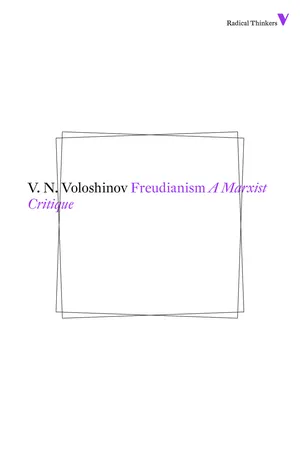
Freudianism is a major icon in the history of ideas, independently rich and suggestive today both for psychoanalysis and for theories of language. It offers critical insights whose recognition demands a change in the manner in which the fundamental principles of both psychoanalysis and linguistic theory are understood. Volosinov went to the root of Freud's theory adn method, arguing that what is for him the central concept of psychoanalysis, "the unconscious," was a fiction. He argued that the phenomena that were taken by Freud as evidence for "the unconscious" constituted instead an aspect of "the conscious," albeit one with a person's "official conscious."
For Volosinov, "the conscious" was a monologue, a use of language, "inner speech" as he called it. As such, the conscious participated in all of the properties of language, particularly, for Volosinov, its social essence. This type of argumentation stood behind Volosinov's charge that Freudianism presented humans in an inherently false, individualistic, asocial, and ahistorical setting.
- 304 pages
- English
- ePUB (mobile friendly)
- Available on iOS & Android
eBook - ePub
About this book
Information
Topic
FilosofíaSubtopic
Filosofía políticaPART I
FREUDIANISM AND MODERN
TRENDS IN PHILOSOPHY AND
PSYCHOLOGY (CRITICAL
ORIENTATION)
1
The Basic Ideological
Motif of Freudianism
Freudianism and the modern world. The ideological motif of Freudianism. Similar motifs in modern philosophy. A preliminary evaluation of Freudianism.
In 1893 a short article by two Viennese doctors, Freud and Breuer, appeared in the pages of a professional journal of psychiatry.1 The article, devoted to a new method of treating hysteria through the use of hypnosis, was entitled by its authors “On the Psychical Mechanism of Hysterical Phenomena (Preliminary Communication).” From the kernel of this “preliminary communication” was to develop one of the most popular ideological trends in modern Europe—psychoanalysis.
Inaugurated as a modest psychiatric method2 with a barely developed theoretical basis, psychoanalysis had, by the end of its first decade of existence, already devised a general theory of psychology of its own that cast a new light on all aspects of the mental life of man. Thereupon, work was undertaken to apply this new psychological theory to the task of elucidating various domains of cultural creativity—art, religion, and, finally, aspects of social and political life. Thus, psychoanalysis succeeded in elaborating its own philosophy of culture. These later postulations of psychoanalysis in general psychology and philosophy gradually came to overshadow the original, purely psychiatric core of the doctrine.3
Psychoanalysis achieved success among wide circles of the European intelligentsia even before World War I. After the war, and especially in recent years [the late 1920s], its influence reached extraordinary proportions in all the countries of Europe and in America. Owing to the breadth of this influence in the bourgeois world and among intellectual circles, psychoanalysis advanced to a position far beyond other contemporary ideological movements; Steiner’s “anthroposophy” alone was possibly able to compete with it. Even such fashionable trends of the past as Bergsonism and Nietzscheanism had never, even at the height of their success, rallied so huge a body of supporters and “interested persons” as Freudianism.
The comparatively slow and, at first (up to 1910 approximately), very difficult progress of psychoanalysis en route to its “conquest of Europe” attests to the fact that this movement was no momentary and superficial “mode of the day,” in the style of Spenglerism, but rather an abiding and profound expression of certain crucial aspects of European bourgeois reality. Therefore, anyone wishing to fathom the spiritual physiognomy of modern Europe can hardly bypass psychoanalysis; it has become too signal and too indelible a feature of modern times.4
How is the success of psychoanalysis to be explained? What is its attraction for a member of the European bourgeoisie?
Needless to say, it is not the specifically scientific, psychiatric aspect of the doctrine. It would be naive to suppose that masses of ardent devotees came to psychoanalysis through interest in the technical problems of psychiatry and through acquaintance with the professional publications in the field. That was not the way they encountered Freudianism. In the vast majority of cases, Freud was the first and last psychiatrist they read and Internationale Zeitschrift für Psychoanalyse the first and only professional journal of psychology whose pages they opened. It would be naive to suppose that Freud had somehow managed to engage the attention of vast circles of people to the technical issues of psychiatry. Obviously, neither was it practical interest in the achievements of a therapeutic method that made psychoanalysis attractive. It would be absurd to assume that all those masses of Freud’s devotees were and are patients at psychiatric clinics eager for a cure. It is beyond doubt that Freud did succeed in striking a nerve in the modern bourgeoisie, but not through the specifically scientific or narrowly practical aspects of his doctrine.
Any ideological movement that is not the restricted property of some select group of specialists but encompasses wide and varied masses of readers who are obviously incapable of coping with the technical details and subtleties of the doctrine—any such ideological movement always allows of definition in terms of a certain basic motif, the ideological dominant of the whole system that determines its success and influence. This basic motif possesses a power of conviction and revelation all of its own and is relatively independent of the complex apparatus of its scientific foundation, to which the public at large does not have access. Therefore, this basic motif can be isolated and formulated in a rough and simple way without the risk of doing an injustice.
In this first—introductory—chapter we intend, somewhat anticipating our later exposition, to take up the task of singling out the basic ideological motif of Freudianism and providing preliminary evaluation of it.
We are guided in doing this by the following considerations.
Before the reader can be introduced into the rather complex and, at times, alluring labyrinth of the psychoanalytical doctrine, he needs to have a solid critical orientation given him. We must first of all show the reader in what philosophical context, that is, in line with which other philosophical currents that have held sway or still do hold sway over the minds of the European intelligentsia, he must perceive psychoanalysis so as to obtain an accurate notion of its ideological essence and value. That is the reason why it is necessary to feature the basic ideological motif of psychoanalysis. We shall see that this motif is by no means anything totally new or surprising, but rather that it is something that can be completely accommodated within the mainstream of all the ideological tendencies of bourgeois philosophy in the first quarter of the twentieth century—perhaps, indeed, the most striking and daring expression of those tendencies.
In the following chapter (Chapter 2), we shall endeavor to give the reader a similar critical orientation for viewing the purely psychological aspect of the Freudian doctrine, without as yet fully expositing that doctrine itself but acquainting the reader with the rivalry of various different trends in modern psychology. In this way we shall define the context within which the specifically psychological tenets of Freudianism should be viewed and judged.
Once the reader has been critically armed and made aware of the historical perspectives in which to view this new phenomenon, we shall proceed, starting with the third chapter, to a systematic exposition of psychoanalysis without recourse to critical commentary. In Part III of our study we shall return again to the critical themes noted in the first two chapters of Part I.
What, then, is the basic ideological motif of Freudianism?
A human being’s fate, the whole content of his life and creative activity—of his art, if he is an artist, of his scientific theories, if he is a scientist, of his political programs and measures, if he is a politician, and so on—are wholly and exclusively determined by the vicissitudes of his sexual instinct. Everything else represents merely the overtones of the mighty and fundamental melody of sex.5
If a person’s consciousness tells him otherwise about the motives and driving forces of his life and creativity, then that consciousness is lying. A skeptical attitude toward consciousness is an ever-present accompaniment to the development of Freud’s basic theme.
Thus, what really counts in a human being is not at all what determines his place and role in history—the class, nation, historical period to which he belongs; only his sex and his age are essential, everything else being merely a superstructure. A person’s consciousness is shaped not by his historical existence but by his biological being, the main facet of which is sexuality.
Such is the basic ideological motif of Freudianism.
In its general form this motif is nothing new and original. What is new and original is the elaboration of its component parts—the concepts of sex and age. In this respect Freud did genuinely succeed in disclosing an enormous wealth and variety of new factors and subtleties that had never before been submitted to scientific inquiry, owing to the monstrous hypocrisy of official science in all questions having to do with human sexual life. Freud so expanded and so enriched the concept of sexuality that the notions we ordinarily associate with that concept comprise merely a tiny sector of its vast territory. This must be kept in mind when making judgements about psychoanalysis: One ought not lose sight of this new and extremely expanded meaning of the term “sexual” in Freud, when, for instance, accusing psychoanalysis, as is commonly done, of “pansexualism.”
Psychoanalysis has, furthermore, revealed much that is surprising also in the matter of the connection between sex and age. The history of a human being’s sexual drive starts at the moment of his birth and proceeds to pass through a long series of individually marked stages of development that by no means correspond to the naive scheme of “innocent childhood-puberty-innocent old age.” The riddle about the ages of man that the Sphinx asked Oedipus found in Freud a unique and surprising solution. How sound a solution is another matter, one we shall take up later on. Here we need only note that both component parts of the basic ideological motif of Freudianism—sex and age—are invested with thoroughly new and rich content. That is why this motif, old in and of itself, has a new ring to it.
It is an old motif. It is constantly repeated during all those periods in the development of mankind when the social groups and classes that had been the makers of history are in the process of being replaced. It is the leitmotif of crisis and decline.
Whenever such a social class finds itself in a state of disintegration and is compelled to retreat from the arena of history, its ideology begins insistently to harp on one theme, which it repeats in every possible variation: Man is above all an animal. And from the vantage point of this “revelation” it strives to put a new construction on all the values that make up history and the world. Meanwhile, the second part of Aristotle’s famous formula—“man is a social animal”—is totally ignored.
The ideology of periods such as these shifts its center of gravity onto the isolated biological organism; the three basic events in the life of all animals—birth, copulation, and death—begin to compete with historical events in terms of ideological significance and, as it were, become a surrogate of history.
That which in man is nonsocial and nonhistorical is abstracted and advanced to the position of the ultimate measure and criterion for all that is social and historical. It is almost as if people of such periods desire to leave the atmosphere of history, which has become too cold and comfortless, and take refuge in the organic warmth of the animal side of life.
That is what happened during the period of the break-up of the Greek city states, during the decline of the Roman Empire, during the period of the disintegration of the feudal-aristocratic order before the French Revolution.
The motif of the supreme power and wisdom of Nature (above all, of man’s nature—his biological drives) and of the impotence of history with its much ado about nothing—this motif equally resounds, despite differences of nuance and variety of emotional register, in such phenomena as epicureanism, stoicism, the literature of the Roman decadence (e.g. Petronius’s Satyricon), the skeptical ratiocination of the French aristocrats in the seventeenth and early eighteenth centuries. A fear of history, a shift in orientation toward the values of personal, private life, the primacy of the biological and the sexual in man—such are the features common to all of these ideological phenomena.
And now once again, starting at the very end of the nineteenth century, motifs of the same kind have been distinctly voiced in European ideology. For twentieth century bourgeois philosophy the abstract biological organism has again become the central hero.
The philosophy of “Pure Reason” (Kant), of the “Creative I” (Fichte), of “Idea and the Absolute Spirit” (Hegel), that is, that which constituted the undeniably energetic and, in its way, respectable philosophy of the heroic age of the bourgeoisie (end of the eighteenth and first half of the nineteenth century), such philosophy still commanded a full measure of enthusiasm for history and organization (in the bourgeois style). In the second half of the nineteenth century this philosophy became increasingly diminished and gradually came to a standstill in the lifeless and static schemes of the “school philosophy” of epigones (neo-Kantians, neo-Fichteans, neo-Hegelians), final...
Table of contents
- Cover Page
- Halftitle Page
- Title Page
- Copyright Page
- Contents
- Preface
- Translator’s Introduction
- Part I: Freudianism and Modern Trends in Philosophy and Psychology (Critical Orientation)
- Part II: An Exposition of Freudianism
- Part III: A Critical Analysis of Freudianism
- Appendix I: Discourse in Life and Discourse in Art (Concerning Sociological Poetics)
- Appendix II: V. N. Voloshinov and the Structure of Language in Freudianism
- Index
Trusted by 375,005 students
Access to over 1.5 million titles for a fair monthly price.
Study more efficiently using our study tools.
Frequently asked questions
Yes, you can cancel anytime from the Subscription tab in your account settings on the Perlego website. Your subscription will stay active until the end of your current billing period. Learn how to cancel your subscription
No, books cannot be downloaded as external files, such as PDFs, for use outside of Perlego. However, you can download books within the Perlego app for offline reading on mobile or tablet. Learn how to download books offline
Perlego offers two plans: Essential and Complete
- Essential is ideal for learners and professionals who enjoy exploring a wide range of subjects. Access the Essential Library with 800,000+ trusted titles and best-sellers across business, personal growth, and the humanities. Includes unlimited reading time and Standard Read Aloud voice.
- Complete: Perfect for advanced learners and researchers needing full, unrestricted access. Unlock 1.5M+ books across hundreds of subjects, including academic and specialized titles. The Complete Plan also includes advanced features like Premium Read Aloud and Research Assistant.
We are an online textbook subscription service, where you can get access to an entire online library for less than the price of a single book per month. With over 1.5 million books across 990+ topics, we’ve got you covered! Learn about our mission
Look out for the read-aloud symbol on your next book to see if you can listen to it. The read-aloud tool reads text aloud for you, highlighting the text as it is being read. You can pause it, speed it up and slow it down. Learn more about Read Aloud
Yes! You can use the Perlego app on both iOS and Android devices to read anytime, anywhere — even offline. Perfect for commutes or when you’re on the go.
Please note we cannot support devices running on iOS 13 and Android 7 or earlier. Learn more about using the app
Please note we cannot support devices running on iOS 13 and Android 7 or earlier. Learn more about using the app
Yes, you can access Freudianism by Valentin Voloshinov, IR Titunik, I.R. Titunik in PDF and/or ePUB format, as well as other popular books in Filosofía & Filosofía política. We have over 1.5 million books available in our catalogue for you to explore.