- 128 pages
- English
- ePUB (mobile friendly)
- Available on iOS & Android
eBook - ePub
About this book
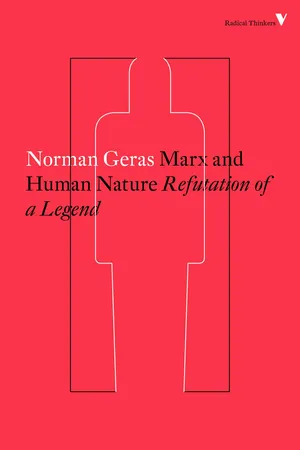
In this passionate and polemical classic work, Norman Geras argues that the view that Marx broke with all conceptions of human nature in 1845 is wrong. Rather, his later writings are informed by an idea of a specifically human nature that fulfills both explanatory and normative functions. Over one hundred and thirty years after Marx's death, this book-combining the strengths of analytical philosophy and classical Marxism-rediscovers a central part of his heritage.
Information
Topic
FilosofíaSubtopic
Crítica filosóficaIII
Human Nature
and Historical
Materialism
It is surely remarkable that so many have discerned, with the emergence of the materialist conception of history, a dismissal by Marx of the idea of human nature. The German Ideology, after all, setting down that celebrated conception for the first time, expressly criticizes the mistake of those who, ignoring what it terms the ‘real basis of history’, thereby exclude from the historical process ‘the relation of man to nature’, create an ‘antithesis of nature and history’.21 It might be thought that, for Marx, this antithesis is mistaken only with respect to external nature, and not also with respect to nature as something inherent in humanity. But it is easy to show that this is not the case. Marx includes such an inner, human nature squarely within the ‘real basis of history’.
In fact, The German Ideology at one point echoes a passage from The Holy Family just in emphasizing nature’s internal as well as external dimensions. In both works, the intent behind the emphasis is a materialist one, a ‘double’ natural constraint being insisted upon in opposition to themes which are manifestly idealist. In The Holy Family, Marx accuses Bruno Bauer of sublimating ‘all that affirms a finite material existence outside infinite self-consciousness’ and, hence, of combating nature - ‘nature both as it exists outside man and as man’s nature’. Bauer, Marx also says, does not recognize ‘any power of human nature distinct from reason.22 In the passage from The German Ideology, it is Christianity, rather, that is the object of criticism: ‘The only reason why Christianity wanted to free us from the domination of the flesh and “desires as a driving force” was because it regarded our flesh, our desires as something foreign to us; it wanted to free us from determination by nature only because it regarded our own nature as not belonging to us. For if I myself am not nature, if my natural desires, my whole natural character, do not belong to myself- and this is the doctrine of Christianity - then all determination by nature - whether due to my own natural character or to what is known as external nature - seems to me a determination by something foreign, a fetter, compulsion used against me, heteronomy as opposed to autonomy of the spirit … Christianity has indeed never succeeded in freeing us from the domination of desires…’23
The resemblance between the passages is striking enough not to have to be laboured. Affirming certain natural determinants, both exploit the same linguistic device, separating nature as a whole into what is external to man and man’s own. Both thereby refer to a ‘nature’ human beings possess in virtue precisely of nature, not of the ‘particular form of society’; thus to a make-up that, relative to particular social forms, is enduring and general, a human nature in our sense. As we shall see, this sort of materialist usage of it - of ‘power(s) of human nature’, ‘natural desires’ (more often: ‘needs’), ‘natural character’ - plays an important, explanatory role in the formulation of Marx’s theory of history.
However, The Holy Family is also echoed by The German Ideology in a second, normative usage of the same idea. In some familiar lines from the former of these works, Marx had spoken of the proletariat’s indignation at its abasement, ‘an indignation to which it is necessarily driven by the contradiction between its human nature and its condition of life’.24 The German Ideology describes the proletarian similarly: as one ‘who is not in a position to satisfy even the needs that he has in common with all human beings’; one whose ‘position does not even allow him to satisfy the needs arising directly from his human nature’.25 For the way in which they conflict with the needs of a common human nature, the social relations responsible for the proletarian position and condition are here implicitly condemned.
These similarities in the two works may serve to give us our bearings. In the sequence of Marx’s writings, the Theses on Feuerbach come between The Holy Family, composed in late 1844, and The German Ideology, begun during the autumn of 1845 and discontinued the following summer. The Holy Family is an ‘early’ work; in other words, it antedates historical materialism. That it makes reference to human nature will surprise no one, since it is well-known that the concept is to be found in Marx’s early writings. The German Ideology, on the other hand, itself proposes the theory of historical materialism. Whether or not the virtually identical references that it makes to human nature surprise anyone, they are prima facie testimony to a continuity of thought exactly where the sixth thesis is alleged to mark a rupture.
The German Ideology, like the Theses, remained unpublished during Marx’s lifetime, but too much should not be made of this. For two years he and Engels tried hard to get it published, and failed.26 Although in the event not completed, then depleted by the criticism of the mice and other vicissitudes, it is the most reliable guide we have to the ideas its authors at this time wished to put forth. If a clue is needed to difficulties in the Theses, it is as likely as anything is to provide one since, written only shortly after them, it manifestly shares and enlarges upon their preoccupations, its most interesting and important section being given over partly to critical remarks about Feuerbach. Of course, this work is only an initial, hence somewhat rough, statement of historical materialism. But it is more relevant than anything written later to deciphering the meaning of the sixth thesis, and we shall be able to see in any case how things stand with Marx’s subsequent works.
In The German Ideology, as well as the similarities with The Holy Family just observed, we find indeed the crux of the present question. Let us examine one passage, the best known amongst several like it and occurring, be it noted, not just in the same work as, but right in the thick of, the presentation of Marx’s new conception of history. There is a formulation in it that is nearly identical in character to the central formulation of the sixth thesis. Where this one differs from that, however, is in being implanted within a context better indicative of what it might, and also of what it cannot, mean. ‘This mode of production must not be considered simply as being the reproduction of the physical existence of the individuals. Rather it is a definite form of activity of these individuals, a definite form of expressing their life, a definite mode of life on their part. As individuals express their life, so they are. What they are, therefore, coincides with their production, both with what they produce and with how they produce. Hence what individuals are depends on the material conditions of their production.’27
The mode of production is said here to be the form in which individuals express their life, which form is said in turn to bear intimately on what they are. What individuals are is declared, in consequence, to coincide with their mode of production, and it is this, the penultimate statement of the passage that is the crucial one. Despite the terminological variation, its tendency is substantially the same as that of the third sentence of the thesis. Obviously, ‘what individuals are’ is quite near, in the entity it denotes, to their ‘nature’, and that it is stated in this case to coincide with, rather than just be, the mode of production is itself a difference of little significance. Whether we have that what individuals are coincides with28 their mode of production or that man’s ‘nature’ is the ensemble of social relations, either way we have a relationship that is very close but whose content is otherwise somewhat vague, in need of clearer definition. In fact these are only two of a whole family of similar formulations that Marx was disposed to use at about this time. I shall introduce further of its members in due course.
In the present instance, we find clues to what the formulation might mean in its immediate context. Just before it, there is the idea that in the mode of production individuals express their life in a certain way and, according as they do so, what they are. Perhaps the penultimate sentence here is meant only to round off what has gone before, affirming such a relation of expression between mode of production and what individuals are. It would then resemble (2) above, that man’s ‘nature’ is manifested in the ensemble of social relations. Alternatively, perhaps its meaning is explicated in what directly follows it, the assertion of a relation of dependence. On that assumption, if we take the dependence - of what individuals are upon the conditions of production - as being anything short of a total and exclusive one, then we have an idea similar to (1) above, that the nature of man is conditioned by the social relations. With neither suggestion would the formulation under scrutiny evidence any rejection of a human nature.
However, could Marx plausibly be thought to have intended it as a rejection? Whether because he meant by it to reduce what individuals are to their mode of production, or because he did indeed have in mind a relation of total dependence, or whatever? Could he, here, be taken as having meant something like (3)? No, he could not. He could not, because in the very same place in this work, as direct preamble to the quoted passage, use is made of precisely a concept of human nature. Not only that; this use shows it to be fundamental rather than incidental to the historical conception being proposed. It is fundamental to historical materialism in the exact sense of being a part of its theoretical foundation.
What precedes the excerpt I have already quoted is this: ‘The first premise of all human history is, of course, the existence of living human individuals. Thus the first fact to be established is the physical organization of these individuals and their consequent relation to the rest of nature. Of course, we cannot here go either into the actual physical nature of man, or into the natural conditions in which man finds himself - geological, oro-hydrographical, climatic and so on. All historical writing must set out from these natural bases and their modification in the course of history through the action of men.’29 Italics in this passage are mine but notice the emphasis that is original to it: the ‘first’ fact to be established; again, one of the natural ‘bases’ from which historical research must ‘set out’ - man’s physical constitution. Then, lest anyone should think to dissipate what is so plainly given here as point of departure, by leaning on the last phrase about its ‘modification’, the text at once goes on to associate with this basic physical make-up a quite general human attribute, an attribute, indeed, cited by Marx as specifically, distinctively human: ‘Men can be distinguished from animals by consciousness, by religion or anything else you like. They themselves begin to distinguish themselves from animals as soon as they begin to produce their means of subsistence, a step which is conditioned by their physical organization.’30 Only after this - a notion of human nature if such there be - do we come to the congruence we have just now seen asserted between what individuals are and a particular mode of production.
The identical pattern of thought is found in more compressed form at other points in The German Ideology. Also right in the midst of the exposition of historical materialism, there is Marx’s observation, ‘Men have history because they must produce their life, and because they must produce it moreover in a certain way: this is determined by their physical organization; their consciousness is determined in just the same way.’ I shall digress for a moment to comment that since, hard by in the text, consciousness is identified thus with language: ‘Language is as old as consciousness, language is practical, real consciousness that exists for other men as well, and only therefore does it also exist for me’;31 we have confirmation of the hypothesis, formulated earlier apropos of language, that Marx could perfectly well have recognized certain capacities as inherent in the natural constitution of the individual whilst urging in the strongest terms the social dimension of them. Now, let us articulate the pattern of thought ascertained. It may be put as follows: if diversity in the character of human beings is in large measure set down by Marx to historical variation in their social relations of production, the very fact that they entertain this sort of relations, the fact that they produce and that they have a history, he explains in turn by some of their general and constant, intrinsic, constitutional characteristics; in short by their human nature. This concept is therefore indispensable to his historical theory. It contributes to founding what he gives out in the theory as the material basis of society and history. To reformulate the point in the terms that have been used throughout this essay: if the nature of man depends upon the ensemble of social relations, it does not depend wholly on them, it is conditioned but not determined by them, because they themselves depend on, that is, are partly explained by human nature, which is a component of the nature of man.
One further example of this train of thought before we proceed. Elsewhere Marx again alludes to those powers of human beings that are distinctively human, in saying that ‘the production, as well as the satisfaction, of [their] needs is an historical process, which is not found in the case of a sheep or a dog.’ At the same place, in the sequel to this, he goes on in a vein now surely familiar: ‘The conditions under which individuals have intercourse with each other … are conditions appertaining to their individuality, in no way external to them; conditions under which alone these definite individuals, living under definite relations, can produce their material life and what is connected with it, are thus the conditions of their self-activity and are produced by this self-activity. The definite condition under which they produce thus corresponds … to the reality of their conditioned nature, their one-sided existence …’32 Observe the form of the last assertion. Before we had coincidence, now we have correspondence, between the actuality of individuals and the conditions of their production. Here as there, the context licenses the interpretation that the character of individuals is conditioned by the latter; it might, perhaps, license the interpretation that in the conditions of production - these being for their part ‘produced by this self-activity’ of the individuals - their character is in some sort manifested. However, here as there, there can be no excuse for reading the formula as a reductionist one, dismissive of human nature.
In the way of an anthropology implicated in Marx’s...
Table of contents
- Cover Page
- Halftitle Page
- Title Page
- Copyright Page
- Contents
- Dedication
- Foreword
- Introduction
- I. Definitions
- II. The Sixth Thesis
- III. Human Nature and Historical Materialism
- IV. For Human Nature
- Notes
- Bibliography
- Index
Trusted by 375,005 students
Access to over 1.5 million titles for a fair monthly price.
Study more efficiently using our study tools.
Frequently asked questions
Yes, you can cancel anytime from the Subscription tab in your account settings on the Perlego website. Your subscription will stay active until the end of your current billing period. Learn how to cancel your subscription
No, books cannot be downloaded as external files, such as PDFs, for use outside of Perlego. However, you can download books within the Perlego app for offline reading on mobile or tablet. Learn how to download books offline
Perlego offers two plans: Essential and Complete
- Essential is ideal for learners and professionals who enjoy exploring a wide range of subjects. Access the Essential Library with 800,000+ trusted titles and best-sellers across business, personal growth, and the humanities. Includes unlimited reading time and Standard Read Aloud voice.
- Complete: Perfect for advanced learners and researchers needing full, unrestricted access. Unlock 1.5M+ books across hundreds of subjects, including academic and specialized titles. The Complete Plan also includes advanced features like Premium Read Aloud and Research Assistant.
We are an online textbook subscription service, where you can get access to an entire online library for less than the price of a single book per month. With over 1.5 million books across 990+ topics, we’ve got you covered! Learn about our mission
Look out for the read-aloud symbol on your next book to see if you can listen to it. The read-aloud tool reads text aloud for you, highlighting the text as it is being read. You can pause it, speed it up and slow it down. Learn more about Read Aloud
Yes! You can use the Perlego app on both iOS and Android devices to read anytime, anywhere — even offline. Perfect for commutes or when you’re on the go.
Please note we cannot support devices running on iOS 13 and Android 7 or earlier. Learn more about using the app
Please note we cannot support devices running on iOS 13 and Android 7 or earlier. Learn more about using the app
Yes, you can access Marx and Human Nature by Norman Geras in PDF and/or ePUB format, as well as other popular books in Filosofía & Crítica filosófica. We have over 1.5 million books available in our catalogue for you to explore.