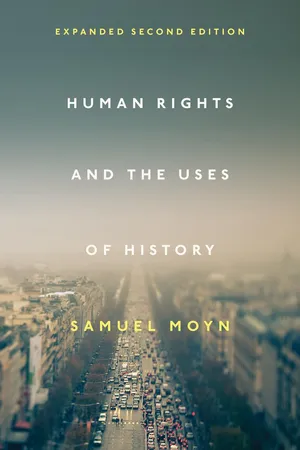
What are the origins of human rights? This question, rarely asked before the end of the Cold War, has in recent years become a major focus of historical and ideological strife. In this sequence of reflective and critical studies, Samuel Moyn engages with some of the leading interpreters of human rights, thinkers who have been creating a field from scratch without due reflection on the local and temporal contexts of the stories they are telling.
Having staked out his owns claims about the postwar origins of human rights discourse in his acclaimed Last Utopia, Moyn, in this volume, takes issue with rival conceptions - including, especially, those that underlie justifications of humanitarian intervention.
- 208 pages
- English
- ePUB (mobile friendly)
- Available on iOS & Android
eBook - ePub
About this book
Information
1
ON THE GENEALOGY OF MORALS
The enterprise of writing the history of human rights has become a widespread activity only in the past decade. Lynn Hunt’s Inventing Human Rights is its most prominent result so far, identifying the Enlightenment and the age of democratic revolutions as the moment when the cause was born.1 Yet if human rights history is now chic, it is also confused. Not long ago the president of the main American professional association of historians announced to all students of the past—whatever the place and time and subject of their research—that they “are all historians of human rights.”2 But what could such a claim possibly mean?
The most troubling shortcoming of the contemporary attempt to give human rights a history is that it distorts the past to suit the present. And in this gambit, it is late, fatally late: the current wave of human rights history is the tardy fruit of the fashion of human rights in politics, and contributors to the genre clearly set out to provide backstories to the vogue of human rights just a few years ago, when they exercised a literally millennial appeal. But the vine withered as the fruit ripened. The sad fact is that historiography has not caught up with history, and even the professionals—especially the professionals—are still providing the prologue to the idealism so powerful during Bill Clinton’s presidency.
The shift in political debate has been impossible to miss. Even those who retain an investment in human rights cannot treat them as an unquestionable good, mainly because the America that once seemed to many enthusiasts to be the prospective servant of universality abroad all too quickly became the America pursuing low-minded imperial ambitions in high-minded humanitarian tones. The effect on human rights as a public language and political cause has been staggering, and it is not yet clear whether they can recover.
If radical apostasy is the sign that times have changed, then the ideological journey of the writer David Rieff provides the most spectacular evidence. Once a paladin of human rights—and a champion of American humanitarian intervention—Rieff has now turned on the politics he once embraced. For Rieff, human rights, far from being the universal panacea he and writers such as Michael Ignatieff and Samantha Power once considered them, now stand revealed as an ideology perfectly designed to cloak the “military humanism” of empire.3 Agree with him or not, Rieff’s evolution shows that Communism is not the only god that can fail.
The conversion of Tony Judt has been less radical but more interesting. He made his name excoriating French left-wing intellectuals for their failure to champion rights—a failure he saw as rooted in their nation’s revolutionary tradition, especially when measured against Anglo-American political wisdom. Rights have an “extrapolitical status,” he wrote thirteen years ago, diagnosing as French pathology the error of making them “an object of suspicion.”4 Now he says that universalistic invocations of rights often mask particular interests—and never more so than in America’s current wars—even though he once chastised opponents of rights who took this very position. Formerly treating them as an intellectual talisman, Judt now complains in passing about “the abstract universalism of ‘rights’—and uncompromising ethical stands taken against malign regimes in their name.” He warns that such abstractions can all too easily lead those who invoke them to “readily mistake the US president’s myopic rigidity for their own moral rectitude.”5 Of course, Judt still understands himself to be a committed liberal intellectual, at a time when he thinks practically all other liberals have disappeared. But not just the world has changed; he has too, and most strikingly in his acknowledgment that his old standard can hallow many causes.6
The travails of rights today mean there is more, not less, at stake in excavating their history. Hunt’s account falls neatly into two parts. The first deals with Enlightenment humanitarianism. She argues that the early-modern explosion of novels, especially the wildly popular sentimental novels of Samuel Richardson and Jean-Jacques Rousseau, led people beyond aristocratic and religious frameworks to see one another as fellow humans worthy of empathy. In this connection, Hunt devotes an interesting chapter to the eighteenth century’s rejection of torture—a topic that gives her book obvious contemporary relevance. Since the majority of human cultures have valued or at least tolerated bodily violation, the repugnance it now inspires has to be explained. Hunt suggests that the rise of sentiment purveyed by the novel combined with a new view of the integrity of the body, with potent results. Torture—together with other corporal violence like honorable dueling, beating wives, spanking children and baiting animals—began to fall from favor in Western culture (save in exported form in colonial rule).7
It is true that a rise in compassion for suffering humanity was one ingredient in the explosion of claims for political rights. As Hannah Arendt once observed, in Roman times to call someone a “human” meant referring to him as “outside the range of the law and the body politic of the citizens, as for instance a slave—but certainly a politically irrelevant being.”8 Of course, the eighteenth century had a foundation on which it could build in conferring meaning and value on being human alone. Monotheistic religions always made room for notions of common brotherhood. The source of “empathy” with suffering humanity, for its part, has most plausibly been located in changes in medieval spirituality: Jesus began to be valued as an exemplar of corporal suffering, and Mary became central to Christian piety for having practiced the virtue of compassion.9 Meanwhile, it is familiar to credit the Renaissance for discovering (or rediscovering) the dignity of man; in his famous study of the Renaissance, Jacob Burckhardt claimed that this period elevated humanity from a merely “logical notion” to a morally resonant force.10 The eighteenth century doubtless did more to strengthen and secularize the emotive appeals to dignified and suffering humanity than it did to create them. Still, Hunt is surely right about the crucial significance of the Enlightenment—an age of feeling as much as it was an age of reason—for spreading the value of humanity as an end in itself.
If there is a connection between the eighteenth-century rise of humanitarian sentiment and the new wave of rights claims, however, it is only a very loose one. The close relationship Hunt asserts between the two is overly general, because humanitarianism did not and need not always take the form of revolutionary rights assertions or the search for legal guarantees, whether domestic or international. It is also questionable because “rights talk,” rooted in ancient Stoicism, Christian natural law and seventeenth-century contractualism, had historical lineages completely different from humanitarianism. The most sensible conclusion to take away from Hunt’s book is that the rise of humanitarianism affected and broadened the rights tradition. But it hardly determined it completely.
Hunt links the rise of the phrase “rights of man” in France after the 1750s to the efflorescence of sympathy as a cultural imperative. But, as she shows, the older language of natural rights persisted, notably in the United States. More important, in spite of her claims that this transformation was also essentially connected with the creation of a new kind of autonomous individual, the humanitarian lineage does not and cannot account for many of the central notions of the rights of man, ones that Hunt ignores: other sorts of judicial guarantees, the right to practice one’s religion, the liberty to speak one’s mind or publish freely and, above all, the protection of private property.
The second half of Hunt’s book turns to some of these subjects, in a highly readable story of the revolutionary declaration of the rights of man. She gives Americans credit for announcing human rights first (even though, again, they used the phrase “natural rights” and did not accord bodily suffering the same centrality). To their discredit, Hunt argues, the Americans did not keep the faith with their own contribution. Luckily, the French soon took up the torch, especially in their Declaration of the Rights of Man and Citizen of 1789. Hunt is most interested in what she repeatedly calls the cascading logic of human rights, whereby those who announced rights were compelled to extend them to Jews, blacks and women (or at least to consider doing so). And when groups initially excluded from humanity were not brought into the fold, as Hunt points out, they sometimes forced the issue. Early feminists like Olympe de Gouges and Mary Wollstonecraft declared the rights of women, while slaves in the French Caribbean demanded liberation.
Even restricting attention to what Hunt does cover, her massively disproportionate emphasis on bodily violation in general and on torture specifically is revealing. Hunt’s book is for an audience for whom torture—and other visible state action—is the most grievous affront to morality. But humanitarian sentiment will seem less praiseworthy to anyone who suspects that the focus on visible forms of cruelty obscures structural wrongs that are less easy to see—even when they sometimes also cause the body to suffer, as with the pangs of hunger or the exhaustion of work. This is the sense in which Hunt’s narrative is structured to provide background and authority for 1990s humanitarian idealism—and its recent after-effects. There is a relationship between George W. Bush’s justification of the Iraq War as a humanitarian campaign against “torture chambers and rape rooms” and the single-minded focus on America’s own torture sparked by the Abu Ghraib images.11 Only very recently could outrage so tightly focused on Abu Ghraib shift to deeper questions, whether about the morality and plausibility of the war and the global relations that permitted it or the inherently violent nature of occupation. Hunt’s exclusive concern with spectacular wrongs like torture therefore comes at a price. It leads her to overlook, among other things, the central place held by the right to private property in the declarations of the era, as well as the countervailing pressure for social and economic rights. Strangely, for a book about the revolutionary invention of human rights, Hunt fails even to mention either the “right to work,” which first appeared during the French Revolution, or the very different declaration of rights of 1793, which first featured it.
But in the end the main failing of Hunt’s book—and the contemporary agenda of human rights history—is not selectivity. In a highly summary concluding chapter, Hunt indicates that the point of her tale is to explain how it later became possible for the United Nations to base itself on human rights in its Universal Declaration of Human Rights (1948) and for a global movement to form. But this is to forsake an authentically historical treatment of rights in the age of revolution. And if historians miss how different rights were in the past, they will fail even to recognize what it would take to explain rights in the present.
Hunt often treats “human rights” as a body of ideas somehow insulated from history—as if they were a set of beliefs analogous to heliocentrism or relativity, needing only discovery and acceptance. The protagonists of her book are not people thinking and acting on their convictions but rights themselves, which do things like “creep,” “thicken,” “gain ground,” “gather momentum,” “reveal a tendency to cascade,” have a “bulldozer force,” “make their way ineluctably,” “take shape by fits and starts,” “take a backseat” and “remain in need of rescue.”12 Hunt provides historical details about the recognition of human rights but ultimately seems to think of them as timeless. In a few mysterious asides, she suggests that rights have biological foundations, in spite of her own demonstration of how chronologically and culturally specific they are.
But a series of interlocking contexts for the revolutionary rights at the center of Hunt’s book shows that they need to be differentiated from contemporary “human rights,” rather than seen as paving the way for their eventual triumph. So the difficulty is not just that many of the rights of the era are left out of account but that those that are examined need to be put in the proper context.
The first crucial fact is that humanitarianism could underwrite violations of rights as well as their defense. Forty years ago, Arendt argued that the explosion of pity was the source not of rights but of terror. The most important text for critically analyzing emotion in the politics of the period, Arendt’s On Revolution (1963), interpreted Maximilien Robespierre’s Terror not as an act of demented criminality but as the first politics based on feeling others’ pain. But for Robespierre, the alleviation of suffering required what he called “a compassionate knife” to lance the dangerous pustules on the body politic, purging the enemies of virtue without and within. The results were catastrophic: “Par pitié, par amour pour l’humanité,” petitioners from the Paris Commune wrote to the National Convention, “soyez inhumains!”—out of pity and love of humanity, you must be inhuman.13 Hunt briefly acknowledges some of the dark sides of a culture of sentimental virtue, like sensationalism and compassion fatigue. But the Terror is not in her book, and so she does not confront Arendt’s disquieting contention that “pity, taken as the spring of virtue, has proved to possess a greater capacity for cruelty than cruelty itself.”14 (It is not for nothing that Communist parties, particularly the French one, have always seen 1917 as the logical successor of 1789.)
If humanitarianism could have ambiguous consequences, so could rights themselves. Some historians have attached great significance to the fact that the French, even in 1789, did not proclaim the rights of man alone; they declared the rights of “man and citizen,” as part of a paean to the general will. From the outset of the French Revolution, there was a conceptual and political dilemma between membership in humanity and membership in a collective. And what if a choice arose between honoring the rights of men and preserving the community of citizens? The doyenne of the field, Hunt has for a few years been insisting that the French Revolution needs to be defended as a progressive victory against those skeptics who would reduce the event to its violence and terror. She deserves great credit for doing so, but it is rather disappointing that she fails to address how revolutionary-era rights might be salvaged from their implication in the bloodshed that so swiftly followed upon their announcement.
The abolition of torture, climaxing in the Revolution, also needs to be understood in a larger context of the changing deployment of violence. In her study of the campaign against torture, Hunt echoes Michel Foucault’s view in Discipline and Punish that modernity forced the state to relinquish its hold on the body; but while Foucault famously argued that this departure involved more insidious forms of control, Hunt defends it as a good thing. Yet both overlook the fact that the violence involved in what Hunt calls the “sacrificial rite” of punishment under the Old Regime—in which the criminal’s public torture provided communal expiation—persisted in novel and magnified forms.15 As historian David Bell spells out in a fascinating book, the invention of total war over the revolutionary years, whose explosion swamped the world with more devastating violence than ever, was the new and often more frightening guise that public sacrifice could take.16
In her last pages, Hunt allows that the rise of humanitarianism and the upsurge of carnage are historical twins, thanks especially to the quintessentially modern penchant to sacrifice oneself and others in war waged for humanity’s sake or at least in humanity’s name. But she seems not to grasp that this admission amounts to a considerable qualification of her thesis, and she follows this insight with the bland reassurance that empathy “has become a more powerful force for good than ever before.”17
In contrast to Judt—not to mention Karl Marx, to whose critique of the language of rights she devotes only a desultory page—Hunt is not sensitive to the way that formalistic invocations of rights can sometimes mask narrow agendas. For her, the true significance of this same “abstract universalism” is that it can permit proliferating rights claims. But what is at stake in interpreting the unintended consequences of abstraction is nowhere more in evidence than in recent shifts of views about the meaning of the Haitian uprising of 1791–1803. Until recently, the standard interpretation of the “Black Jacobins” of the Caribbean—in the phrase C. L. R. James gave to his 1938 masterpiece on the su...
Table of contents
- Cover Page
- Halftitle Page
- Title Page
- Copyright Page
- Dedication
- Contents
- Preface
- 1. On the Genealogy of Morals
- 2. The Surprising Origins of Human Dignity
- 3. On Altruism Without Politics
- 4. Spectacular Wrongs: On Humanitarian Intervention
- 5. Of Deserts and Promised Lands: On International Courts
- 6. Human Rights in History
- 7. The Intersection with Holocaust Memory
- 8. Torture and Taboo
- 9. Soft Sells: On Liberal Internationalism
- 10. Reclaiming the History of Duties
- Epilogue: The Future of Human Rights
- Notes
- Acknowledgments
- Index
Trusted by 375,005 students
Access to over 1.5 million titles for a fair monthly price.
Study more efficiently using our study tools.
Frequently asked questions
Yes, you can cancel anytime from the Subscription tab in your account settings on the Perlego website. Your subscription will stay active until the end of your current billing period. Learn how to cancel your subscription
No, books cannot be downloaded as external files, such as PDFs, for use outside of Perlego. However, you can download books within the Perlego app for offline reading on mobile or tablet. Learn how to download books offline
Perlego offers two plans: Essential and Complete
- Essential is ideal for learners and professionals who enjoy exploring a wide range of subjects. Access the Essential Library with 800,000+ trusted titles and best-sellers across business, personal growth, and the humanities. Includes unlimited reading time and Standard Read Aloud voice.
- Complete: Perfect for advanced learners and researchers needing full, unrestricted access. Unlock 1.5M+ books across hundreds of subjects, including academic and specialized titles. The Complete Plan also includes advanced features like Premium Read Aloud and Research Assistant.
We are an online textbook subscription service, where you can get access to an entire online library for less than the price of a single book per month. With over 1.5 million books across 990+ topics, we’ve got you covered! Learn about our mission
Look out for the read-aloud symbol on your next book to see if you can listen to it. The read-aloud tool reads text aloud for you, highlighting the text as it is being read. You can pause it, speed it up and slow it down. Learn more about Read Aloud
Yes! You can use the Perlego app on both iOS and Android devices to read anytime, anywhere — even offline. Perfect for commutes or when you’re on the go.
Please note we cannot support devices running on iOS 13 and Android 7 or earlier. Learn more about using the app
Please note we cannot support devices running on iOS 13 and Android 7 or earlier. Learn more about using the app
Yes, you can access Human Rights and the Uses of History by Samuel Moyn in PDF and/or ePUB format, as well as other popular books in Politique et relations internationales & Philosophie politique. We have over 1.5 million books available in our catalogue for you to explore.