"We fight for our religion, for our women, for our land, and lastly to save our skin. As for them, they're only fighting to save their skin."
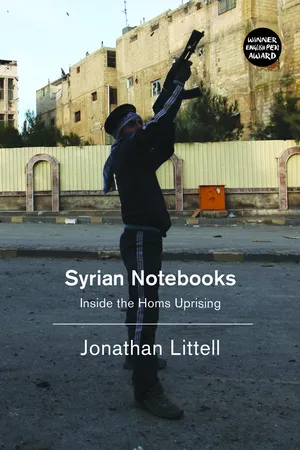
In 2012, Jonathan Littell traveled to the heart of the Syrian uprising, smuggled in by the Free Syrian Army to the historic city of Homs. For three weeks, he watched as neighborhoods were bombed and innocent civilians murdered. His notes on what he saw on the ground speak directly of horrors that continue today in the ongoing civil war.
Amid the chaos, Littell bears witness to the lives and the hopes of freedom fighters, of families caught within the conflict, as well as of the doctors who attempt to save both innocents and combatants who come under fire. As government forces encircle the city, Littell charts the first stirrings of the fundamentalist movement that would soon hijack the revolution.
Littell's notebooks were originally the raw material for the articles he wrote upon his return for the French daily Le Monde. Published nearly immediately afterward in France, Syrian Notebooks has come to form an incomparable close-up account of a war that still grips the Middle East-a classic of war reportage.
- 256 pages
- English
- ePUB (mobile friendly)
- Available on iOS & Android
eBook - ePub
About this book
Information
Topic
HistoireSubtopic
Histoire du Moyen-OrientWednesday, February 1
Baba ‘Amr
Slept well despite the cold. Dreams: riots, automatic weapons, beach, students, episodes combining these elements. When I wake up, around 9:00 AM, a few mortar shells, a little further away. Our host has left but one of his friends makes us breakfast.
We go out to phone, the apartment doesn’t have any reception. In front of Hassan’s command post, ‘Alaa, Fadi, and some other guys are drinking tea, beneath a newly installed awning to keep out the rain. It’s nice out. Ra’id calls Ibn Pedro: he has guests, and no planned time for departure. He’ll call back. Abu Bilal informs him about the situation at the center: there is fighting everywhere, Safsafi is cut off, it’s really war.
‘Alaa explains their plans for the soldiers surrounded in the building: they’re going to mine the supporting pillars, then give them a choice between coming over to their side, or being blown up.
The mortars start up again, one very close, Ra’id hears it whistle. I tell him it’s good if you can hear the whistle: if you can hear the whistle, it’s not for you. He looks rather unconvinced.
11:30 AM. It’s raining now. Still no news from Ibn Pedro. We go to the mosque, where I remain sitting in a corner, alone, as Ra’id goes out to attend to his affairs. Little by little, the men come in to pray.
We go to the school [the headquarters of the Military Council]. Muhannad isn’t there. There’s an Irish woman journalist, with Jeddi and Danny, looking harassed. Jeddi yells at Ra’id: “Danny, translate. I’m fed up with him! He wants war, war, war. Humanitarian questions don’t interest him.” Ra’id: “No need to translate, my friend.” The young woman wants to leave tomorrow, and I ask to leave with her, in case.
I had met Danny Abdul Dayem, a young twenty-three-year-old Syrian-Brit, at Abu Bari’s clinic the same day we arrived in Homs, and I was struck by his perfect English, a very rare thing here. He himself was just returning from vacation in England, and welcomed my suggestion to come work with me. During the following days it was impossible for me to find him or even to speak with him on the phone. We would learn later on that he had immediately been picked up by the Information Bureau, with whom we didn’t have the best relations. After my departure, when the systematic bombing of Baba ‘Amr began, Danny began appearing several times a day on YouTube, denouncing in English the atrocities filmed by the activists and calling for international help. On February 13, as the shelling was intensifying, he left Baba ‘Amr to find refuge in Lebanon. He has since then granted several interviews to English-language television networks about the horrors he witnessed.
1:00 PM. We find Imad in front of Hassan’s command post, looking harassed, I don’t know if it’s because of us or something else. No sign of Ibn Pedro. “The way isn’t free,” Imad states, tired. I return to the apartment, at least it’s warm.
A feeling of imprisonment takes shape. It’s been five days now that I’ve been trying to leave, the guys are furtive, not clear, there’s shelling, Ra’id is annoyed by everything, me, the situation, his computer that keeps crashing, the phone network doesn’t work well and it’s hard to communicate, it’s what is called a shitty situation, I guess. And there is absolutely nothing to be done.
Visit to Imad’s clinic, to look for Abu Salim. He isn’t there. In front of the clinic, stickers from the Syrian Arab Red Crescent, laughable protection. Work setting up the operating room. Quick visit from ‘Abd ar-Razzaq Tlass, who has come to see how the work is advancing. Several wounded: a person badly burned, after a gas explosion caused by a mortar shell on Monday, a man machine-gunned Sunday at a checkpoint in Insha’at, a young guy with his face burned who caught the backfire of a shell that fell at the foot of his building, through the window of his apartment, five days ago. Now he’s doing better, he explains all this to us with his face covered with cream, and shows us a photo of himself taken a few days ago, his head completely wrapped in bandages. The man wounded by bullets is a taxi driver who was coming from Damascus with a passenger and who was machine-gunned at 4:00 AM by a checkpoint.
Arrival of Dr. ‘Ali, the living martyr. “Yesterday was a slaughter.” Seventeen wounded. Of course, no one told us anything, or showed us anything.
Around 4:00 PM, arrival of Abu Hanin, from the Information Bureau, the Maktab al-I’ilami. He immediately tears into me, in English. “I don’t even know you,” I reply. “Yes, but I spoke with him last week,” he says, pointing to Ra’id. “He said he’d be back in ten minutes, and you guys disappeared.” The Irish woman is leaving in half an hour. Can’t I go with her? “No, you can’t. You guys say you are on your own, fine, you say you can manage, fine, now manage with your people.” Things are getting out of hand. Ra’id intervenes and it starts, half in English, half in Arabic.
Abu Hanin: “You see, we are Arabs. This is how it is with Arabs.” Ra’id: “This has nothing to do with Arabs. I’m Arab too.” The guy is grotesque, aggressive, incoherent. We sense he can’t stand the fact that we bypassed them. Finally, he turns to me: “Why do you say to him you cannot go because we have a problem? I never said that. You have fresh material, of course it is in our interest that you publish it. If we can help you go out, we will. But we can’t. You can’t go with the woman.” I try to smooth things out, finally he gives me a sensible explanation: “She’s leaving in a truck, veiled, disguised as a Syrian woman, with Syrian papers. You think you can leave like that? You think so?” I do my best to calm him down, smooth over the misunderstanding, but he is out of control. Finally, we agree that he’ll help me if he can.
In the apartment. Tea, reading. A few men are sleeping or resting. Around 5:30 PM, a series of mortar shells, not far, near the cemetery. Hassan arrives with his two boys, very cute and shy. The guys have the children play with pistols, safety on but loaded.
6:00 PM. An Mi-24 combat helicopter is whirling around the neighborhood. The guys are unhappy with the performance of Alain Juppé at the Security Council. They start playing a video game, soccer. Ra’id disappeared hours ago, no news.
I ask ‘Alaa to take me on motorbike to find Ra’id. He doesn’t know where to go but we’ll look. We weave through the puddles, go down a long avenue with our lights out, reach the second health center, Imad’s, then from there the clinic, the one where we were this afternoon; there, they direct us to a first activists’ house, but it’s the one where we had met the Communist lawyer, there are just a few guys there, finally we find the apartment of the maktab. Ra’id is indeed here, with Marcel, working on his computer to try to save his files. I thank ‘Alaa who leaves.
There are dozens of activists sprawled everywhere, glued to their laptops, all on YouTube or Facebook or Twitter. Someone offers me a chicken and fries sandwich and lends me a Mac, e-mail finally, terribly slow. The Irish journalist has already left. Abu Hanin probes me: “Why didn’t you come see us? Why did you avoid us?” I answer diplomatically. When I mention the term al-Maktab al-I’ilami, Abu Hanin denies that such a bureau exists: “We’re just a group of friends, that’s all.” On the walls, photos of martyrs. Brief political discussion, but it doesn’t go far.
More discussions later. Abu Hanin tells me that if our guys can get me across the autostrad, his can take care of the rest. Promises me that if there is a way, he’ll get me out tomorrow or Saturday. Friday isn’t good, it’s a dangerous day because of the demonstrations.
Ra’id is completely absorbed in his computer problems and barely pays attention when I talk to him. Finally I leave him there and have a friend of the living martyr take me back to the apartment.
Thursday, February 2
Baba ‘Amr – al-Qusayr – border – Beirut
10:30 AM. Breakfast of bread, olive oil, za‘atar, green olives, and tea with Hassan, Imad, and Ahmad. No sign of Ra’id. Imad assures me I’m leaving today, communicates that Ibn Pedro is checking out the route. No one answers the phone. We wait.
11:00 AM. Ra’id arrives. Vague, evasive, exhausted after having spent the night on his computer, barely says hello. Speaks with Imad but doesn’t translate anything, doesn’t explain anything. Then goes to the neighbor’s place where we had slept the day before yesterday. Five minutes later, arrival of Ibn Pedro. “Yallah.” I want to wait for Ra’id, but he refuses: “Yallah, yallah.” I get into a car where there are already two other people who are also leaving. Departure. I call Paris and explain the situation, but no way to reach Ra’id, who still hasn’t changed his SIM card.
Two phone networks function in Homs, Syriatel and MTN. Ra’id had an MTN number but, since our return to Baba ‘Amr, MTN was working more and more poorly; Syriatel too, actually, but better than MTN. I had thus suggested to Ra’id that he switch to Syriatel, which he would do a little later on. A few days later, all the cellphone networks in Homs were cut off. As I write this, they still haven’t been re-established.
Crossing of the autostrad. It is 12:40 PM. In a house a little further on, the men who left in front of us are praying while they wait for us. Despite his difficult, temperamental side, Ibn Pedro has a magnificent illuminated smile, which lights up as soon as prayer is over.
We separate: the other two leave one way, me the other, with Ibn Pedro and a driver, in a little Suzuki pickup truck, directly for Lebanon apparently. Ibn Pedro has a Kalashnikov stuck between his legs, the driver is armed too, if we come across a flying checkpoint things will go sour. On the road, the two men remain glued to their cellphones, Ibn Pedro has three, the network doesn’t work well at all but from time to time they receive information. The sun is shining, it illuminates all the flat countryside and the murky puddles, we alternate between muddy paths and well-traveled roads, passing through several villages; in the distance, the Djebel Lubnan bars the horizon, pale blue, a long fringe of white clouds clinging to its snowy peaks. It’s warm in the passenger compartment, the truck jolts along, we pass smugglers on motorbikes loaded with jerrycans of fuel oil, farmers on tractors, Bedouin camps, green, muddy fields.
1:30 PM. Stop in a village. On the TV, Isma‘il Haniyeh. The driver who dropped off the other two joins us, it’s Abu ‘Abdallah, the same man who had brought us to Homs. No idea of the waiting time, no one tells me anything and in any case I’d be hard pressed to understand. I try to resume the Comparison of Lysander with Sylla, but they bring me lunch, copious and superb as usual, with hard-boiled eggs and ful in sauce. Afterwards, I read, the wait stretches on. Ra’id finally calls and confirms that they’re taking me directly to Lebanon, insha’Allah.
2:30 PM. We leave, with Abu ‘Abdallah. Roads, villages, then a muddy, rutted path, the same one we took going in. We pass endless streams of trucks and vans, transporting merchandise in the other direction. Then again a road where we meet up, to my immense pleasure, with my old friend Fury and his aging pickup. He takes me with Ibn Pedro to al-Qusayr, to the same house we had stayed at on the way in, Abu Amar’s, who is still as welcoming and warm. Mayte [Carrasco, a Spanish journalist friend, who works for TV Cinco] is in town, Fury takes me to where she’s staying with her colleagues, and I quickly explain the situation to them. They’ve been in al-Qusayr for five days, they’re still waiting to get into the city. Could Ibn Pedro bring them in? I go back to Abu Amar’s house with the activist who’s shepherding them, a guy from al-Qusayr who speaks a little English. Ibn Pedro’s answer: I’ll take them if Abu Hanin asks me to. But Abu Hanin can’t be reached. Bukra sabah, insha’Allah.
Fury receives a phone call: the way is clear. At 4:30 PM we leave, again piled into the pickup’s cabin, three of us with Ibn Pedro. The Kalashnikov is still there, but first we go to drop it off at the farm where we had gone to meet the commander, on the way in; Fury, however, keeps his grenade, which he waves in front of me, laughing. We also stop by another house from which he emerges with a small bag full of dollars, 100-dollar bills, the famous “Ben Franklins,” and wads of Syrian pounds, as well as a box of dates, soft and exquisite. The journey to the border takes an hour, the same roads as we took on the way in. The sun sets behind the Jabal, the puddles shine in the mud like pale yellow mirrors, the sky turns pale, everything is blue and brown and green. Traffic jams of trucks of all sizes at an FSA checkpoint, the vans get stuck in the mud, the men push. Fury and Ibn Pedro have a discussion, I don’t know about what. Then finally a road, Fury pushes his pickup to 100–120 kph, it’s even more terrifying than the possibility of a flying checkpoint. Detour to drop by a house where thick wads of Syrian pounds are stacked next to the sobia. “Bukra Lubnan,” the host, an obese man, tells me with a big smile, “alyoum hun.” Me, crestfallen: “What, fi mishkil? Alyoum maf fi Lubnan?”54 Fury laughs: “Yallah, yallah.” In fact the man just wanted to offer me hospitality, as is the custom. Fortunately they’re no Georgians, he doesn’t insist. As we leave, in the cabin, Ibn Pedro stuffs the wads of bills into a plastic bag, the same wads that were near the sobia I think. Fury barrels down the roads, night falls, he passes other vehicles without slowing down, speeds through a village, weaving between motorbikes and pedestrians in the dark. Finally, in another village, a house, the same one as on the way in, with the same host. Brief wait, the motorbikes are coming to get us. With night the cold has come, I’m freezing on the motorbike that bumps between the puddles with its lights out, the driver guides himself from the light of the moon. Above the stars are shining, I recognize Orion, the Pleiades. Crossing.55 Some young soldiers are warming themselves and joking in a hut, the motorbike stalls, no problem. Another house: outside, in front of a brazier, I warm my hands, alone for a moment, it’s wonderfully soothing.
After they usher me into the reception room of the house. There’s an old gentleman with a baby on his knees, to whom I give some cough drops, and, a rare thing, a lady who starts invoking Allah when I tell her I have two children. Then it’s time to leave. Ibn Pedro has disappeared, and Fury, with whom I take a souvenir photo, isn’t coming. We say our farewells and Fury packs me into a small pickup truck loaded with God knows what, together with two farmers, a skinny little guy with a moustache and a fat one, repeating “Beirut, Beirut” with a big smile. Davai, Beirut, apparently from here on it’s easy. In fact it’s going to be the Keystone Cops, probably the worst part of the journey. A kilometer further on, they motion to me to get out of the vehicle, together with the fat gut: we’re approaching a Lebanese Army checkpoint, we have to go around it. The fat guy takes my bag and we begin walking through plowed fields, the mud is sticky but fortunately not too soft. Very soon, I realize that we’re walking right through the white light of the checkpoint’s spotlight, my shadow stretches across the plowed field for a dozen meters, they must see us as in broad daylight and it would be a pigeon shoot. They don’t shoot, we slowly emerge from the spotlight’s beam, but the fat guy starts running, I follow as well as I can, we cover maybe half a kilometer like that, dogs are barking around the checkpoint, in the distance I can see the pickup, which on its side has passed the checkpoint, stopped with all its lights off. Just at that instant a vehicle arrives on the road, we run and I jump into the pickup with the fat guy, just in time. It’s a civilian truck, if it had been an Army vehicle we’d have been fucked.
We start off, rejoin the highway where we had met the motorbikes on the way in, and we speed up, going as fast as the old heap allows, which isn’t bad. Then finally we arrive in front of a big checkpoint, the border post apparently. The guys park right next to it, alongside another pickup truck, and we get out. There’s a dubious-looking shop in front of the checkpoint, to the right, with an impassive man in a keffiyeh standing in front. I follow the mustachioed farmer inside and watch him exchange a few words with the storekeeper. Then I go back out, still under the gaze of the man in the keffiyeh. The fat guy grabs me, drags me next to the shop, and motions to me to pretend to piss. I pretend to piss. When he turns around, I turn around too. Just in front of the checkpoint, a massive man with a crew cut and a leather jacket, who’s just getting out of a military-looking jeep, starts yelling at me in Arabic. He’s obviously an officer, even if he isn’t in uniform. I look at him, shrug my shoulders, and head for the pickup truck. Next to me, the fat guy smiles at him inanely. We get into the pickup and start up. The officer has already lost interest in us and is heading for the shop. We make a U-turn and start at top speed on the main road. I look, but the military isn’t following us. Out of precaution, I erase the souvenir photos of Fury. After a few kilometers, finally, we turn on to a dirt path to the right of the road. I wonder why the hell we just didn’t take it straight off. Jolts, we skirt round the checkpoint, enter the town from above, in front of a big modern church, then we find the road again and continue on. A little further on we pass another checkpoint, but it’s a normal Army checkpoint, we pass without trouble.
Further on, the two farmers stop a minivan and bundle me into it: “Taxi, taxi, Beirut.” Long journey via Ba‘albik, passengers get in and out. In Chtaura, before the climb, a young woman gets in and sits in front: the first woman’s hair I’ve seen for eighteen days, aside from Mayte’s. During the ascent, stop at a supermarket, the driver’s assistant and one of his pals buy some wine and offer me some in a plastic cup: coarse, rough, bad, it’s divine. The pass is snow-covered and very beautiful in the night. Then it’s the long descent toward Beirut.
Rip-off attempt at arrival, when I get droppe...
Table of contents
- Cover Page
- Halftitle Page
- Title Page
- Copyright Page
- Contents
- Maps
- Introduction to the Verso Edition
- Preliminary Note
- Monday, January 16: Tripoli, Lebanon
- Tuesday, January 17: Tripoli – border – al-Qusayr
- Wednesday, January 18: Al-Qusayr
- Thursday, January 19: Al-Qusayr – Baba ‘Amr
- Friday, January 20: Baba ‘Amr
- Saturday, January 21: Baba ‘Amr
- Sunday, January 22: Baba ‘Amr
- Monday, January 23: Baba ‘Amr
- Tuesday, January 24: Baba ‘Amr – al-Khalidiya – al-Bayada
- Wednesday, January 25: Al-Bayada – Safsafi – Bab as-Sba‘a – Safsafi
- Thursday, January 26: Safsafi – Bab Drib – Karam al-Zaytun – Bab Tadmur – Safsafi
- Friday, January 27: Safsafi – Bab Drib – Safsafi
- Saturday, January 28: Safsafi – Baba ‘Amr – al-Khalidiya – al-Bayada
- Sunday, January 29: Al-Bayada
- Monday, January 30: Al-Bayada – al-Khalidiya
- Tuesday, January 31: Al-Khalidiya – Baba ‘Amr
- Wednesday, February 1: Baba ‘Amr
- Thursday, February 2: Baba ‘Amr – al-Qusayr – border – Beirut
- Epilogue
- Table of Ranks
Trusted by 375,005 students
Access to over 1.5 million titles for a fair monthly price.
Study more efficiently using our study tools.
Frequently asked questions
Yes, you can cancel anytime from the Subscription tab in your account settings on the Perlego website. Your subscription will stay active until the end of your current billing period. Learn how to cancel your subscription
No, books cannot be downloaded as external files, such as PDFs, for use outside of Perlego. However, you can download books within the Perlego app for offline reading on mobile or tablet. Learn how to download books offline
Perlego offers two plans: Essential and Complete
- Essential is ideal for learners and professionals who enjoy exploring a wide range of subjects. Access the Essential Library with 800,000+ trusted titles and best-sellers across business, personal growth, and the humanities. Includes unlimited reading time and Standard Read Aloud voice.
- Complete: Perfect for advanced learners and researchers needing full, unrestricted access. Unlock 1.5M+ books across hundreds of subjects, including academic and specialized titles. The Complete Plan also includes advanced features like Premium Read Aloud and Research Assistant.
We are an online textbook subscription service, where you can get access to an entire online library for less than the price of a single book per month. With over 1.5 million books across 990+ topics, we’ve got you covered! Learn about our mission
Look out for the read-aloud symbol on your next book to see if you can listen to it. The read-aloud tool reads text aloud for you, highlighting the text as it is being read. You can pause it, speed it up and slow it down. Learn more about Read Aloud
Yes! You can use the Perlego app on both iOS and Android devices to read anytime, anywhere — even offline. Perfect for commutes or when you’re on the go.
Please note we cannot support devices running on iOS 13 and Android 7 or earlier. Learn more about using the app
Please note we cannot support devices running on iOS 13 and Android 7 or earlier. Learn more about using the app
Yes, you can access Syrian Notebooks by Jonathan Littell, Charlotte Mandell in PDF and/or ePUB format, as well as other popular books in Histoire & Histoire du Moyen-Orient. We have over 1.5 million books available in our catalogue for you to explore.