- 176 pages
- English
- ePUB (mobile friendly)
- Available on iOS & Android
eBook - ePub
About this book
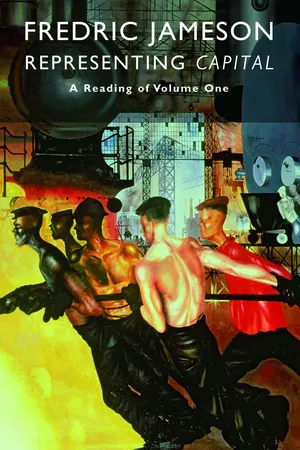
Representing Capital, Fredric Jameson's first book-length engagement with Marx's magnum opus, is a unique work of scholarship that records the progression of Marx's thought as if it were a musical score. The textual landscape that emerges is the setting for paradoxes and contradictions that struggle toward resolution, giving rise to new antinomies and a new forward movement. These immense segments overlap each other to combine and develop on new levels in the same way that capital itself does, stumbling against obstacles that it overcomes by progressive expansions, which are in themselves so many leaps into the unknown.
Information
Topic
PhilosophySubtopic
Critical TheoryChapter 1
The Play of Categories
The first three chapters of Capital (“Part One: Commodities and Money”10) are the most widely read and studied section of the book and also the most controversial. The concentrated dialectical language of these chapters (“flirting with Hegel,” as Marx put it) has been deplored by those who feel that it renders these chapters inaccessible to the general reader and in particular to working class people, but also that an essentially idealistic Hegelianism is incompatible with Marx’s materialism, which emerged, indeed, from the latter’s determination to free himself from it. Meanwhile, these chapters return Marxism to a philosophical framework which Marxian political economy (or rather its critique of political economy) decisively displaced from the outset. Louis Althusser, the most influential proponent of this position, recommended that this section be skipped on first reading, and also that a prudent distance be observed between the mature texts and those still essentially philosophical musings on “alienation” (the 1844 manuscripts) with which Marx’s study of political economy began. (Many years earlier, from an equally anti-dialectical, although a philosophically quite distinct standpoint, Karl Korsch had advised a similar strategy and a similar vigilance.11)
A certain plausibility is lent Althusser’s position by Marx’s own hesitations on the subject. He rewrote a first, simpler exposition for the second edition of Capital, adding many of the dialectical bravura pieces to which Althusser objected; later on, for the French translation, he went back and tried to resimplify much of the same material. It may also be added that in reality the “final” text of these chapters was itself initially also a rewrite of his preceding little book or pamphlet, A Contribution to the Critique of Political Economy (1859),12 so that one may be justified in taking a longer look at the uncertain place of this whole section in the overall plan (without particularly wanting to offer psychological speculations as to Marx’s perfectionism or his propensity to leave projects unfinished).
Meanwhile, for many, the first three chapters contain virtually all the essential propositions of Capital itself and this section stands as the unavoidable entryway to that work as a whole. To amputate the latter of its exposition of the theory of value is to reduce the remainder to a vulgar economics treatise, not much more elevated than the standard works of political economy it so devastatingly analyzes and criticizes. For the theory of value is something like Capital‘s hermeneutic dimension: it secures the existence, behind all appearances of price and market exchange, of those deeper laws which it is the vocation of Marxian theory to bring to light, and without which the “violent fluctuations” (782) as well as the irreversible expansion of capitalism, along with its emergence and dissolution, can scarcely be understood. In this sense, Marx’s version of the labor theory of value dramatically solves one of the age-old mysteries of the market (how can anyone make money out of a fair exchange?).
On the other hand, it should be pointed out that the labor theory of value is not expounded in these first chapters, only appearing for the first time in Chapter 6. Part One assuredly trains us in the habit of seeking out the essences behind appearances, as Hegel might put it; yet the decisive invitation “to leave this noisy sphere” of circulation and the market (“where everything takes place on the surface and in full view of everyone”), and to follow the capitalist and the worker “into the hidden abode of production” (279)—this invitation is not extended until the end of Chapter 6. Where Part One takes us proves on the contrary to be the same dead end in which the preceding work had left us, namely a theory of money which will scarcely play a role in the main body of Capital and whose most useful contribution to this immense analysis of capitalism will be to show that money is itself a symptom of underlying structural contradictions (that is to say, a “mediation,” a stopgap solution which does not resolve the contradictions themselves but only “provides the form within which they have room to move” [198]; we will return to this important formulation later on).
Marx has thus here moved backward rather than forward: he has taken as a point of departure the endpoint of the earlier Critique, its coming to rest on a theory of money, and returned to deepen and complexify, to philosophize its starting point in the commodity form, in the process emerging from this renewed immersion with the theory of value; but he has scarcely made a further beginning with the theory of capital, which only gets going in Chapter 4.
This is my rationale for returning Part One to its previous form and seeing it as a small but complete treatise in its own right, like its predecessor. Nor is it to be considered in analogy to the overture of an opera, but a smaller satellite unity of the type of Wagner’s Rheingold (pondered at much the same time as Marx’s chapters)—a short opening spectacle to inaugurate the tretralogy, just as in ancient Greece the satyr play concluded it. It is a solution which satisfies Althusser’s objections, to the degree to which we are now able to see it as a related yet semi-autonomous discussion in its own right, one which lays the ground and frees the terrain for the principal task to come, and as a more finished product, perhaps, a more lovingly formed and polished artifact than the Hauptwerk to follow (of which, to be sure, Marx was in any case proud enough).
This approach by no means abruptly dismisses the first three chapters, as Althusser sometimes seems scandalously enough to do; nor does it disdain the dialectical flourishes and figural enrichment of these pages, which rather betray some of the most interesting secrets of Marx’s creativity. But it does allow us to ask questions about form and about autonomy which may also offer useful insights and a equally new perspective when we come to the last section of Capital (Part Eight, on so-called primitive accumulation). It may also prove useful when we confront the three enormous and virtually self-sufficient chapters which seem to interrupt the movement of the book like islands in the sea, namely those on “The Working Day” (Chapter 10), on “Machinery and Large-Scale Industry” (Chapter 15), and on “The General Law of Capitalist Accumulation” (Chapter 25).
One of the ways of reading Capital—that is, of grasping the place of its individual analyses and propositions in the construction of the whole—lies in seeing it as a series of riddles, of mysteries or paradoxes, to which at the proper moment the solution is supplied. Unsurprisingly, this solution will be a dialectical one; it will not dissipate the strangeness of the initial paradox or antinomy by way of a dry and rational unmasking, but preserve the strangeness of the problem within the new strangeness of the dialectical solution. The elaboration of these riddles is of unequal length; they overlap, they find their dénouements at unpredictable moments, in which from time to time the identity of some of the riddles with each other is unexpectedly revealed. To be sure, the riddle of riddles is capitalism itself, and how in its radical difference from all other social formations (or modes of production) it can exist in the first place.
Part One, indeed, unlike the main body of Capital—as we will henceforth call the text that develops from Part Two through Part Seven—contains a number of illustrative references to radically different modes of production: There are the four “forms of production” (Chapter 1) from which “the commodity vanishes” along with its theoretical problems: the Robinsonade, medieval (feudal) Europe, the peasant family, and the “association of free men” (socialism).13 Later on (pp. 182ff) we have the Indian village and the Inca mode of production (what in the Grundrisse Marx called the Asiatic mode of production).14 These examples are usefully illuminated by the Althusserian distinction between structural domination and structural determination.15 The determination of all these social formations is to be sure economic, in the sense of the type of production current in each. Yet the unifying ideology of each one—the dominant—may well be quite different: various forms of religion, or else the ethos of the polis or ancient city-state, or power relations and personal domination, as in feudalism (not to mention the now unmentionable Asiatic mode, unified by way of the God-emperor at its center). In these cases the ideological or religious dominant is distinct from its determinant in the type of production involved: only in capitalism are these two things identical, and the economic determinant is also the secular dominant (or in other words its structuration by the money form). If this seems already too mysterious we may rephrase it in terms of community or collectivity (Gemeinschaft): the various pre-capitalist societies, whatever their technical production, are all organized collectively: only capitalism constitutes a social formation—that is, an organized multiplicity of people—united by the absence of community, by separation and by individuality.
Meanwhile, it is true that the identity of dominant and determinant in capitalism in principle constitutes it as the first transparent society, that is to say, the first social formation in which the “secret of production” is revealed. Indeed, it is this transparency which grounds the truth claims of Marxism, a knowledge of society only being possible when commodification has become tendentially universal, that is, when wage labor has largely superceded all other forms of class relationship.16 Yet this possibility of truth in capitalism is immediately occulted by ideology in the narrower sense of what ideologists produce and invent to conceal that truth. Thus, for one thing, the understanding of pre-capitalist societies (indeed, the very possibility of their existence as alternatives to this one) is at once dispelled: “the pre-bourgeois forms of the social organization of production are treated by political economy in much the same way as the Fathers of the Church treated pre-Christian religions” (175); or alternately, “they believe that there once was history, but there isn’t any any more” (175n.). For another, various ideological versions of a capitalist “dominant” are elaborated in order to simulate a unity of capitalist society which is analogous to those pre-capitalist societies, or in other words which seems collective. In our time, to be sure, this dominant takes the form of the “market,” now generalized into a metaphysical principle (and a permanent feature of human nature as well); the market (reduced by Marx to “the sphere of circulation,” or simply “exchange”) is then proclaimed to be a unifying principle and some equivalent (but better and somehow more natural) form of collectivity. The whole of Part One may then be understood as a wholesale attack on the ideology of the market, or if you prefer, a fundamental critique of the concept of exchange and, indeed, of the very equation of identity as such.
We must accustom ourselves to the principle of dialectical synonymity: the process whereby a critique is waged on several levels of implication at once, so that the critique of the equation will lead on (through various mathematical developments and speculations in which Marx delighted and which are mostly not indulged here in Capital)17 into a critique of identity which finds its kinship in Hegel’s identity of identity and non-identity, that is, his dialectic of identity and difference (which ceaselessly turn into one another), but which then in its multiple developments far exceeds Hegel’s original version; a critique of more specific economic (or political-economic) theories or ideologies of the dynamics of the exchange of goods and the equivalence of their values; not to speak of the legal “equality” of individuals “free” to sell their labor power under capitalism: the critique of the “contract,” then, not to speak of equilibrium; the spuriousness of any thematization of self-consciousness as a mirror reflexion of consciousness; and finally that of the abstraction involved in equating one concrete thing or phenomenon with another. A dialectical critique or critical force-field will then variously impact all of these apparently synonymous levels of equality or equivalence—the philosophical, the political, the economic, the ideological, the productive—in the process not omitting a return to the ideological equivalence which has identified them all with one another by insisting on the specificity of production as opposed to circulation or consumption. But it is also important to stress the dialectical nature of these critical operations in the following way: the repudiation of equivalences or identities does not simply result in the affirmation of differences; for the very act by which different objects are set in equivalence with each other already presupposes difference as such. Rather, as we shall see, the very alternation between identity and difference must be destabilized in another (more dialectical) way.
Yet the very tendency to do so itself reveals yet another fundamental feature of the critical process, which is its relationship to and dependence on dualities. I am tempted to characterize this as a pre-philosophical matter, indeed, something like a pre-Socratic bedrock of the dialectic as such. I have spoken elsewhere of the kinship of the dialectic with the binary oppositions of structuralism.18 Now it is duality itself that comes into play and complicates matters, for it cannot be dealt with by way of the simple positivities of structuralist analysis. Duality must be affirmed when it has been forgotten or ideologically repressed; it must be denounced when it is deployed in all kinds of obscurantist strategies; nor can it be affirmed as a metaphysical principle (as I was just tempted into doing), for it is not eternal but rather always situation-specific and singular, and to that degree even its methodological or structural generalization and characterization as “the dialectic” is obscurantist and misleading.
Still, it is unavoidable to begin with the dualities that crowd the first pages of this text, however we find ourselves able to dispatch or defuse them later on: use value and exchange value engage us at once and will long continue to do so, despite Marx’s apparent (and explicit) bracketing of the category of use value, which will allegedly no longer enter into the analysis of capital. In this, the book apparently imitates its object of study (“the particular course taken by our analysis forces this tearing apart of the object under investigation: this corresponds also to the spirit of capitalist production” [443]): for the seller of the commodity has no interest in its use value (provided it has one, that is, provided someone else will want to buy it)—“use values must never be treated as the immediate aim of the capitalist” (254). We may thus say that use value is already presupposed at the beginning of Capital (and that we are already in a commodity system); in any case it has apparently been excluded from the investigation in advance.
But this appearance is misleading (as all appearances apparently are), and in fact an immense dual...
Table of contents
- Cover
- About the Author
- Title Page
- Copyright
- Dedication
- Contents
- Introduction
- 1. The Play of Categories
- 2. The Unity of Opposites
- 3. History as Coda
- 4. Capital in Its Time
- 5. Capital in Its Space
- 6. Capital and the Dialectic
- 7. Political Conclusions
Trusted by 375,005 students
Access to over 1.5 million titles for a fair monthly price.
Study more efficiently using our study tools.
Frequently asked questions
Yes, you can cancel anytime from the Subscription tab in your account settings on the Perlego website. Your subscription will stay active until the end of your current billing period. Learn how to cancel your subscription
No, books cannot be downloaded as external files, such as PDFs, for use outside of Perlego. However, you can download books within the Perlego app for offline reading on mobile or tablet. Learn how to download books offline
Perlego offers two plans: Essential and Complete
- Essential is ideal for learners and professionals who enjoy exploring a wide range of subjects. Access the Essential Library with 800,000+ trusted titles and best-sellers across business, personal growth, and the humanities. Includes unlimited reading time and Standard Read Aloud voice.
- Complete: Perfect for advanced learners and researchers needing full, unrestricted access. Unlock 1.5M+ books across hundreds of subjects, including academic and specialized titles. The Complete Plan also includes advanced features like Premium Read Aloud and Research Assistant.
We are an online textbook subscription service, where you can get access to an entire online library for less than the price of a single book per month. With over 1.5 million books across 990+ topics, we’ve got you covered! Learn about our mission
Look out for the read-aloud symbol on your next book to see if you can listen to it. The read-aloud tool reads text aloud for you, highlighting the text as it is being read. You can pause it, speed it up and slow it down. Learn more about Read Aloud
Yes! You can use the Perlego app on both iOS and Android devices to read anytime, anywhere — even offline. Perfect for commutes or when you’re on the go.
Please note we cannot support devices running on iOS 13 and Android 7 or earlier. Learn more about using the app
Please note we cannot support devices running on iOS 13 and Android 7 or earlier. Learn more about using the app
Yes, you can access Representing 'Capital' by Fredric Jameson in PDF and/or ePUB format, as well as other popular books in Philosophy & Critical Theory. We have over 1.5 million books available in our catalogue for you to explore.