"The journey filled me with bitterness and grief. I remember looking down on a nighttime Tel Aviv from the windows of a place taking me back to London and thinking hopelessly, 'flotsam and jetsam, that's what we've become, scattered and divided. There's no room for us or our memories here. And it won't be reversed.'"
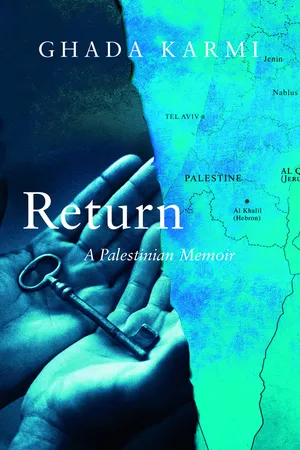
Having grown up in Britain following her family's exile from Palestine, doctor, author and academic Ghada Karmi leaves her adoptive home in a quest to return to her homeland. She starts work with the Palestinian Authority and gets a firsthand understanding of its bizarre bureaucracy under Israel's occupation.
In her quest, she takes the reader on a fascinating journey into the heart of one of the world's most intractable conflict zones and one of the major issues of our time. Visiting places she has not seen since childhood, her unique insights reveal a militarised and barely recognisable homeland, and her home in Jerusalem, like much of the West Bank, occupied by strangers. Her encounters with politicians, fellow Palestinians, and Israeli soldiers cause her to question what role exiles like her have in the future of their country and whether return is truly possible.
- 336 pages
- English
- ePUB (mobile friendly)
- Available on iOS & Android
eBook - ePub
About this book
Information
CHAPTER 1
Journey to Ramallah
‘What the hell was I thinking of?’
I had sworn never to return to this torn-up, unhappy land after that first trip in 1991 when I broke a long-standing family taboo against ever visiting the place that had been Palestine and then became Israel. It had always been too painful to contemplate, too traumatic an acknowledgement of our loss and the triumph of those who had taken our place. In the two weeks I spent there on that first visit, I travelled up and down the country of my birth, looking at the remnants of the old Palestine and at what its new occupants had wrought in the years since our flight in 1948. I was barely able to comprehend the changed landscape of what had been an Arab place, its new inhabitants speaking an alien language, their looks a motley assortment of European, Asian, African, and any mixture of these.
It was a momentous journey that had filled me with bitterness and grief. I remember looking down on a night-time Tel Aviv from the windows of the plane taking me back to London and thinking hopelessly, ‘Flotsam and jetsam, that’s what we’ve become, scattered and divided. There’s no room for us or our memories here. And it won’t ever be reversed.’
As it transpired, I broke my resolve and returned to the same land several times after 1991, and here I was again. The white walls and white-tiled floor of the huge apartment I would be living in stared back at me silently. The man from the United Nations Development Programme office in Jerusalem, who had driven me to Ramallah, had left – it felt more like abandoned – me with affable expressions of welcome and reassurance that I would be very happy staying there. My footsteps echoed through the wide, tiled hall, the three large bedrooms, and spacious double reception room with its separate seating areas for men and women in the conventional Arab style. I wondered when on earth I would ever be inviting the hordes of people needed to fill them.
It was an early afternoon during the hot summer of 2005. I sank down on one of the armchairs, my case and computer still packed beside me, ready to leave at any minute. I was in one of the ‘Gemzo Suites’, an imposing white stone apartment hotel on a high point in al-Bireh, a large village just outside Ramallah that had been a separate place until 1994, when its administration was merged with Ramallah’s. ‘Gemzo’ in fact stood for Jimzu, a village to the east of the town of al-Ramleh in pre-1948 Palestine, where the owner of the Suites’ family had presumably originated. It must have been a pretty little place, built on a hillside and surrounded by cactus plants and olive trees, before it was demolished in September 1948 by Palestine’s new owners. Commemorating place names in that now vanished Palestine was a common practice amongst Palestinians in exile, as if to defy history and recreate those lost towns and villages. Even when such people were not old enough to remember the places for themselves, their parents or other older relatives passed on their nostalgic memories. In the same way most Palestinian homes displayed pictures of Jerusalem in its Arab days, as if there had been no 1967 and no Israel.
I should have been grateful to be housed in such style, but all I felt that first day was a desire to cross the Allenby Bridge that separated Jordan from the Israeli-occupied Palestinian territories, and go back to my father’s flat in Amman where I had been staying. Sitting in that large and echoing Gemzo suite, I tried to will myself back into the mood that had impelled me to leave England where I had lived for most of my life to come to a place which I knew more in theory than in practice, more as an abstract cause than a living reality. I thought back to the hurdles I had had to overcome in getting to this point: my own scruples, the difficulties of entering Palestine – even the visa application, a matter of banal routine when going anywhere but to the country I was headed for.
‘Why is it so difficult for you to just give me the visa?’ I asked the expressionless official behind the glass counter at the Israeli consulate in London. Visiting the consulate had been a novel experience. Up until then I had been nowhere near any Israeli official building except as part of a demonstration against Israel. I never even saw these places on such occasions, since a phalanx of policemen and a closed iron gate usually blocked the view. ‘It’s already been agreed by your people in Jerusalem. All I was supposed to do was collect it.’
‘It’s not so simple,’ he answered wearily. He had fair hair and blue eyes; I could have taken him for a Swedish bank clerk. At my sceptical look, he threw up his hands. ‘What can I tell you?’ he exclaimed, ‘computers down since two days, and we got no technician from Israel to repair them.’ It seemed that for ‘security’ reasons, no computer expert from London would have been allowed to do the job. ‘Anyway,’ he said, trying to make light of it. ‘What’s the fuss already? You’re a UK citizen. No problem. You get your visa when you arrive.’
In the event, no Israeli technician ever arrived, and I ended up travelling without the visa. ‘Well, that’s a good one!’ snorted my Arab friends afterwards. ‘Couldn’t they think of anything better? You must know they’ve got a file on you for sure. You’ll never get in! The Israelis know everything!’ they added darkly. There was a widespread conviction amongst many Arabs that the Israeli secret services were fiendishly clever. Innocuous incidents involving Israelis became sinister until proved otherwise. But after my experience at the consulate, I remember wondering if Israelis were such super-efficient, Machiavellian geniuses after all. Perhaps they’re just as bumbling and incompetent as we are, I thought. Had the same incident occurred at an Arab consulate, none of us would even have questioned it. ‘Bloody useless Arabs,’ we’d have said. ‘Why don’t they ever learn?’
The thought recurred on the next hurdle in my journey, as I stood before the Israeli immigration control at the Jordan–West Bank border. I had just arrived from Amman where I spent a few days with my father. The immigration officer, a young woman sitting behind the glass window of her booth, looked fed up and ready for her lunch break. She was dark and pimply with crinkly black hair and could have been Afro-Caribbean. She asked me a few questions in a listless sort of way, as if following a drill which she had learned by heart and which bored her stiff.
‘Where are you going to in Israel? What is the purpose of your visit?’ she intoned in a sing-song voice.
‘I’m going to Jerusalem, where I’ll be working for UNDP,’ I answered, as I had been told to do. I doubted that she knew or cared to know what the UNDP was. Most Israelis regarded the UN as their enemy because of what they believed to be its inbuilt pro-Arab majority. They routinely dismissed any censure against them by the world body, usually voiced through its General Assembly, as plain and simple bias. But she did not question it any further.
‘Do you intend to visit anyone in the West Bank?’
‘I don’t think so,’ I answered untruthfully, but again as instructed, and added: ‘Maybe.’
‘Who do you know in Israel?’
I reeled off a list of Jewish Israeli friends, as it had been suggested I should. She eased herself off her stool and disappeared behind the booth. I could see her talking to another female immigration officer, this one blond and clearly Ashkenazi (of European extraction) and likely to be her superior on those grounds alone. There was a well-known but little publicised prejudice among Ashkenazi Jews in Israel against Arab or oriental Jews, which led to a variety of attitudes and practices that discriminated against them. The girl came back at a leisurely pace, taking her time studying my passport. ‘It says here you were born in Israel.’ She was looking at the page where my place of birth was recorded as Jerusalem.
‘Not Israel,’ I corrected, ‘Palestine.’ As indeed it was before 1948, but a grave error to mention in an interview which had been going well until then. ‘OK,’ she said, suddenly alert. ‘Go there. You have to wait there,’ pointing to a bench against the wall. The queue of people behind me pressed up to the window, glad of the space I had vacated.
It used to be routine for someone with a record of pro-Palestinian political activism like myself to be stopped for questioning each time I tried to enter Israel. But as I had grown older, and presumably less of a threat, it happened less often. A left-wing Israeli activist friend, Akiva Orr, who was regularly subjected to interrogation in the same way, used to say to me, ‘Listen, Ghada, don’t complain! If the day comes, God forbid, they don’t stop me at the border any more, I’ll know I’m finished!’
After an hour of waiting without an explanation from anyone, a man came over holding my passport. ‘OK,’ he said not without courtesy, ‘you can go.’ ‘What was the problem?’ I asked. He did not answer, and just waved me back to the same immigration officer. She looked at me without interest, and only mildly questioned my request to have the Israeli visa stamped on a paper separate from my passport. ‘Why you don’t want me to stamp the passport?’ I explained that Arab countries like Saudi Arabia or Lebanon, having no diplomatic relations with Israel, would not allow me to enter if an Israeli visa were stamped on my passport. She shrugged and let me through. The relative ease with which I crossed the border, even given this incident, was probably due to my Western passport, although it was still no guarantee. British or European visitors whom Israel suspected of being Palestinian supporters could often be detained for hours, or even expelled.
However many times I made the bridge crossing in later years, I never got used to this exercise of Israeli control over what was not Israel’s to police at all. Strictly speaking, only Jordanian and Palestinian immigration officers should have manned the border between Jordan and the West Bank, since Israel ‘proper’, as it was known within its pre-1967 borders, did not extend that far. Inside the Israeli terminal building a huge colour photograph of a smiling King Hussein of Jordan, lighting Yitzhak Rabin’s cigarette in a show of friendship, paid lip service to the peace treaty signed between the two countries in 1994. In reality the only power in the vicinity was Israel, and the Israeli blue and white flag fluttering possessively at the Allenby Bridge emphasised the point.
Had I been a Palestinian West Bank ‘resident’, the scene at the bridge would have been very different: crowds, long queues, hold-ups, searches, interrogations and hours of waiting, with the ever-present possibility of rejection or arrest. In subsequent years, with Israel’s increasing self-confidence in its occupation of Palestinian land, this distinction became less marked and crossing the bridge was easier. But whether it was a Western or a Palestinian traveller, the essence of all these measures was the unpredictability of Israeli behaviour. No one could be sure of entering the country, let alone getting anywhere inside it, and planning a journey in advance was something of a futile exercise.
I was not one of those people who found it exciting to live in other countries. Even when I was younger and supposedly more adventurous, I had never gone to summer camps or joined student groups on jaunts to foreign places. Aside from two years spent in the Arab countries at the end of the 1970s, when I had forced myself to go with much trepidation, I had never strayed far from England. That visit, first to Syria and then to Jordan, had been all about my quest for belonging, to find my roots and a credible identity. Perhaps I was too eager at the time, too intense in my search, but my journeys ended in failure on both counts. I felt no more a part of them than they did of me. I was not ‘Arab’ enough there, and too ‘Arab’ in England, despite being thoroughly anglicised and immersed in English culture.
I supposed my trip in 2005 was a search of the same kind, but it was more inchoate, not properly thought through, as if I were groping to find my way through a fog. My decision had been spurred on by a mixture of frustration and unhappiness, no basis for rational choices. I regarded my situation as a deeply unsatisfactory one. I had no settled personal life, something it seemed I was doomed to endure, and I felt that my professional life – the activism, the writing, the organisational work – was at a dead end too. In the past, when such feelings assailed me, I would find solace in a new political project or initiative. But this time I found none which I could pursue with any conviction. I felt stale and wrung out.
Like many Palestinians, my greatest pursuit, indeed obsession, for most of my adult life had been Palestine. There was no room in it for much else. I lived and breathed it, worried about its adversities which felt as urgent and immediate as if they were happening beside me. I kept abreast of all its news, read constantly, combed through the internet for more information, monitored the media, talked to other activists, attended and also organised meetings and conferences, and wrote endlessly about it – to such an extent that when anyone asked what I did for a living, I would answer, ‘I’m a full-time Palestinian!’ It was not really true, of course, since I had worked as a doctor of medicine, been a medical historian and later become an academic. But being a Palestinian was the only thing that felt real.
However, after years of activism I had begun to feel disconnected and irrelevant. The gap between what seemed like shadow-fencing with Israel in the security of London and the real fight taking place on the ground in Palestine was too great to ignore. After the Oslo Accords between Israel and the Palestinians were drawn up in 1993,1 Yasser Arafat and the rest of the leadership returned to Palestinian soil from forty years of exile. And with them, the centre of gravity of the Palestinian cause and the real political action shifted inside. This made the rest of us still promoting the cause outside Palestine feel left behind, like people trying to catch a train that has long departed.
Until that happened, the cause had been with us in exile. Since the late 1960s when the Palestine Liberation Organisation (PLO) was at its zenith, internationally known and a magnet for idealists from all over the world who flocked to join its ranks, our ideas and decisions were the ones that mattered. For the first time since the Nakba – the cataclysmic event of 1948, when most of us were dispersed out of Palestine – we felt ourselves connected to one another in an unprecedented national project that promised liberation from the Israeli grip on our homeland. It was the PLO, formed in exile, its fighters drawn from the refugee camps of exile, that gave us those feelings of relevance and value, even of importance. It brought our case, previously forgotten or scornfully dismissed, before the world’s attention. Our compatriots inside Palestine, living under either Jordanian or Israeli rule, were often sidelined in this national awakening. As its power grew, the PLO acquired, however unconsciously, the status of a substitute homeland for the refugees in their camps and most of us in exile, even of signifying Palestine itself.
This was not universally acknowledged at the time, and it was only when the PLO departed our midst that we realised how central its existence had been for a scattered people like us. It had given us an identity and a focus. That last act of return from exile, trumpeted as a triumph, was for us outside an abandonment. 1994, the year in which Arafat and his men moved to Gaza, deprived the diaspora, especially the refugees in the camps, of their backbone support and signalled the end of our relevance as political actors. This was not as drastic as it seemed when it first happened, for there was still a PLO representative office in London which to some degree maintained our connection with each other.
In its heyday, the PLO had functioned as a virtual government-in-exile, with a parliament in the shape of the Palestine National Council (PNC), the PLO’s highest legislative body. The PNC aimed to represent the whole Palestinian people and brought together delegates from all the Palestinian communities inside and outside Palestine. Various PLO unions of workers, writers, students and women were established, and a host of welfare services was set up for Palestinian refugees, chiefly those in Jordan and Lebanon. These refugees had hitherto subsisted on international aid from the UN and other charitable sources. But after 1971, the PLO developed its own welfare, medical and social programmes for them, created work opportunities, and adopted the children of fighters killed during operations against Israel.
Most crucially, the organisation provided armed protection for the refugee camps. Supposedly safe places under international law, these had been a target for Israeli military operations from the 1950s onwards. They were also subject to in-fighting among groups with different political affiliations. The loss of PLO protection in 1982, when the fighters were withdrawn from the camps and forced into exile in the wake of the Israeli siege of Beirut, leaving them defenceless, had tragic consequences. A short while later, in September 1982, two Beirut refugee camps, Sabra and Shatila, were overrun by fiercely anti-Palestinian Lebanese Phalangist forces, their entry facilitated by Israel’s army, which had surrounded the camps. Up to 2,000 people, mostly old men, women and children, were massacred in a killing spree lasting two days.
After 1974, when Yasser Arafat, the PLO chairman, gave his famous address to the UN General Assembly signalling the organisation’s international acceptance, PLO representatives, acting as quasi-ambassadors, were appointed to most world capitals. The first PLO representative in London, Said Hammami, arrived in 1975. We were soon drawn to his office, which became a centre for meetings, engagement and activism. Many of us aspired to visit the PLO’s headquarters in West Beirut and meet Arafat in person. I remember making such a trip in 1976, and the sense of wonderment I felt on seeing the huge map of Palestine on the wall outside his office, and the young men in kufiyyas (the black-and-white check headdress that has become Palestine’s national symbol), chatting in Palestinian Arabic. I felt connected with my origins as never before, and thrilled to be at the centre of the cause.
Looking back years later, the PLO had been far from perfect. Its guerrilla factions were frequently disunited, disagreed on strategy, and as a result made serious mistakes. Many Palestinians were quick to condemn and criticise. But for all that, it was undeniable that the PLO achieved a seismic shift in their political fortunes. Forgotten for two decades as ‘Arab refugees’ living on handouts, their cause returned to the world stage with the PLO. In the exceptional circumstances of exile, with a displaced people, most of whom lived outside the homeland, the PLO managed to bring Palestinians together under its umbrella and restore their sense of themselves as a community fighting for a common cause. The institutions it established had never existed before and, had things gone differently, they could have been adapted to form the basis of a new Palestinian state.
But now all that was over, part of another world, and Arafat and his men had gone. In the vacuum of leadership left behind, everyone was looking for a role, uncertain how to go forward or what to do. I remember writing comments and articles about these events until it dawned on me that in this changed world I was likely to end up a kind of second-hand Palestinian, an armchair windbag, whom no one listened to because of my distance from the real thing.
The thought was galling, especially when I found myself with people who had gone to work or live in my homeland. Although most of them were not Palestinian, when they came back they often regarded themselves as authorities on the country. I had noticed that Palestine frequently brought out such feelings in people because they saw it as a friendless orphan, and no one seemed to be in overall charge. I would listen to their experiences with something like envy that it was they and not I who was recounting those stories. They created in me a sense of distance and irrelevance that became intolerable, until I realised there was only one way to end it. I would have to go there myself and re-establish my connection with the people who lived there, my people, whose lives I would share, even if only for a while.
Although I had sworn in 1991 never to return, I had gone back on my oath within two years of that visit, and several times afterwards. But those trips were often brief and work-related. Living there would be ...
Table of contents
- Cover Page
- Halftitle Page
- Title Page
- Copyright Page
- Dedication
- Contents
- Acknowledgements
- Author’s Note
- Prologue
- Chapter 1: Journey to Ramallah
- Chapter 2: The Ministry of Media and Communications
- Chapter 3: The Separation Wall
- Chapter 4: Dr Farid
- Chapter 5: A Concert in Nablus
- Chapter 6: A Tale of Two Ministers
- Chapter 7: A Trip to Jerusalem
- Chapter 8: Hebron
- Chapter 9: Interlude in Amman
- Chapter 10: Evenings with My Father
- Chapter 11: Gaza
- Chapter 12: A Gaza Kidnapping
- Chapter 13: Qalqilya, the Walled City
- Chapter 14: The City of David
- Chapter 15: Fatima
- Chapter 16: Motherhood
- Chapter 17: The Conference
- Epilogue
- On the Typeface
Trusted by 375,005 students
Access to over 1.5 million titles for a fair monthly price.
Study more efficiently using our study tools.
Frequently asked questions
Yes, you can cancel anytime from the Subscription tab in your account settings on the Perlego website. Your subscription will stay active until the end of your current billing period. Learn how to cancel your subscription
No, books cannot be downloaded as external files, such as PDFs, for use outside of Perlego. However, you can download books within the Perlego app for offline reading on mobile or tablet. Learn how to download books offline
Perlego offers two plans: Essential and Complete
- Essential is ideal for learners and professionals who enjoy exploring a wide range of subjects. Access the Essential Library with 800,000+ trusted titles and best-sellers across business, personal growth, and the humanities. Includes unlimited reading time and Standard Read Aloud voice.
- Complete: Perfect for advanced learners and researchers needing full, unrestricted access. Unlock 1.5M+ books across hundreds of subjects, including academic and specialized titles. The Complete Plan also includes advanced features like Premium Read Aloud and Research Assistant.
We are an online textbook subscription service, where you can get access to an entire online library for less than the price of a single book per month. With over 1.5 million books across 990+ topics, we’ve got you covered! Learn about our mission
Look out for the read-aloud symbol on your next book to see if you can listen to it. The read-aloud tool reads text aloud for you, highlighting the text as it is being read. You can pause it, speed it up and slow it down. Learn more about Read Aloud
Yes! You can use the Perlego app on both iOS and Android devices to read anytime, anywhere — even offline. Perfect for commutes or when you’re on the go.
Please note we cannot support devices running on iOS 13 and Android 7 or earlier. Learn more about using the app
Please note we cannot support devices running on iOS 13 and Android 7 or earlier. Learn more about using the app
Yes, you can access Return by Ghada Karmi in PDF and/or ePUB format, as well as other popular books in History & Social Science Biographies. We have over 1.5 million books available in our catalogue for you to explore.