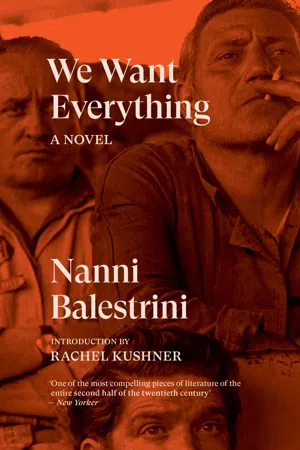
It was the Autumn of 1969, and Italy exploded. Across the north of the country, factory workers stormed out on strike, demanding better pay and working conditions. The slogan "We Want Everything" rang through the streets. Italy's "Hot Autumn" had begun.
In Nanni Balestrini's fictionalized account of the uprising, a young worker from Italy's impoverished south arrives at Fiat's Mirafiori factory in Torino, where he barely scrapes by with fourteen hour days of backbreaking work. His frustration is palpable, and soon he is agitating again his bosses for fun and giving himself minor injuries to win sick leave. Soon enough, he is swept up by a snowballing worker movement that leads to months of continuous strikes at Mirafiori. Eventually, the conflict bubbles out of the factory. The growing pressure having produced an inevitable crack, the streets are lined with barricades, and tear gas wafts into private homes.
Introduced by Rachel Kushner, author of the critically acclaimed The Flamethrowers, We Want Everything is an explosive account of a revolution that would clear the way for another decade of radical unrest.
- 224 pages
- English
- ePUB (mobile friendly)
- Available on iOS & Android
eBook - ePub
About this book
Information
Eighth chapter Autonomy
Thursday 5 June: At Mirafiori, while the lines stuttered back to work, the Foundry workers joined the struggle. Workers from workshop 2 continued to strike for 8 hours each shift. The struggle spread to workshops 3 and 4. The workers from those workshops decided to join the struggle with the same claims as workshop 2: 200 lire increase in base pay, promotion to the metalworker category. The management offered between 3 and 21 lire on the position allowance. The workers refused this offer. As long as we don’t get everything we’ve asked for, the struggle will continue. On the lines the unions called a strike of 2 hours per shift. It was only partly successful. The line workers had been moving since Thursday against the work rates and for pay increases and category advancement, fighting independently of the unions.
The unions’ request for the line delegate didn’t mean these problems would be solved. The current struggle can’t be reduced to the election of a delegate. On the engine and transmission assembly lines the workers strike for two hours per shift since Tuesday. They decided to fight for advancement to second category for everyone. Some of the preparation workers joined in. In the Presses the unions end the strike with laughable results. The workers were against it and production didn’t return to normal. The workers don’t want to return to the previous work rates and the bosses are worried. Fiat management is trying to get back to normal production at any cost because it has lost tens of millions in production precisely at the time when there’s greatest demand in the market.
The unions try to start the struggles one at a time, one finishing and another starting, to avoid the struggle widening and to stop the workers organising themselves in the factories from expressing their will autonomously. But the working-class struggle won’t be controlled this way. Almost every day a new struggle starts, and it’s the workers who start it. This is a big test of the working class’s strength. But it’s not enough. There’s a risk that while new struggles are started, others end with unsatisfactory results which will impede the formation of a strong and permanent organisation of workers who know how to oppose day by day the working conditions imposed by the bosses. If workers end up divided and disorganised after the struggle, this is a defeat, even if something has been gained. If workers come out of the struggle more united and organised, this is a victory, even if some demands remain unmet.
Friday 6 June: 8 hour strike each shift, not only in workshops 2 and 3 but also in the South Foundries. The struggle also continues in workshop 4. Saturday 7 June: Management suspends a worker from workshop 13 for three days. Monday 9 June: 8 hour strike in both shifts at workshop 13. The causes: no reason on the part of the management for the suspension of the worker and no response from the union to the workers’ requests over: promotion to second category for all. Equal insurance for all. Workers’ control over work rates. Equal bonuses for all. Increased downtime. Changes to the work environment. Wage increases that won’t be absorbed into the national contracts.
North and South Foundries, 8 hour strike on both shifts. To divide the workers management offers a 67 lire increase to the press operators. Only 100 out of 890 accept. Body lines: First shift, spontaneous strike at 10 o’clock by the painting and polishing workers. Claims: wages, categories, work rates. The internal commission said it would reply by 8 o’clock, but was neither seen nor heard. Now they say they will reply next Monday. The supervisors came by on the second shift trying to divide the workers by giving second category to some of them. Fiat is cornered. Hardly any vehicles coming out, shortage of supplies for Rivalta and the organisation of work disrupted. This is the first result of our struggle. A decisive week starts now.
What does the boss do? In opposition to our struggle, the boss, with the complicity of the union, tries to make us participate in and consent to our exploitation. This is, in substance, what the line delegate is about. Against the workers’ interests in widening the struggle at this point, they want to: either separate us from the rest of the Italian working class with a separate Fiat contract, like in ’62, or fence us in with an advance on the future contract, which is the same thing. What does the union do? Attempts to halt the strikes in the individual workshops, comes into the factories to tell us what the boss proposes, takes its own proposals to the boss, negotiates them on our hides and ignores our will and our aims.
What do we workers want? At the Mirafiori North and South Foundries we’ve said it and said it again, with all-out strikes. We want: a 200 lire increase now on the base rate, or wage parity with the steelworkers. Which means 30,000 lire a month more on our base pay, and not the pittance the bosses have offered. On the assembly lines we want 50 lire more on the base rate. Second category for all workers after six months’ work in the factory. We want this all right away. None of this is negotiable. None of this is an advance on the contracts. We don’t want the boss’s work rhythms. We say to the boss and the unions: The line delegate is no use to us. We want section meetings and workshop committees, which we’ll use to organise a permanent struggle against the boss, his work rhythms, his servants. We’ll organise ourselves, we’ll all become delegates. Workers, when we fight the boss is weak, this is the moment to attack. We need to organise and widen our struggle, workshop by workshop.
Tuesday 10 June: The union’s politics of dividing the workers by allowing category advancement to some and giving differentiated wage increases gets its first results. The struggle in the Foundries ends and the workers go back to work. The mechanical lines continue the strike for two hours. Some workers from the body workshop in workshop 54 are reorganising themselves and ask the comrades to intervene and prepare a leaflet listing their claims to distribute the next day. The workers from workshop 25, hot work, ovens, also request a leaflet for the next day.
Wednesday 11 June: The workers from the afternoon shift at workshop 54 have decided that if they don’t get an answer to their claims by Friday they’ll strike. The tendency to organise autonomously, renouncing union mediation for bargaining with the bosses, is spreading. In fact there are requests for leaflets from the workers of workshop 13, workshop 85, new sections of workshop 14 and the lines of the body workshops, and workers from the Foundries. As a result, Fiat’s repressive politics gets worse. Two sackings at workshop 13 yesterday. Today the workers got six thousand lire less in their pay packets, deducted for time on strike.
Foundry workers: The boss is in crisis. Production, reduced by half, is further disrupted by initiatives of the workers who are fed up with waiting for the contract negotiations, which the boss is preparing to confront. If the struggle at the Foundries had lasted another few days, production in whole sections of Fiat would have stopped: Mechanics, Rivalta. But this time the boss had enough stock to allow production elsewhere at a reduced rate, and so was able to hold out longer than the workers. But anyway our struggle, leaving aside the limited results, has shown the boss our strength. We must use this strength to break the boss once and for all. It’s a fact that here in the Foundries, where the struggle was harder and the workers, united, had resisted for longer, the boss resigned himself to conceding increases, even if they were differentiated and much lower than our claims. But this didn’t happen on the lines, where the workers had also made wage claims.
But what raises did the boss concede? Our claims were: 200 lire more on the base wage or wage and conditions parity with the steelworkers, that is, 30,000 more a month in the pay packet. Because the work is hard and dangerous and we’re not animals who work gratis. The union refused to put this claim, at the same time that it occurred to them to trumpet the management’s offers. The increases offered by the bosses aren’t on base pay but on the allowance for positions. This means that a transfer would lose you this advantage, and we know how easily the bosses can transfer you from one position to another. The 200 lire is the same for everyone because it unites the workers in the struggle and takes away the ability to discriminate that the boss uses against us.
Rather, the management offers that the union had outlined so well in their latest leaflet were divided by category, precisely to make the workers who would gain the most abandon the struggle one by one. So there is no point arguing among ourselves over it, because that is what the boss wants, to discourage our attempts at organisation. Because, comrades, this is the biggest victory in this struggle, apart from the boss’s few miserable lire. For the first time we have succeeded in organising and conducting the struggle with our own aims, in the decisive moment for us. But that’s not enough; the isolation of our struggle that the union wanted forced the Foundry workers to bear the full weight of the strike, when all the workers of Mirafiori wanted to fight.
Now we get it: the organisation we have created has allowed us to carry out the struggle in the factory, but it hasn’t allowed us to overcome the isolation forced on us by the internal commission and the union. Refusing to carry our claims forward. Dividing the struggle of North Foundry from South Foundry. Not informing workers in Fiat’s other sections. But the reasons we acted still hold. Just as we were able to organise ourselves in the workshop, we need to be able to organise all of Mirafiori. How? Only by cooperating with the workers of the other workshops will we be able to organise struggles that cause the least harm to us and the most harm to the boss. Only by making our full organised force felt will we force the boss to surrender.
Thursday 12 June: At Mirafiori the autolimitation of production by workers in workshop 13 continues. On the lines, on the 850, on the 124, on the 125, shortage of doors. At this point the management is too scared to carry out widespread reprisals. But they try to hit individual workers in the most advanced points of the struggle, sacking them or transferring them. They hope this will scare the rest. But this move mustn’t go unchallenged. We need to respond blow by blow, stopping work as soon as a comrade is hit. The most effective weapon against this repression is unity and the workers’ cooperation among themselves. The Fiat workers’ struggle is spreading from Mirafiori to other firms. Grandi Motori, at Settimo, crane drivers and riggers. Grandi Motori Centro, sections P and B. Sima, lathe operators. Spa Centro, section 3.
All the Fiat Mirafiori workers who have been on strike in recent days have asked for the same thing: wage increases. Even the requests for category advancement mean: higher wages. And the same goes for increases in other components of the wage. But all of these claims had one common characteristic: the increases were claimed equally for everyone with automatic category advancement for everyone. Even the points on other matters tended to be the same for everyone. This means one fundamental thing: We want to get to an equal wage for everyone. In fact the workers have become aware that differences in wages, bonuses, categories, allowances and so on are one of the boss’s tools for dividing workers.
In fact the boss, to avoid losing millions more in production, made use of the differential increases to bring an end to the struggle. He conceded category advancement to some workers but not others; for example, concession to leading hand on the lines, advancement for Maintenance. He conceded differential wage increases: for example, machine controllers and press operators in the Foundries. And in general on that part of the wage that encourages greater productivity or acceptance of danger: piece rates in the Presses, position allowances in the Foundries. The union delegates refused to be the spokesmen for the workers’ claims for immediate equal wage increases for everyone.
They remain faithful to the principle that you request increases in the base wage only every three years when the contracts are up. They accept a series of divisive elements that the boss introduces regarding wages, categories, differentiation between various workshops and sections. Because of this they split the workers’ general claims, dividing the struggle and creating confusion among the workers. But the workers want to get to an equal wage for everyone, because it eliminates divisions and unifies the struggle. Because then everybody inside the factory is indispensable, the technician as much as the worker, a machine or line specialist or a manual worker. Because now we can all do everything. Because living costs are the same for everyone.
So it doesn’t make any sense for a clerk to be paid a full wage when he’s off sick while a worker loses part of his wage. It doesn’t make any sense for a clerk to get four weeks’ leave and a 40-hour week, while a worker gets three weeks and works 44 hours. It doesn’t make sense for some workers to be paid more and others less. Because of this, we Mirafiori workers won’t be satisfied with delegates or increases of a few lire; we say: The struggle continues. And our struggle is joined by the workers at Spa Centro, with a march of 1,000 workers in the sections, at Grandi Motori, at Spa Stura, and also at Lingotto.
Monday 16 June: In workshop 54 at 5 o’clock the 124, 125, 125 Special lines are held up. Section heads, workshop heads and Fiat managers rush in and try to convince them to start work. Members of the internal commission also arrive and say that by Wednesday they’ll have an answer. This time, however, the workers’ reply is different and they say: While you talk, we’re going on strike. After the evening meal break the 850 line also joins in, completely stopping production in workshop 84. The bosses ask why there’s a strike and the workers reply: You know very well why. At this point the supervisors try to make the 850 workers finish 22 bodies that were still there, on the pretext that they would rust. The workers refuse, forcing the supervisors to get on the lines and finish the bodies.
It looks like the workers from workshops 1 and 3 of the Medium and Large Presses and also workshop 85, vehicle transport, will go again tomorrow. At 6 o’clock these workers, who drive the finished cars from the lines to the transporters, will have an answer from the union. If the union responds negatively to their claim over categories and being considered drivers rather than handlers, tomorrow they’ll go on strike and push the vehicles instead of driving them. This could cause hold-ups in the line, because the yard would be flooded with vehicles within half an hour. The occupation of the Nichelino town hall also continues. In the past four weeks Fiat has lost tens of millions of lire in production and continues to lose more. Even in the last few days Mirafiori has produced only about fifty per cent of normal output in tons.
Tuesday 17 June: The struggle at Mirafiori is at its highest and most stirring point. In light of the ongoing strike on the second shift that is blocking all production on the lines, Fiat played a new card. The bosses now understand that the workers don’t want anything to do with the unions. They have been forced to call directly on the striking workers to negotiate. After consultations with the unions, they ask the strikers to send delegates to the Unione Industriale.22 Because they are used to wheeling and dealing, they delude themselves that they can con the workers with a few words. They offer them 17 lire, not for everyone, but on different components of the wage. But the workers won’t let themselves be bought for small change.
And so the lord bosses, so well mannered and elegant, let loose with some foul insults. You terroni, filthy southerners, up until yesterday you were scratching in the dirt, and today you dare to raise your heads. The workers answered these insults right back in kind but what’s more, once they were back in the factory, gave the kind of reply that counts for more, intensifying the struggle. A march of thousands of workers filled every corner of the factory, including the women’s sections. To the cry of: Out, out, they stopped what little work was still going on. They stopped the 125 Special line and the 500 line again. Fiat is on its knees. In this uncomfortable position they play one last card. The twelve workers who had gone to the Unione Industriali were called up alone, without the unions, who are just about out of the game, to the office of Marciano, the deputy director of Mirafiori.
This guy invites them to convince their striking comrades to return to work because, let it be understood, very grave steps could be taken. If you haven’t decided by this evening, he says, everything here will blow up, and if it goes on like this we will be forced to suspend people. If you suspend even one striking worker, the twelve reply, the whole factory will intensify the struggle. Fiat isn’t prepared to negotiate on this basis, Marciano says, playing hard. And we’re not prepared to work. And that is how, in fact, it goes. The second shift on the lines leaves the factory at eleven o’clock in the evening without having touched a single vehicle. At the gates it was so tense it seemed Torino was about to explode. Not a single union official was to be seen.
Wednesday 18 June: At six in the morning the workers on the first shift at workshop 54 returning to the factory learn what had happened the day before, about the great struggle their comrades in the second shift had continued and even widened. Yesterday the strike stuttered along, they say, today we’ll hit like an avalanche. And that’s how it goes. From one assembly line, the 124, only a single vehicle exits, from another, three or four cars. The 500 lines, after going along at a reduced rate themselves, stop completely. Both shifts are now on strike, all the lines stopped. At 1.30pm the workers from the first shift leave the factory with fists raised. And they are greeted with the same salute by the workers of the second shift who are re-entering the factory and who started the strike at Mirafiori.
The workers from the second shift continue the strike, solid. Fiat tries to make them work by running the lines empty. But after a short time it becomes clear even to the bosses that the workers are making fun of this move and the lines stop. A march starts from workshop 54 and disrupts workshops 52, 53, 55, 56. Not a single vehicle leaves the lines all afternoon. With the strike on the assembly lines completely under the workers’ control, the march heads towards the management building. They meet the union delegates there, who try to deny everything that they have said against the strike in the past few days. They are no longer heard. The march moves towards the gates, where it blocks the truck exit. And finally it re-enters the lines, where a number of workers step up to speak to the meetings that are gathering all around.
Thursday 19 June: Comrade workers of Rivalta, yesterday in workshop 72 the workers suspended work for an hour. The request for uniforms was only a pretext, the reality is that the workers were protesting against exploitation and the brutish conditions inside and outside the factory. Inside because the bosses continue to up the work rates, making the work more and more unbearable. With work rates that make you spit blood without even time to eat or go to the can. Outside because the starvation wages are no longer enough to pay higher and higher rents and don’t allow workers even the bare essentials of life. So workers are forced to live eight to a room or sleep on benches at the station. That’s it, Fiat’s workers are starved of money and want to work less.
Rivalta is at the most advanced point of technological development, the model of automation, the boss’s jewel. All the special vehicle assembly lines have been transferred here. The 128 and the 130, the latest Fiat models, are built here. Today Fiat uses Rivalta to make up the increasingly bad losses caused by the struggle at Mirafiori, at least in part. They try to squeeze the workers, asking for production increases every day, pushing to the limit of the workers’ resistance. The 128 line produces four extra vehicles a day. But workshop 72 signalled the beginning of the struggle. The bosses tried to pre-empt it, generously conceding some categories because they are scared that the struggle at Mirafiori will become the struggle at all of Fiat. And we know that all of Fiat in the struggle means beating the boss with objectives chosen and organised by the workers, workshop by workshop.
Friday 20 June: Comrade workers, for the fourth day the second shift in the body workshop has held up all production. The workers’ marches have bloc...
Table of contents
- Introduction: Popular mechanics
- First part
- First chapter: The south
- Second chapter: Work
- Third chapter: The north
- Fourth chapter: Fiat
- Fifth chapter: The struggle
- Second part
- Sixth chapter: The wage
- Seventh chapter: The comrades
- Eighth chapter: Autonomy
- Ninth chapter: The assembly
- Tenth chapter: The insurrection
- Afterword
- Notes
Trusted by 375,005 students
Access to over 1.5 million titles for a fair monthly price.
Study more efficiently using our study tools.
Frequently asked questions
Yes, you can cancel anytime from the Subscription tab in your account settings on the Perlego website. Your subscription will stay active until the end of your current billing period. Learn how to cancel your subscription
No, books cannot be downloaded as external files, such as PDFs, for use outside of Perlego. However, you can download books within the Perlego app for offline reading on mobile or tablet. Learn how to download books offline
Perlego offers two plans: Essential and Complete
- Essential is ideal for learners and professionals who enjoy exploring a wide range of subjects. Access the Essential Library with 800,000+ trusted titles and best-sellers across business, personal growth, and the humanities. Includes unlimited reading time and Standard Read Aloud voice.
- Complete: Perfect for advanced learners and researchers needing full, unrestricted access. Unlock 1.5M+ books across hundreds of subjects, including academic and specialized titles. The Complete Plan also includes advanced features like Premium Read Aloud and Research Assistant.
We are an online textbook subscription service, where you can get access to an entire online library for less than the price of a single book per month. With over 1.5 million books across 990+ topics, we’ve got you covered! Learn about our mission
Look out for the read-aloud symbol on your next book to see if you can listen to it. The read-aloud tool reads text aloud for you, highlighting the text as it is being read. You can pause it, speed it up and slow it down. Learn more about Read Aloud
Yes! You can use the Perlego app on both iOS and Android devices to read anytime, anywhere — even offline. Perfect for commutes or when you’re on the go.
Please note we cannot support devices running on iOS 13 and Android 7 or earlier. Learn more about using the app
Please note we cannot support devices running on iOS 13 and Android 7 or earlier. Learn more about using the app
Yes, you can access We Want Everything by Nanni Balestrini in PDF and/or ePUB format, as well as other popular books in Literature & Literature General. We have over 1.5 million books available in our catalogue for you to explore.