For a long time, the term 'ideology' was in disrepute, having become associated with such unfashionable notions as fundamental truth and the eternal verities. The tide has turned, and recent years have seen a revival of interest in the questions that ideology poses to social and cultural theory, and to political practice.
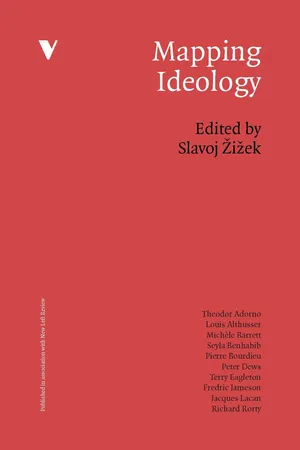
Mapping Ideology is a comprehensive reader covering the most important contemporary writing on the subject. Including Slavoj Zizek's study of the development of the concept from Marx to the present, assessments of the contributions of Luk?cs and the Frankfurt School by Terry Eagleton, Peter Dews and Seyla Benhabib, and essays by Adorno, Lacan and Althusser, Mapping Ideology is an invaluable guide to the most dynamic field in cultural theory.
- 348 pages
- English
- ePUB (mobile friendly)
- Available on iOS & Android
eBook - ePub
Mapping Ideology
About this book
Information
1
Messages in a Bottle
Theodor W. Adorno
I
Key people — The self-important type who thinks himself something only when confirmed by the role he plays in collectives which are none, existing merely for the sake of collectivity; the delegate with the armband; the rapt speechmaker spicing his address with wholesome wit and prefacing his concluding remark with a wistful ‘Would that it were’; the charity vulture and the professor hastening from one congress to the next – they all once called forth the laughter befitting the naive, provincial and petty-bourgeois. Now the resemblance to the nineteenth-century satire has been discarded; the principle has spread doggedly from the caricatures to the whole bourgeois class. Not only have its members been subjected to unflagging social control by competition and co-option in their professional life, their private life too has been absorbed by the reified formations to which interpersonal relations have congealed. The reasons, to start with, are crudely material: only by proclaiming assent through laudable service to the community as it is, by admission to a recognized group, be it merely a freemasonry degenerated to a skittles club, do you earn the trust that pays off in a catch of customers and clients and the award of sinecures. The substantial citizen does not qualify merely by bank credit or even by dues to his organizations; he must donate his life-blood and the free time left over from the larceny business, as chairman or treasurer of committees he was half drawn to as he half succumbed. No hope is left to him but the obligatory tribute in the club circular when his heart attack catches him up. Not to be a member of anything is to arouse suspicion: when seeking naturalization, you are expressly asked to list your memberships. This, however, rationalized as the individual’s willingness to cast off his egoism and dedicate himself to a whole which is really no more than the universal objectification of egoism, is reflected in people’s behaviour. Powerless in an overwhelming society, the individual experiences himself only as socially mediated. The institutions made by people are thus additionally fetishized: since subjects have known themselves only as exponents of institutions, these have acquired the aspect of something divinely ordained. You feel yourself to the marrow a doctor’s wife, a member of a faculty, a chairman of the committee of religious experts – I once heard a villain publicly use that phrase without raising a laugh – as one might in other times have felt oneself part of a family or tribe. You become once again in consciousness what you are in your being in any case. Compared to the illusion of the self-sufficient personality existing independently in the commodity society, such consciousness is truth. You really are no more than doctor’s wife, faculty member or religious expert. But the negative truth becomes a lie as positivity. The less functional sense the social division of labour has, the more stubbornly subjects cling to what social fatality has inflicted on them. Estrangement becomes closeness, dehumanization humanity, the extinguishing of the subject its confirmation. The socialization of human beings today perpetuates their asociality, while not allowing even the social misfit to pride himself on being human.
II
Legalities – What the Nazis did to the Jews was unspeakable: language has no word for it, since even mass murder would have sounded, in face of its planned, systematic totality, like something from the good old days of the serial killer. And yet a term needed to be found if the victims – in any case too many for their names to be recalled – were to be spared the curse of having no thoughts turned unto them. So in English the concept of genocide was coined. But by being codified, as set down in the International Declaration of Human Rights, the unspeakable was made, for the sake of protest, commensurable. By its elevation to a concept, its possibility is virtually recognized: an institution to be forbidden, rejected, discussed. One day negotiations may take place in the forum of the United Nations on whether some new atrocity comes under the heading of genocide, whether nations have a right to intervene that they do not want to exercise in any case, and whether, in view of the unforeseen difficulty of applying it in practice, the whole concept of genocide should be removed from the statutes. Soon afterwards there are inside-page headlines in journalese: East Turkestan genocide programme nears completion.
III
Freedom as they know it — People have so manipulated the concept of freedom that it finally boils down to the right of the stronger and richer to take from the weaker and poorer whatever they still have. Attempts to change this are seen as shameful intrusions into the realm of the very individuality that by the logic of that freedom has dissolved into an administered void. But the objective spirit of language knows better. German and English reserve the word ‘free’ for things and services which cost nothing. Aside from a critique of political economy, this bears witness to the unfreedom posited in the exchange relationship itself; there is no freedom as long as everything has its price, and in reified society things exempted from the price mechanism exist only as pitiful rudiments. On closer inspection they too are usually found to have their price, and to be handouts with commodities or at least with domination: parks make prisons more endurable to those not in them. For people with a free, spontaneous, serene and nonchalant temper, however, for those who derive freedom as a privilege from unfreedom, language holds ready an apposite name: that of impudence.
IV
Les Adieux – ‘Goodbye’ has for centuries been an empty formula. Now relationships have gone the same way. Leavetaking is obsolete. Two who belong together may part because one changes his domicile; people are anyway no longer at home in a town, but as the ultimate consequence of freedom of movement, subject their whole lives even spatially to whatever the most favourable conditions of the labour market may be. Then it’s over, or they meet. To be lastingly apart and to hold love fast has become unthinkable. ‘O parting, fountain of all words’, but it has run dry, and nothing comes out except bye, bye or ta-ta. Airmail and courier delivery substitute logistical problems for the anxious wait for the letter, even where the absent partner has not jettisoned anything not palpably to hand as ballast. Airline directors can hold jubilee speeches on how much uncertainty and sorrow people are thereby spared. But the liquidation of parting is a matter of life and death to the traditional notion of humanity. Who could still love if the moment is excluded when the other, corporeal being is perceived as an image compressing the whole continuity of life as into a heavy fruit? What would hope be without distance? Humanity was the awareness of the presence of that not present, which evaporates in a condition which accords all things not present the palpable semblance of presence and immediacy, and hence has only scorn for what finds no enjoyment in such simulation. Yet to insist on parting’s inner possibility in face of its pragmatic impossibility would be a lie, for the inward does not unfold within itself but only in relation to the objective, and to make ‘inward’ a collapsed outwardness does violence to the inward itself, which is left to sustain itself as if on its own flame. The restoration of gestures would follow the example of the professor of German literature who, on Christmas Eve, held his sleeping children for a moment before the shining tree to cause a déjà vu and steep them in myth. A humanity come of age will have to transcend its own concept of the emphatically human, positively. Otherwise its absolute negation, the inhuman, will carry off victory.
V
Gentlemen’s honour – Vis-à-vis women men have assumed the duty of discretion, one of the means whereby the crudity of violence is made to appear softened, control as mutual concession. Since they have outlawed promiscuity to secure woman as a possession, while yet needing promiscuity to prevent their own renunciation from rising to an unendurable pitch, men have made to the women of their class who give themselves without marriage the tacit promise not to speak of it to any other man, or to infringe the patriarchal dictate of womanly reputation. Discretion then became the joyous source of all secrecy, all artful triumphs over the powers that be, indeed, even of trust, through which distinction and integrity are formed. The letter Holderlin addressed to his mother after the fatal Frankfurt catastrophe, without being moved by the expression of his ultimate despair to hint at the reason for his breach with Herr Gontard or even to mention Diotima’s name, while the violence of passion passes over into grief-stricken words about the loss of the pupil who was his beloved’s child – that letter elevates the force of dutiful silence to burning emotion, and makes such silence itself an expression of the unendurable conflict of human right with the right of that which is. But just as amid the universal unfreedom each trait of humanity wrung from it grows ambiguous, so it is even with manly discretion, which is reputedly nothing but noble. It turns into an instrument of woman’s revenge for her oppression. That men have to keep quiet among themselves, indeed, that the whole erotic sphere takes on a greater air of secrecy the more considerate and well-bred people are, procures for women opportunities from the convenient lie to sly and unhampered deception, and condemns the gentleman to the role of dimwit. Upper-class women have acquired a whole technique of isolation, of keeping men apart, and finally of wilfully dividing all the spheres of feeling, behaviour and valuation, in which the male division of labour is grotesquely reduplicated. This enables them to manipulate the trickiest situations with aplomb – at the cost of the very immediacy that women so pride themselves on. Men have drawn their own conclusions from this, colluding in the sneering sousentendu that women just are like that. The wink implying cosi fan tutte repudiates all discretion, although no name is dropped, and has moreover the justification of knowing that, unfailingly, any woman who avails herself of her lover’s gallantry has herself broken the trust he placed in her. The lady who is one, and refuses to make of gentility the mockery of good manners, therefore has no choice but to set aside the discredited principle of discretion and openly, shamelessly take her love upon her. But who has the strength for that?
VI
Post festum — Pain at the decay of erotic relationships is not just, as it takes itself to be, fear of love’s withdrawal, nor the kind of narcissistic melancholy that has been penetratingly described by Freud. Also involved is fear of the transience of one’s own feeling. So little room is left to spontaneous impulses that anyone still granted them at all feels them as joy and treasure even when they cause pain, and indeed, experiences the last stinging traces of immediacy as a possession to be grimly defended, in order not to become oneself a thing. The fear of loving another is greater, no doubt, than of losing that other’s love. The idea offered to us as solace that in a few years we shall not understand our passion and will be able to meet the loved woman in company with nothing more than fleeting, astonished curiosity, is apt to exasperate the recipient beyond all measure. That passion, which breaches the context of rational utility and seems to help the self to escape its monadic prison, should itself be something relative to be fitted back into individual life by ignominious reason, is the ultimate blasphemy. And yet inescapably passion itself, in experiencing the inalienable boundary between two people, is forced to reflect on that very moment and thus, in the act of being overwhelmed by it, to recognize the nullity of its overwhelming. Really one has always sensed futility; happiness lay in the nonsensical thought of being carried away, and each time that went wrong was the last time, was death. The transience of that in which life is concentrated to the utmost breaks through in just that extreme concentration. On top of all else the unhappy lover has to admit that exactly where he thought he was forgetting himself he loved himself only. No directness leads outside the guilty circle of the natural, but only reflection on how closed it is.
VII
Come closer—The split between outer and inner, in which the individual subject is made to feel the dominance of exchange value, also affects the supposed sphere of immediacy, even those relationships which include no material interests. They each have a double history. That they, as a third between two people, dispense with inwardness and objectify themselves in forms, habits, obligations, gives them endurance. Their seriousness and responsibility lie partly in not giving way to every impulse, but asserting themselves as something solid and constant against individual psychology. That, however, does not abolish what goes on in each individual: not only moods, inclinations and aversions, but above all reactions to the other’s behaviour. And the inner history stakes its claim more forcefully the less the inner and outer are distinguishable by probing. The fear of the secret decay of relationships is almost always caused by those involved allegedly or really finding things ‘too hard’. They are too weak in face of reality, overtaxed by it on all sides, to muster the loving determination to maintain the relationship purely for its own sake. In the realm of utility every relationship worthy of human beings takes on an aspect of luxury. No one can really afford it, and resentment at this breaks through in critical situations. Because each partner knows that in truth unceasing actuality is needed, a moment’s flagging seems to make everything crumble. This can still be felt even when the objectified form of the relationship shuts it out. The inescapable duality of outer and inner upsets precisely authentic, affectively charged relationships. If the subject is deeply involved while the relationship’s outward aspect prevents him, with good reason, from indulging his impulse, the relation is turned to permanent suffering and thus endangered. The absurd significance of trivia like a missed telephone call, a stinted handshake, a hackneyed turn of phrase, springs from their manifesting an inner dynamic otherwise held in check, and threatening the relationship’s objective concreteness. Psychologists may well condemn the fear and shock of such moments as neurotic, pointing out their disproportion to the relation’s objective weight. Anyone who takes fright so easily is indeed ‘unrealistic’, and in his dependence on the reflexes of his own subjectivity betrays a faulty adjustment. But only when one responds to the inflection of another’s voice with despair is the relation as spontaneous as it should be between free people, while yet for that very reason becoming a torment which, moreover, takes on an air of narcissism in its fidelity to the idea of immediacy, its impotent protest against coldheartedness. The neurotic reaction is that which hits on the true state of affairs, while the one adjusted to reality already discounts the relationship as dead. The cleansing of human beings of the murk and impotence of affects is in direct proportion to the advance of dehumanization.
VIII
Depreciation - Kandinsky wrote in 1912: ‘An artist, having once “found his form at last”, thinks he can now go on producing works in peace. Unfortunately, he usually fails to notice that from this moment (of “peace”) he very soon begins to lose the form he has at last found.’ It is no different with understanding. It does not live on stock. Each thought is a force-field, and just as the truth-content of a judgement cannot be divorced from its execution, the only true ideas are those which transcend their own thesis. Since they have to dissolve petrified views of objects, the mental precipitate of social ossification, the form of reification which lies in a thought’s being held as a firm possession opposes its own meaning. Even opinions of the most extreme radicalism are falsified as soon as they are insisted upon, as society eagerly confirms by discussing the doctrine and thus absorbing it. This casts its shadow over the concept of theory. There is not one that, by virtue of its constitution as a fixed, coherent structure, does not harbour a moment of reification within it: develop paranoid features. Precisely this makes it effective. The concept of the idée fixe touches not only on the aberration but is an ingredient of theory itself, the total pretension of something particular that arises as soon as a discrete moment is held fast in isolation. Ideas related to their antithesis are not exempt. Even theories of the utmost dignity are prone at least to reified interpretation. They seem in this to comply secretly with a demand of the commodity society. The idée fixe, like persecution mania, usually relates to the attribution of guilt. The mania’s system cannot see through the system of mania, the veil of the social totality. It therefore hits out at a single principle: for Rousseau civilization, for Freud the Oedipus complex, for Nietzsche the rancour of the weak. If the theory is not of that kind, its reception can still render it paranoid. To say in a precise sense that someone holds this or that theory is already to imply the stolid, blankly staring proclamation of grievances, immune to selfreflection. Thinkers lacking in the paranoid element— one of them was Georg Simmel, though he made of the lack a panacea – have no impact or are soon forgotten. By no means does this imply their superiority. If truth were defined as the utterly non-paranoid, it would be at the same time not only the utterly impotent and in conflict with itself, to the extent that practice is among its elements – but it would also be wholly unable to evolve a coherent structure of meaning. Flight from the idée fixe becomes a flight from thought. Thinking purified of obsession, a thoroughgoing empiricism, grows itself obsessive while sacrificing the idea of truth, which fares badly enough at empiricists’ hands. From this aspect, too, dialectics would have to be seen as an attempt to escape the either/or. It is the effort to rescue theory’s trenchancy and consequential logic without surrendering it to delusion.
IX
Procrustes – The throttling of thought makes use of an almost inescapable pair of alternatives. What is wholly verified empirically, with all the checks demanded by competitors, can always be foreseen by the most modest use of reason. The questions are so ground down in the mill that, in principle, little more can emerge than that the percentage of tuberculosis cases is higher in a slum district than on Park Avenue. The sneering empiricist sabotage thrives on this, being patted on the back by the budget makers who administer its affairs in any case, and shown the drawn-down corners of the mouth that signify: ‘Knew it all along’. But that which would be different, the contribution the scientists claim to thirst for, they deprecate equally, just because it is not known by everyone: ‘Where is the evidence?’ If this is lacking, a thought can only be vain and idle speculation, whereas research is supposed to caper like reportage. These fatal alternatives induce ill-tempered defeatism. People do science as long as something pays for it. But they have faith in neither its relevance nor the bindingness of its results. They would discard the whole consignment of junk, if changes in the social form of organization made redundant, for example, the ascertaining of statistical averages, in admiration of which formal democracy is mirrored as the mere superstition of the research bureaux. The procedure of the official social sciences is little more now than a parody of the businesses that keep such science afloat while really needing it only as an advertisement. The whole apparatus of book-keeping, administration, annual reports and balance sheets, important sessions and business trips, is set in motion to confer on commercial interests the semblance of a general necessity elicited from the depths. The self-induced motion of such office work is called research only because it has no serious influence on material production, still less goes beyond it as critique. In research the spirit of this world plays by itself, but in the way children play bus conductors, selling tickets that lead nowhere. The assertion of such spirit’s employees that one day they will bring off their synthesis of theory and factual material, they just lack the time at present, is a foolish excuse that backfires on them in tacitly acknowledging the priority of practical obligations. The table-embroidered monographs could hardly ever, and then only in a sardonic mode, be elevated to theory by mediating mental operations. The endless collegial hunt, careering between the ‘hypotheses’ and ‘proofs’ of social science, is a wild-goose chase, since each of the supposed hypotheses, if inhabited by theoretical meaning at all, breaks through precisely the shaky facade of mere facticity, which in the demand for proofs prolongs itself as research. That music cannot b...
Table of contents
- Cover
- Title Page
- Contents
- INTRODUCTION The Spectre of Ideology Slavoj Žižek
- 1 Messages in a Bottle
- 2 Adorno, Post-Structuralism and the Critique of Identity
- 3 The Critique of Instrumental Reason
- 4 The Mirror-phase as Formative of the Function of the I
- 5 Ideology and Ideological State Apparatuses (Notes towards an Investigation)
- 6 The Mechanism of Ideological (Mis)recognition
- 7 Determinacy and Indeterminacy in the Theory of Ideology
- 8 The New Questions of Subjectivity
- 9 Ideology and its Vicissitudes in Western Marxism
- 10 Feminism, Ideology, and Deconstruction: A Pragmatist View
- 11 Ideology, Politics, Hegemony: From Gramsci to Laclau and Mouffe
- 12 Doxa and Common Life: An Interview
- 13 Postmodernism and the Market
- 14 How Did Marx Invent the Symptom?
- List of Sources
- Index
- Copyright
- The Mapping Series
Trusted by 375,005 students
Access to over 1.5 million titles for a fair monthly price.
Study more efficiently using our study tools.
Frequently asked questions
Yes, you can cancel anytime from the Subscription tab in your account settings on the Perlego website. Your subscription will stay active until the end of your current billing period. Learn how to cancel your subscription
No, books cannot be downloaded as external files, such as PDFs, for use outside of Perlego. However, you can download books within the Perlego app for offline reading on mobile or tablet. Learn how to download books offline
Perlego offers two plans: Essential and Complete
- Essential is ideal for learners and professionals who enjoy exploring a wide range of subjects. Access the Essential Library with 800,000+ trusted titles and best-sellers across business, personal growth, and the humanities. Includes unlimited reading time and Standard Read Aloud voice.
- Complete: Perfect for advanced learners and researchers needing full, unrestricted access. Unlock 1.5M+ books across hundreds of subjects, including academic and specialized titles. The Complete Plan also includes advanced features like Premium Read Aloud and Research Assistant.
We are an online textbook subscription service, where you can get access to an entire online library for less than the price of a single book per month. With over 1.5 million books across 990+ topics, we’ve got you covered! Learn about our mission
Look out for the read-aloud symbol on your next book to see if you can listen to it. The read-aloud tool reads text aloud for you, highlighting the text as it is being read. You can pause it, speed it up and slow it down. Learn more about Read Aloud
Yes! You can use the Perlego app on both iOS and Android devices to read anytime, anywhere — even offline. Perfect for commutes or when you’re on the go.
Please note we cannot support devices running on iOS 13 and Android 7 or earlier. Learn more about using the app
Please note we cannot support devices running on iOS 13 and Android 7 or earlier. Learn more about using the app
Yes, you can access Mapping Ideology by Slavoj Zizek in PDF and/or ePUB format, as well as other popular books in Philosophy & Critical Theory. We have over 1.5 million books available in our catalogue for you to explore.