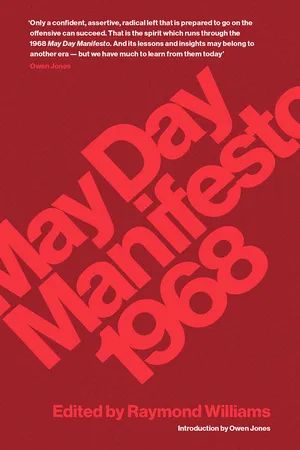
The original publication of the May Day Manifesto in 1967 collected together the most influential radical voices of the era. Among the seventy signatories were Raymond Williams, E. P. Thompson, Stuart Hall, Iris Murdoch, Terry Eagleton, Ralph Miliband and R. D. Laing. The manifesto set out a new agenda for socialist Britain, in the aftermath of the failure of postwar labours.
Urgently relevant to the current arguments about the crisis of austerity, the burden of empire and the failures to control rampant capitalism, it offers a complete road map to a brighter future. Covering the purpose of the state and how finance and empire are twinned, the importance of a planned economy for all, the role of Britain in the world, the manifesto hoped to inspire change and a fairer society. It is a bold reminder that there are alternatives to the current situation, and that alternative policies can make a difference.
- 240 pages
- English
- ePUB (mobile friendly)
- Available on iOS & Android
eBook - ePub
May Day Manifesto 1968
About this book
Information
1. May Day
May Day, for many hundreds of years, has been a people’s holiday: a celebration of growth on the land. For the last eighty years, coming out of this history, May Day has been an international festival - a demonstration and commitment - of the labour movement.
As we go out on this May Day, and look at our world, we see the familiar priorities of power and money, set over against people. But now with one difference, that the agent of just these priorities, in Britain, is a Labour government. It is a strange paradox, which must be faced and understood.
The immediate paradoxes are startling. While thousands of our people are without homes, while our schools are overcrowded and our health service breaking under prolonged strain, we have watched the wives of Labour ministers, protected by police, launching Polaris nuclear submarines. In a prolonged economic crisis, which has consistently falsified orthodox descriptions and remedies, a Labour government has stuck to old and discredited policies: cutting ordinary people’s living standards, and putting the protection of a capitalist economic and financial system before jobs, care and extended education. At City banquets, at the centre of a society that still flaunts private wealth, places are set for Labour ministers to describe the historic objectives of their own party - the defence and advancement of the working people - as selfishness and indiscipline. The limited provisions of the welfare state are called sacred cows, and are cut, in a false equation with a still intolerable military expenditure. More than half a million people are left to stand and wait without jobs, and in this new language are called spare capacity. The new generations are generations of weapons.
This is now the dangerous gap: between name and reality; between vision and power; between our human meanings and the deadening language of a false political system. In an increasingly educated society, in which millions of people are capable of taking part in decisions, in which there is all the experience of a mature labour movement and a political democracy, in which there is a growing and vital confidence in our ability to run our own lives, we are faced with something alien and thwarting: a manipulative politics, often openly aggressive and cynical, which has taken our meanings and changed them, taken our causes and used them; which seems our creation, yet now stands against us, as the agent of the priorities of money and power.
How has this happened? This is the only real question to ask, on this May Day, so that we can find ways of ending the danger and the insult that the political situation in Britain now increasingly represents. The sound of protest is rising again, in many parts of the country, and this is a critical moment. The years of radical campaigning, from Suez through Aldermaston to the early sixties made connexions that still hold, groups that still function. The Labour movement, in the unions and in the constituencies, has worked and struggled with a remarkable resilience. And it seemed, for a time, just a few years ago, that all this effort was coming together, into a new move forward. While the Tory illusion disintegrated, the Labour party, under the new leadership of Harold Wilson, caught up, for a while, the sense of movement, the practical urgency of a change of direction. After the defensive years, we saw the hope and the possibility of a really new start. There was a notable quickening in the Labour party itself, and the new radicals, campaigning for human alternatives to a nuclear strategy, to social poverty and to cultural neglect, came, in majority, to work for a Labour government: never uncritically, but with a measured and seemingly reasonable hope.
After those years of shared effort, we are all, who worked for a Labour government, in a new situation. For the sense of failure - a new kind of failure, in apparent victory - is implacably there, in every part of the Left. Not the crowing over failure; not the temporary irritation; but a deeply concerned and serious recognition of a situation we had none of us wholly understood. The obstacles to progress, once so confidently named for our eager combined assault, may now, for the government, have become a platform. But, however plausible the rationalizations, however ingenious the passing reassurances, hardly anyone is deceived. A definition has failed, and we are looking for new definitions and directions.
At any time, in the history of a people, such a moment is critical. For to recognize failure can be to live with failure: to move, as it would be easy to do, away from politics, and let the game, the sound, go on over our heads. There will always, it is true, be an irreducible nucleus of active resisters: the nonconformists, as has happened so often in Britain, losing their impetus to change the society but digging in, in their own circles, to maintain their positions. This minority is still large in Britain, by comparison with earlier periods: large enough, by any standards, to make certain that a living radicalism is maintained. Yet it seems to many of us, when all the pressures have been weighed, that now is not the moment for this kind of withdrawal. On the contrary, it is now, during the general failure, that it is time for a new, prolonged and connected campaign.
What failed to happen, in the early sixties, was a bringing together, into a general position, of the many kinds of new political and social response and analysis, around which local work had been done and local stands made. The consequence of this failure is now very apparent. While the positions were fragmentary, they could be taken, without real commitment, into the simple rhetoric of a new Britain. Now, as that rhetoric breaks, the fragments are thrown back at us: this issue against that. So a failure in one field - the persistence of poverty - can be referred to another - the economic crisis - and this in turn to another - the military expenditure - and this again to another - our foreign policy - and this back to the economic crisis, in an endless series of references and evasions. And then the character of the general crisis, within which these failures are symptoms, can never be grasped or understood or communicated. What we need is a description of the crisis, as a whole, in which not only the present mistakes and illusions but also the necessary and urgent changes can be intelligently connected.
It is our basic case, in this manifesto, that the separate campaigns in which we have all been active, and the separate issues with which we have all been concerned, run back, in their essence, to a single political system and its alternatives. We believe that the system we now oppose can only survive by a willed separation of issues, and the resulting fragmentation of consciousness. Our own first position is that all the issues - industrial and political, international and domestic, economic and cultural, humanitarian and radical - are deeply connected; that what we oppose is a political, economic and social system; that what we work for is a different whole society. The problems of whole men and women are now habitually relegated to specialized and disparate fields, where the society offers to manage or adjust them by this or that consideration or technique. Against this, we define socialism again as a humanism: a recognition of the social reality of man in all his activities, and of the consequent struggle for the direction of this reality by and for ordinary men and women.
2. Where the analysis starts
Consider first where a political analysis starts. You can start from an election, and what is necessary to win it. But if you do, you have taken as central a particular fact, which then affects or determines all the subsequent analysis. What you are most interested in, and what you want to happen, decides the things you discuss and the way you discuss them. Or you can start, alternatively, from the general condition of a country: its overall record, its total results. You can discuss the condition of Britain as if it were some single thing, to be amended by this percentage or improved by that average. But then the general figure can hide as much as it shows; it can show a national income, but not how it is distributed; or a total production, but not what things are produced. What looks like a neutral analysis has in fact been prejudiced by a political assumption: that we are all in the same situation, and have an equal stake and interest in it. Or again you can start from the state of an alliance, or the defence requirements of a particular region. You go on, in a realistic manner, to weigh political factors, to count friends and enemies and the leanings of neutrals. The argument flows, but you do not always notice that your choice of a starting point is a choice of what you take to be decisively important. If the state of an alliance is where you start, you do not look first at the war in Vietnam, but at the effect of the war on the relations between Britain and the United States. If defence is assumed, against a specified enemy, the first call on your resources is military expenditure, and you discuss what is left over in relation to that. Or again, you can start an analysis from particular personal careers: the prospects of X in his new administration; the developing rivalry between Y and Z; the character factors, in this speech or that television appearance. And what is then supposed to matter, to the majority of men, is how these careers will work out. Policies, then, are an aspect of careers, and are judged accordingly.
We are all familiar with these kinds of analysis. In fact, between them, they dominate orthodox discussion, serious and popular. To be interested in politics is to be interested in these things and in these ways. It is often difficult to see how things might be otherwise, how you could start differently. This is how a particular culture imposes its orthodoxy, in a way before any of the detailed arguments start. You may go on to differ, at this or that point, but if you accept those starting points, there are certain things you can never find time to say, or say reasonably and relevantly. The key to a political analysis is always where it starts.
In our own case we have started from our situation as socialists, in the present contradictions of a Labour government. But we have defined our socialism in a particular way, so as to make our position clear. It is not our first interest to oppose this government, or to make what is usually called a rebel move. We do not start from that perspective, because there are more important things to start from. The contradictions are out in the open, and we draw attention to them. But when we say that a definition has failed, and that we are looking for new definitions and directions, we are not primarily referring to the prospects of the government or the condition of the Labour party. We are asking what it means to live in Britain now, with the familiar political landmarks changing and disappearing, and with an urgent reality that we must try to understand, as particular people in a particular country. We believe we have lived too long under the domination of other starting points, and that the kind of politics which follows from them is destructive and pointless. We think we have to make the break to seeing the world in our own way, and then by analysis and description to offer this way to others, to see how far they can agree with it, how closely it connects with their lives.
Our starting point, then, is where people are living. Not the abstract condition of a party or a government or a country, but the condition of life of the majority of ordinary people. Our first detailed analysis will be of what we are calling the social realities, in day-to-day living: in income and poverty; in social relations at work, in education and in housing. We then move out from that, in a widening analysis and description, until we can see the outlines of what we are calling a world system, of a new international capitalism and a new kind of imperialism, which are at the roots not only of the British economic crisis, but of the world political crisis and the realities and dangers of war. For that is the essential perspective, and only then, with the analysis and description completed, shall we return to the usual starting point: what comes out of that reality, as a political situation.
3. Social realities
We have to start with a paradox, in the real situation. There is now serious, widespread and avoidable poverty in Britain, but in another way of looking at the same country, there is a high standard of living, especially by comparison with the years before the war. In the technical progress of the society, and supported by the long struggles of the unions and other reforming agencies, the post-war Labour government made real changes in the conditions of ordinary life: peace-time full employment; the extension of the social services; the expansion of public ownership. There was then not only a higher standard of living, increasingly apparent as the post-war shortages and reorganization were worked through by the fifties. There was also a substantial gain in the dignity, happiness and security of millions of working people. Conditions before and after the war became a familiar contrast, and an important one. This in its turn was interpreted as a contrast between poverty and affluence.
Full employment, undoubtedly, was a major real factor. If the society had simply got wealthier, in total, but left two or three million people out of work, the change would have been differently understood. But until 1967, the average unemployment rate in the society rarely rose above 2.5 per cent. It is true that in certain regions, and in certain industries and occupations, ‘full employment’ had a hollow ring. Yet memories of the mass unemployment of the thirties lived on, handed from father to son. With that depression as their reference point, most people were impressed by this particular aspect of a better society.
Moreover, although the serious periodic balance-of-payments crises typical of the post-war era slowed down and even at times stopped the growth of output, they did not cause those absolute declines in output which were so characteristic a feature of the pre-war trade cycle. Average earnings, except during periods of wage restrictions and wage freeze, rose fairly steadily. There was for many people a real prospect of improved living standards; and with the rapid expansion in the employment of married women, multi-earner families became very common.
So there was more money to spend, and also, with an economic system geared to the rapid production of consumer goods, a partial blurring of distinctions in patterns of consumption between social groups. Home ownership became a realizable goal for some working people; cars, washing machines and similar goods (scarcely ‘luxuries’ in any case especially for the old person or the large family) became more widely available. But these tangible improvements formed the basis of a myth, which Labour intellectuals as much as anyone have helped to create and propagate. It is the myth that the basic problems of the distribution of wealth have been solved, that poverty has effectively ceased to exist or seriously matter, and that we are now comfortably set upon the smooth road to progress and greater equality. It is only ten years since the now President of the Board of Trade was writing:
The essential fact remains that the rich are distinctly less rich and the poor are much less poor. The levelling process is a reality even in terms of consumption standards; and Britain has an appreciably more equal society after six years of Labour rule either than it had before the war or than it would otherwise have had.
Even when the hollowness of this argument became exposed by the progressive accumulation of research, a process of accommodation occurred. There was no fundamental reassessment of the analysis. The view that poverty had been brought to an end was still complacently assumed, and is still the official rhetoric of British society. What poverty remained was seen as incidental, a matter of special cases which could be treated in isolation from wider, structural considerations. Inequality was similarly incidental, or alternatively was only of that kind essential for providing necessary incentives to make the economic system operate more effectively.
We reject these views. To move from the rhetoric to the reality is to see that not everyone has in fact shared equally in the benefits of economic growth and full employment: that the gap between rich and poor has not, in fact, grown noticeably less. Two per cent of the British people still own 55 per cent of all private wealth. Ten per cent own 80 per cent. Differences of income are still very wide. When income from property is added to earnings, the top 1 per cent of the British people receive about as much income as the bottom 30 per cent put together. These are the ground-lines of all the other changes.
Our case then is: that there are still gross and intolerable areas of traditional poverty and inequality. Further, that post-war capitalism, even at its most successful, creates and ratifies new kinds of poverty. That the policies of the current Labour government, far from tackling these problems at their source, have intensified them. And that it is possible, by a socialist analysis and programme, to reveal and to change those mechanisms inherent in British capitalist society which create the poverty and inequality which, with a shift of emphasis, have now plainly to be seen.
4. Poverty today
The continuing personal poverty in our society is not incidental; it is a matter of conscious social policy, and of the structures of society itself. Poverty not only remains substantial, but the prospect of the comprehensive legislative programme which could abolish it, at one stage promised, recedes with every turn of the economic crisis. Nor is it a question of ignorance. The scale of the problem of poverty is officially admitted, and much of the most important recent evidence comes from the government’s own surveys.
The numbers subject to poverty, by any reasonable definitions, are very large indeed. Using the standard of 40 per cent above basic National Assistance rates, in 1964, Peter Townsend estimated that three million members of families whose head was in full-time work, two and a half million persons of pensionable age, three quarters of a million fatherless families, three quarters of a million chronic sick or disabled and over half a million families of unemployed fathers were in poverty. This amounts to about 14 per cent of the population. By basic National Assistance standards, about a third of those groups were in acute poverty.
It has long been known that old age is accompanied by a descent into poverty for a large proportion of old people. The government’s Circumstances of Retirement Pensioners report in 1966 estimated that three quarters of a million old people lived below National Assistance level. Supplementary Pensions legislation has somewhat improved this position. But if one takes Supplementary Benefit levels as a new minimal definition of subsistence, since 1966, one still finds 1,670,000 old people in poverty; one must add to this figure 20 per cent or more dependants of these pensioners, and an unknown but significant number who would be entitled to Supplementary Benefit but do not receive it. About a third of old people, from official evidence, cannot live without special supplementation of their income to subsistence level.
Widespread poverty is not confined to retired people, and there has been growing attention in recent years to the problem of poverty among wage earners and families. The Ministry of Social Security estimated that 280,000 families with two or more children lived, before November 1966, at or below National Assistance level. This included 910,000 children. By the newer Supplementary Benefit standards (amounting to 14s per week extra for a family with three children) there were 345,000 families in poverty, including 125,000 in full-time work, and 1,110,000 children. One-child families were excluded from this Circumstances of Families report, but if one adds them the Ministry estimates that out of a total of seven million families, approaching half a million, with up to one and a quarter million children, were in poverty.
These families in poverty include a large proportion of the chronic sick, the unemployed, and fatherless families. A third of families whose wage earner was sick or unemployed were receiving National Assistance, in 1966, while a quarter were entitled to but not receiving it. Though large families are only a small minority of the total in poverty, nevertheless one in five of them with six or more children were in poverty by the still stringent Supplementary Benefit standards. Most families made fatherless by widowhood or separation had total incomes near to National Assistance level in 1966; half received National Assistance. Of the half million families the Ministry estimated to be in poverty 145,000 were fatherless. The wage-stop is an additional factor, keeping another 30,000 families in poverty by these standards. This regulation restricts the Supplementary Benefit payable to the sick and unemployed, where payment of the full rate would increase a man’s income. By this rule, a family whose needs by the Supplementary Benefit scale amount to £15-20 a week can quite easily only get £10-12. The law thus confirms the below-subsistence incomes of men in work.
On top of the wage-stop, there are 140,000 families who could not be raised to Supplementary Benefit levels because they are in work. One recent survey which excluded some low-paid occupations such as agriculture, retail distribution, and catering, estimated that the earnings of nearly 16 per cent of men were below £15 per week. Of course women’s earnings are much lower than this. In a number of industries, notably public employment and texti...
Table of contents
- Cover Page
- Title Page
- Copyright Page
- Contents
- Introduction
- Preface
- 1. May Day
- 2. Where the analysis starts
- 3. Social realities
- 4. Poverty today
- 5. The facts of inequality
- 6. Social poverty
- 7. Housing, health and education
- 8. The realities of work
- 9. Communications
- 10. Advertising
- 11. The meaning of modernization
- 12. New capitalist requirements
- 13. The laws of the new market
- 14. The laws of the United States economy
- 15. The economic drive outwards
- 16. America and Europe
- 17. The technological gap
- 18. Effects on the ‘host’ nations
- 19. The new imperialism
- 20. The power of trade
- 21. The power of money
- 22. The international firm
- 23. The effects of aid
- 24. Changes in the Third World
- 25. Elites and armies
- 26. War and Cold War
- 27. The Cold War moves outwards
- 28. Political managers of the world
- 29. Backlash in Europe
- 30. The British crisis
- 31. The position of British industry
- 32. The response of British industry
- 33. Special characteristics of British capitalism
- 34. The role of the State
- 35. But what is the State?
- 36. Labour’s aims and capitalist planning
- 37. Labour and the crisis of the world economy
- 38. The Rake’s Progress
- 39. Devaluation and after
- 40. The power of capital and labour in Britain
- 41. There are alternative policies
- 42. Against managed politics
- 43. Voters, representatives and others
- 44. Two meanings of social democracy
- 45. The Labour Party
- 46. Other radical groupings
- 47. Other socialist groupings
- 48. The unions and politics
- 49. The bearings of change
- 50. The politics of the manifesto
Trusted by 375,005 students
Access to over 1.5 million titles for a fair monthly price.
Study more efficiently using our study tools.
Frequently asked questions
Yes, you can cancel anytime from the Subscription tab in your account settings on the Perlego website. Your subscription will stay active until the end of your current billing period. Learn how to cancel your subscription
No, books cannot be downloaded as external files, such as PDFs, for use outside of Perlego. However, you can download books within the Perlego app for offline reading on mobile or tablet. Learn how to download books offline
Perlego offers two plans: Essential and Complete
- Essential is ideal for learners and professionals who enjoy exploring a wide range of subjects. Access the Essential Library with 800,000+ trusted titles and best-sellers across business, personal growth, and the humanities. Includes unlimited reading time and Standard Read Aloud voice.
- Complete: Perfect for advanced learners and researchers needing full, unrestricted access. Unlock 1.5M+ books across hundreds of subjects, including academic and specialized titles. The Complete Plan also includes advanced features like Premium Read Aloud and Research Assistant.
We are an online textbook subscription service, where you can get access to an entire online library for less than the price of a single book per month. With over 1.5 million books across 990+ topics, we’ve got you covered! Learn about our mission
Look out for the read-aloud symbol on your next book to see if you can listen to it. The read-aloud tool reads text aloud for you, highlighting the text as it is being read. You can pause it, speed it up and slow it down. Learn more about Read Aloud
Yes! You can use the Perlego app on both iOS and Android devices to read anytime, anywhere — even offline. Perfect for commutes or when you’re on the go.
Please note we cannot support devices running on iOS 13 and Android 7 or earlier. Learn more about using the app
Please note we cannot support devices running on iOS 13 and Android 7 or earlier. Learn more about using the app
Yes, you can access May Day Manifesto 1968 by Raymond Williams in PDF and/or ePUB format, as well as other popular books in Politics & International Relations & Communism, Post-Communism & Socialism. We have over 1.5 million books available in our catalogue for you to explore.