The idea of a Lenin renaissance might well provoke an outburst of sarcastic laughter. Marx is OK, but Lenin? Doesn't he stand for the big catastrophe which left its mark on the entire twentieth-century?
Lenin, however, deserves wider consideration than this, and his writings of 1917 are testament to a formidable political figure. They reveal his ability to grasp the significance of an extraordinary moment in history. Everything is here, from Lenin-the-ingenious-revolutionary-strategist to Lenin-of-the-enacted-utopia. To use Kierkegaard's phrase, what we can glimpse in these writings is Lenin-in-becoming: not yet Lenin-the-Soviet-institution, but Lenin thrown into an open, contingent situation.
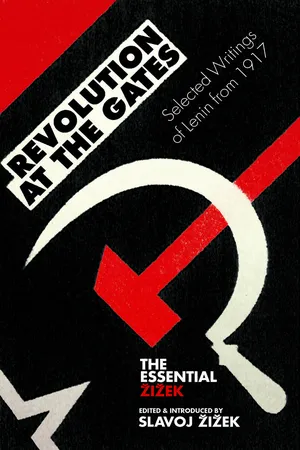
In Revolution at the Gates, Slavoj Zizek locates the 1917 writings in their historical context, while his afterword tackles the key question of whether Lenin can be reinvented in our era of "cultural capitalism." Zizek is convinced that, whatever the discussion-the forthcoming crisis of capitalism, the possibility of a redemptive violence, the falsity of liberal tolerance-Lenin's time has come again.
- 352 pages
- English
- ePUB (mobile friendly)
- Available on iOS & Android
eBook - ePub
About this book
Information
Topic
PhilosophieSubtopic
HistoriographieAfterword
Afterword: Lenin’s Choice
In academic politics today, the idea of dealing with Lenin immediately gives rise to two qualifications: yes, why not, we live in a liberal democracy, there is freedom of thought … provided that we treat Lenin in an “objective, critical and scientific way”, not in an attitude of nostalgic idolatry, and, furthermore, from a perspective firmly rooted in the democratic political order, within the horizon of human rights—that is the lesson learned painfully through the experience of twentieth-century totalitarianism.
What are we to say to this? The problem lies in the further implicit qualifications which can easily be discerned by a “concrete analysis of the concrete situation”, as Lenin himself would have put it.i “Fidelity to the democratic consensus” means acceptance of the present liberal-parliamentary consensus, which precludes any serious questioning of the way this liberal-democratic order is complicit in the phenomena it officially condemns, and, of course, any serious attempt to imagine a different sociopolitical order. In short, it means: say and write whatever you like—on condition that you do not actually question or disturb the prevailing political consensus. Everything is allowed, solicited even, as a critical topic: the prospect of a global ecological catastrophe; violations of human rights; sexism, homophobia, anti-feminism; growing violence not only in faraway countries, but also in our own megalopolises; the gap between the First and the Third World, between rich and poor; the shattering impact of the digitalization of our daily lives … today, there is nothing easier than to get international, state or corporate funds for a multidisciplinary research project on how to fight new forms of ethnic, religious or sexist violence. The problem is that all this occurs against the background of a fundamental Denkverbot: a prohibition on thinking.
Today’s liberal-democratic hegemony is sustained by a kind of unwritten Denkverbot similar to the infamous Berufsverbot (prohibition on employing individuals with radical Left leanings in the state organs) in Germany in the late 1960s—the moment we show a minimal sign of engaging in political projects which aim seriously to challenge the existing order, the answer is immediately: “Benevolent as it is, this will inevitably end in a new Gulag!” The ideological function of constant references to the Holocaust, the Gulag, and more recent Third World catastrophes is thus to serve as the support of this Denkverbot by constantly reminding us how things could have been much worse: “Just look around and see for yourself what will happen if we follow your radical notions!” What we encounter here is the ultimate example of what Anna Dinerstein and Mike Neary have called the project of disutopia: “not just the temporary absence of Utopia, but the political celebration of the end of social dreams”.ii And the demand for “scientific objectivity” amounts to just another version of the same Denkverbot: the moment we seriously question the existing liberal consensus, we are accused of abandoning scientific objectivity for outdated ideological positions. This is the “Leninist” point on which one cannot and should not concede: today, actual freedom of thought means freedom to question the prevailing liberal-democratic “post-ideological” consensus—or it means nothing.
The Right to Truth
The perspective of the critique of ideology compels us to invert Wittgenstein’s “What one cannot speak about, thereof one should be silent” into “What one should not speak about, thereof one cannot remain silent”. If you want to speak about a social system, you cannot remain silent about its repressed excess. The point is not to tell the whole Truth but, precisely, to append to the (official) Whole the uneasy supplement which denounces its falsity. As Max Horkheimer put it back in the 1930s: “If you don’t want to talk about capitalism, then you should keep silent about Fascism.” Fascism is the inherent “symptom” (the return of the repressed) of capitalism, the key to its “truth”, not just an external contingent deviation of its “normal” logic. And the same goes for today’s situation: those who do not want to subject liberal democracy and the flaws of its multiculturalist tolerance to critical analysis, should keep quiet about the new Rightist violence and intolerance.
If we are to leave the opposition between liberal-democratic universalism and ethnic/religious fundamentalism behind, the first step is to acknowledge the existence of liberal fundamentalism: the perverse game of making a big fuss when the rights of a serial killer or a suspected war criminal are violated, while ignoring massive violations of “ordinary” people’s rights. More precisely, the politically correct stance betrays its perverse economy through its oscillation between the two extremes: either fascination with the victimized other (helpless children, raped women…), or a focus on the problematic other who, although criminal, and so on, also deserves protection of his human rights, because “today it’s him, tomorrow it’ll be us” (an excellent example is Noam Chomsky’s defence of a French book advocating the revisionist stance on the Holocaust). On a different level, a similar instance of the perversity of Political Correctness occurs in Denmark, where people speak ironically of the “white woman’s burden”, her ethico-political duty to have sex with immigrant workers from Third World countries—this being the final necessary step in ending their exclusion.
Today, in the era of what Habermas designated as die neue Unübersichtlichkeit (the new opacity),iii our everyday experience is more mystifying than ever: modernization generates new obscurantisms; the reduction of freedom is presented to us as the dawn of new freedoms. The perception that we live in a society of free choices, in which we have to choose even our most “natural” features (ethnic or sexual identity), is the form of appearance of its very opposite: of the absence of true choices.iv The recent trend for “alternate reality” films, which present existing reality as one of a multitude of possible outcomes, is symptomatic of a society in which choices no longer really matter, are trivialized. The lesson of the time-warp narratives is even bleaker, since it points towards a total closure: the very attempt to avoid the predestined course of things not only leads us back to it, but actually constitutes it—from Oedipus onwards, we want to avoid A, and it is through our very detour that A realizes itself.
In these circumstances, we should be especially careful not to confuse the ruling ideology with ideology which seems to dominate. More then ever, we should bear in mind Walter Benjamin’s reminder that it is not enough to ask how a certain theory (or art) positions itself with regard to social struggles—we should also ask how it actually functions in these very struggles. In sex, the true hegemonic attitude is not patriarchal repression, but free promiscuity; in art, provocations in the style of the notorious “Sensation” exhibitions are the norm, the example of art fully integrated into the establishment. Ayn Rand brought this logic to its conclusion, supplementing it with a kind of Hegelian twist, that is, reasserting the official ideology itself as its own greatest transgression, as in the title of one of her late non-fiction books: “Capitalism, This Unknown Ideal”, or in “top managers, America’s last endangered species”.
Indeed, since the “normal” functioning of capitalism involves some kind of disavowal of the basic principle of its functioning (today’s model capitalist is someone who, after ruthlessly generating profit, then generously shares parts of it, giving large donations to churches, victims of ethnic or sexual abuse, etc., posing as a humanitarian), the ultimate act of transgression is to assert this principle directly, depriving it of its humanitarian mask. I am therefore tempted to reverse Marx’s Thesis 11: the first task today is precisely not to succumb to the temptation to act, to intervene directly and change things (which then inevitably ends in a cul-de-sac of debilitating impossibility: “What can we do against global capital?”), but to question the hegemonic ideological co-ordinates. In short, our historical moment is still that of Adorno:
To the question “What should we do?” I can most often truly answer only with “I don’t know.” I can only try to analyse rigorously what there is. Here people reproach me: When you practise criticism, you are also obliged to say how one should make it better. To my mind, this is incontrovertibly a bourgeois prejudice. Many times in history it so happened that the very works which pursued purely theoretical goals transformed consciousness, and thereby also social reality.v
If, today, we follow a direct call to act, this act will not be performed in an empty space—it will be an act within the hegemonic ideological co-ordinates: those who “really want to do something to help people” get involved in (undoubtedly honourable) exploits like Médecins sans frontières, Greenpeace, feminist and anti-racist campaigns, which are all not only tolerated but even supported by the media, even if they seemingly encroach on economic territory (for example, denouncing and boycotting companies which do not respect ecological conditions, or use child labour) – they are tolerated and supported as long as they do not get too close to a certain limit.vi
This kind of activity provides the perfect example of interpassivity:vii of doing things not in order to achieve something, but to prevent something from really happening, really changing. All this frenetic humanitarian, Politically Correct, etc., activity fits the formula of “Let’s go on changing something all the time so that, globally, things will remain the same!”. If standard Cultural Studies criticize capitalism, they do so in the coded way that exemplifies Hollywood liberal paranoia: the enemy is “the system”, the hidden “organization”, the anti-democratic “conspiracy”, not simply capitalism and state apparatuses. The problem with this critical stance is not only that it replaces concrete social analysis with a struggle against abstract paranoiac fantasies, but that—in a typical paranoiac gesture—it unnecessarily redoubles social reality, as if there were a secret Organization behind the “visible” capitalist and state organs. What we should accept is that there is no need for a secret “organization-within-an-organization”: the “conspiracy” is already in the “visible” organization as such, in the capitalist system, in the way the political space and state apparatuses work.viii
Let us take one of the hottest topics in today’s “radical” American academia: postcolonial studies. The problem of postcolonialism is undoubtedly crucial; however, postcolonial studies tend to translate it into the multiculturalist problematic of the colonized minorities’ “right to narrate” their victimizing experience, of the power mechanisms which repress “otherness”, so that, at the end of the day, we learn that the root of postcolonial exploitation is our intolerance towards the Other, and, furthermore, that this intolerance itself is rooted in our intolerance towards the “Stranger in Ourselves”, in our inability to confront what we have repressed in and of ourselves—the politico-economic struggle is thus imperceptibly transformed into a pseudo-psychoanalytic drama of the subject unable to confront its inner traumas.… (Why pseudo-psychoanalytic? Because the true lesson of psychoanalysis is not that the external events which fascinate and/or disturb us are just projections of our inner repressed impulses. The unbearable fact of life is that there really are disturbing events out there: there are other human beings who experience intense sexual enjoyment while we are halfimpotent; there are people submitted to terrifying torture.… Again, the ultimate truth of psychoanalysis is not that of discovering our true Self, but that of the traumatic encounter with an unbearable Real.) The true corruption of American academia is not primarily financial, it is not only that universities are able to buy many European critical intellectuals (myself included—up to a point), but conceptual: notions of “European” critical theory are imperceptibly translated into the benign universe of Cultural Studies chic. At a certain point, this chic becomes indistinguishable from the famous Citibank commercial in which scenes of East Asian, European, Black and American children playing is accompanied by the voice-over: “People who were once divided by a continent … are now united by an economy”—at this concluding highpoint, of course, the children are replaced by the Citibank logo.ix
The great majority of today’s “radical” academics silently count on the long-term stability of the American capitalist model, with a secure tenured position as their ultimate professional goal (a surprising number of them even play the stock market). If there is one thing they are genuinely afraid of, it is a radical shattering of the (relatively) safe life-environment of the “symbolic classes” in developed Western societies. Their excessive Politically Correct zeal when they are dealing with sexism, racism, Third World sweatshops, and so on, is thus ultimately a defence against their own innermost identification, a kind of compulsive ritual whose hidden logic is: “Let’s talk as much as possible about the necessity of a radical change, to make sure that nothing will really change!” The journal October is typical of this: when you ask one of the editors what the title refers to, they half-confidentially indicate that it is, of course, that October—in this way, you can indulge in jargo...
Table of contents
- Cover
- About the Author
- Also By This Author
- Title Page
- Copyright
- Contents
- A Note on Bibliographical Sources
- Introduction: Between the Two Revolutions: Slavoj Žižek
- Revolution at the Gates
- Afterword: Lenin’s Choice: Slavoj Žižek
- Index
Trusted by 375,005 students
Access to over 1.5 million titles for a fair monthly price.
Study more efficiently using our study tools.
Frequently asked questions
Yes, you can cancel anytime from the Subscription tab in your account settings on the Perlego website. Your subscription will stay active until the end of your current billing period. Learn how to cancel your subscription
No, books cannot be downloaded as external files, such as PDFs, for use outside of Perlego. However, you can download books within the Perlego app for offline reading on mobile or tablet. Learn how to download books offline
We are an online textbook subscription service, where you can get access to an entire online library for less than the price of a single book per month. With over 1.5 million books across 990+ topics, we’ve got you covered! Learn about our mission
Look out for the read-aloud symbol on your next book to see if you can listen to it. The read-aloud tool reads text aloud for you, highlighting the text as it is being read. You can pause it, speed it up and slow it down. Learn more about Read Aloud
Yes! You can use the Perlego app on both iOS and Android devices to read anytime, anywhere — even offline. Perfect for commutes or when you’re on the go.
Please note we cannot support devices running on iOS 13 and Android 7 or earlier. Learn more about using the app
Please note we cannot support devices running on iOS 13 and Android 7 or earlier. Learn more about using the app
Yes, you can access Revolution at the Gates by V. I. Lenin, Slavoj Zizek in PDF and/or ePUB format, as well as other popular books in Philosophie & Historiographie. We have over 1.5 million books available in our catalogue for you to explore.