- English
- ePUB (mobile friendly)
- Available on iOS & Android
eBook - ePub
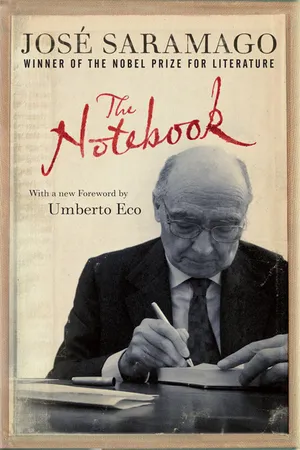
The Notebook
About this book
Thought-provoking and lyrical, The Notebook records the last year in the life of Jos? Saramago. In these pages, beginning on the eve of the 2008 US presidential election, he evokes life in his beloved city of Lisbon, revisits conversations with friends, and meditates on his favorite authors. Precise observations and moments of arresting significance are rendered with pointillist detail, and together demonstrate an acute understanding of our times. Characteristically critical and uncompromising, Saramago dissects the financial crisis, deplores Israel's punishment of Gaza, and reflects on the rise of Barack Obama. The Notebook is a unique journey into the personal and political world of one of the greatest writers of our time.
Information
October 2008
October 1: Where Is the Left?
Three or four years ago, in an interview with a South American newspaper, from Argentina, I think, I came out with a statement I subsequently thought would provoke discomfort, discussion, even a scandal (such was my naïveté), beginning with local left-wing groups and continuing, who knows, like a wave growing in concentric circles, out into the international media—at least such political, trade union or cultural organs of the media that are the tributaries of the said left. The paper reproduced my argument word for word, in all its harshness, not shying away from actual obscenities, as in the following: “The left has no fucking idea of the world it’s living in.”
The left responded to my deliberate challenge with the iciest of silences. No communist party, for instance, beginning with the one of which I’m a member, emerged from its stockade to refute what I had said or simply to argue about the propriety or the lack of propriety of my language. Even more to the point, nor did any of the socialist parties then in government in their respective countries—I’m thinking especially of those in Portugal and Spain—consider it necessary to demand a clarification from the impudent writer who had dared to throw a stone into a fetid swamp of indifference. Nothing of anything at all, absolute silence, as if there were nothing but dust and spiders in the ideological tombs where they had taken refuge, or nothing more than an ancient bone that was no longer solid enough for a relic. For several days I felt as excluded from human society as if I were carrying the plague, or were the victim of a kind of cirrhosis of the mind, no longer able to speak coherently. I even ended up thinking that the compassionate line going the rounds among those people who were keeping so quiet was something like, “Poor thing, what can you expect at his age?” It was clear that they didn’t think my opinions worthy of their consideration.
Time went on, and on, the state of the world grew increasingly complicated, and the left continued fearlessly to play out the roles, whether in power or in opposition, that had been handed to them. I, who had in the meantime made another discovery, that Marx was never so right as he is today, imagined, when the cancerous mortgage scam broke in the United States a year ago, that the left, wherever it was, if it was still alive, would finally open its mouth to say what it thought of the matter. I already have an explanation: the left doesn’t think. It doesn’t act, it doesn’t risk taking a step. What happened then has gone on happening, right up to today, and the left has continued in its cowardly fashion not thinking, not acting, not risking taking a step. Which is why the insolent question in my title should not cause surprise: “Where is the Left?” I am not suggesting any answers; I have already paid too dearly for my illusions.
October 2: Enemies at Home
That there is a crisis in the family is something nobody would dare to deny, however much the Catholic Church might seek to disguise the disaster with a mellifluous rhetoric that doesn’t even deceive itself. Nor can we deny that many so-called traditional values of family and social cohabitation have gone down the drain, dragging with them even those values that ought to be defended from the constant attacks coming from the highly conflictive society in which we live; nor that today’s schools—the successors to those old schools that for many generations were tacitly charged (in the absence of anything better) with making up for the educational failings of the family unit—are paralyzed, riddled with contradictions and mistakes, disoriented by successive pedagogical methods that are not in fact pedagogical methods, that too often are no more than passing fashions or amateur experiments doomed to fail. They are doomed by the very lack of intellectual maturity of those who formulated them, without being able to formulate or answer a question that to my mind is essential: “What kind of citizens are we trying to produce?”
The social landscape is not a pretty sight. Strangely, our more or less worthy rulers do not seem as concerned with these matters as they should be, perhaps because they think that since these are universal problems the solution—whenever it is found—will be automatic, for everyone.
I disagree. We live in a society that seems to have made violence a way of social interaction. The aggression that is inherent in this species of ours, and which at times we think that we have managed to control through education, burst brutally up from the depths in the past twenty years, manifesting itself right across the social sphere, prompted by modes of idleness that have stopped using simple hedonism to condition the consumer’s mentality and instead use violence: led by television, where ever more perfect fake blood gushes out every hour of the day and night, and video games that are like instruction manuals for teaching total intolerance and perfect cruelty, and, because all of this is connected, the avalanche of ads for erotic services, welcomed by all newspapers, including the more right-thinking ones, while they cram their editorial pages (if any still remain?) with hypocritical instructions to society on how it should behave. Do I exaggerate? Then explain to me how it is we have reached the point where many parents are afraid of their children—those sweet adolescents, our hope for tomorrow, from whom the word “no” from a father or mother grown tired of irrational demands instantly unleashes a fury of insults, of outrageous behavior, of aggression. Physical aggression, in case you had any doubt about my meaning. Many parents harbor their worst enemies in their own home: their children. Ruben Darío innocently wrote of “that divine treasure, youth.” He would not write so today.
October 6: On Fernando Pessoa
He was a man who knew languages and wrote poetry. He earned his bread and wine replacing words with words. He wrote poetry as one must write poetry, as if for the first time. To begin with he called himself Fernando, a person like anyone else. One day he remembered to announce the imminent appearance of a super-Camões, a Camões much greater than the old one, but since he was a man who was known to be discreet, who used to walk through Douradores in a light-colored gabardine, a bow tie, and featherless hat, he did not say that the super-Camões was in fact himself. After all, this super-Camões could not become a still greater Camões; he was merely waiting to become Fernando Pessoa, a phenomenon the like of which Portugal had never known. Naturally, his life was made up of days, and we know that days may be alike but each never happens more than once, which is why it is not surprising that on one of those days when Fernando passed in front of a mirror he spied in it, at a glance, another person.1 He thought this was just another optical illusion, those ones that happen when you’re not paying attention, or that the last glass of eau de vie had not agreed with his liver and his head, but he cautiously took a step back just to make sure that—as is usually assumed—when mirrors show something they do not make mistakes. This one, however, had indeed made a mistake: there was a man looking out at him from inside the mirror, and that man was not Fernando Pessoa.
He was a little shorter, and his face was somewhat dark-skinned and completely clean-shaven. Unconsciously Fernando brought his hand to his upper lip, then breathed deeply in childlike relief: his moustache was still there. One can expect many things from an image that appears in a mirror, but not that it will speak. And because these two, Fernando and the image that wasn’t an image of him, were not going to stay watching one another forever, Fernando Pessoa said, “My name is Ricardo Reis.” The other man smiled, nodded, and disappeared. For a moment the mirror was empty, bare, then right away another image appeared, of a thin, pale man who looked as if he were not long for this world. It seemed to Fernando that this must have been the first one; however, he made no comment, merely saying, “My name is Alberto Caeiro.” The other did not smile; he merely nodded slightly, agreeing, and left. Fernando Pessoa waited, having always been told that whenever there are two a third will always follow. The third figure took a few seconds to arrive, and he was one of those men who look as if they have more health than they know what to do with, and he had the unmistakable air of an engineer trained in England. Fernando said, “My name is Álvaro de Campos,” but this time he did not wait for the image to disappear from the mirror, but moved away from it himself, probably tired from having been so many people in such a short space of time. That night, in the small hours of the morning, Fernando Pessoa awoke wondering whether Álvaro de Campos had stayed in the mirror. He got up, and what he found there was his own face. So he said, “My name is Bernardo Soares,” and went back to bed. It was after assuming these names and a few others that Fernando thought it was time for him, too, to be ridiculous, and he wrote the most ridiculous love letters in the world. He made great progress in his work of translation and poetry, and then he died. His friends had told him he had a great future ahead of him, but he can’t have believed them—believed them so little, in fact, that he unfairly decided to die in the prime of life, aged forty-seven, if you can believe such a thing. A moment before the end he asked to be handed his glasses: “Give me my glasses,” were his last, formal words. To this day nobody has sought to learn what he wanted them for, such is the way the final wishes of the dying are ignored or despised, but it seems quite likely that what he wanted was to look in a mirror to see who was there in the end. But he was not allowed enough time. Actually, there wasn’t even a mirror in the room. Fernando Pessoa never did find out for sure who he was, but thanks to his doubts we can manage to learn a little more about who it is we are.
October 7: The Other Side
What might things be like when we are not looking at them? This question, which seems less absurd to me every day, is one that I asked often as a child, but only asked myself, not my parents or my teachers, because I guessed that they would smile at my naïveté (or at my stupidity, according to a more radical opinion) and would give me the only answer that would never convince me: “When we are not looking at them, things look just the same as when we are looking at them.” I always thought that things, whenever they were alone, were other things. Later, when I had reached that phase of adolescence characterized by the disdainful conceit with which it judges the childhood from which it has emerged, I thought I had found the definitive solution to the metaphysical concern that had tormented my tender years: I thought that if you were to set up a camera in such a way that it would shoot a picture automatically in a room where there were no human presences, you would be able to catch things unawares, and in this way learn their true appearance. I forgot that things are smarter than they seem and don’t allow themselves to be tricked quite so easily: they know perfectly well that inside each camera there is a human eye hidden. . . Besides, even if the equipment had cunningly been able to capture the image of the thing face-on, its other side would have remained beyond the reach of the optical, mechanical, chemical, or digital system of that photographic record. And it would have been toward that hidden side that at the last moment, ironically, the photographed thing would have turned its secret aspect, that twin sister of darkness. When we enter a room that is immersed in absolute darkness and turn on a light, the darkness disappears. So it is not strange that we should ask ourselves, “Where has it gone?” And there can only be one reply: “It didn’t go anywhere; darkness is simply the other side of light, its secret aspect.” It is a pity that nobody told me earlier, when I was a child. Today I would know all about darkness and light, about light and darkness.
October 8: Getting Back to the Subject
The lessons of life have taught us how little use a political democracy will be, however well-balanced it may appear in its internal structures and institutional functioning, if it is not constituted as the basis for an effective and real economic democracy and for a no less real and effective cultural democracy. It may seem a worn-out old commonplace to say such a thing today about certain ideological concerns of the past, but it would be shutting our eyes to the simple historical truth if we were not to recognize that the democratic trinity—politics, economics, culture, each part complementing and enabling the others—at the height of its prosperity as an idea for the future represented one of the most passion-inspiring civic flags that in recent history has ever managed to awake consciences, mobilize wills, move hearts. Today, scorned and thrown into the rubbish heap of formulas that have been worn down by use and stripped of their true nature, the idea of economic democracy has given way to a market that is obscenely triumphant, even at the moment of an extremely serious crisis on its financial axis, whilst the idea of a cultural democracy has ended up being replaced by an alienating industrialized mass marketing of culture. We are not progressing, we are regressing. And it becomes ever more absurd to speak of democracy if we insist on mistakenly identifying it exclusively with the quantitative and mechanical expressions of it that we call political parties, parliaments, and governments, without paying any attention to their actual content and the distorted, abusive use they tend to make of the vote that justified them and placed them where they are.
You should not conclude from what I have just written that I am against the existence of parties: I am a member of one of them myself. You should not think that I abhor parliaments or their members: I would wish both to be better, more active and responsible in all things. Nor should you believe that I am the Providential creator of a magic recipe that will allow people henceforth to live without having to put up with bad government and waste time on elections that rarely solve the problems: I just refuse to accept that it is only possible to govern and wish to be governed according to the supposedly democratic models currently in use, which to my mind are distorted and incoherent, and which certain politicians (not always in good faith) want to make universal, along with the false promises of social development that barely manage to disguise the egotistical and relentless ambitions that really motivate them. We nurture these ills in our own home, then behave as though we were the inventors of a universal panacea capable of curing all the ills of the body and the spirit of the planet’s six thousand million inhabitants. Ten drops of our democracy three times a day and you will be happy forever. The truth is, the only really deadly sin is hypocrisy.
October 9: God and Ratzinger
What might God think of Ratzinger? What might God think of the Roman Catholic and Apostolic Church of which this Ratzinger is sovereign pope? As far as I know (and it is fair to say that I know rather little), no one has ever yet dared to formulate these heretical questions, perhaps knowing in advance that there are not nor will there ever be answers to them. As I once wrote during a spell of vain metaphysical inquiry, a good fifteen years ago, God is the silence of the universe and man is the cry that gives meaning to that silence. It is in the Lanzarote Notebooks and it has been quoted frequently by theologians of the neighboring country who have been so kind as to read my work. Of course, for God to think something of Ratzinger or of the church that the pope has been trying to rescue from a totally predictable death—whether from starvation or from failing to find ears to hear it or faith to reinforce its foundations—it would be necessary to demonstrate the existence of said God, the most impossible of tasks, in spite of the supposed proofs offered by Saint Anselm; even Saint Augustine confessed that trying to explain the Trinity was like emptying the ocean with a bucket into a hole in the sand. The reason that God, if he exists, ought to be grateful to Ratzinger is the concern the pope has shown in recent times for the delicate condition of the Catholic faith. People do not go to mass, they have stopped believing in the dogmas and acting on the prejudices that generally made up the basis of spiritual life for their forefathers, and of their material life too, as happened, for example, with many of those bankers established in the very first years of capitalism, who were strict Calvinists and, as far as one can gather, of a personal and professional honesty that was proof against any devilish temptation of a subprime variety. The reader might perhaps be thinking that this sudden switch in the transcendent subject I began by broaching—that is, the Episcopal synod gathered in Rome—was a more or less dialectic ploy to introduce a critique of the irregular behavior (to say the least) of contemporary bankers. That was not my intention, nor is this my area of expertise, if I have such a thing.
So then, let us return to Ratzinger. Something occurred to this man, who is undoubtedly intelligent, with an extremely active life within and around the Vatican (suffice it to say that he was head of the Congregation for the Doctrine of Faith, the successor, though using other methods, of the ominous Holy Office, formerly better known as the Inquisition), something that one might not expect from someone with his degree of responsibility, whose faith we should respect while not respecting the expression of his medieval thinking. Scandalized by secularism, frustrated at the church’s abandonment by the faithful, he opened his mouth at the mass with which the synod began to let loose such outrageous remarks as “If we look at history, w...
Table of contents
- Cover
- Title
- Copyright
- Dedication
- Contents
- Foreword: Impenitently Irritated, and Tender
- Preface
- September 2008
- October 2008
- November 2008
- December 2008
- January 2009
- February 2009
- March 2009
- April 2009
- May 2009
- June 2009
- July 2009
- August 2009
- September 2009
- October 2009
- November 2009
Trusted by 375,005 students
Access to over 1.5 million titles for a fair monthly price.
Study more efficiently using our study tools.
Frequently asked questions
Yes, you can cancel anytime from the Subscription tab in your account settings on the Perlego website. Your subscription will stay active until the end of your current billing period. Learn how to cancel your subscription
No, books cannot be downloaded as external files, such as PDFs, for use outside of Perlego. However, you can download books within the Perlego app for offline reading on mobile or tablet. Learn how to download books offline
Perlego offers two plans: Essential and Complete
- Essential is ideal for learners and professionals who enjoy exploring a wide range of subjects. Access the Essential Library with 800,000+ trusted titles and best-sellers across business, personal growth, and the humanities. Includes unlimited reading time and Standard Read Aloud voice.
- Complete: Perfect for advanced learners and researchers needing full, unrestricted access. Unlock 1.5M+ books across hundreds of subjects, including academic and specialized titles. The Complete Plan also includes advanced features like Premium Read Aloud and Research Assistant.
We are an online textbook subscription service, where you can get access to an entire online library for less than the price of a single book per month. With over 1.5 million books across 990+ topics, we’ve got you covered! Learn about our mission
Look out for the read-aloud symbol on your next book to see if you can listen to it. The read-aloud tool reads text aloud for you, highlighting the text as it is being read. You can pause it, speed it up and slow it down. Learn more about Read Aloud
Yes! You can use the Perlego app on both iOS and Android devices to read anytime, anywhere — even offline. Perfect for commutes or when you’re on the go.
Please note we cannot support devices running on iOS 13 and Android 7 or earlier. Learn more about using the app
Please note we cannot support devices running on iOS 13 and Android 7 or earlier. Learn more about using the app
Yes, you can access The Notebook by José Saramago, Amanda Hopkinson, Daniel Hahn, Amanda Hopkinson,Daniel Hahn in PDF and/or ePUB format, as well as other popular books in Literature & Literary Biographies. We have over 1.5 million books available in our catalogue for you to explore.