In The Notion of Authority, written in the 1940s in Nazi-occupied France, Alexandre Koj?ve uncovers the conceptual premises of four primary models of authority, examining the practical application of their derivative variations from the Enlightenment to Vichy France.
This foundational text, translated here into English for the first time, is the missing piece in any discussion of sovereignty and political authority, worthy of a place alongside the work of Weber, Arendt, Schmitt, Agamben or Dum?zil.
The Notion of Authority is a short and sophisticated introduction to Koj?ve's philosophy of right. It captures its author's intellectual interests at a time when he was retiring from the career of a professional philosopher and was about to become one of the pioneers of the Common Market and the idea of the European Union.
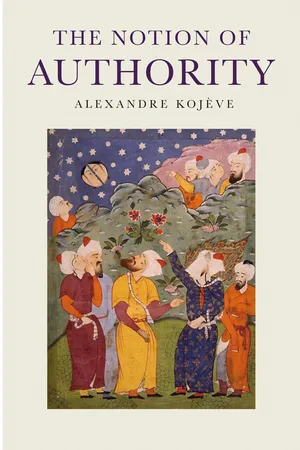
- 224 pages
- English
- ePUB (mobile friendly)
- Available on iOS & Android
eBook - ePub
The Notion of Authority
About this book
Information
Topic
PhilosophieSubtopic
Dissertations philosophiquesPreliminary Remarks
It is a curious fact that the problem and notion of authority have been little studied. Questions pertaining to the transfer of authority and its genesis have been the main concern, while the actual essence of this phenomenon has rarely attracted any attention. However, it is obviously impossible to tackle political power or even the structure of the state without knowing what authority is as such. A study of the notion of authority, albeit provisional, is therefore essential, and must precede any study of the question of the state.
To say that theories of authority are lacking is not to say that they are nonexistent. If we forget about variants, we can say that four distinct (essentially different and irreducible) theories have been proposed in the course of history:
1. The theological or theocratic theory: primary and absolute Authority belongs to God; all other (relative) authorities are derived from it. (This theory was elaborated mainly by the Scholastics, but the partisans of ‘legitimate’, not to say hereditary, monarchy also claim it as their own.)
2. Plato’s theory: ‘Just’ or ‘legitimate’ authority is based on, and emanates from, ‘justice’ or ‘equity’. Any authority that has a different character is only a pseudo-authority that is in reality nothing other than (more or less brute) force.
3. Aristotle’s theory, in which the justification for authority is found in wisdom, knowledge, and the possibility of anticipating, of transcending the immediate present.
4. Hegel’s theory, which reduces the relationships of authority to that of master and slave (of victor and vanquished), the former having been ready to risk his life to be recognised while the latter has chosen submission over death.
Unfortunately, only the last theory has received comprehensive philosophical elaboration, developed not only on the level of phenomenological description but also that of metaphysical and ontological analysis. The remaining theories have not gone beyond the level of phenomenology, and are not, moreover, in any way complete even in this department. (It must be said that Hegel’s theory has never been truly understood and that it was very quickly forgotten. Thus, Hegel’s most important successor – Marx – completely neglected the problem of Authority.)
All four theories are exclusive. Each of them acknowledges only one type of Authority (namely, the one it describes), and sees in the other ‘authoritarian’ phenomena nothing other than a manifestation of pure and simple force.
Note: There is, certainly, yet another ‘theory’ of Authority, which sees in the latter nothing but a manifestation of force. But we shall see later on that Force has nothing to do with authority, being even its direct opposite. Reducing Authority to Force is therefore simply either to deny or ignore the existence of the former. It is for this reason that we have not listed this erroneous opinion among the theories of Authority.
In order to be able to judge and criticise these theories (indeed to understand them in the proper sense of the word), one would have to start by drawing up a comprehensive list of all phenomena that could be filed under the rubric ‘Authority’ and see if these phenomena correspond (in whole or in part) to one (or several) of the proposed theories.
Theories for which there are no corresponding phenomena are to be rejected as false. As for the remaining ones, we must see whether they account for all or only part of the phenomena.
To this end, the phenomena of Authority must be subjected to a phenomenological analysis with a view to unearthing ‘pure phenomena’, that is to say, those that are irreducible to one another (or showing, in the case of ‘compound’ phenomena, the ‘pure’ elements of which they are made up).
If we find ‘pure’ phenomena that none of the suggested theories account for, further theories must then be formulated.
In other words, the phenomenological analysis (A, I) must answer the question ‘What is it?’ addressed to all phenomena that in a manner of speaking we qualify ‘instinctively’ as authoritarian. It must reveal the essence (the idea: das Wesen) of Authority as such, as well as the structure of this ‘essence’, that is to say, the various irreducible types of its manifestation (while ignoring ‘accidental’ variations caused by simple divergences in local and temporal conditions of the realisation of Authority as such).
But phenomenological analysis can carry out its function only on condition of being truly complete. We must be certain that all possible types of Authority have been enumerated and that each one of them has been decomposed into truly simple elements that are irreducible to other elements.
This is possible, however, only if the analysis is systematic; that is why we must necessarily move beyond the phenomenological plane and rise to the metaphysical level.
The metaphysical analysis (A, II) relates the phenomenon of Authority to the fundamental structure of the objectively real World. In this way, it allows us to see whether the described phenomena correspond to all possibilities provided by the World, and whether a given phenomenon has a simple or compound metaphysical origin.
Finally, the ultimate justification of the theory founded on, and guaranteed by, the metaphysical analysis can derive only from an even more profound analysis, which penetrates down to the ontological level.
The ontological analysis (A, III) studies the structure of Being as such, and it allows us to understand the whys and wherefores of the (metaphysical) structure of the real World. This same structure, for its part, allows us to classify and analyse systematically (on the phenomenological level) the phenomena in question that appear in this World.
Note: In all these three analyses, the notion of God must be used, even assuming that the latter does not exist, being nothing other than a ‘myth’. Since the ‘believer’ has always attributed to God the maximum of authority, it is therefore in Him that this phenomenon can be studied as if under a microscope. We shall avoid applying to Man what we discover in God. And it is precisely if God is nothing more than a ‘myth’ that the analysis of divine Authority is in fact an analysis of human Authority: without realising it, Man projects onto God what he discovers – more or less unconsciously – in himself, in such a way that he can be studied while studying ‘his’ God.
The theory of Authority that results from this triple analysis will be fully guaranteed and justified. It might serve in turn as a starting point for various deductions (B).
The theory will have, first of all, political applications (B, I). Assuming that every state presupposes and is based on Authority, the theory of the State can be deduced from the theory of Authority.
Secondly, the theory of Authority will have ethical applications (B, II). A correct and justified theory will make it possible to defend Authority and the State (and more specifically, therefore, the authoritarian State) against moral or moralising critiques deduced from non-political notions. In other words, the theory of Authority will make possible the deduction of a specifically political ethics, which would be essentially different from the ‘private’ morality that is generally the basis of attempts to criticise Authority in its being and in its acts.
Finally, the theory of authority will have psychological applications (B, III). Knowing what Authority is, the way Man and men must be acted on can be deduced so as either to engender or to maintain an Authority.
In what follows, all these questions can only be sketched out. I make no claim to lay down a definitive and complete theory of Authority. We must rather formulate problems and indicate general directions towards their resolution.
A. Analyses
1. PHENOMENOLOGICAL ANALYSIS
1
a) In order to be able to draw up a list of all authoritarian phenomena, we must first be selective with regard to the given phenomena, i.e. we have to be able to distinguish phenomena that realise and reveal the essence of Authority from those that have nothing to do with it (sometimes despite appearances).
In other words, we need to begin by providing a definition of Authority – a general one, which can encompass all particular cases; such a definition will be purely ‘formal’ and ‘nominal’. Let us then look for a
general definition of Authority
There is Authority only where there is (real, or at least possible) movement, change, and action. Authority is held only over that which can ‘react’, that is to say, that which can change according to what or who represents (‘embodies’, realises, or exercises) Authority. And, quite obviously, Authority belongs to the person who can effect change and not to the one subjected to change: Authority is essentially active and not passive.
We can therefore say that the real ‘support’ of any authority is necessarily an agent in the proper and strong sense of the term, that is to say, an agent who is held to be free and conscious (and so, either a divine being or a human being, and never something like an animal, for example).
Note: Admittedly, the authoritarian act is not necessarily spontaneous: it is possible to have authority while carrying out an order given by someone else. But the agent invested with authority is assumed to understand this order and accept it freely: a gramophone that transmits the words of the leader has no authority in itself.
The being invested with authority is then necessarily an agent, and the authoritarian act is always an absolute (conscious and free) act.
However, the authoritarian act is distinguished from all other acts by the fact that it does not encounter opposition from the person or persons towards whom it is directed. This in turn presupposes both the possibility of opposing it and the conscious and voluntary renunciation of realising this possibility. (Examples: if I throw someone out of the window, the fact that he falls has nothing to do with my authority; but I am exerting a manifest authority on him if he throws himself out of the window following an order that I give him, and which, materially, he was in a position to choose not to carry out. The hypnotiser has no authority over the person he has hypnotised. I do not need to exercise my authority to make someone do what he feels like doing and would have done even without my telling him to do it.)
Authority is therefore necessarily a relation (between agent and patient): it is an essentially social (rather than individual) phenomenon; there have to be at least two in order for Authority to exist.
THEREFORE: Authority is the possibility that an agent has of acting on others (or on another) without these others reacting against him, despite being capable to do so.
Or again: by acting with Authority, the agent can change the outward human given without suffering a repercussion from this action, i.e. without himself changing as a result of his action.
(Examples: If, in order to make someone get out of my room, I have to use force, I have to change my own behaviour to realise the act in question, and I show through this behaviour that I have no authority; things are completely different if I do not move and this person leaves the room, that is to say, changes, as a result of my simply saying ‘get out!’ If the given order provokes a discussion, that is to say, forces the one who gives it to do something himself – namely engage in a discussion – as a function of this order, then there is no authority. And even less so if the discussion leads to giving up the order or even to a compromise, that is to say, precisely to changing the act that was supposed to provoke an outward change without itself changing.)
Or again, finally: Authority is the possibility of acting without making compromises (in the broad sense of the term).
Note: Any discussion is already a compromise because it boils down to this: ‘Do such and such a thing unconditionally.’ ‘No, I shall do it only on condition that you do this other thing, namely that you convince me.’ ‘All right, point granted.’
b) This definition clearly shows that the phenomenon of Authority is related to the phenomenon of Right (see short article on Right).1 In fact:
I have a right to something when I can do it without encountering an opposition (reaction), the latter being in principle possible.
(Example: If I want to take from someone 100 francs which belong to him, he will ‘react’ and I will suffer the ‘repercussions’ of my act; but if he owes me this money, i.e. if I have a Right over him, I don’t have to suffer any ‘reaction’ when my action transfers the 100 francs from his pocket into mine.)
There is, nevertheless, an essential difference between these two ‘related’ phenomena.
In the case of Authority, the ‘reaction’ (or opposition) never exceeds the sphere of pure possibility (it is never actualised): its realisation destroys Authority. With Right, by contrast, the ‘reaction’ can be actualised without thereby destroying Right: all that is needed is for this ‘reaction’ to be directed against a person other than the one who has the Right. (In the above example, the violent ‘reaction’ of the debtor need only be directed against a judge, a bailiff, a police officer, and so on.)
What follows from this distinction is that, if in principle Authority excludes force, Right implies and presupposes force while being something different from it (there is no Right without court of law, no court without police that can carry out the decisions of the court by force.)
Furthermore, the relation noted between Authority and Right explains why every Authority necessarily has a legal or legitimate character (in the eyes of those who recognise it: which goes without saying, since any Authority is necessarily a recognised Authority; not to recognise an Authority is to negate it, and thereby destroy it).
THEREFORE: 1) Exercising an Authority is not only something different from using force (violence), but the two phenomena are mutually exclusive. Generally speaking, one needs to do nothing in order to exert Authority. The mere fact of being compelled to call on the intervention of force (violence) proves that no Authority is involved here. Conversely, it is not possible – without using force – to make people do what they would not have done spontaneously (of their own accord) without calling upon the intervention of Authority.
Note: If someone does what I ask him to do out of ‘love’ for me, he does it spontaneously, because he would do anything to please me without my having to intervene or act on him. The relation of Love is therefore essentially something different from the relation of Authority. But since Love produces the same result as Authority, we can easily make a mistake by conflating the two phenomena and saying that the beloved has an ‘authority’ over the lover, or that the person subject to an authority – that is to say, recognising it – has a love for it. This leads to an explanation of the natural human propensity to love the one whose Authority one recognises, as well as recognising the Authority of the one one loves. But the two phenomena remain, nevertheless, clearly distinct.
2) ‘Legal’ or ‘legitimate’ action can also be an ‘authoritarian’ action: all that is needed for this to be so is that the actualisation of possible ‘reactions’ is (freely and consciously) renounced. (In this case, Right exerts an Authority, while remaining a Right in so far as there is a force capable of realising this Right, if need arises – that is to say, if Right ceases to exercise its Authority. In short, Right has authority only for those who ‘recognise’ it, but it remains a Right even for those who are subject to it without ‘recognising’ it.)
As for ‘authoritarian’ action, it is by definition ‘legal’ or ‘legitimate’. Because ...
Table of contents
- Cover Page
- Halftitle Page
- Title Page
- Copyright Page
- Contents
- Translator’s Note
- Introduction to the French Edition
- Preliminary Remarks
- Appendices
- Notes
Trusted by 375,005 students
Access to over 1.5 million titles for a fair monthly price.
Study more efficiently using our study tools.
Frequently asked questions
Yes, you can cancel anytime from the Subscription tab in your account settings on the Perlego website. Your subscription will stay active until the end of your current billing period. Learn how to cancel your subscription
No, books cannot be downloaded as external files, such as PDFs, for use outside of Perlego. However, you can download books within the Perlego app for offline reading on mobile or tablet. Learn how to download books offline
Perlego offers two plans: Essential and Complete
- Essential is ideal for learners and professionals who enjoy exploring a wide range of subjects. Access the Essential Library with 800,000+ trusted titles and best-sellers across business, personal growth, and the humanities. Includes unlimited reading time and Standard Read Aloud voice.
- Complete: Perfect for advanced learners and researchers needing full, unrestricted access. Unlock 1.5M+ books across hundreds of subjects, including academic and specialized titles. The Complete Plan also includes advanced features like Premium Read Aloud and Research Assistant.
We are an online textbook subscription service, where you can get access to an entire online library for less than the price of a single book per month. With over 1.5 million books across 990+ topics, we’ve got you covered! Learn about our mission
Look out for the read-aloud symbol on your next book to see if you can listen to it. The read-aloud tool reads text aloud for you, highlighting the text as it is being read. You can pause it, speed it up and slow it down. Learn more about Read Aloud
Yes! You can use the Perlego app on both iOS and Android devices to read anytime, anywhere — even offline. Perfect for commutes or when you’re on the go.
Please note we cannot support devices running on iOS 13 and Android 7 or earlier. Learn more about using the app
Please note we cannot support devices running on iOS 13 and Android 7 or earlier. Learn more about using the app
Yes, you can access The Notion of Authority by Alexandre Kojève, Francois Terré, Hager Weslati in PDF and/or ePUB format, as well as other popular books in Philosophie & Dissertations philosophiques. We have over 1.5 million books available in our catalogue for you to explore.