As the crisis of capitalism unfolds, the need for alternatives is felt ever more intensely. The struggle between radical movements and the forces of reaction will be merciless. A crucial battlefield, where the outcome of the crisis will in part be decided, is that of theory.
Over the last twenty-five years, radical intellectuals across the world have produced important and innovative ideas. The endeavour to transform the world without falling into the catastrophic traps of the past has been a common element uniting these new approaches.
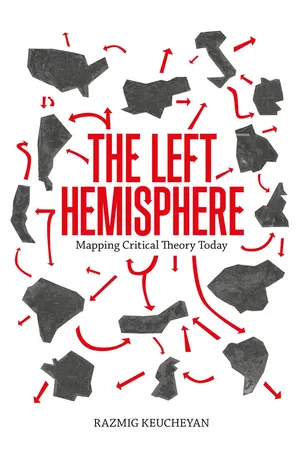
This book-aimed at both the general reader and the specialist-offers the first global cartography of the expanding intellectual field of critical contemporary thought. More than thirty authors and intellectual currents of every continent are presented in a clear and succinct manner. A history of critical thought in the twentieth and twenty-first centuries is also provided, helping situate current thinkers in a broader historical and sociological perspective.
- 304 pages
- English
- ePUB (mobile friendly)
- Available on iOS & Android
eBook - ePub
About this book
Information
Topic
PhilosophySubtopic
Critical TheoryContexts
CHAPTER ONE
The Defeat of Critical Thinking (1977–93)
PERIODIZING
In the beginning was defeat. Anyone who wishes to understand the nature of contemporary critical thinking must start from this fact.
From the second half of the 1970s, the protest movements born in the late 1950s, but which were inheritors of much older movements, went into decline. The reasons are various: the oil shock of 1973 and the reversal of the ‘long wave’ of the trente glorieuses; the neo-liberal offensive with the election of Margaret Thatcher and Ronald Reagan in 1979 and 1980; the capitalist turn in China under the leadership of Deng Xiaoping; the decline of old forms of working-class solidarity; the Left’s ascension to power in France in 1981 and, with it, ministerial prospects encouraging the conversion of leftist militants who had distinguished themselves in May 1968; the definitive loss of credibility of the Soviet and Chinese blocs; and so on and so forth. The Sandinista Revolution in Nicaragua in 1979 was probably the last event to exhibit the characteristics of a revolution in the traditional sense. The same year, the Iranian Islamic Revolution was the first of a series of political objects difficult to identify that filled subsequent decades.
This process of decline attained its clearest expression, if not its culmination, in the fall of the Berlin Wall. Clearly, something had come to an end around 1989. The problem is to know what and to identify the moment when what ended had begun.
If we attempt a periodization, several divisions are possible. Firstly, it might be argued that we had reached the end of a short political cycle, whose inception dated back to the second half of the 1950s. This cycle was that of the ‘New Left’. This term refers to ‘left-wing’ organizations – in particular, Maoist, Trotskyist and anarchist – as well as the ‘new social movements’ of feminism and political ecology, for example. The New Left emerged around 1956, the year of the Suez crisis and the crushing of the Budapest uprising by Soviet tanks, but also that of Khrushchev’s ‘secret speech’ on Stalin’s crimes to the Twentieth Congress of the Communist Party of the Soviet Union. In France that year deputies (including the Communists) voted to grant special powers to Guy Mollet’s government for ‘pacifying’ Algeria.
To belong to the New Left was to reject the alternative imposed in 1956 by the two established camps, while continuing to develop a radical critique of capitalism. In other words, it consisted in condemning both Anglo-French policy towards Egypt – and imperialism in general – and the Soviet intervention in Budapest. The apogee of the New Left occurred from around 1968 until about 1977 (the Italian autonomist movement). The French and Mexican 1968, the Italian ‘extended’ May and ‘hot autumn’ of 1969, the Argentinian ‘Cordobazo’ (1969),1 and the Prague Spring – these were all part of the same international trend. A first option for periodization thus consists in arguing that what ended in 1989 was the cycle begun in 1956 by the Egyptian and Hungarian crises and the ensuing reactions on the radical Left. The Cuban Revolution (1959) and the Vietnam War are other events that helped drive this cycle.2
A second option dates the political cycle that ended around 1989 back to the Russian Revolution of 1917 or the 1914 war. This is what the historian Eric Hobsbawm has called the ‘short twentieth century’.3 The First World War, and the Bolshevik Revolution of which it was a condition of possibility, are then regarded as the ‘matrices’ of the twentieth century. The barbarism witnessed by this age, especially during the Second World War, is presented as a consequence of changes in the modality and intensity of collective violence that occurred during World War I. Other aspects of the century are related to these developments. The role of ‘ideologies’, for example, of which 1989 is supposed to have sounded the death-knell, while 1917 is alleged to have represented their ‘totalitarian’ intrusion into history.4 In this second hypothesis the New Left is regarded as a sub-cycle subordinate to the broader cycle initiated in 1914 or 1917.
A third possibility consists in believing that 1989 ended a cycle initiated at the time of the French Revolution in 1789. This is a longer-range hypothesis, with weightier political and theoretical consequences. It is sometimes characterized as ‘postmodern’, with reference to the works of Jean-François Lyotard, Marshall Berman and Fredric Jameson in particular.5 Postmodernism is based on the idea that the French Revolution lies at the beginning of political modernity. From this standpoint, subsequent revolutions – the Russian and Chinese, for example – represent sequels to that event. Yet in so far as the Communist regimes failed to realize the modern project inaugurated by the French Revolution, that whole project is regarded as compromised. This third hypothesis implies that the intellectual categories – reason, science, time, space – and political categories – sovereignty, citizenship, territory – peculiar to modern politics must be abandoned for new categories. ‘Network’ forms of organization, the importance ascribed to minority ‘identities’, or the supposed loss of sovereignty by nation-states in the context of globalization form part of this hypothesis.
Three beginnings – 1789, 1914–17, 1956 – for one ending: 1989. Different divisions are possible and can be superimposed on these. Postcolonial studies stress the major events of modern colonial history (the end of the Haitian Revolution in 1804 or the Sétif massacres of 1945 in Algeria, for example). The 1848 Revolution and the Paris Commune are likewise sometimes invoked as origins of the political cycle that came to a conclusion in 1989. The relative significance accorded events also varies depending on the region of the world considered. In Latin America, instances of national independence in the first half of the nineteenth century, the Mexican Revolution of 1910, and the Cuban Revolution of 1959 are central. In Europe, the end of the Second World War and the trente glorieuses can serve as reference-points, just as in Asia the proclamation of the People’s Republic of China in 1949 can.
The new forms of critical thought are obsessed with these issues of periodization. In the first place, they involve thinking their own historical location in cycles of political struggle and theoretical development. Never has a set of critical theories devoted such importance to this problem. Obviously, Marxism has always posed the issue of its relationship to history in general and intellectual history in particular. This is the significance of the countless debates over the links between Marx and Hegel, Marx and the classical political economists, or Marx and the utopian socialists. It is also the meaning of discussions about the link between the emergence of Marxism and the revolutions of Marx’s time: those of 1848 and the Paris Commune, in particular. But the problem is posed more sharply when, to employ a Shakespearean phrase of which Jacques Derrida was fond, time seems to be ‘out of joint’, as it is today.6 It is true that prioritizing one or other of the cycles we have mentioned has different implications. The postmodern hypothesis, as has been indicated, has profound consequences, in that it assumes the disappearance of the modern form of politics. While the other two options do not involve such radical revision, they nevertheless lead to a serious reassessment of the doctrines and strategies of the Left since the early twentieth century.
We shall return to the question of periodization and the answers offered by the new critical thinking. For now, it is crucial to assign due importance to the fact that these theories develop in a conjuncture marked by the defeat of the Left intent on social transformation. This defeat goes back to a cycle that began with the French Revolution, the Russian Revolution, or the second half of the 1950s. But in any event, it is well-attested and its scope is profound. It is decisive for understanding the new forms of critical thinking. It imparts a particular coloration and ‘style’ to them.
TOWARDS A GEOGRAPHY OF CRITICAL THINKING
In Considerations on Western Marxism, Perry Anderson has shown that the defeat of the German Revolution in the years 1918–23 led to a significant mutation in Marxism.7 The Marxists of the classical generation had two main characteristics. Firstly, they were historians, economists, sociologists – in short, concerned with empirical sciences. Their publications were mainly conjunctural and focused on the political actuality of the moment. Secondly, they were leaders of parties – that is, strategists confronting real political problems. Carl Schmitt once claimed that one of the most important events of the modern age was Lenin’s reading of Clausewitz.8 The underlying idea is that to be a Marxist intellectual in the early twentieth century was to find oneself at the head of one’s country’s working-class organizations. In truth, the very notion of ‘Marxist intellectual’ made little sense, the substantive ‘Marxist’ being self-sufficient.
These two characteristics were closely linked. It is because they were political strategists that these thinkers required empirical knowledge to make decisions. This is the famous ‘concrete analysis of concrete situations’ referred to by Lenin. Conversely, their role as strategists nourished their reflections with first-hand empirical knowledge. As Lenin wrote on 30 November 1917 in his postscript to State and Revolution, ‘It is more pleasant and useful to go through the “experience of the revolution” than to write about it.’9 In this phase of Marxism’s history the ‘experience’ and the ‘writing’ of revolution were inextricably linked.
The ‘Western’ Marxism of the subsequent period was born out of the erasure of the relations between intellectuals/leaders and working-class organizations that had existed in classical Marxism. By the mid-1920s, workers’ organizations had everywhere been beaten. The failure in 1923 of the German Revolution, whose outcome was regarded as crucial for the future of the working-class movement, sounded a halt to hopes of any immediate overthrow of capitalism. The decline that set in led to the establishment of a new kind of link between intellectuals/leaders and working-class organizations. Gramsci, Korsch and Lukács were the first representatives of this new configuration.10 With Adorno, Sartre, Althusser, Della Volpe, Marcuse and others, the Marxists who dominated the years 1924–68 possessed converse characteristics to those of the preceding period. For a start, they no longer had organic links with the workers’ movement and, in particular, with the Communist parties. They no longer held leadership positions. In those instances where they were members of Communist parties (Althusser, Lukács, Della Volpe), they had complex relations with them. Forms of ‘fellow-travelling’ can be observed, exemplified by Sartre in France. But an irreducible distance between intellectuals and party remained. It is not necessarily attributable to the intellectuals themselves: Communist party leaderships were often profoundly mistrustful of them.11
The rupture between intellectuals and working-class organizations characteristic of Western Marxism had a significant cause and a significant consequence. The cause was the construction from the 1920s of an orthodox Marxism that represented the official doctrine of the USSR and fraternal parties. The classical period of Marxism was one of intense debates over, in particular, the character of imperialism, the national question, the relationship between the social and the political, and finance capital. From the second half of the 1920s, Marxism became fossilized. This placed intellectuals in a structurally difficult position, since any innovation in the intellectual domain was henceforth denied them. This was a major cause of the distance that now separated them from working-class parties. It confronted them with the alternative of maintaining allegiance or keeping their distance from the latter. With time the separation only grew, all the more so in that other factors aggravated it, like the increasing professionalization or academicization of intellectual activity, which tended to distance intellectuals from politics.
A notable consequence of this new configuration was that Western Marxists, unlike those of the previous period, developed abstract forms of knowledge. For the most part they were philosophers and often aestheticians or epistemologists. Just as the practice of empirical science was bound up with the fact that the Marxists of the classical period played leadership roles within workers’ organizations, so remoteness from such roles prompted a ‘flight into abstraction’. Marxists now produced hermetic knowledge, inaccessible to ordinary workers, about fields without any direct relationship to political strategy. In this sense, Western Marxism was non-‘Clausewitzian’.
The case of Western Marxism illustrates the way in which historical developments can influence the content of thinking that aspires to make history. More precisely, it demonstrates the way in which the type of development that is a political defeat influences the course of the theory which has suffered it.12 The failure of the German revolution, Anderson argues, led to an enduring rupture between the Communist parties and revo...
Table of contents
- Cover
- Title Page
- Copyright
- Epigraph
- Contents
- Introduction
- Part I: Contexts
- Part II: Theories
- Conclusion: Worksites
Trusted by 375,005 students
Access to over 1.5 million titles for a fair monthly price.
Study more efficiently using our study tools.
Frequently asked questions
Yes, you can cancel anytime from the Subscription tab in your account settings on the Perlego website. Your subscription will stay active until the end of your current billing period. Learn how to cancel your subscription
No, books cannot be downloaded as external files, such as PDFs, for use outside of Perlego. However, you can download books within the Perlego app for offline reading on mobile or tablet. Learn how to download books offline
Perlego offers two plans: Essential and Complete
- Essential is ideal for learners and professionals who enjoy exploring a wide range of subjects. Access the Essential Library with 800,000+ trusted titles and best-sellers across business, personal growth, and the humanities. Includes unlimited reading time and Standard Read Aloud voice.
- Complete: Perfect for advanced learners and researchers needing full, unrestricted access. Unlock 1.5M+ books across hundreds of subjects, including academic and specialized titles. The Complete Plan also includes advanced features like Premium Read Aloud and Research Assistant.
We are an online textbook subscription service, where you can get access to an entire online library for less than the price of a single book per month. With over 1.5 million books across 990+ topics, we’ve got you covered! Learn about our mission
Look out for the read-aloud symbol on your next book to see if you can listen to it. The read-aloud tool reads text aloud for you, highlighting the text as it is being read. You can pause it, speed it up and slow it down. Learn more about Read Aloud
Yes! You can use the Perlego app on both iOS and Android devices to read anytime, anywhere — even offline. Perfect for commutes or when you’re on the go.
Please note we cannot support devices running on iOS 13 and Android 7 or earlier. Learn more about using the app
Please note we cannot support devices running on iOS 13 and Android 7 or earlier. Learn more about using the app
Yes, you can access The Left Hemisphere by Razmig Keucheyan, Gregory Elliott in PDF and/or ePUB format, as well as other popular books in Philosophy & Critical Theory. We have over 1.5 million books available in our catalogue for you to explore.