"We know that communism is the right hypothesis. All those who abandon this hypothesis immediately resign themselves to the market economy, to parliamentary democracy - the form of state suited to capitalism - and to the inevitable and "natural" character of the most monstrous inequalities." Alain Badiou
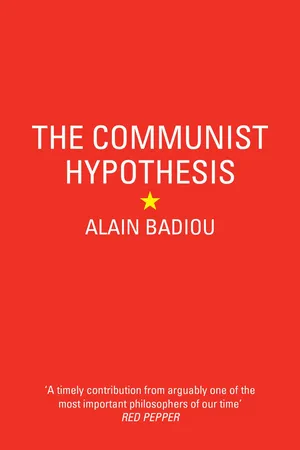
Alain Badiou's 'communist hypothesis', first stated in 2008, cut through the cant and compromises of the past twenty years to reconceptualize the Left. The hypothesis is a fresh demand for universal emancipation and a galvanizing call to arms. Anyone concerned with the future of the planet needs to reckon with the ideas outlined within this book.
- 224 pages
- English
- ePUB (mobile friendly)
- Available on iOS & Android
eBook - ePub
The Communist Hypothesis
III
The Paris Commune:
A Political Declaration on Politics1
The political parties, groups, unions and factions that have claimed to be representative of the workers and the people long maintained a formal fidelity to the Paris Commune. They adhered to Marx’s concluding statement in his admirable text The Civil War in France: ‘Working men’s Paris, with its Commune, will be forever celebrated as the glorious harbinger of a new society.’
They regularly visited the Mur des fédérés, the monument evoking the twenty thousand shot dead in May 1871. Marx again: ‘Its martyrs are enshrined in the great heart of the working class.’
Does the working class have a heart? Today, in any case, little is remembered, and badly so. The Paris Commune was recently removed from [French] history syllabuses, in which, however, it had barely occupied a place. The public ranks are swollen with the direct descendants of the Versaillais, those for whom communism is a criminal utopia, the worker an outdated Marxist invention, the revolution a bloody orgy, and the idea of a non-parliamentary politics a despotic sacrilege.
As usual, however, the problem is not one of memory but of truth. How are we to concentrate the political truth of the Commune today? Without neglecting textual and factual supports, what is at stake here is to reconstitute, by means that will be largely philosophical, this episode of our history in its irreducibility.
Of course, when I say ‘our’ history, it has to do with the ‘we’ of a politics of emancipation, the ‘we’ whose virtual flag remains red, and not the tri-coloured one flown by the killers of the spring of 1871.
Reference points, 1 – the facts
I shall begin with a selection of dated examples. This will form the first part, after which I shall reorder the account according to new categories (situation, appearing [apparaître],2 site, singularities, event, inexistent aspect [inexistent] …).
In the very middle of the nineteenth century, in France, Napoleon III is in power. He typifies the racketeering and authoritarian balance-sheet of the Republican Revolution of February 1848. This kind of outcome had been practically guaranteed only a few months after the insurrection that brought down Louis-Philippe in June 1848, when the republican petty bourgeoisie consented to, and even supported, the massacring of Parisian workers by Cavaignac’s troops. Just as, in 1919, the German social-democratic petty bourgeoisie were to set up the distant possibility of a Nazi hypothesis by organizing the massacre of the Rosa Luxemburg-led Spartacists.
On 19 July 1870, the French government, too self-confident and victim to Bismarck’s devious manoeuvres, declares war on Prussia. On 2 September, the disaster at Sedan occurs and the Emperor is captured.3 This danger leads to a partial arming of the Parisian population in the form of a National Guard, the internal framework of which is constituted by workers. But the internal situation is in fact determinant: on 4 September, after large demonstrations, the Hôtel-de-Ville is stormed and the empire overthrown. But as was the case in 1830 and 1848, power is at once monopolized behind the scenes by a group of ‘Republican’ politicians, i.e., the Jules Favres, Simon and Ferry (‘the Republic of the Juleses’ as Henri Guillemin will say), Emile Picard and Adolphe Thiers, all of whom wish for only one thing: to negotiate with Bismarck in a bid to contain the working-class political insurgency. But they must put people off the scent, so in order to subdue the resolve of the Parisian population they immediately proclaim a Republic, although they fail to specify any constitutional content; and in order to circumvent patriotic sentiment they call themselves ‘the Government of National Defence’. Under these conditions the masses leave them to get on with it, and instead join in the resistance, which the long siege on Paris by the Prussians will exacerbate.
In October, in shameful conditions, Bazaine surrenders at Metz with the bulk of the French army. Then, all sorts of little government schemes, recounted in minute detail in the great books Henri Guillemin dedicated to the 1870 war and the origins of the Commune, lead to the surrender of Paris and the armistice of 28 January 1871. A majority of Parisians have long been in no doubt that this government is in reality a government of ‘National Defection’.
But it is also a government of bourgeois defence against popular movements. Its problem is now to find a way to disarm the Parisian workers of the National Guard. There were at least three reasons why the politicians in power were able to think the situation to their advantage. First, they had managed with great haste to get an Assembly elected that was dominated by rural and provincial reaction, indeed, a sort of chambre introuvable of the extreme right that was legitimist4 and socially vengeful. Against revolution nothing beats an election: it is this same maxim that De Gaulle, Pompidou and their allies on the official left will revive in June 1968. Second, the principal and foremost recognized revolutionary leader, Blanqui, is in prison. Third, the clauses of the armistice leave Paris encircled by Prussian troops from the North and the East.
Early on the morning of 18 March, some military detachments try to seize the cannons held by the National Guard. The attempt comes up against an impressive, spontaneous mobilization in the workers’ quartiers by the Parisian people, and notably by the Parisian women. The troops withdraw; the government flees to Versailles.
On 19 March, the Central Committee of the National Guard, being the worker leadership that had been elected by the units of the Guard, makes a political declaration. This is a fundamental document to which I will return in detail.
On 26 March, the new Parisian authorities organize the election of a Commune of 90 members.
On 3 April, the Commune attempts a first military sortie to confront the troops that the government, with Prussian authorization, has redirected against Paris. The sortie fails. Those taken prisoner by the troops, including two highly respected members of the Commune, Flourens and Duval, are massacred. A sense of the ferocity of the repression to come fills the air.
On 9 April, the Commune’s best military leader, the Polish republican Dombrowski, has some success, notably in recapturing Asníres.
On 16 April, supplementary elections for the Commune are held in an absolutely above-board manner and in the greatest calm.
Between 9 May and 14 May, the military situation worsens considerably in the south-west suburbs. The forts of Issy and Vanves fall.
All this while (between the end of March and the middle of May), the people of Paris pursue their lives inventively and peacefully. All kinds of social measures concerning work, education, women and the arts are debated and decided upon. For an idea of the prioritization of issues, note, for example, that on 18 May – the government army will enter Paris en masse on 21 May – a vote is held on the number of classes to create in primary schools.
In fact Paris is at once peaceful and extraordinarily politicized. Purely descriptive accounts by witnesses to the scene are rare: the non-militant intellectuals generally support Versailles, and most of them (Flaubert, Goncourt, Dumas fils, Leconte de Lisle, Georges Sand …) make base remarks. None of the intellectuals are more admirable than Rimbaud and Verlaine, declared partisans of the Commune, and Hugo, who, without understanding anything, will instinctively and nobly oppose the repression.
One chronicle is absolutely extraordinary. Its attribution to Villiers de l’Isle Adam is regularly contested and then reaffirmed. In any case, it makes intensely visible the combination of peace and political vivacity that the Commune had installed in the streets of Paris:
One enters, one leaves, one circulates, one gathers. The laughter of Parisian children interrupts political discussions. Approach the groups, listen. A whole people entertain profound matters. For the first time workers can be heard exchanging their appreciations on things that hitherto only philosophers had tackled. There is no trace of supervisors; no police agents obstruct the street hindering passers-by. The security is perfect.
Previously, when this same people went out intoxicated for its bals de barríre,5 the bourgeoisie distanced itself, saying quietly: ‘If these people were free, what would become of us? What would become of them? They are free and dance no longer. They are free and they work. They are free and they fight.’
When a man of good faith passes close by them today, he understands that a new century has just hatched and even the most sceptical remains wondrous.
Between 21 May and 28 May, the troops of Versailles take Paris barricade by barricade, the final combats taking place in the workers’ redoubts of the north-east arrondissements: the 11th, the 19th, the 20th … The massacres succeed each other without interruption, continuing well after the ‘bloody week’. At least twenty thousand people are shot dead. Fifty thousand are arrested.
Thus commences the Third Republic, which is still held by some today to be the golden age of ‘citizenship’.
Reference points, 2 – the classical interpretation
At this very time, Marx proposed an account of the Commune that is wholly inscribed in the question of the state. For him, it comprises the first historical case in which the proletariat assumes its transitory function of the direction, or administration, of the entire society. From the Commune’s initiatives and impasses he is led to the conclusion that the state machine must not be ‘taken’ or ‘occupied’, but broken.
Let’s note in passing that the chief fault of the analysis probably lies in the notion that between March and May 1871 it was the question of power that was the order of the day. Whence those tenacious ‘critiques’ that have become commonplaces: what the Commune supposedly lacked was decision-making capacity. If it had immediately marched on Versailles, if it had seized the gold of the Bank of France … To my mind, these ‘ifs’ lack real content. In truth, the Commune had neither the means to address them properly, nor in all likelihood the means to arrive at them.
Marx’s account in fact is ambiguous. On the one hand, he praises everything that appears to lead to a dissolution of the state and, more specifically, of the nation-state. In this vein he notes: the Commune’s abolition of a professional army in favour of directly arming the people; all the measures it took concerning the election and revocability of civil servants; the end it put to the separation of powers in favour of a decisive and executive function; and its internationalism (the financial delegate of the Commune was German, the military leaders Polish, etc.). But, on the other hand, he deplores incapacities that are actually statist incapacities [incapacités étatiques]: its weak military centralization; its inability to define financial priorities; and, its shortcomings concerning the national question, its address to other cities, what it did and did not say about the war with Prussia, and its rallying of provincial masses.
It is striking to see that, twenty years later, in his 1891 preface to a new edition of Marx’s text, Engels formalizes the Commune’s contradictions in the same way. He shows, in effect, that the two dominant political forces of the 1871 movement, the Proudhonians and the Blanquists, ended up doing exactly the opposite of their manifest ideology. The Blanquists were partisans of centralization to excess and of armed plots in which a small number of resolute men would take power, to exercise it authoritatively to the advantage of the working masses. But instead they were led to proclaim a free federation of communes and the destruction of state bureaucracy. Proudhonians were hostile to any collective appropriation of the means of production and promoted small, self-managed enterprises. Yet they ended up supporting the formation of vast worker associations for the purpose of directing large-scale industry. Engels quite logically concludes from this that the Commune’s weakness lay in the fact that its ideological forms were inappropriate for making decisions of state. And, moreover, that the result of this opposition is quite simply the end of Blanquism and of Proudhonism, making way for a single ‘Marxism’.
But how would the current that Marx and Engels represented in 1871, and even much later, have been more adequate to the situation? With what extra means would its presumed hegemony have endowed the situation?
The fact of the matter is that the ambiguity of Marx’s account will be carried [sera levée] both by the social-democratic disposition and by its Leninist radicalization, that is, in the fundamental motif of the party, for over a century.
In effect, the ‘social-democratic’ party, the party of the ‘working class’ – or the ‘proletarian’ party – and then later still the ‘communist’ party, is simultaneously free in relation to the state and in a position to exercise power.
It is a purely political organ that is constituted by subjective support – by ideological rupture – and as such is exterior to the state. With respect to domination, it is free; it bears the thematic of revolution or of the destruction of the bourgeois state.
But the party is also the organizer of a centralized, disciplined capacity that is entirely bent on taking state power. It bears the thematic of a new state, the state of the dictatorship of the proletariat.
It can be said, then, that the party realizes the ambiguity of the Marxist account of the Commune, gives it body. It becomes the political site of a fundamental tension between the non-state, even anti-state, character of a politics of emancipation, and the statist character of the victory and duration of that politics. Moreover, this is the case irrespective of whether the victory is insurrectional or electoral: the mental schema is the same.
This is why the party will engender (particularly from Stalin onwards) the figure of the party-state. The party-state is endowed with capacities designed to resolve problems the Commune left unresolved: a centralization of the police and of military defence; the complete destruction of bourgeois economic decisions; the rallying and submission of the peasants to workers’ hegemony; the creation of a powerful international, etc.
It is not for nothing that, as legend has it, Lenin danced in the snow the day Bolshevik power reached and surpassed the 72 days in which the Paris Commune’s entire destiny was brought to a close.
Yet, although it may have provided a solution to the statist problems that the Commune was unable to resolve, it remains to be asked whether in solving them the party-state did not suppress a number of political problems that, to its merit, the Commune had been able to discern.
What is in any case striking is that, retroactively thought through the party-state, the Commune is reducible to two parameters: first, to its social determination (workers); and second, to a heroic but defective exercise of power.
As a result the Commune gets emptied of all properly political content. It is certainly commemorated, celebrated and claimed, but only as a pure point for the articulation of the social nature of state power. But if that is all it consists in, then the Commune is politically obsolete. For it is rendered so by – what Sylvain Lazarus has proposed to call – the Stalinist political mode, for which the unique place of politics is the party.
That is why its commemoration also happens to proscribe its reactivation.
On this point there is an interesting story concerning Brecht. After the war, Brecht returns prudently to ‘socialist’ Germany, in which Soviet troops lay down the law. He sets out in the year of 1948 by stopping in Switzerland to get news of the situation from abroad. During his stay he writes, with the aid of Ruth Berlau, his lover at the time, a historical play called The Days of the Commune. This is a solidly documented work in which hist...
Table of contents
- Cover Page
- Halftitle Page
- Title Page
- Copyright Page
- Contents
- Preamble: What Is Called Failure?
- I. We Are Still the Contemporaries of May ’68
- II. The Cultural Revolution: The Last Revolution?
- III. The Paris Commune: A Political Declaration on Politics
- IV. The Idea of Communism
- Appendix. Letter from Alain Badiou to Slavoj Žižek: On the Work of Mao Zedong
Trusted by 375,005 students
Access to over 1.5 million titles for a fair monthly price.
Study more efficiently using our study tools.
Frequently asked questions
Yes, you can cancel anytime from the Subscription tab in your account settings on the Perlego website. Your subscription will stay active until the end of your current billing period. Learn how to cancel your subscription
No, books cannot be downloaded as external files, such as PDFs, for use outside of Perlego. However, you can download books within the Perlego app for offline reading on mobile or tablet. Learn how to download books offline
Perlego offers two plans: Essential and Complete
- Essential is ideal for learners and professionals who enjoy exploring a wide range of subjects. Access the Essential Library with 800,000+ trusted titles and best-sellers across business, personal growth, and the humanities. Includes unlimited reading time and Standard Read Aloud voice.
- Complete: Perfect for advanced learners and researchers needing full, unrestricted access. Unlock 1.5M+ books across hundreds of subjects, including academic and specialized titles. The Complete Plan also includes advanced features like Premium Read Aloud and Research Assistant.
We are an online textbook subscription service, where you can get access to an entire online library for less than the price of a single book per month. With over 1.5 million books across 990+ topics, we’ve got you covered! Learn about our mission
Look out for the read-aloud symbol on your next book to see if you can listen to it. The read-aloud tool reads text aloud for you, highlighting the text as it is being read. You can pause it, speed it up and slow it down. Learn more about Read Aloud
Yes! You can use the Perlego app on both iOS and Android devices to read anytime, anywhere — even offline. Perfect for commutes or when you’re on the go.
Please note we cannot support devices running on iOS 13 and Android 7 or earlier. Learn more about using the app
Please note we cannot support devices running on iOS 13 and Android 7 or earlier. Learn more about using the app
Yes, you can access The Communist Hypothesis by Alain Badiou in PDF and/or ePUB format, as well as other popular books in Filosofia & Filosofi. We have over 1.5 million books available in our catalogue for you to explore.