- 208 pages
- English
- ePUB (mobile friendly)
- Available on iOS & Android
eBook - ePub
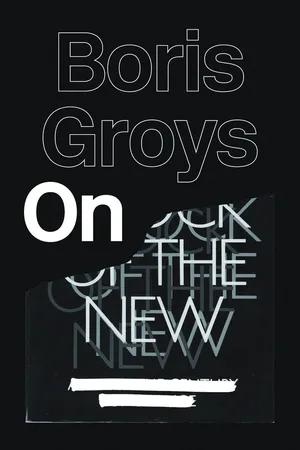
On the New
About this book
On the New looks at the economies of exchange and valuation that drive modern culture's key sites: the intellectual marketplace and the archive. As ideas move from one context to another, newness is created. This continuous shifting of the line that separates the valuable from the worthless, culture from profanity, is at the center of Boris Groys's investigation which aims to map the uncharted territory of what constitutes artistic innovation and what processes underpin its recognition and appropriation.
Information
Topic
FilosofíaSubtopic
Arte generalPART I
THE NEW IN THE ARCHIVE
1
The New between Past and Future
The demand for the new arises primarily when old values are archived and so protected from the destructive work of time. Where no archives exist, or where their physical existence is endangered, people prefer to transmit tradition intact rather than innovate, or else to appeal to principles and ideas which are regarded as independent of time and, in that sense, always immediately accessible and unchanging. Such ostensibly atemporal principles and ideas are posited as ‘true’ in hopes that they will subsist or be rediscovered even if their cultural anchorage is destroyed. Classical art obeys certain canonical rules or else appeals to the mimetic representation of nature in order to reflect, as faithfully as possible, a nature whose essential aspects are regarded as immutable. Thinking is, accordingly, expected to respect a mythical tradition or the invariable laws of logic. Only when the social and technical means for preserving the old appear to have been secured does interest in the new arise, for it then seems superfluous to produce tautological, derivative works that merely repeat what has long been contained in archives. Thus the new ceases to represent a danger and becomes a positive demand only after the identity of tradition has been preserved – not by the putatively ideal permanence of truth, but by technical arrangements and media – and after it has been made accessible to all.
In classical antiquity and the European Middle Ages, an orientation to the new was usually condemned: it was believed to be simply a concession to the power of time, which gave rise to deviations from the models handed down by oral or written tradition. Thought’s chief mission was to offer permanent resistance to the march of time, supposed imperceptibly to destroy the memory of tradition, and to preserve an ancient heritage, protecting it as far as possible from deforming innovations. Thus the new could be conceived of only as deformation or as an error committed involuntarily, out of forgetfulness or under the pressure of changed circumstances. In this perspective, active insistence on the new could be understood only as amoral accommodation to the frailties of human memory or the exigencies of secular power.
Today it is widely held that the attitude toward the new changed completely in modernity, which is supposed to have celebrated it without reserve.14 The change was in fact not as radical as it might seem. Thought in modernity, unlike thought in most earlier periods, set out from the assumption that universal truth could manifest itself not just in the past, but in the present and future as well. In other words, it assumed that truth announced itself in reality, beyond tradition, as meaning, essence, being, and so on. Hence modern man tended to expect and hope that this new truth would reveal itself to him and deliver him from his earlier errors. Even in modernity, however, this truth that revealed itself in time was conceived as eternal and extra-temporal. Once unveiled, consequently, it became something to be permanently preserved for the future. That is why this future was, in modernity, generally conceived of as the past had been imagined earlier: as harmonious, immutable, and subordinate to the one truth. The utopianism of modernity was, in its fashion, a conservatism of the future. It is no accident that this utopianism approved the destruction wrought by wars and revolutions. Such violent destruction of the historical archives was incapable of jeopardizing the newly discovered universal truth; it could only free it from the burden of the past and purify it, because, if the locus of truth is the real itself, then the disappearance of tradition could, at the very least, do the truth no harm. For this reason, modern ideologies, from the moment they came into power, always adopted extremely conservative positions, like those that prevailed in the Soviet Union not so long ago. They had attained truth and their triumph had called an end to history; nothing new was now possible. With that, however, the most archaic structures of thought were immediately revived.15
Acceptance of a truth which reveals itself in time even radicalizes, in a certain sense, that truth’s claim to originality and anteriority. This modern conception of the truth may already be found in Plato: the soul remembers the truth to which it had access even before it came into the world, before the beginning of any tradition, before the beginning of the world as such. The new truth here turns out to be still older and more original than any tradition explicitly present in culture. This conception of the new truth as a truth more original still than any oral or written cultural tradition is also widespread in modernity. The philosophy and literature of modernity are both in constant pursuit of something that cannot be relativized in the course of time: they seek the basic logical forms and structures of perception, language, the aesthetic experience, and so on. Nietzsche and Freud, for instance, work with material that comes from ancient myths; Marx calls for a return, at a new stage of development, to an original society without private property. The art of modernity turned to the culture of primitive peoples, the infantile, and the elementary.16 There was no substantial change, in modernity, in the conception of the new as something anterior to all historical time, or in the demand that the truth be more original than all the errors that succeeded it.
Descartes’ cogito ergo sum is generally considered to mark the beginning of modern philosophy. With that as his motto, Descartes set out to position himself beyond the limits of everything that could be called into doubt and, consequently, prove impermanent in historical time; his aim was to found a methodology thanks to which the future could be organized on unified, rational, universal, immutable bases.17 The most influential modernist movements in the arts pursued the same goal: suffice it to consider the radical methodological doubt as to the permanence of historical art forms that Malevich or Mondrian, for example, expressed by means of art itself. Both these painters sought to establish the structure of any possible picture beyond all the historically determined pictorial forms and to declare the formal structure thus revealed for the first time to be the universal artistic style of the future.18
The thinking and culture of the modern period are happy to contrast themselves with the past, but reluctant to contrast themselves with the future, which they conceive of as the domain of their unlimited expansion. The future is here regarded as a straightforward continuation of the present, just as, earlier, the present was regarded as a straightforward continuation of the past. The same holds for the theories of the modern period that seek to integrate the demands of historicity as fully as possible.
To be sure, since Romanticism and the collapse of Hegelian historicism at the latest, an influential philosophical current has contended that an extra-historical truth and a stable, rationally organized, utopian future are unattainable. This acceptance of the historical, however, is as a rule bound up with the claim that everything historical is singular, unrepeatable, incomparable, ephemeral.19 Yet, where comparison is lacking, the new becomes impossible. True, an uninterrupted dynamic and incredible tension and activity then prevail, but this incessant, uninterrupted movement remains monotonous and has no value at all: no clichés are as stable and monotonous as Romantic clichés. The Romantic utopia is a utopia of movement and singularity that likewise proffers itself outside the archives as permanently open and accessible. As such, it does not essentially differ from the classical utopia of eternal truths.
This fundamental modern utopia remains decisive in Marxism, existentialism, hermeneutics, psychoanalysis, life philosophy, structuralism, the Heideggerian school, and deconstruction, to name just some of the philosophical currents that have followed in Hegel’s wake. All of course produce discourses that make it possible to describe truth’s historical relativity. These discourses themselves, however, are not conceived of as historically relative. In this connection, it is basically irrelevant to what extent each particular discourse contends that the inner logic of historical change can be described and mastered or, on the contrary, to what extent the possibility of description and mastery is denied. It is precisely the reference to the essential hiddenness and difference of ‘Being’ and the ‘Other’, responsible for historical change according to Heidegger or the theorists of French poststructuralism, which makes it possible to pursue the conversation about this hidden ‘Other’ indefinitely, and thus to occupy the whole horizon of the future.20 Where the object of discourse is constantly slipping away, the discourse itself proves endless: the endlessness of interpretations, textuality, or desire exceeds any particular historical present or future. Even when the theme of such discourse is radical finitude and différance, as in Derrida, for example, it is impossible to bring that discourse to an end, hence to determine its limits and differentiate it from something else that might limit its expansion in time.
The other that is here made responsible for historical change may be named nature, history, life, desire, class struggle, race instinct, technology, language, the call of being, textuality, or différance. Common to all these terms, however, is the reference to something extra-cultural, something that culture does not know or that conceals itself from culture, something that is not controlled by culture and thus determines it. Some believe they can detect this Other in Hegel’s dialectical spirit; then there are those, such as Heidegger or Derrida, who prefer to invoke the Other that is in principle hidden or, rather, constantly hides itself. However, to the extent that the Other – i.e., this or that working of time – acquires the status of independent reality, the capacity to govern culture from within, to renew it, and thus to determine it, the philosophical discourses and artistic practices that appeal to the Other advance a claim to privileged status in the cultural context and thus, ultimately, a claim to dominate culture. Regardless of the way these discourses and practices invoke the other – positively or negatively, directly or indirectly, celebrating it or seemingly denying it – they define themselves as, basically, meta-cultural and dominating the future. They appeal to time itself and consequently regard themselves as immune to the historical change that occurs in time.
The march of time is not, however, the hidden cause of the changes in values in which the times find expression, as the nice phrase goes. The logic of the revaluation of values mandates the new even when the times by no means call for it.21 This logic is an economic strategy that consciously and artificially produces new times. Even that which comes about more or less unconsciously in time becomes a cultural value only by virtue of this logic. Value hierarchies are not automatically altered by changing times; rather, temporal processes are positively or negatively utilized by operations with values in the supra-temporal perspective of the cultural archives and the comparisons they make possible.
14Hans Robert Jauß relates the transition to modernity and the positive appreciation of the new to the ‘quarrel of the ancients and moderns’ in mid-eighteenth-century France (H. R. Jauß, ‘Ästhetische Normen und geschichtliche Reflexion in der “Querelle des Anciens et des Modernes”’, in Charles Perrault, ed., Querelle des Anciens et des Modernes, Munich, 1964, pp. 8–64). For Jauß, however, the definitive turn toward the new begins only with Baudelaire, whose aesthetic connects modernité with nouveauté and revalorizes ‘transitory beauty’ as well as fashion (H. R. Jauß, ‘Der literarische Prozeß des Modernismus von Rousseau bis Adorno’, in Reinhart Herzog and Reinhart Koselleck, eds., Epochenschwelle und Epochenbewußtsein, Munich, 1987, pp. 258ff.). It is true that Jauß already detects a radical demand for the new and a concomitant devalorization of the old in Christianity, arguing that the new continues to function as an ideal in all European culture; however, this demand is, in his view, still ‘domesticated’ by the claim that the God of the Old Testament is identical with that of the New (H. R. Jauß, ‘Il faut commencer par le commencement!’, in ibid., pp. 563ff.).
It may, however, be objected that, in Baudelaire as well, the new is still in every sense domesticated, since every new thing contains, in Baudelaire’s estimation, an immutable element of eternal beauty: ‘This is in fact an excellent opportunity to establish a rational and historical theory of beauty, in contrast to the academic theory of a unique and absolute beauty; to show that beauty is always and invariably of a double composition, although the impression that it produces is single … Beauty is made up of an eternal, invariable element, whose quantity it is excessively difficult to determine, and of a relative, circumstantial element, which will be, if you like, whether severally or all at once, the age, its fashions, its morals, its emotions’ (Charles Baudelaire, The Painter of Modern Life and Other Essays, trans. Jonathan Mayne, 2nd ed., London, 1995, p. 3). The aesthetic tradition, to which every work of art necessarily refers, is thus still conceived, not as historical, but as ‘eternal beauty’ in Baudelaire.
15On the connection between the Russian avant-garde and socialist realism, see Boris Groys, The Total Art of Stalinism: Avant-Garde, Aesthetic Dictatorship, and Beyond, trans. Charles Rougle, Princeton, 1992.
16The avant-garde’s orientation to the primitive is well known. For a critical account, see Arnold Gehlen, Zeit-Bilder, Frankfurt, 1960, pp. 144–9.
17The path that leads from the utopia of the total destruction and renewal of the world to the limited utopia of the ego cogitans in Descartes is particularly conspicuous in the following passage: ‘Thus we see that buildings undertaken and carried out by a single architect are generally more seemly and better arranged than those that several hands have sought to adapt, making use of old walls that were built for other purposes … Similarly, I conceived, peoples that were once half-savage and grew civilized only by degrees, and therefore made their laws only insofar as they were forced to by the inconvenience of crimes and disputes, could not have such good public order as those that have observed, ever since they first assembled, the decrees of some wise legislator … True, we do not observe that all the houses of a city are pulled down merely with the design of rebuilding them in a different style and thus making the streets more seemly; but we do see that many men have theirs pulled down in order to rebuild them … By this parallel I became convinced that it would not be sensible for a private citizen to plan the reform of a state by altering all its foundations and turning it upside down in order to set it on its feet again, or again for him to reform the body of the sciences or the established order of teaching them in the schools; but that as to the opinions I had so far admitted to belief, I could not do better than to set about rejecting them bodily, so that later on I might admit to belief either other, better opinions, or even the same ones, when once I made them square with the norm of reason’ (René Descartes, ‘Discourse on the Method’, in idem, Philosophical Writings, trans. E. Anscombe and P. T. Geach, London, 1954, pp. 15–17).
18On that which transcends time in art, see Kazimir Malevich, ‘God Is Not Cast Down’, in idem, Essays on Art, trans. Xenia Clowacki-Prus and Arnold McMillin, vol. 1, Copenhagen, 1968.
19‘This absolutization of the “now”, which transforms it into the passing “instant”, the poetological structure of the “epiphany”, may everywhere be regarded as a characteristic feature of modern literature’ (K. H. Bohrer, Plötzlichkeit: Zum Augenblick des ästhetischen Scheins, Frankfurt, 1981, p. 63). See also Jean-François Lyotard, ‘Newman: The Instant’, in Andrew Benjamin, ed., The Lyotard Reader, Oxford, 1989, pp. 240ff.
20For Derrida, there can be no end to deconstruction, because it is itself this end: ‘And whoever would come to refine, to say the finally final [le fin du fin], namely the end of the end [la fin de la fin], the end of ...
Table of contents
- Cover Page
- Halftitle Page
- Title Page
- Copyright Page
- Table of Contents
- Note on the Text
- Introduction
- Part I: The New in the Archive
- Part II: Strategies of Innovation
- Part III: Innovative Exchange
- Index
Trusted by 375,005 students
Access to over 1.5 million titles for a fair monthly price.
Study more efficiently using our study tools.
Frequently asked questions
Yes, you can cancel anytime from the Subscription tab in your account settings on the Perlego website. Your subscription will stay active until the end of your current billing period. Learn how to cancel your subscription
No, books cannot be downloaded as external files, such as PDFs, for use outside of Perlego. However, you can download books within the Perlego app for offline reading on mobile or tablet. Learn how to download books offline
Perlego offers two plans: Essential and Complete
- Essential is ideal for learners and professionals who enjoy exploring a wide range of subjects. Access the Essential Library with 800,000+ trusted titles and best-sellers across business, personal growth, and the humanities. Includes unlimited reading time and Standard Read Aloud voice.
- Complete: Perfect for advanced learners and researchers needing full, unrestricted access. Unlock 1.5M+ books across hundreds of subjects, including academic and specialized titles. The Complete Plan also includes advanced features like Premium Read Aloud and Research Assistant.
We are an online textbook subscription service, where you can get access to an entire online library for less than the price of a single book per month. With over 1.5 million books across 990+ topics, we’ve got you covered! Learn about our mission
Look out for the read-aloud symbol on your next book to see if you can listen to it. The read-aloud tool reads text aloud for you, highlighting the text as it is being read. You can pause it, speed it up and slow it down. Learn more about Read Aloud
Yes! You can use the Perlego app on both iOS and Android devices to read anytime, anywhere — even offline. Perfect for commutes or when you’re on the go.
Please note we cannot support devices running on iOS 13 and Android 7 or earlier. Learn more about using the app
Please note we cannot support devices running on iOS 13 and Android 7 or earlier. Learn more about using the app
Yes, you can access On the New by Boris Groys, G M Goshgarian, G. M. Goshgarian in PDF and/or ePUB format, as well as other popular books in Filosofía & Arte general. We have over 1.5 million books available in our catalogue for you to explore.