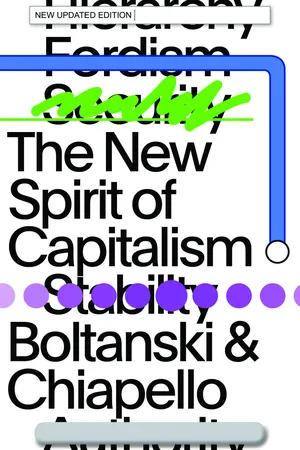
In this major work, sociologists Luc Boltanski and Eve Chiapello go to the heart of the changes in contemporary capitalism. Via an unprecedented analysis of the latest management texts that have formed the thinking of employers in their reorganization of business, the authors trace the contours of a new spirit of capitalism. They argue that from the middle of the 1970s onwards, capitalism abandoned the hierarchical Fordist work structure and developed a new network-based form of organization that was founded on employee initiative and autonomy in the workplace-a "freedom" that came at the cost of material and psychological security. The authors connect this new spirit with the children of the libertarian and romantic currents of the late 1960s (as epitomised by dressed-down, cool capitalists such as Bill Gates and "Ben and Jerry") arguing that they practice a more successful and subtle-form of exploitation. Now a classic work charting the sociological structure of neoliberalism, Boltanski and Chiapello show how the new spirit triumphed thanks to a remarkable recuperation of the left's critique of the alienation of everyday life that simultaneously undermined their "social critique."
In this new edition, the two authors reflect on the reception of the book and the debates it has stimulated.
- 688 pages
- English
- ePUB (mobile friendly)
- Available on iOS & Android
eBook - ePub
The New Spirit of Capitalism
About this book
Information
Topic
EconomiaSubtopic
Storia economicaPART 1
THE EMERGENCE OF A NEW
IDEOLOGICAL CONFIGURATION
1
MANAGEMENT DISCOURSE
IN THE 1990s
Our intention here is to bring out the profound transformation in the spirit of capitalism over the last thirty years: the abandonment of the specific ideological features characteristic of its second embodiment, and the emergence of a new image of firms and economic processes. The aim of this transformation was to provide those whose commitment is indispensable for the expansion of capitalism – the successors to cadres – with self-evident reasons for the ‘right actions’ (markedly different, as we shall see, from the recommendations made in the 1960s); a discourse legitimating these actions; encouraging prospects for individual development; the chance for people to project themselves into a future that was restructured in line with the new rules of the game; and the suggestion of new modes of reproduction for the children of the bourgeoisie, and upward social mobility for others.
1. SOURCES OF INFORMATION ON THE SPIRIT OF CAPITALISM
Management literature as prescription for capitalism
In order to carry out this project, we shall use management literature addressed to cadres.1 This literature, whose main objective is to inform cadres of the latest developments in running firms and managing human beings, emerges as one of the main sites in which the spirit of capitalism is inscribed.
As the dominant ideology, the spirit of capitalism theoretically has the ability to permeate the whole set of mental representations specific to a given era, infiltrating political and trade-union discourse, and furnishing legitimate representations and conceptual schemas to journalists and researchers, to the point where its presence is simultaneously diffuse and general. From among its possible expressions, we have selected management literature as a medium offering the most direct access to the representations associated with the spirit of capitalism in a given era. Within this literature we have, moreover, restricted ourselves to non-technical writings that aim to offer general new managerial mechanisms of a sort to inspire a firm’s operations as a whole. We have therefore excluded specialist literature dealing only, for example, with marketing, production management or accounting, in order to concern ourselves with what might be called ‘management in general’, whose boundaries with the discipline of entrepreneurial policy and strategy on the one hand, and human resources management on the other, are sometimes very tenuous.
Following the example of the spirit of capitalism, which presents two faces – one turned towards capital accumulation, the other towards legitimating principles – management literature can be read on two different levels. We certainly find in it a source of new methods of profit-making and novel recommendations to managers for creating firms that are more efficient and more competitive. But management literature is not purely technical. It is not composed only of practical recipes for improving the productivity of organizations as one improves the performance of a machine. It simultaneously has a high moral tone, if only because it is a normative literature stating what should be the case, not what is the case. Consequently, we may legitimately pose the question of the realism of this literature, and hence how believable it is when it comes to what ‘really’ happens in firms. And it is true that, although they are usually packed with numerous examples and based on case studies, management texts cannot replace survey materials, whether monographs on firms or statistical surveys. They make no claim to be exhaustive. Their orientation is not constative, but prescriptive. In the manner of edifying books or manuals of moral instruction, they practise the exemplum, select the cases employed according to their demonstrative power – what is to be done as opposed to what is not to be done – and take from reality only such of its aspects as confirm the orientation to which they wish to give some impetus. But it is precisely in so far as they constitute one of the main vehicles for the diffusion and popularization of normative models in the world of enterprise that they are of interest to us here.
As a public literature intended to elicit support for the precepts it states and the engagement of a large number of actors – first and foremost cadres, whose zeal and conviction are decisive in the smooth running of firms – management literature cannot be exclusively orientated towards the pursuit of profit. It must also justify the way profit is obtained, give cadres arguments with which to resist the criticisms that are bound to arise if they seek to implement its abundant recommendations, and to answer the demands for justification they will face from their subordinates or in other social arenas. Management literature must therefore demonstrate how the prescribed way of making profit might be desirable, interesting, exciting, innovative or commendable. It cannot stop at economic motives and incentives. It must also be based on normative aims, taking into account not only personal aspirations to security and autonomy, but also the way these aspirations can be attached to a more general orientation to the common good. Were it not for this, it would be impossible to understand why the transmission of operational modes for organizing firms is, in the work of some authors, glorified by a lyrical, even heroic style, or defended by numerous, heteroclite references to noble and ancient sources such as Buddhism, the Bible and Plato, or to contemporary moral philosophy (Habermas in particular).
It is likewise important for our subject to recall that the birth of management literature coincided, at the beginning of the century,2 with the emergence of the new social body of salaried managers and administrators (later referred to by the term ‘manager’ or, in France, cadre). The operational management of large firms was progressively transferred to them, as owners withdrew to the role of shareholders, except where they themselves became salaried senior management.3 From the outset management was thus intended for those who, following the crisis of the 1930s, were to become the new heroes of the economy and the principal addressees of the second spirit of capitalism. Management, which is presented as the systematization of practices within firms and their inscription in general rules of behaviour, gradually enabled a professionalization of supervision. Regarded as one of the founding fathers of the discipline, Henri Fayol wanted to perfect an ‘administrative doctrine’ that made it possible on the one hand to claim that management was a profession with its own rules, thus consummating the break with leadership whose legitimacy derived from ownership, and on the other to pave the way for a professional education. It is not surprising that cadres recognized their own aspirations in this eulogy to professionalism and competence (against the legitimacy of patrimony that was the reference-point for the first spirit of capitalism), as in the importance assigned to education. Hence the second spirit of capitalism finds its most natural expression in management literature. Consequently, it is reasonable to suppose that such literature will likewise register changes and a trend towards other representations, or at least that it will echo the breakdown of the spirit of which it was the main vehicle.
Our choice is, moreover, consistent with that of Werner Sombart or Max Weber. Sombart refers to the books of Leon Battista Alberti, whom he considers the perfect exemplar of the bourgeois of the Quattrocento, on ‘family government’.4 And Weber supplies a preliminary description of the spirit of capitalism by citing the writings of Benjamin Franklin (‘Necessary Hints to Those That Would Be Rich’, ‘Advice to a Young Tradesman’, ‘Memoirs’).5 These texts and the management literature we use belong to one and the same literary genre: works of advice and edification concerning the conduct of business (or the family economy).
The choices of Weber and Sombart are also explained by the impact of the works they used, and this refers us today to the question of the impact of management literature on practice. Granted that realism is not a major feature of the texts studied – since their aim is to state what should be, not what is – it is nevertheless of some relevance to know to what extent they are read, are influential, and are thereby able to influence practices in the way intended by their authors. Failing this, they would not constitute an adequate object for studying the establishment of a new dominant ideology. To do things properly, we would have to know the figures for the diffusion, reading, and utilization in teaching of the texts concerned. In the absence of institutional sources, however, this represents an extremely onerous task. We have skirted round this problem by not choosing a limited number of texts, like our illustrious predecessors, but constructing corpora with many more authors, which afford a representative panorama of the writings of a given period. Moreover, a reading of these texts discloses a high degree of homogeneity in the discourse and, in each of the periods considered, its general organization around a limited number of themes – to the extent that it might be wondered, faced with the marginal variation in the texts, whether such a profusion of texts is justified. This is doubtless the best indication of their ideological character with a vocation to become dominant. Their ideas are taken up, repeated, conveyed by various examples, pass nimbly from one relay to another (from one management journal to the next, from one author or editor to another, from management literature to the professional press for cadres, from the written word to lessons and specialist radio broadcasts). The upshot is that it is extremely difficult to attribute paternity of these bodies of rhetoric to authorial authorities. Their differences, which are often minimal, have the effect of offering various actors different ways of getting a handle on the orientations the authors seek to communicate, and identifying with them. As is no doubt the case with any body of texts that is performative in intent, particularly when the number and diversity of persons to be convinced are great, variation on a few mandatory themes constitutes a condition for effectively transmitting a message that can be broadcast only by being adjusted appropriately.
We have therefore constituted two corpora comprising sixty texts each. The first corpus appeared in the 1960s (1959–69), the second in the 1990s (1989–94); and both deal, in whole or part, with the question of cadres, even if the latter are sometimes referred to by different terms (manager, directeur, chef, dirigeant, etc.). For each of the periods under consideration, these two corpora make it possible to bring out a typical image of what was recommended to firms as regards the type of cadre to employ, the way they should ideally be treated, and the kind of work that might appropriately be asked of them. Appendix 1 sets out the characteristics of the texts analysed, while Appendix 2 presents a bibliography of each corpus. The corpora thus constructed (more than a thousand pages) have been processed in two phases. In the first instance, we submitted them to a traditional analysis based on an extensive reading that aimed at an initial location of their authors’ concerns, the solutions they proposed to the problems of their period, the image they offered of the inherited forms they declared to be outdated, and the various arguments advanced to effect the conversion of their readers. In a second phase, we used the analytical software Prospero@ (see Appendix 3) to corroborate our hypotheses and confirm, by means of specific indicators running through the body of texts, that our analysis did indeed reflect the general state of the corpus (not a personal bias with respect to certain themes that risked exaggerating their importance), and hence the general state of management literature in the relevant years.
The option adopted is basically comparative. Emphasis has been placed on the differences between the two corpora, whereas constants have been paid less attention.6 Dumont observed that the comparative method is the most effective one in the study of ideologies, especially when they pertain to the world the analyst is immersed in, and their salient elements are difficult to identify without an external point of comparison.7 Here that point will be provided by historical distance. Besides, the image of their era reflected by the 1960s texts is decidedly different from what the 1990s texts have to say about it. Once again, we should not ask this kind of literature to afford us a balanced panorama of the past, since its aim is to suggest improvements, and hence to break up some of the mechanisms derived from established practices. It selects, and consequently magnifies, the factors it is rebelling against, ignoring features that might be more enduring and no less important.
Analysing a change that is in the process of being effected, and in some respects remains embryonic, exposes one to the risk of being accused of naivety, even of complicity with one’s object. It is true that in its modern forms – social evolutionism, prediction, futurology – prophecy has often been a powerful tool of mobilization and action. It can help to bring about what it describes (the self-fulfilling prophecy) or, in the case of certain prophecies of calamity, support reactionary opposition to reforms.8 From this viewpoint, one unmasks the ‘ideological’ character (in the sense of illusion, even deception) of some analysis of change, where those who promote it are simply taking their own desires or anxieties for reality. Positivist versions of this challenge often rely on a statistical description of reality. Descriptions of change are supposedly based on an illusion that takes the part for the whole and extrapolates from deliberately selected, unrepresentative cases, to impose a vision of the future for which serious empirical study of the current reality offers not the slightest confirmation.
Thus, it will perhaps be objected that what we describe on the basis of management literature greatly exaggerates features that only marginally affect the operation of firms. The series of indicators assembled in Chapter 4, however, shows that there has already been considerable implementation of the mechanisms described in the literature. Moreover, it will be seen there that we do not possess all the requisite statistical data to bring out the relevant changes. The apparatus of statistical description rests, in fact, on equivalents that are homologous to those used in the established tests on which social selection mainly depended in the previous state. Hence – structurally, as it were – it does not constitute the most adequate tool for recording and counting the new forms of test, particularly when they are established gradually, under the impact of micro-displacements.
In addition, there is a mass of historical examples of descriptions of change that cannot, a posteriori, be said to have been without foundation, even though they were based on fragmentary, partial evidence – which furnished reasons for discrediting them in the name of factual realism. Thus, as Pierre Ansart has shown, Proudhon, spokesman for the artisans – who were a large majority in mid-nineteenth-century France – was statistically right against Marx, whose proletarian utopia seemed to be grounded in circumstances that were not prevalent at the time.9 Criticizing Peter Laslett for slighting the role played by the English East India Company and the Bank of England prior to the eighteenth century, Fernand Braudel writes as follows:
[t]hese are familiar arguments: every time the volume of a leading sector is compared to the total volume of the whole economy, the larger picture reduces the exception to more modest or even insignificant proportions. I am not entirely convinced. The important things are those that have consequences and when these consequences amount to the modernizing of the economy, the ‘business model’ of the future, the accelerated pace of capital formation and the dawn of colonization, we should think more than once about them.10
When it is read for the purpose of deriving ideal types of the spirit of capitalism in the two periods, one of the striking features of management literature is a persistent concern with mobilizing and motivating personnel, especially cadres. ‘How can we give work in firms some meaning?’ is one of th...
Table of contents
- Cover Page
- Title Page
- Copyright Page
- Contents
- Preface (2017)
- Preface: To the English Edition
- Acknowledgements
- Prologue
- General Introduction: On the Spirit of Capitalism and the Role of Critique
- Part I: The Emergence of a New Ideological Configuration
- Part II: The Transformation of Capitalism and the Neutralization of Critique
- Part III: The New Spirit of Capitalism and the New Forms of Critique
- Postscript: Sociology Contra Fatalism
- Postface
- Appendices
- Notes
- Bibliography
- Name Index
- Subject Index
Trusted by 375,005 students
Access to over 1.5 million titles for a fair monthly price.
Study more efficiently using our study tools.
Frequently asked questions
Yes, you can cancel anytime from the Subscription tab in your account settings on the Perlego website. Your subscription will stay active until the end of your current billing period. Learn how to cancel your subscription
No, books cannot be downloaded as external files, such as PDFs, for use outside of Perlego. However, you can download books within the Perlego app for offline reading on mobile or tablet. Learn how to download books offline
Perlego offers two plans: Essential and Complete
- Essential is ideal for learners and professionals who enjoy exploring a wide range of subjects. Access the Essential Library with 800,000+ trusted titles and best-sellers across business, personal growth, and the humanities. Includes unlimited reading time and Standard Read Aloud voice.
- Complete: Perfect for advanced learners and researchers needing full, unrestricted access. Unlock 1.5M+ books across hundreds of subjects, including academic and specialized titles. The Complete Plan also includes advanced features like Premium Read Aloud and Research Assistant.
We are an online textbook subscription service, where you can get access to an entire online library for less than the price of a single book per month. With over 1.5 million books across 990+ topics, we’ve got you covered! Learn about our mission
Look out for the read-aloud symbol on your next book to see if you can listen to it. The read-aloud tool reads text aloud for you, highlighting the text as it is being read. You can pause it, speed it up and slow it down. Learn more about Read Aloud
Yes! You can use the Perlego app on both iOS and Android devices to read anytime, anywhere — even offline. Perfect for commutes or when you’re on the go.
Please note we cannot support devices running on iOS 13 and Android 7 or earlier. Learn more about using the app
Please note we cannot support devices running on iOS 13 and Android 7 or earlier. Learn more about using the app
Yes, you can access The New Spirit of Capitalism by Eve Chiapello,Luc Boltanski, Gregory Elliott in PDF and/or ePUB format, as well as other popular books in Economia & Storia economica. We have over 1.5 million books available in our catalogue for you to explore.