This diary of Hamilton’s journey through the northern colonies provides an interesting account of the life and times during the colonial period. It is a brilliant account of a typical cultured gentleman of the age and background of his times. As a physician, the diarist views life with a realistic eye.
Originally published in 1948.
A UNC Press Enduring Edition — UNC Press Enduring Editions use the latest in digital technology to make available again books from our distinguished backlist that were previously out of print. These editions are published unaltered from the original, and are presented in affordable paperback formats, bringing readers both historical and cultural value.
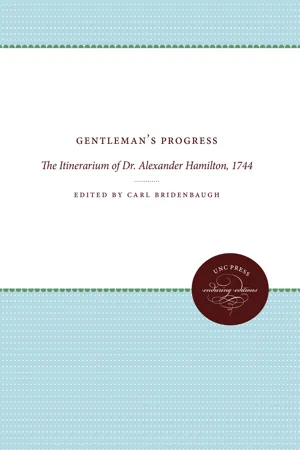
- 310 pages
- English
- ePUB (mobile friendly)
- Available on iOS & Android
eBook - ePub
About this book
Information
Publisher
Omohundro Institute and UNC PressYear
2018Print ISBN
9780807839782
9780807805411
eBook ISBN
9780807839775
Topic
HistoireTHE ITINERARIUM
OF DR. ALEXANDER HAMILTON
1744
AMICO SUO HONORANDO, DIVINITISSIMO DOMINO ONORIO RAZOLINI, MANUSCRIPTUM HOCCE ITINERARIUM, OBSERVANTIAE ET AMORIS SUI QUALCUMQUE SYMBOLIUM, DAT CONSECRATIQUE.
ALEXANDER HAMILTON
[To his honorable friend, the most excellent Signor Onorio Razolini, Alexander Hamilton gives and dedicates this manuscript the Itinerarium as a token of his esteem and affection.]
ITINERARIUM
DIE MERCURII TRIGESIMO MENSIS MAII INCHOATUM ANNO MDCCXLIV
ANNAPOLIS, Wednesday, May 30th. I set out from Annapolis in Maryland upon Wednesday, the 30th of May, att eleven a’clock in the morning, contrary winds and bad weather preventing my intended passage over Chesapeak Bay, so taking the Patapscoe road, I proposed going by way of Bohemia to Newtown upon Chester,1 a very circumflex course, but as the journey was intended only for health and recreation, I was indifferent whether I took the nearest or the farthest route, having likewise a desire to see that part of the country. I was in seeming bad order att my first seting out, being suspicious that one of my horses was lame, but he performed well and beyond my expectation. I travelled but 26 miles this day. There was a cloudy sky and an appearance of rain. Some miles from town I met Mr. H[ar]t2 going to Annapolis. He returned with me to his own house where I was well entertained and had one night’s lodging and a country dinner.
Mr. H[asel]l,3 a gentleman of Barbadoes, with whom I expected to have the pleasure of travelling a good part of my intended journey, had left Annapolis a week or ten days before me and had appointed to meet me att Philadelphia. He went to Bohemia by water and then took chaise over land to Newcastle and Willimington, being forbid for certain physicall reasons to travell on horseback. This was a polite and facetious gentleman, and I was sorry that his tedious stay in some places put it out of my power to tarry for him; so I was deprived of his conversation the far greatest part of the journey.
Mr. H[ar]t and I, after dinner, drank some punch and conversed like a couple of virtuosos. His wife had no share in the conversation; he is blessed indeed with a silent woman, but her muteness is owing to a defect in her hearing, that, without bawling out to her, she cannot understand what is spoke, and therefor not knowing how to make pertinent replys, she chuses to hold her tongue. It is well I have thus accounted for it; else such a character in the sex would appear quite out of nature. Att night I writ to Annapolis and retired to bed att 10 a’clock.
Thursday, May 31. I got up by times this morning pour prendre le frais, as the French term it, and found it heavy and cloudy, portending rain. Att 9 o’clock I took my leave of Mr. H[ar]t, his wife and sister, and took horse. A little before I reached Patapscoe Ferry, I was overtaken by a certain captain of a tobacco ship, whose name I know not, nor did I inquire concerning it lest he should think me impertinent.
Patapscoe Ferry
We crossed the ferry together att 10 o’clock.4 He talked inveteratly against the clergy and particularly the Maryland clerks of the holy cloth, but I soon found that he was a prejudiced person, for it seems he had been lately cheated by one of our parsons.5
Baltimore Town—Gunpowder Ferry—Joppa
This man accompanied me to Baltimore Town,6 and after I parted with him, I had a solitary journey till I came within three miles of Gunpowder Ferry7 where I met one Mathew Baker, a horse jockey.
Crossing the ferry I came to Joppa, a village pleasantly situated and lying close upon the river.8 There I called att one Brown’s, who keeps a good taveren in a large brick house.9 The landlord was ill with intermitting fevers, and understanding from some there who knew me that I professed physick, he asked my advice, which I gave him.
Here I encountered Mr. D[ea]n,10 the minister of the parish, who (after we had dispatched a bowl of sangaree)11 carried me to his house. There passed between him, his wife, and I some odd rambling conversation which turned chiefly upon politicks. I heard him read, with great patience, some letters from his correspondents in England, written in a gazett stile, which seemed to be an abridgement of the politicall history of the times and a dissection of the machinations of the French in their late designs upon Great Brittain. This reverend gentleman and his wife seemed to express their indignation with some zeal against certain of our st[ate]sm[e]n and c[ouncillo]rs att Annapolis who, it seems, had opposed the interest of the clergy by attempting to reduce the number of the taxables. This brought the proverb in my mind, The shirt is nearest the skin. Touch a man in his private interest, and you immediately procure his ill will.
Leaving Joppa I fell in company with one Captain Waters and with Mr. D—gs, a virtuoso in botany. He affected some knowledge in naturall philosophy, but his learning that way was but superficiall.
Description of the Gensing
He showed me a print or figure of the gensing which, he told me, was to be found in the rich bottoms near Susquehanna.12 The plant is of one stemm, or stalk, and jointed. From each joint issues four small branches. At the extremity of each of these is a cinquefoil, or 5 leaves, somewhat oblong, notched and veined. Upon the top of the stemm, it bears a bunch of red berries, but I could not learn if it had any apparent flower, the colour of that flower, or att what season of the year it blossomed or bore fruit. I intended, however, to look for it upon the branches of Susquehanna; not that I imagined it of any singular virtue, for I think it has really no more than what may be in the common liquorice root mixed with an aromatick or spicy drug, but I had a curiosity to see a thing which has been so famous.
After parting with this company, I put up att one Tradaway’s about 10 miles from Joppa. The road here is pritty hilly, stonny, and full of a small gravell. I observed some stone which I thought looked like limestone.
Just as I dismounted att Tradaway’s, I found a drunken club dismissing.13 Most of them had got upon their horses and were seated in an oblique situation, deviating much from a perpendicular to the horizontal plan[e], a posture quite necessary for keeping the center of gravity within its propper base for the support of the superstructure; hence we deduce the true physicall reason why our heads overloaded with liquor become too ponderous for our heels. Their discourse was as oblique as their position; the only thing intelligible in it was oaths and God dammes; the rest was an inarticulate sound like Rabelais’ frozen words a thawing, interlaced with hickupings and belchings. I was uneasy till they were gone, and my landlord, seeing me stare, made that trite apology—that indeed he did not care to have such disorderly fellows come about his house; he was always noted far and near for keeping a quiet house and entertaining only gentlemen or such like, but these were country people, his neighbours, and it was not prudent to dissoblige them upon slight occasions. “Alas, sir!” added he, “we that entertain travellers must strive to oblige every body, for it is our dayly bread.” While he spoke thus, our Bacchanalians, finding no more rum in play, rid off helter skelter as if the devil had possessed them, every man sitting his horse in a see-saw manner like a bunch of rags tyed upon the saddle.
I found nothing particular or worth notice in my landlord’s character or conversation, only as to his bodily make. He was a fat pursy man and had large bubbies like a woman. I supped upon fry’d chickens and bacon, and after supper the conversation turned upon politicks, news, and the dreaded French war;14 but it was so very lumpish and heavy that it disposed me mightily to sleep. This learned company consisted of the landlord, his overseer and miller, and another greasy thumb’d fellow who, as I understood, professed physick and particularly surgery. In the drawing of teeth, he practiced upon the house maid, a dirty piece of lumber, who made such screaming and squalling as made me imagine there was murder going forwards in the house. However, the artist got the tooth out att last with a great clumsy pair of black-smith’s forceps; and indeed it seemed to require such an instrument, for when he showed it to us, it resembled a horsenail more than a tooth.
The miller, I found, professed musick and would have tuned his crowd15 to us, but unfortunatly the two middle strings betwixt the bass and treble were broke. This man told us that he could play by the book. After having had my fill of this elegant company, I went to bed att 10 o’clock.
Friday, June 1st. The sun rose in a clear horizon, and the air in these highlands was, for two hours in the morning, very cool and refreshing. I breakfasted upon some dirty chocolate, but the best that the house could afford, and took horse about half an hour after six in the morning. For the first thirteen miles the road seemed gravelly and hilly, and the land but indifferent.
Susquehanna Ferry
When I came near Susquehanna, I looked narrowly in the bottoms for the gensing but could not discover it. The lower ferry of Susquehanna,16 which I crossed, is above a mile broad. It is kept by a little old man whom I found att vittles with his wife and family upon a homely dish of fish without any kind of sauce. They desired me to eat, but I told them I had no stomach. They had no cloth upon the table, and their mess was in a dirty, deep, wooden dish which they evacuated with their hands, cramming down skins, scales, and all. They used neither knife, fork, spoon, plate, or napkin because, I suppose, they had none to use. I looked upon this as a picture of that primitive simplicity practiced by our forefathers long before the mechanic arts had supplyed them with instruments for the luxury and elegance of life. I drank some of their syder, which was very good, and crossed the ferry in company with a certain Scots-Irishman by name Thomas Quiet. The land about Susquehanna is pritty high and woody, and the channell of the river rockey.
Mr. Quiet rid a little scrub bay mare which he said was sick and ailing and could not carry him, and therefor he ‘lighted every half mile and ran a couple of miles att a footman’s pace to spell the poor beast (as he termed it). He informed me he lived att Monocosy17 and had been out three weeks in quest of his creatures (horses), four of which had strayed from his plantation. I condoled his loss and asked him what his mare’s distemper was, resolving to prescribe for her, but all that I could gett out of him was that the poor silly beast had choaked herself in eating her oats; so I told him that if she was choaked, she was past my art to recover.
This fellow, I observed, had a particular down hanging look which made me suspect he was one of our New Light biggots.18 I guessed right, for he introduced a discourse concerning Whitfield and inlarged pritty much and with some warmth upon the doctrines of that apostle, speaking much in his praise. I took upon me, in a ludicrous manner, to impungn some of his doctrines, which, by degrees, put Mr. Quiet in a passion. He told me flatly that I was damnd without redemption. I replyed that I thought his name and behaviour were very incongruous and desired him to change it with all speed, for it was very impropper that such an angry, turbulent mortall as he should be called by the name of Thomas Quiet.
Principio Iron Works—North East
In the height of this fool’s passion, I overtook one Mr. B[axte]r,19 a proprietor in the iron works there, and, after mutual salutation, the topic of discourse turned from religious controversy to politicks; so putting on a little faster, we left this inflammed bigot and his sick mare behind. This gentleman accompanied me to North East and gave me directions as to the road.
Elk Ferry
I crossed Elk Ferry att 3 in the afternoon.20 One of the ferry men, a young fellow, plyed his tongue much faster than his oar. He characterized some of the chief dwellers in the neighbourhood, particularly some young merchants, my countrymen, for whom he had had the honour to stand pimp in their amours. He let me know that he understood some scraps of Latin and repeated a few hexameter lines out of Lilly’s Grammar.21 He told me of a clever fellow of his name who had composed a book for which he would give all the money he was master of to have the pleasure of reading it. I asked him who this name sake of his was. He replied it was one Terence, and, to be sure, he must have been an arch dog, for he never knew one of the name but he was remarkable for his parts.
Bohemia
Thus entertained, I got over the ferry and rid to Bohemia, and calling att the mannor house there, I found no body att home.22 I met here a reverend parson who was somewhat inquisitive as to where I came from and the news, but I was not very communicative. I understood afterwards it was Parson W[y]e.23
Bohemia Ferry
I crossed Bohemia Ferry and lodged att the ferry house.24 The landlord’s name I cannot remember, but he seemed to be a man of tollerable parts for one in his station. Our conversation run chiefly upon religion. He gave me a short account of the spirit of enthusiasm that had lately possessed the inhabitants of the forrests there and informed me that it had been a common practise for Companys of 20 or 30 hair brained fanaticks to ride thro’ the woods singing of psalms. I went to bed att 9 att night; my landlord, his wife, daughters, and I lay all in one room.
Saturday, June 2d. In the morning there was a clear sky over head but a foggy horizon and the wind att south, which presaging heat, I set out very early.
Sassafrax Ferry
I took the road to Newtown upon Chester River, crossed Sassafrax Ferry att 7 o’clock in the morning, where I found a great concourse of people att a fair. The roads here are exceeding good and even, but dusty in the summer and deep in the winter season. The day proved very hot. I encountered no company, and I went three or four miles out of my way.
Newtown
I reached Newtown25 att 12 o’clock and put up att Dougherty’s, a publick house there. I was scarce arrived when I met severall of my acquaintance. I dined with Dr. Anderson and spent the rest of the day in a sauntering manner. The northeren post arrived att night.26 I read the papers but found nothing of consequence in them; so after some comicall chat with my landlord, I went to bed att eleven o’clock att night.
Sunday, June 3d. I stayed all this day att Newtown and breakfasted with Th. Clay, where I met with one W——b, a man of the law, to appearance a civil, good natured man but set up for a kind of connoiseur in many things. I went to visit some friends and dined att the taveren where I was entertaind by the tricks of a female baboon in the yard. This lady had more attendants and hangers on att her levee than the best person (of quality as I may say) in town. She was very fond of the compliments and company of the men and boys but expressed in her gestures an utter aversion att women and girls, especially negroes of that sex—the lady herself being of a black complexion; yet she did not att all affect her country women.
Att night I was treated by Captain Binning27 of Boston with a bowl of lemmon punch. He gave me letters for his relations att Boston. Whiele we put about the bowl, a deal of comicall discourse pass’d in which the landlord, a man of a particular talent att telling comic storys, bore the chief part.
Monday, June 4th. The morning being clear and somewhat cool, I got up before 5 a’clock and soon mounted horse. I had a solitary route to Bohemia and went very much out of my way by being too particular and nice in observing directions.
Sassafrax and Bohemia Ferries
I reached Mr. Alexa...
Table of contents
- Cover Page
- Title Page
- Copyright Page
- Contents
- Illustrations
- Introduction
- The Itinerarium
- Notes: Introduction
- Notes: Itinerarium
- Index
Trusted by 375,005 students
Access to over 1.5 million titles for a fair monthly price.
Study more efficiently using our study tools.
Frequently asked questions
Yes, you can cancel anytime from the Subscription tab in your account settings on the Perlego website. Your subscription will stay active until the end of your current billing period. Learn how to cancel your subscription
No, books cannot be downloaded as external files, such as PDFs, for use outside of Perlego. However, you can download books within the Perlego app for offline reading on mobile or tablet. Learn how to download books offline
Perlego offers two plans: Essential and Complete
- Essential is ideal for learners and professionals who enjoy exploring a wide range of subjects. Access the Essential Library with 800,000+ trusted titles and best-sellers across business, personal growth, and the humanities. Includes unlimited reading time and Standard Read Aloud voice.
- Complete: Perfect for advanced learners and researchers needing full, unrestricted access. Unlock 1.5M+ books across hundreds of subjects, including academic and specialized titles. The Complete Plan also includes advanced features like Premium Read Aloud and Research Assistant.
We are an online textbook subscription service, where you can get access to an entire online library for less than the price of a single book per month. With over 1.5 million books across 990+ topics, we’ve got you covered! Learn about our mission
Look out for the read-aloud symbol on your next book to see if you can listen to it. The read-aloud tool reads text aloud for you, highlighting the text as it is being read. You can pause it, speed it up and slow it down. Learn more about Read Aloud
Yes! You can use the Perlego app on both iOS and Android devices to read anytime, anywhere — even offline. Perfect for commutes or when you’re on the go.
Please note we cannot support devices running on iOS 13 and Android 7 or earlier. Learn more about using the app
Please note we cannot support devices running on iOS 13 and Android 7 or earlier. Learn more about using the app
Yes, you can access Gentleman's Progress by Carl Bridenbaugh in PDF and/or ePUB format, as well as other popular books in Histoire & Histoire des débuts de l'Amérique. We have over 1.5 million books available in our catalogue for you to explore.