An accessible and timely guide to increasing female presence and leadership in tech companies
Tech giants like Apple and Google are among the fastest growing companies in the world, leading innovations in design and development. The industry continues to see rapid growth, employing millions of people: in the US it is at the epicenter of the American economy. So why is it that only 5% of senior executives in the tech industry are female? Underrepresentation of women on boards of directors, in the C-suite, and as senior managers remains pervasive in this industry. As tech companies are plagued with high-profile claims of harassment and discrimination, and salary discrepancies for comparable work, one asks what prevents women from reaching management roles, and, more importantly, what can be done to fix it?
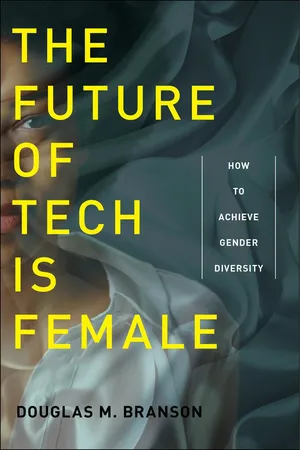
The Future of Tech is Female considers the paradoxes involved in women's ascent to leadership roles, suggesting industry-wide solutions to combat gender inequality. Drawing upon 15 years of experience in the field, Douglas M. Branson traces the history of women in the information technology industry in order to identify solutions for the issues facing women today. Branson explores a variety of solutions such as mandatory quota laws for female employment, pledge programs, and limitations on the H1-B VISA program, and grapples with the challenges facing women in IT from a range of perspectives.
Branson unpacks the plethora of reasons women should hold leadership roles, both in and out of this industry, concluding with a call to reform attitudes toward women in one particular IT branch, the video and computer gaming field, a gateway to many STEM futures. An invaluable resource for anyone invested in gender equality in corporate governance, The Future of Tech is Female lays out the first steps toward a more diverse future for women in tech leadership
- 336 pages
- English
- ePUB (mobile friendly)
- Available on iOS & Android
eBook - ePub
About this book
Information
Part I
The Conundrum
1
Industries That Do Not Hire or Promote
There are many reasons why the information technology industry belongs at the top of a list of industries that do not promote and, in many instances, do not hire women for important jobs. I denominate as “the boo list” a ranking of industries and of companies within those industries according to the extent to which they do not hire and do not promote women. Among major industries, information technology is last at integrating women into leadership roles, senior management, and even middle management positions. Information technology, then, represents the perfect storm of gender imbalance.
Externally, telltale signs of information technology’s less than lackluster performance include the following:
- > In this day and age, a high-profile information technology company, Facebook, went public in a long-awaited public offering. Among the controversies surrounding the offering was that Facebook went public without a single woman on its board of directors.1 Only two of Facebook’s first fifty employees were women, and women remained exceedingly scarce as the company matured.2 When asked why his board had no women, Facebook’s Mark Zuckerberg shot back, “I’m going to find people who are helpful, and I don’t particularly care what gender they are.”3
- > A short while later, another high-profile information technology company, Twitter, went public with no women board members, having learned nothing from its predecessor’s ham-fisted misstep.4 A business journalist pointed out that women and men use Twitter almost equally.5
- > Then the CEO of IT giant Microsoft, Satya Nadella, belittled women employees in tech and “set off a storm about the wage gap” between women and men.6 When asked why tech companies pay women 10 to 25 percent less for comparable work, Mr. Nadella replied, “It’s not really about asking for a raise but knowing and having faith that the system will reward you the right raises as you go along.” “It’s not good karma” for women to ask for raises.7 In other words, in Mr. Nadella’s opinion, there is no wage gap. Women employees make less because they contribute less: if their contributions were equal, his and other companies would have recognized that in pay envelopes (does anyone receive their pay in an envelope anymore?).
- > Early in 2017, the Department of Labor (DOL) sued both Oracle and Google over perceived payment disparities between men and women employees. The DOL’s initial reviews “found systematic compensation disparities against women, pretty much across the board,” at both IT companies.8
Not only IT leaders have tin ears on the subject of diversity. Widely acclaimed, even worshipped, CEO Warren Buffett has caused his company, Berkshire Hathaway, to proclaim, “Our nominating committee does not seek diversity, no matter how defined.”9 At a more mature Facebook, with a market capitalization of $300 billion, only one of the fifty highest-paid executives, as opposed to the first fifty employees in earlier years, is female. That executive, chief operating officer Sheryl Sandberg, author of Lean In, is famous in her own right (see chapter 8).
Overall, Catalyst, the advocacy group for women in business, reports that women hold 20.2 percent of the seats on large cap (Fortune 500) companies’ boards of directors, up from 9.6 percent in 1997, 15.7 percent in 2010, and 16.6 percent in 2012.10 Catalyst further reports that women hold 23 percent of senior-level manager positions and 39.2 percent of management positions overall at S&P 500 corporations.11 By contrast, the Forte Foundation, a Texas-based consortium of corporations and business schools that encourage women to enter business careers, pegs the first number at 14 percent.12
Whatever statistic the reader finds credible, the 2015 Lean In and McKinsey & Company’s Women in the Workplace “concluded that we were 100 years away from gender equality in the c-suite.”13 In information technology, the outlook is not so good—and in fact is much more daunting.
To complete the summary, and by way of further contrast, women occupy 45 percent of the board seats in the not-for-profit sector, a significantly higher number. At the largest not-for profits, including health care providers, United Way organizations, museum complexes, arts groups, and other large organizations, women occupy 37 percent of the board seats, more than double the proportion in business corporations.14
The Landscape
Those overall percentages are aggregate figures. If we look at specific industries we find that, at least several years ago, near the bottom in terms of numbers of female directors was the retail drug industry, a grouping of companies “in the business of large-box (or medium-box) retailing in which many items (not just drugs) are sold and a majority of the shoppers are women.”15 CVS, Walgreen’s, Rite Aid, and Long’s Drugs all had but a single woman on their boards of directors.16 Near the bottom also was the airline industry, “a consumer-oriented industry with a large female employee group.” Media corporations, financial services companies, and, surprisingly, grocery store chains performed very poorly in naming women to their boards of directors.17
In 2017, however, the worst industry in its treatment of women, at least in recruitment and retention of them as directors, was information technology, including development and sale of computer hardware and software:
Nine [information technology] corporations [in the Fortune 500] had six women directors out of seventy-eight. . . . Four large publicly held corporations [had] no women directors at all. Apple Computer and Steve Jobs [sold] iPods and computers for purchase by women and mothers but [had] no women on their board.18
That was the negative picture at the top, with the inescapable message to women lower down in those organizations that, at least at the apex of the pyramid, “good ole boys” were still in control.
A Changing Landscape
But there is a more encouraging picture, one that has changed over time. Twenty-five or thirty years ago the prevailing advice to women aspiring to careers in business was to avoid altogether certain predominantly male industries, say, electric utility companies, oil and gas ventures, or paint and chemical entities. Engineers and cost accountants were thought to rule the roost in those quarters. Further, the standard view was that those in power (the engineers and the accountants) would not be receptive at all, either not hiring women or being hesitant in the extreme about giving women added responsibilities or promoting them. All that seems to be changing. Many industries and corporations once thought to be inhospitable to women now seem to excel in offering opportunities for female hiring and advancement. Thus, although the advice might not be for everyone, women with certain backgrounds (science, engineering, finance, accounting) and a bit of moxie may discover the fastest track to be the one only recently thought to be a dead end, including obscure and remote postings.19
A number of women who have reached the top, becoming chief executive officers (CEOs) of Fortune 500 companies, have followed this pattern:
- > Paula Rosput Reynolds, CEO of Safeco Insurance, after a career spent in public utilities.
- > Lynn Good, CEO of a public utility holding company, Duke Energy.
- > Kimberly Lubel, CEO of another utility company, Sempra Energy.
- > Ellen Kullman, CEO of a paint and chemicals company, Dupont de Nemours, capping a career at that company.
- > Susan Ivey, who had a successful career at the helm of a tobacco company, Reynolds American.
- > Her successor as CEO of Reynolds (now to be acquired by British Tobacco), Susan Cameron.
- > Patricia Woertz, an executive with Gulf Oil and then Chevron, and still later with Texaco, who became CEO of Archer Daniels Midland, our largest agribusiness corporation.
- > Mary T. Barra, CEO of automotive giant General Motors.
- > Marillyn Hewson, CEO of defense and aerospace corporation Lockheed.
- > Phebe Novakovic, CEO of another defense firm, General Dynamics.
- > Lynn Elsenhans, CEO at Sunoco, a leading East Coast refiner and retailer of petroleum products.
- > Kathleen Mazzarella, CEO of electrical products and supply firm Graybar Electric.20
Reaching beyond industries in which women have had some success—that is, marketing, retailing, or food products—we see that women have achieved success in places where they would not have gone thirty years ago. Other women have counterprogrammed in other ways. “The times, they are changing.”
Dreary, Unchanging Landscapes
But not everywhere. And certainly not in information technology.
The financial services sector shows little change. Only 12.5 percent of executives at banks and other publicly held financial services entities are women, compared with the Catalyst finding of 23 percent in the Fortune 500 overall. “Finance has long been dominated by (white) men, whose testosterone flows freely and machismo is never more than two or three cubicles away.”21 Much worse is the transportation sector. Securities and Exchange Commission (SEC) Regulation S-K, Item 502 provides that companies reporting to the SEC must include in proxy statements and annual reports filed with the SEC (10-Ks) a compensation table. The table must show the total compensation (salary, bonuses, present value of stock options, other cash benefits, etc.) of the five highest-paid executive officers in the organization. Reviewing the compensation tables of seventeen publicly held transportation companies reveals that only 7.1 percent of the listed most highly compensated executives (six of eighty-five) are women.22 Changing the experimental group slightly, the Dow Jones Transportation Index basket of twenty companies is nearly the same: 7 percent, that is, only seven of the hundred highest-paid executives are women.23
The transportation sector, however, does not top the list. The industry that tops that list and whose record in hiring and promoting women is truly deficient, and that regards itself as a cutting-edge industry, at the very center of the twenty-first century, is information technology.
A Census
Appendix A contains a list of 127 information technology companies whose shares are publicly traded and information is therefore available. Of the entities on the list, 110 are domiciled in the United States. Examination of the compensation tables of those 110 companies shows that, excluding the women CEOs, 30 women, out of a total of 550 executives, or 5.5 percent, number among the highest-paid officers and executives in the sector.24
If the array of companies surveyed is broadened to include the sample’s 17 foreign IT companies that have a U.S. presence (a stock exchange share listing: China, with five, and Bermuda, Canada, England, France, Germany, India, Ireland, Israel, Netherlands, Taiwan, and Singapore, with one each), the numbers increase to 36 women and 635 potential positions. The percentage of women in executive positions increases slightly, from 5.5 percent to 5.66 percent.25
Other statistics are available, for example, from the Clayman Institute for Gender Research at Stanford University or in the National Academy Reports of the National Science Foundation.26 Those statistics, though, focus on the industry’s employment of women overall. They do not attempt to derive a snapshot of women in leadership roles.27
The information technology sector ranks last as well in the percentage of its directors who are female: “just 8.4% of Silicon Valley companies have women directors, one of the lowest averages,” compared with the Catalyst finding of 20.2 percent overall.28 So the information technology industry waddles onward, not at all improved from its earliest days, at least in terms of promoting women to senior executive positions and to board of directors’ seats. Information technology is through and through a male-dominated industry. You would think it would be different.
Venture Capital and Sand Hill Road
Much of the foregoing moved to a central place on the national stage with a legal c...
Table of contents
- Cover
- Title Page
- Copyright Page
- Dedication
- Contents
- Preface
- Part I. The Conundrum
- Part II. A History of Women in Information Technology
- Part III. Solutions Advanced
- Part IV. Solutions That May Work
- Part V. Needed Fixes—Now
- Appendix A. Publicly Held Information Technology Companies
- Appendix B. Women Senior Executives in Publicly Held Information Technology Companies
- Notes
- Bibliography
- Index
- About the Author
Trusted by 375,005 students
Access to over 1.5 million titles for a fair monthly price.
Study more efficiently using our study tools.
Frequently asked questions
Yes, you can cancel anytime from the Subscription tab in your account settings on the Perlego website. Your subscription will stay active until the end of your current billing period. Learn how to cancel your subscription
No, books cannot be downloaded as external files, such as PDFs, for use outside of Perlego. However, you can download books within the Perlego app for offline reading on mobile or tablet. Learn how to download books offline
Perlego offers two plans: Essential and Complete
- Essential is ideal for learners and professionals who enjoy exploring a wide range of subjects. Access the Essential Library with 800,000+ trusted titles and best-sellers across business, personal growth, and the humanities. Includes unlimited reading time and Standard Read Aloud voice.
- Complete: Perfect for advanced learners and researchers needing full, unrestricted access. Unlock 1.5M+ books across hundreds of subjects, including academic and specialized titles. The Complete Plan also includes advanced features like Premium Read Aloud and Research Assistant.
We are an online textbook subscription service, where you can get access to an entire online library for less than the price of a single book per month. With over 1.5 million books across 990+ topics, we’ve got you covered! Learn about our mission
Look out for the read-aloud symbol on your next book to see if you can listen to it. The read-aloud tool reads text aloud for you, highlighting the text as it is being read. You can pause it, speed it up and slow it down. Learn more about Read Aloud
Yes! You can use the Perlego app on both iOS and Android devices to read anytime, anywhere — even offline. Perfect for commutes or when you’re on the go.
Please note we cannot support devices running on iOS 13 and Android 7 or earlier. Learn more about using the app
Please note we cannot support devices running on iOS 13 and Android 7 or earlier. Learn more about using the app
Yes, you can access The Future of Tech Is Female by Douglas M. Branson in PDF and/or ePUB format, as well as other popular books in Business & IT Industry. We have over 1.5 million books available in our catalogue for you to explore.