In the early nineteenth century, as amateur archaeologists excavated Pompeii, Egypt, Assyria, and the first prehistoric sites, a myth arose of archaeology as a magical science capable of unearthing and reconstructing worlds thought to be irretrievably lost. This timely myth provided an urgent antidote to the French anxiety of amnesia that undermined faith in progress, and it armed writers from Chateaubriand and Hugo to Michelet and Renan with the intellectual tools needed to affirm the indestructible character of the past.
From Paris to Pompeii reveals how the nascent science of archaeology lay at the core of the romantic experience of history and shaped the way historians, novelists, artists, and the public at large sought to cope with the relentless change that relegated every new present to history.
In postrevolutionary France, the widespread desire to claim that no being, city, culture, or language was ever definitively erased ran much deeper than mere nostalgic and reactionary impulses. Göran Blix contends that this desire was the cornerstone of the substitution of a weak secular form of immortality for the lost certainties of the Christian afterlife. Taking the iconic city of Pompeii as its central example, and ranging widely across French romantic culture, this book examines the formation of a modern archaeological gaze and analyzes its historical ontology, rhetoric of retrieval, and secular theology of memory, before turning to its broader political implications.
eBook - ePub
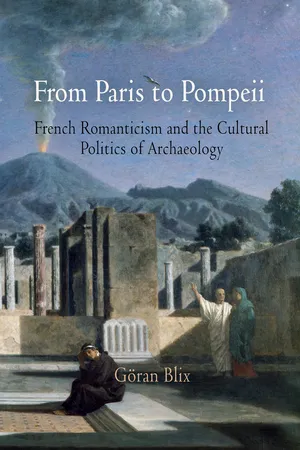
From Paris to Pompeii
French Romanticism and the Cultural Politics of Archaeology
- 320 pages
- English
- ePUB (mobile friendly)
- Available on iOS & Android
eBook - ePub
About this book
Information
Publisher
University of Pennsylvania PressYear
2013Print ISBN
9780812241365
9780812241365
eBook ISBN
9780812201307
ONE
Neoclassical Pompeii
OUR MODERN CONCEPTION of archaeology as a science that unearths even the humblest vestiges of the human past with extreme care and sophistication emerged only gradually over the last two centuries. Archaeology itself, it is true, is as old as history, and evidence pushes the human preoccupation with its own monuments far back into the remote past. The Renaissance is clearly a cultural “rebirth” that is fueled by the archaeological rediscovery of antiquity. Nonetheless, the meaning of the term “archaeology” will here be restricted to a radically new type of relation to the past and to its remnants which emerged roughly at the turn of the eighteenth century, during the shift from neoclassicism to Romanticism. Interest in the fragmentary remains of past cultures underwent a major transformation at that point which completely redefined and reconfigured the archaeological object—from its status and meaning to the way culture related to it. Overall, this shift in perception can be characterized as the transition from a purely aesthetic gaze to a historicizing gaze: the excavated fragment—be it a ruin, a statue, an inscription, a coin, or a vase—was formerly viewed chiefly as an art object, to be appreciated for its aesthetic merit, and either to be held up as a model of beauty or to be found shortcoming with respect to the ideal. In the nineteenth century, the fragment began to be viewed increasingly as a monument, document, or clue, in short, as a memorial device which furnished historical evidence about the past. Dating the vestige became of paramount importance, and the fragment was now endowed with a new type of value, no longer just aesthetic but primarily historical and hermeneutic: insofar as the unearthed object was the witness and survivor of a vanished past, it enabled the viewer to reconstruct and reimagine the world to which it had belonged. From possessing an intrinsic value (beauty), it receded into a network of associations, became absorbed in a historical context, spoke not of itself but of the world in which it was embedded. It is this major shift in attitudes to historical objects that I call the “birth of archaeology,” which I investigate in this part.
The Past as Buried Treasure
The rediscovery of Pompeii and Herculaneum offers an exemplary illustration of the birth of a modern archaeological gaze. Buried during the August 24, 79 C.E., eruption of Vesuvius witnessed by Pliny the Younger,1 and only truly unearthed in the mid-eighteenth century (Herculaneum in 1738, Pompeii in 1748), the two Campanian cities stand out as the most spectacular archaeological find of the Enlightenment. Two and a half centuries later, the sites have not yet been fully exhumed, and about a third of Pompeii's surface remains unexcavated. No other modern discovery has had an equal impact on the popular romance of archaeology or on the decorative arts. An instant sensation, the cities attracted travelers on the Grand Tour, influenced neoclassical painting, and set off a long-term trend in decoration, inspiring, for example, the Pompeian ornamental scheme of Napoleon's castle at Malmaison and the pottery of Josiah Wedgwood.2 In the nineteenth century, this ornamental inspiration gave way to the intense romantic drama of the doomed cities, reproduced endlessly in poetry, painting, and theater, most famously in Bulwer-Lytton's historical disaster novel, The Last Days of Pompeii (1834). The twentieth century kept this mythical event alive by transferring it to film, and directors of toga movies from Luigi Maggi (1908–9) to Sergio Leone (1959) kept turning to Bulwer's classic melodramatic script. The extraordinary fame and mythical fascination of the buried cities make them an ideal seismograph to test changes in the popular perception of archaeology and its cultural role. The major shift I want to map here is the one from an image of Pompeii as a curious site of artistic treasures, prevalent in the eighteenth century, to the romantic myth of the city as a lost world magically restored by the powers of archaeology. Between 1750 and 1830, Pompeii is transformed from a grave to be robbed into the image of a lost civilization; in the process, a sweeping change has occurred—in the nature of the object exhumed, in the value attached to the artifacts, and in the gaze of the beholder.
The first contact with Herculaneum, before real excavations began, occurred as early as 1711, when a well was dug for the Prince d'Elbeuf's new country house at Portici. Several costly marbles, including a statue of Hercules, were exhumed from the pit to the prince's delight. It turned out that his well had been sunk right into the richly adorned proscenium of Herculaneum's theater, but the significance of this find largely escaped him. In dire need of money, he had the pieces smuggled to Rome for restoration, then on to Vienna, as a “gift” to his cousin, the Prince Eugene of Savoy. This mercenary extraction and illicit private transaction set the tone for much to come at Pompeii and Herculaneum. The cities would in fact be treated largely as underground treasuries, mines brimming with artworks, graves to be robbed for the king's collection of antiques. Excavations undertaken in 1738 by Charles de Bourbon, King of Naples, were pursued to enlarge his private collection: tight security around the digs limited access, and restrictions on the right to draw the antiques ensured the king's monopoly on the prestigious finds. It was fortunate, one traveler noted in the 1770s, that Elbeuf had struck upon “the most beautiful statues” at the outset, because “their discovery sparked a much greater curiosity, one which might not have been sustained, unless, at the outset, such interesting finds had been made.”3 The search was on for artistic masterpieces; the cost of the digs was to be suffered for the value and prestige they would bring to their royal patron. It was this high expectation that propelled the digs.
Charles III, like all princely collectors, derived cultural prestige from the artifacts he hoarded at the Museo Borbonico in Portici. This musuem drew curious visitors from afar, attracted dignitaries, and quickly built an international reputation; it also helped put Naples on the map of the Grand Tour as an indispensable stop. Goethe called the museum the “A and Ω of all antique collections” in 1787.4 Since access to the excavations was restricted and the right to draw the objects rarely granted, curiosity in Europe far outpaced the supply of information, and illicit sketches, reports, even artifacts, stolen by underpaid workers and sold to wealthy visitors, began to circulate abroad. An Observations sur les antiquités de la ville d'Herculanum, replete with inaccurate sketches drawn from memory, was published by Cochin fils and Bellicard, after their visit in 1750. The great neoclassical art historian Johann Winckelmann penned a Sendschreiben von den Herculanischen Entdeckungen in 1762, another unauthorized report responding to the Europe-wide demand for news, and was highly critical of the poor conduct of the excavations and the way cultural politics clashed with the interests of science. Charles III deflected criticism while courting interest in the finds by appointing a fifteen-member Accademia Ercolanese to study and publish the artifacts (1755). Between 1757 and 1792, this academy issued a multivolume work with accurate plates entitled Le Antichità di Ercolano, not for commercial sale but to be bestowed, as Jean Seznec writes, on the “happy few”—“even Winckelmann had to make a plea to get the first volume.”5
Much was no doubt lost due to the king's jealous secrecy and use of slave labor at the excavations. When Lord Hamilton, the longtime British ambassador in Naples, guided foreign visitors to Vesuvius and Pompeii, he also often showed off his private cache of memorabilia. Goethe passed through in 1787 and reports that Hamilton led him “into his secret den of art and junk,” where he spotted two “lovely bronze candelabras,” strangely resembling those in Portici: “they might,” he suggests, “have slid sideways from the Pompeian shafts and lost their way into this place.”6 Stressing the private and treasure-like nature of Hamilton's illegal collection, Goethe notes that, as “knight of these hidden treasures,” he can exhibit them only “to his most trusted friends” (426). His commerce in antiques of course only mirrors the period's broader view of them (in which the king participates) as priceless treasures to be mined, extracted, and stashed away. Indeed, Goethe regrets this pillage-style excavation, which leads to such abuses, and wishes it were undertaken “systematically by true German mountain-men” (276). Laments of this sort touching the poor quality of the excavations and assessments by travelers and savants of the finds as “artistic treasures,” as unique aesthetic objects to be bought, sold, hoarded, and copied, reveal a great deal about the eighteenth-century attitude to the material past. In what follows, that relation will be explored under two main headings: as grave robbery without method and as a purely aesthetic assessment. The two are not unrelated: it is because only artistic values are perceived beneath the ground that valuables can be excavated with violent disregard for the site's archaeological integrity.
The motif of the “buried treasure” in archaeology is no neutral metaphor in this setting but points to a mindset favorable to pillaging. Pompeii and Herculaneum are of course priceless treasures, but the reiterated use of this figure by eighteenth-century visitors reveals the narrow framework in which it was possible to grasp these fragments of antiquity. The man often judged to be the father of archaeology, Winckelmann, himself appeals in his Sendschreiben to the hope of finding “treasure” (Schätze) in calling for more aggressive digs at Herculaneum. “Given the certainty,” he writes, “of finding treasures of which our forefathers had no idea, the work is advancing in a rather sleepy fashion.” No more than “fifty laborers, counting the slaves from Algiers and Tunis, are there altogether” (79). The use of slaves or prisoners also jeopardized the very booty to be mined at such low cost.7 If science partook in the excavations, it did so without thwarting the primary purpose of enrichment and without instituting methods to protect the myriad objects and ruins of lesser interest. The antiquarians Cochin and Bellicard remark bluntly that “the temples which have been discovered near the Forum and the plunder [dépouilles] from many private houses have enriched the cabinet of the King of the Two Sicilies.”8 They note also that “everything of value has been removed from the surface of the walls and transported into [his] cabinet” (53). The square cutouts left in the walls from the detached frescoes struck many visitors but without inspiring much indignant comment. The abbé de Saint-Non makes only the technical comment in his Voyage pittoresque (1777) that “it had been necessary to use great precautions to succeed in removing them from the depths of Herculaneum without breaking or damaging them.”9 This cultural strip-mining of the buried ruins testifies to the predominantly aesthetic gaze that the period brought to bear on antiques: the artifacts existed as discrete objects, independent of their frame and easy to detach from their material and cultural context; what mattered was their artistic merit and cultural prestige—everything else could be neglected. This grave-robbing mentality would not be seriously questioned until the turn of the century. The poet Giacomo Leopardi's complaint that “extinct Pompeii returns to daylight…[but] by worldly greed” reveals how the Romantics would evaluate this neoclassical retrieval of antiquity and points to the argument that artworks possessed their full meaning only in their original settings.10 This was the polemical position that Quatremère de Quincy, the late classic, and Chateaubriand, the early Romantic, would famously adopt against the museum.
The vision of the buried past as artistic treasure translated directly at Herculaneum into roughshod means of excavation. The goal of finding and extracting what was valuable at low cost promoted the hiring of cheap labor, unmethodical digs, poor treatment of artifacts, neglect of records, and overall abuse of the site under investigation.11 Tunnels were dug quite at random or merely to secure the quickest access to the artworks, according to the Président de Brosses, who, in 1739, was among the first visitors at Herculaneum: “excavating blindly…they have only dug a few low and narrow tunnels at random.”12 When they could not find an entrance “and were frustrated at this failure,” Cochin reports, the workers “pierced through the wall facing them and penetrated into the room.”13 Space constraints made it impossible to expose entire sections of the city to view, and once rooms had been plundered they were refilled with dirt to clear the passageways. Once a room “has been dug out on all sides and thoroughly searched,” Winckelmann says, “another room of equal size is excavated across from it, and the new dirt removed to the facing room.”14 Cochin corroborates this observation.15 No coherent image of the city could take shape given this profit-oriented method of tunneling: “they clear spaces, refill them, and the underground presents a new face every six months” (50). In this way, goods were extracted and the city reburied as the excavations progressed to more impressive finds.
Visitors often had harsh words for the conduct and management of the excavations. Goethe's desire to see German Bergleute run the operation foreshadows the critical and often nationalistic remarks that foreign tourists would offer. The Spaniard Alcubierre was the man Charles III first appointed to direct the excavation: “he was as unacquainted with antiques as the moon with crabs,” Winckelmann wrote, and “made himself guilty through his inexperience of gross damage and the loss of many beautiful things” (79). But his “incompetence” largely reflects the groping state of archaeology and its profit-oriented outlook in the eighteenth century.16 Winckelmann indignantly relates how a “large public inscription” was found, its metallic letters detached and thrust into a basket, before a copy had been made of the text. The paramount concern, he insists, was to find out “what these letters meant,” and that “nobody can now say.”17 He also caustically relates the fate of some bronze horses, deformed by the lava, which were loaded up on a carriage and thrust into a pile in the castle courtyard at Naples, whereupon they were melted down and recast as busts of the king and queen, an “irresponsible” usage (81–82). In 1785, the Président Dupaty blamed the slow progress on the “bad management” and “indifference of the employers,”18 and seventeen years later Creuzé de Lesser updates this critique by calling for scientific excavations which neither proceed too fast nor falter whenever more profitable terrain beckons. “It was not until 1813, under the French occupation, that a real work-site was established,” the count Kératry would later boast19—with some justification, however, since the “intermittent French tenure of the region [1798–1815]” was “an active period in the history of Pompeian excavations,” during which “the first real attempts at actual reconstruction of certain areas to a pre-eruption state took place.”20
As Philippa Levine has shown, it was only slowly, in the course of the nineteenth century, that archaeology emerged from antiquarianism as a science with a genuine method.21 The distance traveled from 1800 to 1850 can be measured in part by Ernest Renan's 1865 review of Mariette's work in Egypt, which he calls “the greatest scientific enterprise of our century” and situates at the antipodes of “bric-a-brac archeology,” praising its refusal “of the frivolity of the elites, the stupidity of the public, and that vain quest for museum objects which reduces science to a pale amusement.”22 Mariette announces the end of archaeology as grave robbery: he neither seeks “those spectacular objects that impress the idle viewer [le badaud]” nor attempts to “enrich his museum at the expense of the monuments,” as the Germans had done in Berlin, acquiring their “Egyptian collection” by plunging “saw and axe into precious monuments” (369). Not that such practices did not continue, especially in colonial territories, or were virtuously eschewed by the French: let us recall that André Malraux, father of the musée imaginaire, set out in search of Khmer sculptures in the Burmese rainforest in the 1920s, slashing his way to overgrown temples and carving out their stone panels—in the hope of selling them on the Parisian art market.23
From Neoclassical Antiquity to Archaeology
How did timeless artifacts become historical vestiges, charged with vital cultural information? To map this shift it will be necessary to show how the gaze that brought these relics into focus was transformed. This gaze is fairly coherent at any given time, and while savants and tourists evidently differ, they share many period prejudices that authorize us to speak broadly of a neoclassical gaze. Two properties of this gaze are relevant here: first, it judges artifacts chiefly in aesthetic terms; and second, it dehistoricizes and aestheticizes the world itself. Thus the frescoes displayed at Portici were judged strictly as paintings and evaluated unhistorically by the enlightened canons of eighteenth-century taste. And the cities, more broadly, became visible only insofar as they conjured up an idyllic image of classical antiquity; the radical alterity of Pompeii, the way it differed both from modernity and from literary antiquity, was curiously invisible. One qualification should be made: what I here call the neoclassical gaze does not include the antiquarians, a specialist subculture that valued a much broader range of vestiges, such as coins, inscriptions, and charters, but was harshly rejected by the mainstream Enlightenment as petty and myopic.
“All the paintings from Hercu...
Table of contents
- Cover Page
- Title Page
- Copyright Page
- Contents
- List of Illustrations
- Introduction
- Chapter One: Neoclassical Pompeii
- Chapter Two: The Antiquarian Comes of Age
- Chapter Three: The Archaeological Turn
- Chapter Four: The Specular Past
- Chapter Five: Body Politics
- Chapter Six: Lost Worlds and the Archive
- Chapter Seven: The Uses of Archaeology
- Notes
- Bibliography
- Index
- Acknowledgments
Trusted by 375,005 students
Access to over 1.5 million titles for a fair monthly price.
Study more efficiently using our study tools.
Frequently asked questions
Yes, you can cancel anytime from the Subscription tab in your account settings on the Perlego website. Your subscription will stay active until the end of your current billing period. Learn how to cancel your subscription
No, books cannot be downloaded as external files, such as PDFs, for use outside of Perlego. However, you can download books within the Perlego app for offline reading on mobile or tablet. Learn how to download books offline
Perlego offers two plans: Essential and Complete
- Essential is ideal for learners and professionals who enjoy exploring a wide range of subjects. Access the Essential Library with 800,000+ trusted titles and best-sellers across business, personal growth, and the humanities. Includes unlimited reading time and Standard Read Aloud voice.
- Complete: Perfect for advanced learners and researchers needing full, unrestricted access. Unlock 1.5M+ books across hundreds of subjects, including academic and specialized titles. The Complete Plan also includes advanced features like Premium Read Aloud and Research Assistant.
We are an online textbook subscription service, where you can get access to an entire online library for less than the price of a single book per month. With over 1.5 million books across 990+ topics, we’ve got you covered! Learn about our mission
Look out for the read-aloud symbol on your next book to see if you can listen to it. The read-aloud tool reads text aloud for you, highlighting the text as it is being read. You can pause it, speed it up and slow it down. Learn more about Read Aloud
Yes! You can use the Perlego app on both iOS and Android devices to read anytime, anywhere — even offline. Perfect for commutes or when you’re on the go.
Please note we cannot support devices running on iOS 13 and Android 7 or earlier. Learn more about using the app
Please note we cannot support devices running on iOS 13 and Android 7 or earlier. Learn more about using the app
Yes, you can access From Paris to Pompeii by Göran Blix in PDF and/or ePUB format, as well as other popular books in Literature & French Literary Criticism. We have over 1.5 million books available in our catalogue for you to explore.