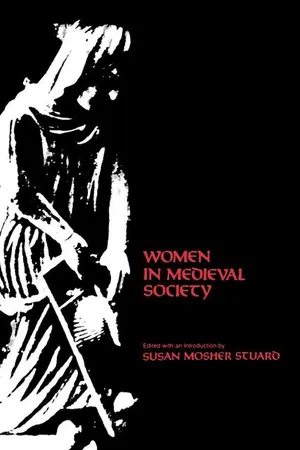
Early medieval women exercised public roles, rights, and responsibilities. Women contributed through their labor to the welfare of the community. Women played an important part in public affairs. They practiced birth control through abortion and infanticide. Women committed crimes and were indicted. They owned property and administered estates. The drive toward economic growth and expansion abroad rested on the capacity of women to staff and manage economic endeavors at home.
In the later Middle Ages, the social position of women altered significantly, and the reasons why the role of women in society tended to become more restrictive are examined in these essays.
The organization of the family—the rights and duties of the husband, the wife, their descendants and dependents—has always had a profound effect on the entire body politic, in primitive societies as well as in highly developed states. The management and distribution of property necessitated extensive marital regulation in the ancient world, and with the establishment of the Christian church, a growing effort was made to legislate the moral aspects of marriage. Yet for centuries the most basic questions remained unresolved. What persons can marry one another? What are the privileges and obligations of the partners to a marriage? Under what, if any, conditions can a marriage be dissolved?
Legislators and theologians alike strove to solve these problems. We have their texts and they illustrate a history of the efforts of church and state to regulate the most intimate tangles life can create. But laws and theories can only tell us what their authors desired to accomplish and not what was, in fact, the truth of everyday life. To be sure, legal codes may be supposed to derive from actual cases brought before tribunals. However, we have no means of judging the extent to which such laws were obeyed by men of the early middle ages. Nor were secular and ecclesiastical laws in harmony. We cannot estimate with certainty which set of rules the ordinary man chose to obey at any given instance.
We have sought to supplement the general picture presented in the Germanic law codes and formulae and the records of ecclesiastical councils with illustrative material from chronicles, letter, and treatises. But such material for this early period tends to be confined to the more scandalous entanglements of the ruling class rather than to the more ordinary marital arrangements of the majority. Therefore, though we cannot speak with assurance of the practical effects of the legislative efforts of the church and state, we can delineate the history of their development, which followed two separate lines until the advent of the Carolingian kings. Thereafter, the leaders of both church and state began to collaborate on creating a more uniform body of regulations. Previously, secular customs in the Germanic kingdoms, influenced to some extent by the traditions of the Roman law, were primarily concerned with the social and economic aspects of marriage, a union legalized by the account of the bride's parents and the payment of a dowry. Such unions could be dissolved with relative ease if either party transgressed certain laws or by mutual consent if suitable economic arrangements were made. The church, on the other hand, had been traditionally concerned with the moral aspects of marriage. In particular, the Latin church had tried consistently to restrict divorce and subsequent remarriage, and by the middle of the ninth century it adopted Augustine's uncompromising position that marriages could not be dissolved even if one party had committed adultery or wished to enter the monastery. The reconciliation of these two concepts: marriage as a social and economic fact and marriage as an indissoluble spiritual bond, was the great problem facing the Frankish church. Our aim is to trace marriage from its genesis in the two opposing systems of law to the success of Hincmar of Rheims in imposing church law in the ninth century.1
Christian attitudes toward marriage and its regulation were, of course, formed within the existing framework of the Roman state where property arrangements and questions concerning the guardianship or tutelage of women remained the province of the civil law. Though the fathers did not dispute that these powers were proper to the secular society, Christian doctrine differed radically from Roman law on the fundamental question of divorce and remarriage.2 Divorce among the Romans was easily obtained. If one party were taken into captivity or reduced to servitude, the marriage was automatically dissolved. Despite some efforts of the emperors to discourage the practice, divorce by mutual consent was allowed in Roman Law, and the Lex Julia required the husband to divorce his adulterous wife.3 Jewish law, from which the Christians drew most of their precepts, similarly made divorce readily available to men, and by Roman times, the trend was toward equal rights for women in this respect.4 At the time of Christ, Jewish doctors were debating the whole question of divorce. Despite the objections of the Pharisees and the dismay of his own followers, Christ himself established the Christian position, enunciating on several occasions the principle of marital indissolubility though he appeared to leave an opening for a man to divorce an adulterous wife.5
From the outset, Christian thinkers made radical departures from both Jewish and Roman traditions in conceiving the idea of Christian marriage within the larger context of the Christian way of life. Though some early Christians, following Paul, regarded marriage as necessary for the containment of lust or a limited good for the fulfillment of God's commandment, “Be fruitful and multiply,” Christianity as a whole was developing the innovative concept of marriage as a spiritual bond which might, in its highest form, eliminate sexual relations altogether.6 The principle of spiritual equality between man and woman was basic to Christian thought, and accordingly the fathers came to glorify marriage as a divine gift and a symbol of the union of Christ and his church which sanctified husband and wife joined by mutual love. Being primarily concerned with the spiritual aspects of marriage and its value as a model of Christian virtue in a pagan world, the early fathers were little concerned with its legal aspects.7 They preached that marriage constituted an indissoluble bond and those who allowed divorce did so only in case of adultery.8 In contrast to the eastern fathers, who did not oppose too strenuously the double standard of divorce inherent in civil law, the later western fathers almost unanimously declared that what was not allowed to women in Christian law was equally illicit for men.9 Ambrosiaster stands alone in sanctioning double standards, allowing divorce and remarriage to the husbands of adulterous wives on the basis of Matthew 19, while denying the same right to women.10 St. Ambrose's prohibition against the remarriage of men during their wives' lifetimes, and St. Jerome's specific command that husbands who had dismissed their adulterous wives could not remarry culminated in St. Augustine's teaching that even adulterous marriages were indissoluble: the partners could separate but neither could remarry while the other was alive.11
Ecclesiastical legislation, however, was considerably more ambiguous than the moral writings of the Latin fathers. The early councils were frequently unclear on the question of indissolubility. They specifically opposed themselves to secular law by prohibiting divorce.12 But, with some misgivings, they followed Paul in allowing divorce to Christians married to Jews, heretics, and pagans, though they generally preferred to prohibit such marriages in the first place.13
The greatest problem was whether adultery justified divorce and remarriage and here the councils occasionally wavered over Christ's apparent exemption for husbands of adulterous wives. Though willing to recognize the possibility of separation from adulterous partners, most of the fourth and fifth century western councils tended to apply their rules of indissolubility to both men and women. Only the Council of Angers, held in 453, limited its prohibition of remarriage to women.14 The Council of Aries, in 314, advised against the remarriage of a man who had repudiated his adulterous wife.15 Without entering into a discussion of adultery, Canon 8 of the ninth synod of Carthage (convened in 404) which was incorporated into the Codex Canonum Ecclesiae Africanae, prohibited remarriage to either partner on pain of penance.16 There were, however, earlier canons softening this rule, such as canon 10 of the Council of Elvira which stated that a woman contracting marriage in good faith with a man who had repudiated his wife without reason should not be excommunicated.17 The Council of Vannes (465) appears to have recognized the dilemma posed by Matthew 19 and allowed remarriage if adultery could be proved.18 This council may have been mindful that, despite ecclesiastical prohibitions, divorce continued to be allowed by the secular codes. The fathers at the ninth synod of Carthage apparently meant to get to the root of the problem by recommending the promulgation of an imperial law to support their prohibition of divorce and remarriage, but there is no evidence that such legislation was ever considered by the emperor.19 The popes were equally ineffective in condemning the remarriage of both men and women as adulterous unions.20
The Christian emperors never made any discernible effort to bring their marriage legislation into conformity with conciliar decrees. Their divorce laws continued to be less strict and maintained the double standard. Constantine allowed women to repudiate their husbands unilaterally if they had committed homicide, sorcery, or tomb desecration whereas husbands were allowed a divorce if their wives were guilty of adultery, acted as procuresses, or were proved to be sorceresses. If a wife could not prove her charges, she was deported but in a similar situation the husband had only to restore the wife's dowry and was not allowed to remarry. To this, Honorius and Theodosius added that a woman who had succeeded in obtaining a divorce could remarry only after five years and could not remarry at all if she had left her husband for a less serious crime. The husband, however, could remarry immediately if he had repudiated his wife for a serious crime and after two years if he repudiated her for a defect of character. Only if he had dissolved the marriage for a trivial disagreement was he required to live in perpetual celibacy.21
This divergence between secular and ecclesiastical law is apparent in other areas of sexual regulation as well. For example, concubinage was never prohibited by Roman Law and in some instances it was specifically allowed.22 The church, on the other hand, insisted that the concubine must either be relinquished or married, depending on her status.23 Incest regulations in Roman Law conformed only partially to Christian principles, and were never extended to include the prohibitions against spiritual affinity which the Christians had derived largely from Jewish Law and incorporated in their own legislation.24
The problem of accommodating Christian precepts to secular law was further complicated by the eruption of Germanic tribes into the shattered Roman Empire. Their laws, codified from the fifth to the ninth century, show occasional Roman influences in the regulation of divorce and Christian influences in the incest prohibitions. We know little about their original marital practices. Tacitus noted that they paid for their wives, which he took to be indicative of the esteem in which they held women, but the practice is capable of less flattering interpretations. Likewise, he praised the fidelity of married couples, though he admitted that the royal families were polygamous.25 Gregory of Tours attested the continuation of polygamy among the Franks through their first century as Christians and, surprisingly, the bishop did not appear to be disturbed by the practice. For example, he calmly related the story of Chlotar's marriage to Guntheaca, the widow of a murdered rival, followed by his marriage to the daughter of another slain enemy, Radegunda. Lest it be supposed that Chlotar was in the habit of repudiating one wife before taking another, we must further cite the king's virtually simultaneous marriage to the sisters, Ingunda and Aregunda. Moreover, Gregory carefully distinguished all these wives from Chlotar's concubines.26
Apparently, the Franks aband...
Table of contents
Cover Page
Title Page
Copyright Page
Contents
Acknowledgments
Introduction
Land, Family, and Women in Continental Europe, 701–1200
Infanticide in the Early Middle Ages
Women in Reconquest Castile: The Fueros of Sepúlveda and Cuenca
Marriage and Divorce in the Frankish Kingdom
The Female Felon in Fourteenth-Century England
Mulieres Sanctae
Widow and Ward: The Feudal Law of Child Custody in Medieval England
Dowries and Kinsmen in Early Renaissance Venice
Women in Charter and Statute Law: Medieval Ragusa/Dubrovnik
Selected Bibliography
Contributors
Index
Trusted by 375,005 students
Access to over 1.5 million titles for a fair monthly price.
Study more efficiently using our study tools.
Frequently asked questions
Yes, you can cancel anytime from the Subscription tab in your account settings on the Perlego website. Your subscription will stay active until the end of your current billing period. Learn how to cancel your subscription
No, books cannot be downloaded as external files, such as PDFs, for use outside of Perlego. However, you can download books within the Perlego app for offline reading on mobile or tablet. Learn how to download books offline
We are an online textbook subscription service, where you can get access to an entire online library for less than the price of a single book per month. With over 1.5 million books across 990+ topics, we’ve got you covered! Learn about our mission
Look out for the read-aloud symbol on your next book to see if you can listen to it. The read-aloud tool reads text aloud for you, highlighting the text as it is being read. You can pause it, speed it up and slow it down. Learn more about Read Aloud
Yes! You can use the Perlego app on both iOS and Android devices to read anytime, anywhere — even offline. Perfect for commutes or when you’re on the go. Please note we cannot support devices running on iOS 13 and Android 7 or earlier. Learn more about using the app
Yes, you can access Women in Medieval Society by Susan Mosher Stuard in PDF and/or ePUB format, as well as other popular books in Historia & Historia europea medieval. We have over 1.5 million books available in our catalogue for you to explore.