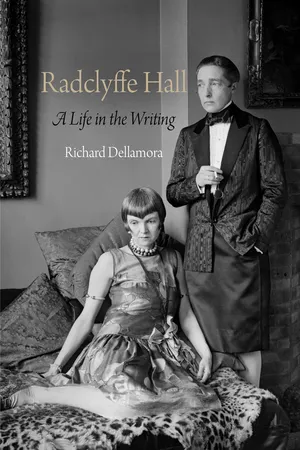
The Well of Loneliness is probably the most famous lesbian novel ever written, and certainly the most widely read. It contains no explicit sex scenes, yet in 1928, the year in which the novel was published, it was deemed obscene in a British court of law for its defense of sexual inversion and was forbidden for sale or import into England. Its author, Radclyffe Hall, was already well-known as a writer and West End celebrity, but the fame and notoriety of that one book has all but eclipsed a literary output of some half-dozen other novels and several volumes of poetry.In Radclyffe Hall: A Life in the Writing Richard Dellamora offers the first full look at the entire range of Hall's published and unpublished works of fiction, poetry, and autobiography and reads through them to demonstrate how she continually played with the details of her own life to help fashion her own identity as well as to bring into existence a public lesbian culture. Along the way, Dellamora revises many of the truisms about Hall that had their origins in the memoirs of her long-term partner, Una Troubridge, and that have found an afterlife in the writings of Hall's biographers.In detailing Hall's explorations of the self, Dellamora is the first seriously to consider their contexts in Freudian psychoanalysis as understood in England in the 1920s. As important, he uncovers Hall's involvement with other modes of speculative psychology, including Spiritualism, Theosophy, and an eclectic brand of Christian and Buddhist mysticism. Dellamora's Hall is a woman of complex accommodations, able to reconcile her marriage to Troubridge with her passionate affairs with other women, and her experimental approach to gender and sexuality with her conservative politics and Catholicism. She is, above all, a thinker continually inventive about the connections between selfhood and desire, a figure who has much to contribute to our own efforts to understand transgendered and transsexual existence today.
- 344 pages
- English
- ePUB (mobile friendly)
- Available on iOS & Android
eBook - ePub
About this book
Trusted by 375,005 students
Access to over 1.5 million titles for a fair monthly price.
Study more efficiently using our study tools.
Information
Publisher
University of Pennsylvania PressYear
2011Print ISBN
9780812243468
9780812243468
eBook ISBN
9780812204650
1
Reading the Poetry
Some echoes of her simple lay will reach the farthest future.
— Sussex Daily News, March 22, 1913
Desires
In view of Hall's uncertainty about the durability of close ties between women, it is not surprising that one finds in her early volumes of verse not only poems that celebrate a singular relationship with another woman but also those that imagine sexual and emotional ties as fleeting. Hall's personal life during her twenties and early thirties resembles the High Victorian Bohemianism exemplified by Charlotte Cushman (1816-1876), an actor celebrated for her performance in Shakespearean trouser roles. With the wealth that she earned on the stage, Cushman retired to Rome, where she supported various American relatives and Emma Stebbins, the female sculptor whom Cushman chose to be her long-term partner.1 Cushman also supported other female artists, friends, and lovers, including at times their husbands. She spoke of the members of this entourage as her “belongings,” a colloquial term that suggests the degree to which Victorian bourgeois life fell within the traditional terms of domestic alliance as described by Michel Foucault.2 One's relations belonged to one by virtue of blood and/or legal connection—and one belonged to them too. For a financially self-supporting woman such as Cushman, one's female lovers were also “belongings,” to be retained if possible as friends once an affair played itself out. Transient desires implied longer-term claims. This practice evokes a second meaning of belonging—that of longing, yearning, desire.
When Hall entered into her majority, she used her newfound wealth to move out of her mother's house and into one of her own. She took her grandmother Diehl with her, and she surrounded herself with women she met while traveling in the United States: Jane Randolph, a widowed cousin with children, and, after a second trip, another cousin, Dorothy Diehl. Both women became Hall's lovers, then friends, and Hall supported them in England. Jane eventually returned to the States and married a rich man. Diehl married Robert Coningsby Clarke, a promising young composer, who set a number of Hall's poems to music.3 For Hall, as for Cushman, these complex arrangements implied a capability and interest in both enduring and short-term relationships.
Hall's lyric poetry focuses on both brief and lasting attractions. The doubling, which can seem contradictory, is especially marked in her third volume, Poems of the Past & Present (1910).4 Shortly after publication of the book, abrupt changes occurred in the lives of Mabel Batten and Hall—namely, the deaths of Hall's grandmother and of Batten's much older husband, George. These events freed the pair to live together in a de facto female marriage until Batten's sudden death six years later. Poems of the Past & Present memorializes the romance, which is signified in the title and arrangement of the volume. The collection is framed with a dedication and with poems of the present that celebrate the couple's mutual devotion as well as Batten's collaboration in preparing the poems for publication.5 Poems of the Past refers most specifically to a sequence of Sapphic verses called the “Fruit of the Nispero.” This group, written earlier, celebrates a playful, sometimes painful and fleeting, pagan love; the framing poems affirm long-term commitment.
Hall dedicated the book “to Mrs. George Batten.” The “Mrs.” and the “George” are diplomatic touches. Marriage offered financial and emotional security to Batten as well as useful cover for extramarital affairs.6 The opening poem, entitled “A Dedication,” sets out the book as inspired by—and written in gratitude for—Batten's love. Book-ending the volume, “Postscript” acknowledges her role in revising, editing, and compiling the poems:
Your hands have touched the cover of my book,
Beloved hands!
Your eyes have read each page and found it good,
Beloved eyes!
What can my verses now attain? Your look
Has given immortality, your wise
Sweet thoughts upon mine own, have surely crowned
These words with laurels Love himself has wound. (125)
Despite the flattery, already in the volume's second poem Hall discloses an irrepressibly cheeky, seductive side. She drops the persona of faithful lover almost as soon as she has assumed it. In this poem, the lyric voice belongs to Pan's piper, who plays a “wayward melody.” The poem ends in “love's delight.”
With Batten on board, Hall began crafting a persona as author. Poems of the Past & Present is the first of her books to include photographs of the author. Opening to the title page, one finds pasted into the book a passport-sized photograph with a three-quarter profile of the head of the author. The semiotics of the image is masculine-feminine.7 Hall's hair is pulled back tightly from her forehead, but she sports the spit curl that appears characteristically in publicity photos of the following decade. She also wears an earring in her ear. Most of the image is given over to her costume of expensive woolen frock coat, tailored jacket, skirt, and cravat. Facing the table of contents is another photo of Hall, with a flawless complexion, portrayed as a sensitive, thoughtful, independent-minded young woman. Again, the hair is pulled back tightly. She wears a stiff, upturned shirt collar, checked bow tie, and tailored jacket.
The dedication of the volume to Batten and the masculine coding of the author's photographs are ploys inviting readers to receive the poetry as autobiographical. Hall does so again in the dedication of her final book of poetry, The Forgotten Island, a volume of erotic verse that recalls Sappho's Lesbos. By this time, the relationship with Batten was strained. Hall declares in the dedication that her inspiration has been prompted by the advent of a new “FRIEND,” “Mrs. Gordon Woodhouse” (5), the talented harpsichordist to whom Batten had introduced Hall several years earlier.8 A high Bohemian, Woodhouse's mariage blanc left space for long-held ties with several male lovers at the same time that she cultivated the admiration of Sapphists, such as the composer Ethyl Smyth.9 In 1914, Hall embarked on a flirtation with Woodhouse that likely ended in bed.10 The account that Hall provided of the book suggests that it may chart the trajectory of an affair. In Baker's words, her “idea was that the poems represented someone's recollection of a previous incarnation on a mythical island like Lesbos and, taken as a whole, they told the story of a love affair which runs from the heights of passion to the dull yearning for new pastures” (57).

3. Marguerite Radclyffe Hall [sic]. Poems of the Past & Present (1910). Title page. Stanford University Library, Stanford, California.

4. Marguerite Radclyffe Hall [sic]. Poems of the Past & Present (1910). Facing table of contents. Stanford University Library, Stanford, California.
In contrast to the newly discovered relationship announced in Poems of the Past & Present, in her final book of poetry, Hall is filled with “eager, sweet longing,” a phrase that brings to mind the “sweetbitter” character of desire in Sappho.11
XLVII
A ship is a lovely thing, great with adventure.
I cannot behold the white sails of a vessel
But lo! I am stirred with an eager sweet longing
For that which may wait on the hour of my coming.
E'en thou, my belovèd, when thou art beside me,
The spell of thy presence restrains not my spirit;
My spirit goes out with the wind to the masthead—
Mine eyes turn away to the ship that is passing!12
Teasers of this sort help account for the fact that almost all the attention directed to the poetry to date has been biographical in character. The invitation to read the poems in this way, however, can lead to error. Baker, for example, believes that A Sheaf of Verses, Hall's second book, grows out of the early days of her sexual intimacy with Batten: Hall “dedicated the collection to ‘Sad Days and Glad Days.’ In spirit the poetry reflected the latter: ‘Believe me, the world is a place full of joy, / And happiness stretches afar.’ The technique and the emotion revealed a growing maturity. The love poems suggested greater confidence. John's homosexuality received an oblique mention” in poems in which “she alluded to her abnormality as a thing of symbolic beauty, a cause of pride not shame, ‘a path to gained respect’” (36). A Sheaf of Verses, however, was published in fall 1908, only a short time after the two women first became lovers, in August 1908 (Baker, 36).13 Much of the book must already have been written by that date. Accordingly, the connection with Batten is not responsible for what Baker regards as Hall's coming out as homosexual in the book.
Constructing the poetry in terms of sexual identity misses more complex views that Hall takes of human relationality and selfhood. Consider, for instance, the poem “Re-Incarnation.” In it, she writes:
Meeting you I felt a thrill,
Strangely sad, and strangely sweet!
Some compelling force of will,
Sprung from sympathies complete,
Sympathies, that rose again
After death's ennobling pain. (35)
These lines express a troubling double awareness of the power of sexual attraction. On the one hand is a telepathic ideal of spontaneous and complete affective sharing—an ideal that has haunted twentieth-century affirmations of lesbian sexual identity.14 On the other hand, the speaker experiences psychical fusion as a potentially threatening subjection to the “will” of another. In the case of the poem, this other is not only or possibly not even primarily the person referred to as other; it is also a spectral visitant.15 The twosome may and will be several, and that several will consist of women and likely men as well who lived in other times and places. Hall does not always sustain this view of multiple selfhood, but the apprehension shapes her work.
The concept of reincarnation in the early twentieth century is most familiar within the context of Theosophy. Whether Hall believed in theosophical doctrine is an open question. What is definite is that the idea of reincarnation familiar within Theosophy provided a frame within which Hall could explore aspects of speculative psychology, in particular, the multiplicity of human selfhood. Spiritualist belief functions similarly for Hall as a vernacular mode in which to pursue questions being worked on in very different ways in the new science of psychoanalysis. Because of the limiting effects of dyslexia on Hall's education and reading, little information exists about the intellectual grounding of her thought. It is known, however, that in part through Batten, a talented singer and sponsor of contemporary music,16 Hall was thoroughly familiar with musical culture at a time that has been referred to as the “English musical renaissance.”17 Similarly, although it was not until after Batten's death that Hall became immersed in the work of the Society for Psychical Research, from the first book of poetry onward, she shows a keen interest in speculative psychology.
New English music at the turn of the twentieth century was strongly antimodernist in character, a trend within modernity that Hall embraced. In Songs of Three Counties and Other Poems (1913), she emphasizes this aspect of her outlook in poems modeled on those of the Classicist and homophile poet A. E. Housman. Poems from A Shropshire Lad were frequently set to music by the new generation of composers. Hall's relation to Aestheticism and the Decadence in late Victorian culture shows not only in the Sapphism of her verse but more broadly as well in her participation in another renaissance, namely, the Hellenistic Revival in English poetry at the turn of the century.18 From her first book onward, she frequently writes in the genre of Theocritean pastoral, with intimations of same-sex desire cloaked in gender-neutral or sexually conventional terms. In an early poem, “Ode to Sappho,” and in The Forgotten Island, she elects for herself the lyric tone of Sappho, a founding voice of Greek poetry that through the genre of pastoral and such figures as Catullus, comes to have strong late antique associations. Hellenistic too—and in congruence with the poetry of Michael Field (Katherine Bradley and Edith Cooper) and the feminist anthropology of Jane Harrison—is Hall's conflation of pagan with Christian sentiment in her poetry.
The most significant of Hall's poems from an intellectual point of view is her “Ode to Swinburne.” In it, she offers a convincing account of Swinburne's secular humanism that is all the more impressive in view of the fact that she converted to Roman Catholicism not long after publishing the poem. As with other neo-Hellenistic poets, such as Field and the Alexandrian Greek poet C. P. Cavafy, who received his early schooling in England, Hall was capable of holding more than one idea in her mind at a time. This openness to possibility, complexity, and contradiction are important to bear in mind in view of the tendency, evinced by Baker, to narrow Hall's position to that of a writer preoccupied above all with questions of sexual identity. Hall was deeply religious. But as her sympathy with Swinburne's radical humanism suggests, her faith was heterodox. This combination of faith and self-consciously modern thought is characteristic of the Hellenistic Revival.
In her poetry, Hall's spirituality is most powerfully expressed in “The Blind Ploughman,” the final poem in the sequence entitled “Rustic Courting” in Songs of Three Counties. In the final section of this chapter, I consider how the poem unexpectedly took on a second life as a populist hymn during World War I. In contrast to Ivor Novello's “Keep the Home Fires Burning,” another wartime anthem written by a subject of same-sex desire, Hall's poem emphasizes not domestic sentiment but the solitary encounter of the individual with God. This lyric poem, with whose male protagonist Hall was strongly to identify, figures in a set of circumstances that brought forcibly home to her the disadvantages that she faced as a female writer in the music publishing industry.19
Aesthetic Desire
Hall desired to make art and to become known for doing so. In the writing of Frederic Myers, the leading psychological theorist among the founders of psychical research, she found persuasively combined an interest in artistic genius, conscious and unconscious mental processes, and dissident desire. In his posthumously published work, Human Personality (1903), Myers writes:
Genius—if that vaguely used word is to receive anything like a psychological definition—should rather be regarded as a power of utilising a wider range than other men can utilise of faculties i...
Table of contents
- Cover Page
- Title Page
- Copyright Page
- Dedication Page
- Contents
- List of Illustrations
- Preface
- Introduction: Writing Radclyffe Hall Writing
- 1 - Reading the Poetry
- 2 - Psychic Incorporation: War, Mourning, and the Technology of Mediumship
- 3 - Symbiosis of Publicity and Privacy: The Slander Trial of 1920
- 4 - The Unlit Lamp: A Feminist Experiment
- 5 - Paris and the Culture of Auto/Biography in the Forge
- 6 - Una Troubridge and Gender Performativity in a Saturday Life
- 7 - Catholicism, Adam's Breed, and the Sacred Well
- 8 - The Well of Loneliness as an Activist Text
- 9 - From Sexual Inversion to Cross Gender in “Miss Ogilvy Finds Herself”
- 10 - After Economic Man: “The Rest Cure-1932”
- 11 - Oneself as the other: Hall, Evguenia Souline, and the Final Writing
- Notes
- Bibliography
- Index
- Acknowledgments
Frequently asked questions
Yes, you can cancel anytime from the Subscription tab in your account settings on the Perlego website. Your subscription will stay active until the end of your current billing period. Learn how to cancel your subscription
No, books cannot be downloaded as external files, such as PDFs, for use outside of Perlego. However, you can download books within the Perlego app for offline reading on mobile or tablet. Learn how to download books offline
Perlego offers two plans: Essential and Complete
- Essential is ideal for learners and professionals who enjoy exploring a wide range of subjects. Access the Essential Library with 800,000+ trusted titles and best-sellers across business, personal growth, and the humanities. Includes unlimited reading time and Standard Read Aloud voice.
- Complete: Perfect for advanced learners and researchers needing full, unrestricted access. Unlock 1.5M+ books across hundreds of subjects, including academic and specialized titles. The Complete Plan also includes advanced features like Premium Read Aloud and Research Assistant.
We are an online textbook subscription service, where you can get access to an entire online library for less than the price of a single book per month. With over 1.5 million books across 990+ topics, we’ve got you covered! Learn about our mission
Look out for the read-aloud symbol on your next book to see if you can listen to it. The read-aloud tool reads text aloud for you, highlighting the text as it is being read. You can pause it, speed it up and slow it down. Learn more about Read Aloud
Yes! You can use the Perlego app on both iOS and Android devices to read anytime, anywhere — even offline. Perfect for commutes or when you’re on the go.
Please note we cannot support devices running on iOS 13 and Android 7 or earlier. Learn more about using the app
Please note we cannot support devices running on iOS 13 and Android 7 or earlier. Learn more about using the app
Yes, you can access Radclyffe Hall by Richard Dellamora in PDF and/or ePUB format, as well as other popular books in Literature & Literary Biographies. We have over 1.5 million books available in our catalogue for you to explore.