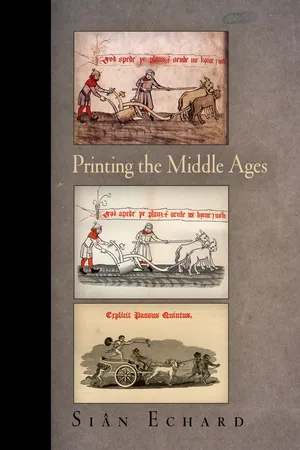
In Printing the Middle Ages Siân Echard looks to the postmedieval, postmanuscript lives of medieval texts, seeking to understand the lasting impact on both the popular and the scholarly imaginations of the physical objects that transmitted the Middle Ages to the English-speaking world. Beneath and behind the foundational works of recovery that established the canon of medieval literature, she argues, was a vast terrain of books, scholarly or popular, grubby or beautiful, widely disseminated or privately printed. By turning to these, we are able to chart the differing reception histories of the literary texts of the British Middle Ages. For Echard, any reading of a medieval text, whether past or present, amateur or academic, floats on the surface of a complex sea of expectations and desires made up of the books that mediate those readings.
Each chapter of Printing the Middle Ages focuses on a central textual object and tells its story in order to reveal the history of its reception and transmission. Moving from the first age of print into the early twenty-first century, Echard examines the special fonts created in the Elizabethan period to reproduce Old English, the hand-drawn facsimiles of the nineteenth century, and today's experiments with the digital reproduction of medieval objects; she explores the illustrations in eighteenth-century versions of Guy of Warwick and Bevis of Hampton; she discusses nineteenth-century children's versions of the Canterbury Tales and the aristocratic transmission history of John Gower's Confessio Amantis; and she touches on fine press printings of Dante, Froissart, and Langland.
eBook - PDF
Printing the Middle Ages
About this book
Information
Publisher
University of Pennsylvania PressYear
2013Print ISBN
9780812240917
9780812240917
eBook ISBN
9780812201840
Table of contents
- Cover
- Title
- Copyright
- Contents
- Preface: The Mark of the Medieval
- A Note on Bibliographic Formats
- Introduction. Plowmen and Pastiche: Representing the Medieval Book
- 1. Form and Rude Letters: The Representation of Old English
- 2. The True History of Sir Guy (and What Happened to Sir Bevis?)
- 3. Aristocratic Antiquaries: Gower on Gower
- 4. Bedtime Chaucer: Juvenile Adaptations and the Medieval Canon
- 5. Froissart's not French (or Flemish): The Travels of a Medieval History
- Coda. The Ghost in the Machine: Digital Avatars of Medieval Manuscripts
- Notes
- Bibliography
- Index
- Acknowledgments
Trusted by 375,005 students
Access to over 1.5 million titles for a fair monthly price.
Study more efficiently using our study tools.
Frequently asked questions
Yes, you can cancel anytime from the Subscription tab in your account settings on the Perlego website. Your subscription will stay active until the end of your current billing period. Learn how to cancel your subscription
No, books cannot be downloaded as external files, such as PDFs, for use outside of Perlego. However, you can download books within the Perlego app for offline reading on mobile or tablet. Learn how to download books offline
Perlego offers two plans: Essential and Complete
- Essential is ideal for learners and professionals who enjoy exploring a wide range of subjects. Access the Essential Library with 800,000+ trusted titles and best-sellers across business, personal growth, and the humanities. Includes unlimited reading time and Standard Read Aloud voice.
- Complete: Perfect for advanced learners and researchers needing full, unrestricted access. Unlock 1.5M+ books across hundreds of subjects, including academic and specialized titles. The Complete Plan also includes advanced features like Premium Read Aloud and Research Assistant.
We are an online textbook subscription service, where you can get access to an entire online library for less than the price of a single book per month. With over 1.5 million books across 990+ topics, we’ve got you covered! Learn about our mission
Look out for the read-aloud symbol on your next book to see if you can listen to it. The read-aloud tool reads text aloud for you, highlighting the text as it is being read. You can pause it, speed it up and slow it down. Learn more about Read Aloud
Yes! You can use the Perlego app on both iOS and Android devices to read anytime, anywhere — even offline. Perfect for commutes or when you’re on the go.
Please note we cannot support devices running on iOS 13 and Android 7 or earlier. Learn more about using the app
Please note we cannot support devices running on iOS 13 and Android 7 or earlier. Learn more about using the app
Yes, you can access Printing the Middle Ages by Siân Echard in PDF and/or ePUB format, as well as other popular books in Literature & Medieval & Early Modern Literary Criticism. We have over 1.5 million books available in our catalogue for you to explore.