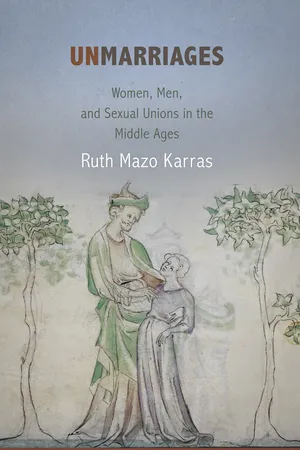
The Middle Ages are often viewed as a repository of tradition, yet what we think of as traditional marriage was far from the only available alternative to the single state in medieval Europe. Many people lived together in long-term, quasimarital heterosexual relationships, unable to marry if one was in holy orders or if the partners were of different religions. Social norms militated against the marriage of master to slave or between individuals of very different classes, or when the couple was so poor that they could not establish an independent household. Such unions, where the protections that medieval law furnished to wives (and their children) were absent, were fraught with danger for women in particular, but they also provided a degree of flexibility and demonstrate the adaptability of social customs in the face of slowly changing religious doctrine. Unmarriages draws on a wide range of sources from across Europe and the entire medieval millennium in order to investigate structures and relations that medieval authors and record keepers did not address directly, either in order to minimize them or because they were so common as not to be worth mentioning. Ruth Mazo Karras pays particular attention to the ways women and men experienced forms of opposite-sex union differently and to the implications for power relations between the genders. She treats legal and theological discussions that applied to all of Europe and presents a vivid series of case studies of how unions operated in specific circumstances to illustrate concretely what we can conclude, how far we can speculate, and what we can never know.
- 296 pages
- English
- ePUB (mobile friendly)
- Available on iOS & Android
eBook - ePub
About this book
Information
Chapter 1

The Church and the Regulation of Unions between Women and Men
The traditions discussed in the Introduction took on new configurations as the Western church claimed control over marriage. The Hebrew Bible allowed one man to have several permanent partners, either several women with full wifely status or one woman as primary and the rest secondary but with all the children having inheritance rights. Ancient Roman law, however, did not: Roman marriage was monogamous, and only the children of a wife could inherit. Prehistoric Germanic forms of union are, as we have seen, very difficult to document, but the evidence points to a pattern more like that of Rome, where one woman and her children were privileged; the idea that there once existed a separate form of full marriage that allowed for the free choice of the parties, not their families, and that was later devalued by the church, is largely a myth.
The standard story that scholars tell about the effects of the church on the formation of legitimate sexual unions is true to this extent: in trying to assert the exclusive legitimacy of marriage, and in doing so claim control over it, the nascent church legal system attempted to assert its authority to draw a sharp line, declaring certain unions to be valid marriages and all others to be invalid, and lumping together all other types of unions. The church did not speak with a unified voice, and in every dispute over the validity of marriage, there were churchmen and laymen on both sides. Whatever side they took in individual cases, however, churchmen tended to devalue any sort of sexual union outside of marriage, both for men and for women, although the weight of tradition and enforcement made this weigh much more heavily on women. This process began in the Christian Roman empire, but the motives behind it were not the same across the medieval millennium, nor were the types of unions that appeared as alternatives. Because a number of other scholars have written in eloquent detail about the history of Christian marriage, this chapter does not attempt a full narrative overview but focuses on those unions that were not considered marriage and the church’s attempts to draw a line.
Late Antique Christianity
Christian views on approved and unapproved sorts of unions as they developed in the late antique period drew heavily on both biblical and Roman law and traditions, but they also brought several innovations. Perhaps surprisingly to us, in light of the relative ease of Roman and Jewish divorce compared with later Christian law, the idea that marriage differed from other unions in its permanence was not the major change. Christian emperors did make it harder for a man to divorce his wife without cause, but although Augustine of Hippo (whose later views on marriage may or may not have been influenced by his earlier experience with the mother of his child, discussed below) argued strongly that even in the case of divorce for cause the parties could not remarry, this did not become entirely accepted in the church until the Carolingian period.1 Rather, the important Christian innovations were the expectation of fidelity on the part of men as well as of women (which is not to say that all Christian men or women lived up to this expectation) and the idea that marriage was now a religious institution, even if it was not yet formally a sacrament. Both these factors worked toward the valorization of marriage as opposed to other types of union. Marriage was no longer mainly an institution for the allying of families and the procreation of heirs, although that remained part of it; it was also the only legitimate outlet for sexual desire and a way for the spouses to participate together in devotion to God.
The ascetic impulse toward the restriction of desire was not unique to Christianity; it was also found in a number of pagan Roman thinkers.2 What was particularly Christian was the idea that the kind of relationship that two laypeople had with each other defined their relationship to God, and that only one form was acceptable. The adoption of a nuptial blessing or other specifically Christian rituals that went along with marriage was part of the new understanding of marriage, although such blessings were not required for a valid marriage.3 Marriage retained an important secular aspect in terms of inheritance rights for the children, however, often involving formal written documentation, and there continued to be tension about whether this was a necessary constitutive element. Probus (r. 276–78) had held that lack of documentation did not invalidate a marriage if the couple were generally held to be married. The emperors Valentinian III (419–55) and Majorian (r. ca. 457–61) legislated that a marriage would not be valid and the children not legitimate without solemnities of marriage or the provision of a dowry, although Theodosius II (401–50) rejected this view for the Eastern empire, sticking with the classical position.4
This spate of marriage legislation spurred by Christian custom had the effect of sharpening the line between marriage and other types of union. With the condemnation of sexual activity in all forms except marriage for men as well as for women in late Roman pagan as well as Christian circles, the difference between marriage and concubinage became not just one of social class but also one of morality, as Augustine’s account quoted below indicates.5 But Christians in late antiquity did not completely condemn concubinage. The Council of Toledo in 400 ruled that a man who had a concubine and not a wife could still take communion within the church, as long as he was faithful to her. Ambrose of Milan (ca. 340–97) condemned married men with concubines and unmarried men who took concubines intending to leave them upon marriage, but not men who kept concubines in lieu of marriage.6 In other words, concubinage, as an exclusive union between a man of higher and a woman of lower status, was recognized as a legal institution by late antique Christian leaders. Yet it was clearly accorded lower status than marriage. In the fifth century, Pope Leo I (440–61) could express the clear view that marriage should be contracted between freeborn people and equals, and a priest could marry his daughter to a man with a concubine without worrying that the bridegroom would be considered already married, unless the concubine was “made freeborn, legitimately endowed, and publicly married.”7 This was, as Judith Evans-Grubbs points out, a view based on “Roman ideas about status and social honor” rather than on Christian views.8
What Christian Europe inherited from the Romans, then, was the idea that an individual could be involved in only one sexual union at a time that could create legitimate heirs, and that that union had to be between partners of equivalent social status. The idea that marriage was the only valid form of union was not part of that legacy (at least not for a man; a woman who entered into a relationship other than marriage, unless with a man of higher status than she, might lose respect and status). As we shall see, some Christians struggled a bit with these ideas, wishing to make of marriage a spiritual joining instead of a property relationship and therefore trying to assimilate other forms of union to it. We turn now to what this might have meant for one particular woman in the later Roman empire, a woman whose name we do not know but who has been immortalized by the writings of her partner. Augustine of Hippo was the church father whose writings most influenced those of medieval authors about marriage and sexuality, particularly important for his emphasis that marriage is a good thing (although not as good as virginity), rather than a lesser evil for people who would otherwise fornicate. Augustine’s account in his Confessions indicates that in his youth, marriage was not expected to be the only union into which an elite man would enter. It also shows us how, in his maturity, he attempted to assimilate a loving and faithful partner to a wife and therefore lend her a respectability that he did not otherwise think she would have.
“With Whom I Was Accustomed to Sleep”: The Anonymous Mother of Adeodatus
Sometime between 370 and 372, when he was between sixteen and eighteen years old and studying in Carthage, Augustine, the future bishop of Hippo, formed a sexual relationship with a woman whom he never named in his Confessions.9 Most translators have inserted the word “mistress” or “concubine” into Augustine’s first mention of her, but in fact he said simply unam habebam, “I had a woman”: “not known in that which is called legitimate marriage, but whom my roaming passion, lacking prudence, had sought out; yet only one, keeping faith to her bed.”10 He later referred to her as “the woman with whom I was accustomed to sleep.”11 They had a son, Adeodatus, and remained together until 385, when Augustine’s mother, Monnica, chose a girl for him to marry. The mother of Adeodatus returned from Milan, where they had been living, to North Africa, where Augustine reported that she took a vow of chastity.12 Augustine never made the marriage; the fiancée whom Monnica chose for him was underage, and before she was old enough to marry, Augustine underwent his conversion and chose celibacy.
We know about the unnamed woman who was Augustine’s long-term partner only from his writing and only in later life, when she was long gone and he had undergone conversion. Scholars have not thought much of her or the relationship. She must, they have assumed, have been a prostitute or an actress, two professions whose practitioners’ sexual reputations might make it difficult for them to marry at all, or of a lower social class such that someone of Augustine’s rank could not legally marry her.13 Augustine described the relationship as being based on lust, both in the passage quoted above and in his description of his actions after the woman returned to Africa, where he described himself as a “slave to lust” who took another concubine. Philip L. Reynolds, taking this description at face value, says: “In Augustine’s eyes, she was not so much a person as an object of carnal desire.”14 But there is no reason why she could not have been both. In Augustine’s view, as he explained in his Confessions, marriage was a treaty (foederatum) for the sake of offspring, whereas the other relationship, while still a pactum, or agreement, was for the sake of lust. Children were unwanted in the latter, although the parents learned to love them once they were born.15 A man who (at the time he wrote) thought all carnal love was sinful lust, excusable only for the sake of creating a legitimate family, was going to have negative things to say about any union with which he was involved that was not marriage, but they did not mean that he did not care about the woman. Augustine wrote, in fact, that his heart was “cut and wounded and bled” when she was “torn from his side,” and that he never got over the pain of the separation, although some recent scholarship has doubted whether all the blame for the tearing belongs to Monnica.16 The tone in which he said that he was unable to emulate his partner’s chastity after their breakup indicates his respect for her.17
In fact, Danuta Shanzer suggests that Augustine may have viewed her as a wife, spiritually if not legally, and that he drew a clear distinction between the long-term concubinage that involved fidelity, and his later, more casual partnership.18 He later wrote in his treatise On the Good of Marriage that if two people were faithful to each other, even if having children was not the purpose of their union, “doubtless without absurdity it can indeed be labeled a marriage.” He went on to suggest that a man who takes such a woman until he finds another “worthy of his status or his wealth whom he can marry as his equal” is an adulterer in his heart—committing adultery with the concubine, not with the potential future wife—but the woman, “should she maintain sexual fidelity with him, and after he takes a wife she gives no thought to marriage herself and steels herself to refrain utterly from such sexual intercourse, I should not perhaps readily presume to call her an adulterer.” Even though she sinned in having sex with him without being married, if she had done so because she wanted children, “she is to be ranked higher than many matrons.” The hypothetical situation he described here seems very similar to the one in which he and his unnamed partner had found themselves.19
Augustine’s unnamed lover cannot have been happy to have been forced to leave her partner of many years and her adolescent son, who remained with his father. The fact that she took a vow (to the God to whom Augustine addresses the Confessions) never to know another man indicates that she was a Christian. Shanzer suggests that she had been one all along, even when Augustine went through his Manichaean phase; the Christian name given to their son might suggest this. It would not be surprising for a Christian woman to have entered into a union of this nature, and she need not have been a slave or prostitute. Shanzer suggests that Augustine’s partner may have been his social equal, someone whom he could conceivably have married, but lower than his mother’s ambition hoped for him. Monnica wanted to wait until he could marry a wife who could help him rise above the provincial petty nobility into which he had been born.20 It is possible that Monnica as a Christian was troubled by the fact that her son had a concubine, but this was so typical of the time for not-yet-married men that scruples about the lack of formalities are not likely to have been the entire reason for her disapproval.21 Shanzer may be right that Augustine could legally, and even socially, have married her. But if Augustine had trouble getting his mother’s permission to marry his partner, surely a woman from his own social class would have equal, if not more, trouble getting her parents’ permission to live with a man outside of “that which is called legitimate marriage,” with no inheritance rights accorded to her children, all the more so if her family were Christian. Most likely, she came from somewhere between the level of the slave or prostitute and the level of Augustine’s family: respectable but not so prosperous. Her family likely calculated that their daughter would be better off as the concubine of this rich young man than as the wife of someone with a less promising future.
Of course, the more respectable her family, the less ch...
Table of contents
- Cover
- Half title
- Title
- Copyright
- Dedication
- Contents
- Introduction: Marriage and Other Unions
- 1. The Church and the Regulation of Unions between Women and Men
- 2. Unequal Unions
- 3. Priests and Their Partners
- 4. On the Margins of Marriage
- Conclusion
- Notes
- Bibliography
- Index
- Acknowledgments
Trusted by 375,005 students
Access to over 1.5 million titles for a fair monthly price.
Study more efficiently using our study tools.
Frequently asked questions
Yes, you can cancel anytime from the Subscription tab in your account settings on the Perlego website. Your subscription will stay active until the end of your current billing period. Learn how to cancel your subscription
No, books cannot be downloaded as external files, such as PDFs, for use outside of Perlego. However, you can download books within the Perlego app for offline reading on mobile or tablet. Learn how to download books offline
Perlego offers two plans: Essential and Complete
- Essential is ideal for learners and professionals who enjoy exploring a wide range of subjects. Access the Essential Library with 800,000+ trusted titles and best-sellers across business, personal growth, and the humanities. Includes unlimited reading time and Standard Read Aloud voice.
- Complete: Perfect for advanced learners and researchers needing full, unrestricted access. Unlock 1.5M+ books across hundreds of subjects, including academic and specialized titles. The Complete Plan also includes advanced features like Premium Read Aloud and Research Assistant.
We are an online textbook subscription service, where you can get access to an entire online library for less than the price of a single book per month. With over 1.5 million books across 990+ topics, we’ve got you covered! Learn about our mission
Look out for the read-aloud symbol on your next book to see if you can listen to it. The read-aloud tool reads text aloud for you, highlighting the text as it is being read. You can pause it, speed it up and slow it down. Learn more about Read Aloud
Yes! You can use the Perlego app on both iOS and Android devices to read anytime, anywhere — even offline. Perfect for commutes or when you’re on the go.
Please note we cannot support devices running on iOS 13 and Android 7 or earlier. Learn more about using the app
Please note we cannot support devices running on iOS 13 and Android 7 or earlier. Learn more about using the app
Yes, you can access Unmarriages by Ruth Mazo Karras in PDF and/or ePUB format, as well as other popular books in History & European Medieval History. We have over 1.5 million books available in our catalogue for you to explore.