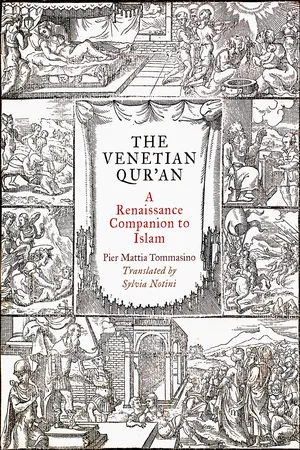
An anonymous book appeared in Venice in 1547 titled L'Alcorano di Macometto, and, according to the title page, it contained "the doctrine, life, customs, and laws [of Mohammed] . . . newly translated from Arabic into the Italian language." Were this true, L'Alcorano di Macometto would have been the first printed direct translation of the Qur'an in a European vernacular language. The truth, however, was otherwise. As soon became clear, the Qur'anic sections of the book—about half the volume—were in fact translations of a twelfth-century Latin translation that had appeared in print in Basel in 1543. The other half included commentary that balanced anti-Islamic rhetoric with new interpretations of Muhammad's life and political role in pre-Islamic Arabia. Despite having been discredited almost immediately, the Alcorano was affordable, accessible, and widely distributed.
In The Venetian Qur'an, Pier Mattia Tommasino uncovers the volume's mysterious origins, its previously unidentified author, and its broad, lasting influence. L'Alcorano di Macometto, Tommasino argues, served a dual purpose: it was a book for European refugees looking to relocate in the Ottoman Empire, as well as a general Renaissance reader's guide to Islamic history and stories. The book's translation and commentary were prepared by an unknown young scholar, Giovanni Battista Castrodardo, a complex and intellectually accomplished man, whose commentary in L'Alcorano di Macometto bridges Muhammad's biography and the text of the Qur'an with Machiavelli's The Prince and Dante's Divine Comedy. In the years following the publication of L'Alcorano di Macometto, the book was dismissed by Arabists and banned by the Catholic Church. It was also, however, translated into German, Hebrew, and Spanish and read by an extended lineage of missionaries, rabbis, renegades, and iconoclasts, including such figures as the miller Menocchio, Joseph Justus Scaliger, and Montesquieu. Through meticulous research and literary analysis, The Venetian Qur'an reveals the history and legacy of a fascinating historical and scholarly document.
- 320 pages
- English
- ePUB (mobile friendly)
- Available on iOS & Android
eBook - ePub
About this book
Information
Publisher
University of Pennsylvania PressYear
2018Print ISBN
9780812250121
9780812250121
eBook ISBN
9780812294972
Topic
StoriaCHAPTER 1
The Misfortune of a Translation
J. J. SCALIGER AND THE CHARCOAL
In the fall of 1576 the French humanist Joseph Justus Scaliger (1540–1606) was desperately trying to locate a book. He was looking for the Alcorano di Macometto, printed in Venice in 1547 by the publisher and bookseller Andrea Arrivabene. Although Arrivabene claimed on the frontispiece of the sought-after book that the text of the Qur’an was translated from Arabic into Italian, the Qur’an had rather been translated from Latin. Most importantly, this book was neither just a translation of the Qur’an into the vernacular nor exclusively a work of anti-Islamic polemic. Dedicated to Gabriel de Luetz, Baron of Aramon, the fourth French ambassador to the Ottoman Empire (1547–1553), the Alcorano di Macometto was, rather, a new and handy companion to Islam and the Ottoman Empire, and the first printed translation of the Qur’an into a European vernacular language.1
Arrivabene printed the book in Italian and in quarto format. In doing so, he gave readers a more accessible version than the Latin encyclopedia of Islam that appeared in Basel in 1543. There, Johann Oporinus (1507–68) and Theodor Bibliander (1509–64), after a long battle against the Swiss authorities, published the twelfth-century Corpus islamolatinum in folio, including in it a selection of medieval and contemporary texts about and against Islam.2
Scaliger, however, was eager to read the new Italian translation of the Qur’an, published in the second half of Arrivabene’s 1547 book. And to find it, he made use of his broad network across the Republic of Letters, contacting booksellers in Venice and northern Europe, and bothering his friends and correspondents with insistent requests. That fall, Scaliger was in Poitier, where he took shelter for the coldest months of the year, though he disdained the cultural isolation of the city and deemed its magistrates as being “enemies of all virtue.” From Poitier, he wrote twice to the Parisian jurist and bibliophile Claude Dupuy (1545–94).3 The first time, on September 25, he beseeched Dupuy to search for the Alcorano everywhere, whether in Paris or Venice, conveniently overlooking the fact that the Venetian lagoon was in the grips of the plague. He wanted to get his hands on that rarity, on that new and precious translation of the Qur’an based, from what he understood, on the Arabic text and published, he thought, around 1526–27. Before sealing his letter, Scaliger also promised to diligently return the book after three months.
Some time later, on December 18, while he was correcting his edition of the Latin elegiac poets to be published by Mamert Patisson (d. 1600), Scaliger wrote to Dupuy again, this time with greater insistence. He no longer expressed shame or humility in imploring him to find the Alcorano di Macometto. To Scaliger, it was impossible that not a single copy was to be had in any of the Paris libraries. After all, Patisson himself had informed him of the presence of the book in Sens (Burgundy), not far from the capital. Scaliger also added that for a long time he had been thinking of nothing else, and that it was hard for him to even imagine receiving any book that he would appreciate more.4
Almost two months later, Scaliger received a copy of the book. But the text he had been so anxious to read proved to be a great disappointment. On February 12, writing once more to Dupuy he complained, “I have received the Qur’an in Italian, but it is no more than ἄνθρακεζ θησαυρόζ [ánthrakes thesaurós]. Indeed, it is not translated from the Arabic, but from the Latin, and literally so. And whoever it was that translated it from the Latin, when Saint Bernard was at the Council of Toledo, did not understand any more of it than I myself would be able to.”5
Scaliger used a Greek motto to express his frustration: ἄνθρακεζ ὁ θησαυρόζ (ánthrakes ó thesaurós), which we might translate as “our treasure is all turned to coal” or, even better, “a treasure gone up in smoke.” The Greek satirist Lucian of Samosata used this motto several times in his dialogues. He quoted it in the Zeuxis as well as in Hermotimus or Concerning the Sects: in this text the old Stoic philosopher Hermotimus, after his lengthy dialogue with Lycinus on the philosophical schools, was as disappointed as Scaliger was before a book he had been so anxious to read, but in which he did not find the treasure he had expected. Likewise, Scaliger was anticipating a treasure, but he found the book delivered as much satisfaction as would a few lumps of charcoal: that is to say, an abridged and inaccurate translation of the Qur’an, taken from the Latin version by Robert of Ketton (1143).6
But why was Scaliger so disappointed? And to what extent is his frustration of interest to us? To understand Scaliger’s discontent we should recall that his interests were above all linguistic. He considered the Qur’an to be a primary source for the study of Arabic, and a new translation into Italian, into the language that had been his father’s, and that was the most widespread after Latin across Europe and the Mediterranean, might certainly have come in handy. This approach harked back to a long European tradition, closely linked to biblical exegesis, which Scaliger had access to through the teachings of the French Orientalist Guillaume Postel (1510–81).
Recent scholarship has shown that the study of Arabic was part of higher humanistic education. The Italian scholar Angelo Michele Piemontese suggested that the collegium pentalingue (Latin, Greek, Hebrew, Arabic, and Chaldean), instead of merely the collegium trilingue (Latin, Greek, Hebrew), was the ideal language requirement in the formation of the perfect scholar—and the perfect library—during the Renaissance.7
The most prominent example of this tradition was Giovanni Pico della Mirandola (1463–1494), a model for all of Europe. British-born Robert Wakefield (d. 1537), for example, in his Oratio de laudibus et utilitate trium linguarum arabicae chaldaicae et hebraicae (Oration on the Praises and Benefits of the Three Languages, Arabic, Chaldean and Hebrew), published in London in 1524, suggested Saint Jerome as the example to be emulated in the linguistic pentad: “divus ille πεντάγλωττοζ Hyeronimus.” But when Wakefield described the virtues of the diplomat and humanist Richard Pace (c. 1482–1536), he compared Pace to Giovanni Pico. According to Wakefield, Pace was “certainly not inferior to the prince Pico in the study of the five main languages.” Pico personified the perfect humanist who mastered the five languages of antiquity and late antiquity: Latin, Greek, Hebrew, Arabic, and Chaldean. During the sixteenth century the collegium pentalingue spread far beyond the boundaries of Renaissance linguistics. The perfect condottiere, the perfect physician, the perfect historian had to master the five languages. Martin Crusius (1526–1607), following Paolo Giovio, described Sultan Mehmet II as a multilingual military captain and patron: “he knew Arabic, Persian, Chaldean, Latin and Greek.” In The Secrets of Alexis of Piedmont, Girolamo Ruscelli of Viterbo (d. 1566) presented himself, under the pseudonym of Alexis of Piedmont, as the ideal physician who mastered the five languages: “I have studied Letters in Latin, Greek, Hebrew, Chaldean, Arabic and in the languages of many other countries.” In a Spanish book on the Ottoman Empire, published the same year as the Alcorano di Macometto (1547), the author, who mainly used Italian sources, feigned access to a historiographical corpus in five languages: “we gathered together many opinions about the fierce nation of the Turks, from Latin and Greek historians, as well as from the ones who wrote in Chaldean, Hebrew and Arabic.”8
A book intended for wide circulation, a translation of a translation, could not possibly have satisfied the needs of a refined linguist such as Scaliger. Though similar in its use of the sources and subjects, the Alcorano di Macometto is distant from sixteenth-century erudite multilingualism both in inspiration and design. It had been conceived for a broad public, both Italian and European, and the author’s intended readership included religious dissidents and political exiles, orthodox polemicists and diplomats traveling to the Ottoman Empire, as well as curious readers who simply wished to be entertained.
A part of this study, therefore, will challenge the research conducted by the Italian historian Carlo De Frede, and be concerned with recontextualizing the Alcorano in Arrivabene’s catalog of history books, as well as within its commercial, religious, and political Venetian milieu.9 That context was greatly influenced by the revolutionary ambitions of Venetian nonconformist circles, as well as by the ideas promoted by the Padua-based Academy of the Infiammati, especially by those of Sperone Speroni (1500–1588) and Alessandro Piccolomini (1508–78). Mindful of the imperatives of the publishing industry, these scholars focused on the need for and cultural dignity of the Italian language and the need for the translation into the vernacular, by displaying a certain mind-set against the study of ancient and especially Oriental languages.
Piccolomini was an acquataince of Andrea Arrivebene. Though aware of the fact that relatively recently it had been considered important to learn ancient and Oriental languages “such as Greek, Chaldean, Arabic, Hebrew, Latin and the like,” in his treatise De la institutione di tutta la vita de l’homo (On the Life-Long Education of a Man) (1542), Piccolomini now clearly discouraged the study of Arabic and Hebrew. This reflected concern that the loss in time would have been far greater than the gains from the additional effort. Furthermore, the major works written in those languages were already available in Latin. This idea was also upheld by Girolamo Ruscelli, who had been active in Arrivabene’s enterprise for many years, and who staunchly defended the dignity of Italian. In dedicating a collection of letters to Tommaso de’ Marini in June 1556, Ruscelli expressed the hope that “this beautiful language of ours” could be “extended to the entire world,” and stressed the fact that “at present, there is hardly an author left, whether Greek, Arabic, or Latin, who is unknown to us, thanks to the diligence and honorable toils of many clever minds.”10
Scaliger’s frustration, and hence the sharp criticism by European Orientalists of the Alcorano di Macometto, was essentially the result of a clash between opposing cultural interests. On one side was the proto-Orientalist European erudition that went back, by way of the Medicean Rome of Giles of Viterbo and Leo Africanus, to Giovanni Pico and to his teacher of Oriental languages, Guglielmo Raimondo Moncada alias Flavius Mithridates. On the other was the flourishing Venetian book market and the great diffusion of translations into the vernacular during the early 1540s.11
During those years, Sperone Speroni’s advice in his Dialogo delle lingue (Dialogue of Languages) (1542) regarding the need to “translate every book of every science” really seemed to have been accomplished and perhaps surpassed. A legion of young printers, editors, translators, and polygraphs arrived in Venice. Those years registered a massive spread of nonconformist religious literature, of translations of the Bible, and of classical and humanistic historiography. Any book could have been translated and printed in Venice in the early 1540s, even the sacred book of Islam.
The Alcorano di Macometto is therefore a product that gathers together old medieval Latin translations from Arabic and new texts about Islam, which had reached Venice from both the western and eastern Muslim Mediterranean. But it is also a product that reflects the Italian political context prior to the Council of Trent. The first half of the 1540s were, in fact, still filled with great expectations of moral, political, and religious renewal and precisely 1547, the year of the Battle of Mülberg and that the Alcorano was published, was a turning point that would mark the history of Qur’anic translations in Italy, as well as the lives of the many individuals who were involved in this edition.
To view this translation from a broader perspective, we ought to at least recall other experiences in translating religious texts within and across religious communities. Besides the Bible translations in Christian Europe, we should take into account the Spanish translations of the Ferrara Bible (1553) addressed to a public of Marranos, the Pentateuch of Constantinople translated in Ladino in 1547, and the process of translating the Qur’an and its commentaries that involved the Moriscos in the Iberian Peninsula and in the Ottoman diaspora, both before and after the Expulsion (1609). Iberian Muslims translated the Qur’an into Spanish vernaculars for Muslim readers who had lost or were forced to abandon the use of Arabic. Moriscos had to follow new strategies to legitimize their linguistic choice. If God’s language, Arabic, was to be lost or abandoned the language of believers could be adopted instead. In this regard, the Moriscos’ strategies resemble those adopted in non-Arabic-speaking Muslim territories like Persia. For instance, ‘Īsā ibn Ǧābir alias Yça Gidelli justified his choices, as early as in 1462 in his Breviario Sunni, as follows: “people who know about Religion should teach using the language that other people could understand.” Even more interesting is the tradition (ḥadīth), on which the copyist, and possibly the translator into Spanish, of the so-called Qur’an of Toledo (1606) founded his work: “the prophet Muhammad said that the best language is the one that people understand.”12
At any rate, the Greek motto chosen by Scaliger effectively sums up the fading of his hopes, like those of many later European Orientalists in reading the Alcorano di Macometto. These hopes were stoked much like a fire by the publishing formula that Arrivabene included on the title page: “Newly translated from Arabic into the Italian tongue.” The formula turned the Alcorano di Macometto into one of the most hotly debated editions, and least studied ones, in terms of its genesis and diffusion, among all sixteenth-century Venetian publications. Those few words, in fact, decontextualized from the contemporary publishing usage, have aroused and disappointed the curiosity of European proto-Orientalists and modern scholars of Oriental languages over the centuries, just as they have rejected, albeit with a few excellent exceptions, the efforts of the historians of early modern Europe, who mostly relegated Arrivabene’s companion to the margins of their discipline.
Scaliger’s few words were followed by the growth of an opinion that, when cyclically repeated among Orientalists, was transformed over the centuries into a condemnation, a critical oblivion that can be summed up as follows: the Alcorano di Macometto is nothing but an awkward translation of the Latin Qur’an by Robert of Ketton (1143) printed by Bibliander (1543). And, worse, by declaring that he had had the Qur’an translated from the Arabic, Arrivabene was nothing more than a cunning and ruthless entrepreneur, an astute publisher who preached falsehoods on his title pages.
Once it had been revealed that the Italian companion was dependent on the Latin encyclopedia edited by Bibliander, the Alcorano was then dismissed as mere plagiarism, over the centuries becoming no more than a bibliographic curiosity unworthy of in-depth analysis. Indeed, this critical censure was based on the very myth of the book’s rarity, which, starting from the eighteenth century, leapt from one bibliographic repertoire to another (“editio perrara,” “fort rare et recherchée,” “libro assai raro,” “veramente raro,” “libro rarissimo,” etc.). Thus, it led to the absence of the verification of its actual or, at least, likely diffusion through necessary bibliographical research of European and international breadth. Hence, the critical approach to the book was marked from the outset by two partial and rather shallow truths: its rarity and the poor quality of the Qur’anic translation.
JOHN SELDEN AND THE “ITALIAN IMPOSTOR”
After Scaliger’s criticism of the Alcorano, the opinion held by European Orientalists did not change. Actually, the cloud of smoke surrounding the genesis and the nature of the book grew thicker and thicker. The Englishman John Selden (1584–1654) contributed a great deal to this. In addition to a manuscript by Robert of Ketton and an exemplar of Bibliander’s encyclopedia, Selden owned, and quickly commented on, the Alcorano di Macometto as well. In 1631 and again in 1640...
Table of contents
- Cover
- Half title
- Title
- Copyright
- Contents
- Preface
- 1. The Misfortune of a Translation
- 2. The Material Text: Three States, One Edition, a History Book
- 3. “What Everybody Wishes for and Keeps Silent”: Analysis of the Context Through the Paratext
- 4. “And He Translated the Alcorano in the Vulgar Tongue”: Giovanni Battista Castrodardo, Translator of the Alcorano di Macometto
- 5. The Iberian and Italian Mi‘rāǧ by Giovanni Battista Castrodardo: An Unknown Dante Scholar and Muhammad’s Ascension into Heaven
- 6. The Religion of the Italians, or Purgatory and the Qur’an: A Belief and a Place Between Robert of Ketton and Roberto Bellarmino
- 7. Scribendae Historiae Gratia: The Oration of Sergius the Monk to the Prophet Muhammad
- 8. Reading and Rewriting the Alcorano di Macometto: Francesco Sansovino Between the Historie Universali and the Selve
- 9. A Cheese Maker from Lucca and a Miller from Friuli
- 10. The Fortune of the Alcorano di Macometto and a Conclusion
- Appendix
- Notes
- Bibliography
- Index of Names
- Acknowledgments
Trusted by 375,005 students
Access to over 1.5 million titles for a fair monthly price.
Study more efficiently using our study tools.
Frequently asked questions
Yes, you can cancel anytime from the Subscription tab in your account settings on the Perlego website. Your subscription will stay active until the end of your current billing period. Learn how to cancel your subscription
No, books cannot be downloaded as external files, such as PDFs, for use outside of Perlego. However, you can download books within the Perlego app for offline reading on mobile or tablet. Learn how to download books offline
Perlego offers two plans: Essential and Complete
- Essential is ideal for learners and professionals who enjoy exploring a wide range of subjects. Access the Essential Library with 800,000+ trusted titles and best-sellers across business, personal growth, and the humanities. Includes unlimited reading time and Standard Read Aloud voice.
- Complete: Perfect for advanced learners and researchers needing full, unrestricted access. Unlock 1.5M+ books across hundreds of subjects, including academic and specialized titles. The Complete Plan also includes advanced features like Premium Read Aloud and Research Assistant.
We are an online textbook subscription service, where you can get access to an entire online library for less than the price of a single book per month. With over 1.5 million books across 990+ topics, we’ve got you covered! Learn about our mission
Look out for the read-aloud symbol on your next book to see if you can listen to it. The read-aloud tool reads text aloud for you, highlighting the text as it is being read. You can pause it, speed it up and slow it down. Learn more about Read Aloud
Yes! You can use the Perlego app on both iOS and Android devices to read anytime, anywhere — even offline. Perfect for commutes or when you’re on the go.
Please note we cannot support devices running on iOS 13 and Android 7 or earlier. Learn more about using the app
Please note we cannot support devices running on iOS 13 and Android 7 or earlier. Learn more about using the app
Yes, you can access The Venetian Qur'an by Pier Mattia Tommasino, Sylvia Notini in PDF and/or ePUB format, as well as other popular books in Storia & Storia dell'Europa rinascimentale. We have over 1.5 million books available in our catalogue for you to explore.