Throughout the twentieth century, African Americans challenged segregation at amusement parks, swimming pools, and skating rinks not only in pursuit of pleasure but as part of a wider struggle for racial equality. Well before the Montgomery bus boycott, mothers led their children into segregated amusement parks, teenagers congregated at forbidden swimming pools, and church groups picnicked at white-only parks. But too often white mobs attacked those who dared to transgress racial norms. In Race, Riots, and Roller Coasters, Victoria W. Wolcott tells the story of this battle for access to leisure space in cities all over the United States.
Contradicting the nostalgic image of urban leisure venues as democratic spaces, Wolcott reveals that racial segregation was crucial to their appeal. Parks, pools, and playgrounds offered city dwellers room to exercise, relax, and escape urban cares. These gathering spots also gave young people the opportunity to mingle, flirt, and dance. As cities grew more diverse, these social forms of fun prompted white insistence on racially exclusive recreation. Wolcott shows how black activists and ordinary people fought such infringements on their right to access public leisure. In the face of violence and intimidation, they swam at white-only beaches, boycotted discriminatory roller rinks, and picketed Jim Crow amusement parks. When African Americans demanded inclusive public recreational facilities, white consumers abandoned those places. Many parks closed or privatized within a decade of desegregation. Wolcott's book tracks the decline of the urban amusement park and the simultaneous rise of the suburban theme park, reframing these shifts within the civil rights context.
Filled with detailed accounts and powerful insights, Race, Riots, and Roller Coasters brings to light overlooked aspects of conflicts over public accommodations. This eloquent history demonstrates the significance of leisure in American race relations.

eBook - ePub
Race, Riots, and Roller Coasters
The Struggle over Segregated Recreation in America
- 320 pages
- English
- ePUB (mobile friendly)
- Available on iOS & Android
eBook - ePub
Race, Riots, and Roller Coasters
The Struggle over Segregated Recreation in America
About this book
Information
CHAPTER 1
A Tarnished Golden Age: Race and Recreation Before World War II
In 1924, when the educator and social activist Dorothy Height was twelve years old, she decided to learn how to swim. Height and a few friends traveled to Pittsburgh’s downtown YWCA and approached the front desk. The receptionist told them simply, “Negro girls [cannot] swim in the YWCA pool.” “The YWCA’s discrimination seemed small and petty,” remembered Height, “but it struck a painful chord that reverberated in each of us long afterward.” She never did learn to swim, but she later worked to desegregate all YWCA facilities nationwide and in 1965 ran their newly established Office of Racial Justice.1 Countless activists across the country echo Height’s early experience of recreational segregation. A young Livingston Johnson, who was a leading activist in 1960s Pittsburgh, recalled being thrown out of a local roller-skating rink in the 1930s. “The ticket taker told me, ‘get out of here; these people will kill you.’ I got out.”2 Johnson identified this incident as the inspiration for his later civil rights work in the city. As these anecdotes suggest, recreational segregation was particularly cruel to children, who would harbor the memories of exclusion throughout their lives. As these children grew up, many used such memories to fuel their passion for racial justice. The experiences of Height and Johnson in prewar Pittsburgh also illustrate the kinds of racial barriers erected by recreational facilities, from the YWCA’s institutional policy of exclusion to the violence meted out by rowdy whites at a local skating rink.
A utopian vision of urban life might center on public amusements. Crowds of immigrants and native-born Americans, men and women, working and middle classes, young and old, cavorting together at an amusement park or beach suggests democratic promise and urban vitality. Nostalgia for such scenes is prevalent in the twenty-first-century reality of privatized leisure and urban decline. Boarded-up and abandoned amusement parks and boardwalks in Atlantic City, Coney Island, and countless other resorts have become central images in our national declension narrative of neglected cities. But what we have lost was always an illusion; democracy was premised on racial exclusion. The amusement park was never, as suggested by the historian Judith Adams, “a perfect embodiment of the American spirit.”3 Nevertheless, the allure of public leisure was understood by all Americans, across racial and class lines. African Americans, believing in the promise of democratic space, resisted their exclusion from recreation. It was this resistance, rather than the illusory idea of a vibrant and open recreational culture, that might define the early twentieth century as a “golden age” of public leisure. But it was a golden age that was tarnished because white violence and institutional policies supporting recreational segregation undercut black resistance. 4 White owners and customers believed recreation could be kept virtuous and safe by excluding African Americans and promoting a sanitized vision of white leisure.
In the late nineteenth century modest picnic grounds and religious camps on the outskirts of major northern cities proved irresistible to entrepreneurs seeking to capitalize on the success of the Chicago World’s Fair and Coney Island—pioneers in the area of commercial recreation. Private companies running electric trolley lines built amusement parks around these picnic grounds to lure riders and increase profits. Steamboat operators on the Great Lakes and Midwest rivers also capitalized on the new fascination for parks, beaches, and boardwalks.5 Cincinnati now had its own Coney Island, Cleveland had Euclid Beach, New Jersey had Palisades Park, Youngstown had Idora Park, and Pittsburgh had Kennywood Park. Most major northern cities boasted large trolley parks by 1910, and a handful of southern cities, such as Ashland, West Virginia, where Camden Park was located, followed suit. Americans, blessed with increased leisure time, now routinely traveled by trolley, train, or boat to swim, dance, and risk the new mechanical rides. But this physical movement immediately raised issues of exclusion. Indeed, the legal foundation of segregation, the 1896 Supreme Court decision Plessy v. Ferguson, emerged from white resentment of elite Louisiana blacks who regularly traveled by train from New Orleans to Gulf Coast resorts.6 In this decision the relationship between segregation and violence emerged as a central tenet of the “separate but equal” doctrine.
While the majority of the justices argued that segregation would maintain social order, Justice John Marshall Harlan, in the lone dissent, wrote that segregation “can have no other result than to render permanent peace impossible, and to keep alive a conflict of races, the continuance of which must do harm to all concerned.”7 For Harlan, segregation incited violence rather than preventing it, but this argument would find little support in legal circles until after World War II. By the 1940s the question of whether individual rights usurped the quest for public order was at the center of legal struggles over segregation. Did preventing violence require the separation of the races? Many lawyers and judges suggested it did. Arguing before the Maryland court in 1952 that Baltimore’s beaches and swimming pools should remain segregated, the city solicitor stated, “I think one of the greatest objectives is to keep order and prevent riots. It is better for public safety in any activity involving physical contact that the races be separated.”8 But this widely held belief that segregation in public accommodations was necessary for public order was not inevitable or maintained equally across the nation. Nevertheless, by the mid-twentieth century, the threat of violence shaped arguments both for and against segregated recreation.
Patterns of racial segregation in parks, beaches, and roller rinks were more complex and less bounded by law than most Americans recognize. The 1875 Civil Rights Act included a provision requiring equal access to public accommodations, but the Civil Rights Cases in 1883 undermined the ability of courts to force private individuals or businesses to end discrimination. Such forms of discrimination, the court ruled, were not “state action” covered by the Fourteenth Amendment. In response, eighteen northern and border states passed civil rights laws that banned racial discrimination in public amusements.9 Meanwhile the Civil Rights Cases and the Plessy decision unleashed a torrent of southern legislation explicitly segregating public accommodations. These laws suggest a strict binary—southern codification of segregation versus northern informal practices of segregation—most commonly referred to as de jure versus de facto segregation. This dichotomy has oversimplified our geographic and chronological understanding of recreational segregation from its outset.
Prior to the codification of segregation in the 1890s the South and North practiced very similar forms of de facto segregation in places of amusement. Starting with C. Vann Woodward’s foundational 1955 work, The Strange Career of Jim Crow, numerous scholars have detailed how segregation was not the “natural” outcome of previous racial practices but a campaign of white supremacy and terror that reached its height at the turn of the twentieth century.10 Howard Rabinowitz’s revision of Woodward’s thesis—that segregation replaced total exclusion from some public accommodations and therefore represented an incremental improvement for southern blacks—is particularly persuasive in the area of urban recreation. City officials often excluded blacks from parks and pools, sites fraught with tension, prior to the 1890s. Leon Litwack argues, “The expansion of recreation in the late nineteenth century mandated exclusion of blacks from most amusement parks, roller skating rinks, bowling alleys, swimming pools, and tennis courts.”11 In addition, these sites of commercial recreation were usually heterosocial, where men and women met for leisure and relaxation. This gender mixing immediately raised the specter of miscegenation, as leisure suggested physical intimacy. As Edward Ayers points out, “the history of segregation shows a clear connection to gender: the more closely linked to sexuality, the more likely was a place to be segregated.”12 Therefore, even before codification of Jim Crow in the 1890s, whites were more likely to enforce racial separation in recreational spaces than anywhere else.
Unlike public parks and picnic grounds, which had existed for decades and where there was some interracial mixing in the Reconstruction period, commercial recreation reached its height at the same time as statutory Jim Crow. Therefore, there was no historical memory of interracial contact in skating rinks and amusement parks. Like segregation itself, commercial amusements were modern institutions that came of age in the 1890s.13 Because they were concentrated in towns and cities, they also reflected a reorganization of urban space, a geography of leisure. Central to this geography was consumption, and in sites where leisure was consumed actively and men and women mixed, segregation invariably followed. In the South this practice was more immediately evident, with “Whites Only” signs and state laws underlying the racialization of space. Nevertheless, in the urban North, where commercial recreation was exploding in popularity by 1900, civil rights laws were generally unenforced before the 1940s. State legislatures passed these statutes to appease black voters, but white opinion was deeply opposed to “social equality.”14 Even when civil rights laws were enforced, penalties for violating them were minimal. In 1885 a series of cases won by African Americans protesting racial discrimination in roller-skating rinks in Cleveland, for example, resulted in awards ranging from one cent to fifty cents.15 More typical was the lawsuit filed in 1900 by an African American man denied entry into a dancing pavilion at Idora Park in Youngstown, Ohio. In this case the Court of Common Pleas ruled that it was not a “public resort” and therefore not subject to civil rights statutes.16 On the issue of recreation the nation was relatively united at the turn of the century. Racial mixing at amusement parks, beaches, roller rinks, and swimming pools proclaimed full social equality. And a white public newly entranced by commercial amusements would not tolerate the presence of African Americans in these spaces.
African American sociologists and scholars writing about black life in the first half of the twentieth century noted the pervasiveness of recreational segregation. Particularly in the era of the first Great Migration, during the late 1910s and into the 1920s, black scholars and migrants catalogued regional differences around segregation. For them the simplistic de jure versus de facto dichotomy never fully described either southern or northern urban life. Rather, the lived experience of mobility, violence, and the elusive term “freedom” mapped their world. The integrated train and streetcar became a central image of a loosening of segregation’s ties in the urban North. The segregated amusement park and swimming pool, in contrast, reflected segregation’s persistence. Forrester B. Washington, a prominent reformer in the National Urban League, was typical in his focus on the “problem” of recreation for racial uplift ideologues concerned about the respectability of migrants. Washington lamented that the migrant has “found the wholesome agencies of recreation either closed or closing to him, while at the same time the agencies of commercialized vice have welcomed him with open arms.”17 Ordinary migrants were less concerned with the dangers of vice but were equally incensed by the pervasiveness of segregated recreation documented by Washington. In seventeen southern cities Washington found there was “complete segregation” of all playgrounds, parks, bathing beaches, and swimming pools. Of the forty remaining cities in his study, all segregated their bathing beaches and only three reported no segregation in swimming pools. Playgrounds and parks, in contrast, were not formally segregated in the North. Commercial recreation followed a similar pattern: southern cities segregated amusement parks and movie theaters entirely, while owners of private amusements in other cities dictated some segregation.18
The difference was one of degree. A swimming pool in Richmond, private or public, was a whites-only facility. A similar pool in Pittsburgh might allow African Americans to enter on allotted times or days, often a Monday. In the case of amusement parks, the policies in cities throughout the country were similar. Park owners gave African Americans the opportunity to use the park on “off days,” often at the beginning or end of the season when the weather was less agreeable. In some cases this was only once a year, as in Lakewood Park in Atlanta or Idora Park in Youngstown.19 In other cases it was once a week, as in Bob-Lo Island outside Detroit, or on alternate days, as in Hot Springs, Arkansas.20 Parallel policies existed for golf courses, bowling alleys, and roller rinks—few were entirely integrated, but on particular days African Americans could gain entrance. In response some African American entrepreneurs opened black-only amusement parks, rinks, or pools. Norfolk, Virginia, alone boasted two black parks in the 1920s, and black-owned and -managed amusement parks were located in Joplin, Missouri, Lexington, Kentucky, Washington, D.C., Baltimore, Birmingham, Atlanta, and Macon, Georgia.21 In Nashville, Tennessee Preston Taylor, a wealthy funeral director, opened Greenwood Park for local blacks, complete with a skating rink and amusement hall.22 And in Kansas City, Missouri, African Americans opened Lincoln Electric Park as an alternative to the segregated Electric Park.23 These were often precarious enterprises, but they offered safe spaces for black consumers to picnic, dance, and play without fear of confrontation with white customers or hired guards. They also demonstrated African Americans’ full engagement with the world of commercial amusements that defined urban America in the early twentieth century. The creation of separate spaces was a strategy of resistance that refuted white assumptions that blacks were not worthy of such amusements.
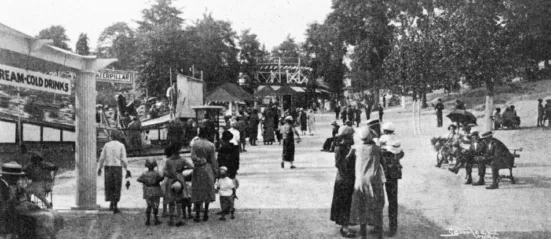
Figure 1. African Americans strolling in Suburban Gardens. This black park offered African Americans rides, picnic grounds, and other amenities denied to them in white facilities. William H. Jones, Recreation and Amusement Among Negroes in Washington, D.C. (Washington, D.C.: Howard University Press, 1927), 101.
The landscape of segregated amusements in the North and South did reflect the regions’ different legal structures. Rather than a “Whites Only” sign, the universal symbol of Jim Crow, a northern migrant would often encounter a “Members Only” sign.24 In order to circumvent the civil rights laws of the late nineteenth century and prevent lawsuits from black consumers, white owners created fictitious “clubs” at thei...
Table of contents
- Cover
- Title
- Copyright
- Contents
- Introduction
- 1. A Tarnished Golden Age: Race and Recreation Before World War II
- 2. The Fifth Freedom: Racial Liberalism, Nonviolence, and Recreation Riots in the 1940s
- 3. “A Northern City with a Southern Exposure”: Challenging Recreational Segregation in the 1950s
- 4. Violence in the City of Good Neighbors: Delinquency and Consumer Rights in the Postwar City
- 5. Building a National Movement: Students Confront Recreational Segregation
- 6. “Riotland”: Race and the Decline of Urban Amusements
- Conclusion
- Notes
- Index
- Acknowledgments
Trusted by 375,005 students
Access to over 1.5 million titles for a fair monthly price.
Study more efficiently using our study tools.
Frequently asked questions
Yes, you can cancel anytime from the Subscription tab in your account settings on the Perlego website. Your subscription will stay active until the end of your current billing period. Learn how to cancel your subscription
No, books cannot be downloaded as external files, such as PDFs, for use outside of Perlego. However, you can download books within the Perlego app for offline reading on mobile or tablet. Learn how to download books offline
Perlego offers two plans: Essential and Complete
- Essential is ideal for learners and professionals who enjoy exploring a wide range of subjects. Access the Essential Library with 800,000+ trusted titles and best-sellers across business, personal growth, and the humanities. Includes unlimited reading time and Standard Read Aloud voice.
- Complete: Perfect for advanced learners and researchers needing full, unrestricted access. Unlock 1.5M+ books across hundreds of subjects, including academic and specialized titles. The Complete Plan also includes advanced features like Premium Read Aloud and Research Assistant.
We are an online textbook subscription service, where you can get access to an entire online library for less than the price of a single book per month. With over 1.5 million books across 990+ topics, we’ve got you covered! Learn about our mission
Look out for the read-aloud symbol on your next book to see if you can listen to it. The read-aloud tool reads text aloud for you, highlighting the text as it is being read. You can pause it, speed it up and slow it down. Learn more about Read Aloud
Yes! You can use the Perlego app on both iOS and Android devices to read anytime, anywhere — even offline. Perfect for commutes or when you’re on the go.
Please note we cannot support devices running on iOS 13 and Android 7 or earlier. Learn more about using the app
Please note we cannot support devices running on iOS 13 and Android 7 or earlier. Learn more about using the app
Yes, you can access Race, Riots, and Roller Coasters by Victoria W. Wolcott in PDF and/or ePUB format, as well as other popular books in History & North American History. We have over 1.5 million books available in our catalogue for you to explore.