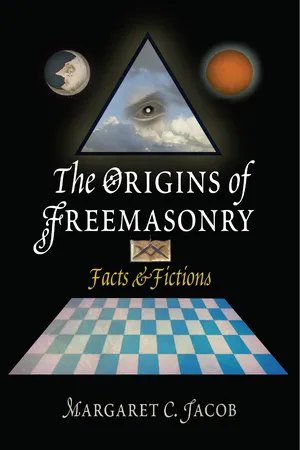
Can the ancestry of freemasonry really be traced back to the Knights Templar? Is the image of the eye in a triangle on the back of the dollar bill one of its cryptic signs? Is there a conspiracy that stretches through centuries and generations to align this shadow organization and its secret rituals to world governments and religions? Myths persist and abound about the freemasons, Margaret C. Jacob notes. But what are their origins? How has an early modern organization of bricklayers and stonemasons aroused so much public interest? In The Origins of Freemasonry, Jacob throws back the veil from a secret society that turns out not to have been very secret at all.
What factors contributed to the extraordinarily rapid spread of freemasonry over the course of the eighteenth century, and why were so many of the era's most influential figures drawn to it? Using material from the archives of leading masonic libraries in Europe, Jacob examines masonic almanacs and pocket diaries to get closer to what living as a freemason might have meant on a daily basis. She explores the persistent connections between masons and nascent democratic movements, as each lodge set up a polity where an individual's standing was meant to be based on merit, rather than on birth or wealth, and she demonstrates, beyond any doubt, how active a role women played in the masonic movement.
- 176 pages
- English
- ePUB (mobile friendly)
- Available on iOS & Android
eBook - ePub
About this book
Information
CHAPTER 1
Origins
In 1717, four old London lodges consolidated and a remarkable social organization emerged. They formed the Grand Lodge of London, an umbrella organization to which other British, and eventually even foreign lodges would give their affiliation, and then as their numbers grew, seek to imitate. Within decades Benjamin Franklin brought the freemasonry he had learned in London to Philadelphia. From this rather simple beginning grew an organization that by 1750 was steeped in controversy yet growing in popularity in both Europe and America.1
Who were these masons, why did they form a “Grand Lodge”? Were there no masons before 1717? Masons, carpenters, bakers, bell makers, barber-surgeons had all been protected and supervised by guilds for centuries in many European countries. Medieval and early modern guilds provided social life, benefits, wage protection, and quality control over skills and finished goods.2 The identity of members and hence their right to work in places far from home was protected by secret words and handshakes. A worker who knew them was truly a member of the guide. Frequently, the guild masters acted in concert with town officials to maintain order and to ensure the stability of prices and wages as well as the quality of work.3 But of the many medieval artisan crafts, only the masons’ guilds survived the transition into modern market conditions by becoming something other than a protective and disciplining club for workers, by becoming freemasonry. 4
In seventeenth-century urban Scotland and England, where the open, unprotected wage economy had become far advanced relative to the rest of Europe, lodges saw their numbers dwindle. They began to admit nonmasons largely because their dues were needed. The guild system had essentially broken down, and if buildings were to be built, capital was needed. What began out of necessity transformed this one guild into a voluntary society; in the process few of the original stonemasons found a place. Thus began a transformation that is sometimes called the transition from operative to speculative masonry; let us just call it the transition from masonic guild to freemasonry. The four London lodges must have gone through such a process. We meet them only in 1717 when the existence of the Grand Lodge became known. But the great English architect, Sir Christopher Wren, had been asked to head the London lodges as early as 1710—one of the few pieces of information we have about them before 1717.5
Besides conviviality and fellowship, the masonic lodges held other cultural attractions for merchants and gentlemen. Master masons were literate and known for their mathematical and architectural skills, particularly with fortifications, military and urban. The myth and lore associated with the lodges tied the geometrical skills of the masters with ancient learning supposedly inherited from the legendary Egyptian priest, Hermes Trismegistes.6 He was thought to have taught Moses and to have transmitted a mystical understanding of the heavens that included a dedication to mathematics. Educated nonmasons may have been attracted to the lodges because of orally transmitted legends about their antiquity, and because in them the prosperous found useful men skilled in architecture and engineering. The mystical, in the form of the Hermetic tradition, combined with the utilitarian to bond brothers who became increasingly interested in the first, while shedding the second.7
Two individuals stand out from the transitional period of masonry as practiced by simple stone workers, to masonry as a new form of social fraternizing. One of the earliest nonmasons to be admitted into a lodge in the 1650s was Sir Robert Moray, a Scot, a man of the new science associated with Bacon and Descartes, and a military engineer. He was also one of the founders of the Royal Society of London and a key player in the English civil wars. Moray, like the Oxford antiquarian, Elias Ashmole, who also accepted membership in a lodge in that decade, may have believed that masonry put him closer to the oldest tradition of ancient wisdom, associated with Hermes, out of which mathematics and the mechanical arts were said to have been nourished. Moray always signed his letters with his masonic emblem—a mark of his dedication to the ancient craft. For his part, Ashmole dabbled in alchemy (as did his contemporary Sir Isaac Newton) and may be described as a seeker after ancient lore and wisdom.8 By the 1690s more and more gentlemen like Moray and Ashmole, some merchants, and others who were denizens of London political life had been brought into the lodges.
The details of the historical process by which, after 1650, a guild of workers evolved into a voluntary society of gentlemen are probably forever lost. While there are Scottish records, the English ones have mostly disappeared. As we will see with greater detail in Chapter 4, one lodge in Dundee, Scotland, shows nonmasons being admitted throughout the seventeenth century, but by 1700 the gentlemen have taken charge of the lodge.9 The Scottish historian, David Stevenson, sees Scotland as the home of modern freemasonry.10 It was—since lodges there were the first to become social clubs for the genteel. But the freemasonry of the eighteenth-century Enlightenment—the fraternity, ideals and constitution exported to continental Europe—encoded not the local Scottish customs and clan governance, but the institutions and constitutional ideals originating in the English Revolution against royal absolutism.
A manuscript from 1659, now housed in the Royal Society of London, makes the link between ancient wisdom and national governance. “This Craft … founded by worthy Kings and Princes and many other worshipful men” prescribes dedication to the seven liberal arts, particularly geometry. Hermes taught it and he was “the father of Wisemen [who] found out the two pillars of Stone whereon the Sciences were written and taught them forth, and at the making of the Tower of Babylon there was the craft of masonry found….”11 The manuscript narration about “Free Masons’ Word and Signs,” gives away its contemporary milieu, the revolution of the 1640s, the birth of constitutional government bound by laws or rules. It speaks in passing about “parliament” and further admonishes its members: “You shall … truly observe the Charges in the Constitution.” It also invokes the ancient teacher and philosopher Hermes and the sciences that he taught. As we shall see in chapter 3, the document had been collected by the new Royal Society because it was attempting to write a history of all the trades and crafts—a project it never completed.
As the Oxford English Dictionary shows, the use of the term “constitution” to mean “rules, statutes, or charges” adopted by a body has few if any precedents prior to the 1650s. In that revolutionary decade, after the execution of Charles I in 1649, parliament enacted laws for the new republic. Simultaneously, voluntary societies with constitutions, however loosely structured, came into existence. At one point the 1659 document speaks quaintly of a French king as having been “elected,” at another it speaks of a biblical time when “the King … made a great Councell and parliament was called to know how they might find meanes” to provide for the unemployed.12 The English masons saw their history as inextricably bound up, not always happily, with the fate of kings and states. After 1700 they also came increasingly to be associated with a new cultural movement in favor of religious toleration and the end of censorship, the Enlightenment. Where we find the word “constitutions” being used in French for the first time to denote the rules or statutes of an organization (in 1710) the context is masonic and employs terms like “brothers” and “Grand Master.”13
Of the many forms of new social behavior to become an integral part of enlightened culture during the eighteenth century, freemasonry has been the most difficult to understand. Secretive, ritualistic, devoted in many Grand Lodges to hierarchy—that would be one set of characteristics! But the eighteenth-century lodges also consistently spoke about civic virtue and merit, about men meeting as equals, about the need for brothers to become philosophers, about their being “enlightened.” They said it in every European language: brothers must become in French éclairé, in Dutch verlichte, in German aufgeklärt.14 Such lofty ideals surfaced early in the transition from masonic guild to the society of freemasons. With ideals and myths went a set of ancient practices and beliefs born in the guilds, but capable of being given modern meaning. By late in the century the egalitarian logic had spread—particularly in France—where, as shall see in the last chapter, women flocked to the new “lodges of adoption.”
Now seen to be enlightened, masonic practices such as elections, majority rule, orations by elected officials, national governance under a Grand Lodge, and constitutions—all predicated on an ideology of equality and merit—owed their origin to the growth of parliamentary power, to the self-confidence of British urban merchants and landed gentry, and not least, to a literature of republican idealism. John To-land, a major republican Whig activist of the early eighteenth century, and his patron the Lord Mayor of London, Sir Robert Clayton, can be linked directly to London lodges that may have formed the nucleus of the Grand Lodge.15 The masonic ideology of rising by merit, which justified egalitarian fraternizing among men of property free to chose their governors, belonged first and foremost to the English republican tradition. This identity did not prevent the lodges from being hierarchical and everywhere eager for aristocratic patronage, but it did ultimately tilt the lodges in the direction of being schools for government—more, rather than less, democratic government.
Such practices when taken onto the European Continent played into the love of secrecy found in court culture and imitated by elites, but in the new lodges secrecy and clubbing also inspired new degrees and ceremonies, and new political aspirations. By the later part of the century imitations of freemasonry appeared: such were the radical Illuminati founded in Bavaria in 1776.16 They were an overtly political group, eager to reform German society. In general, whether in Europe or America, masonic lodges sought never to be overtly political, never to take sides publicly. But the format of the lodge offered a template that other groups could imitate or embrace; it also offered men and some women the chance to imagine that they governed themselves competently.
The 1720s in London were critically important. The decade spawned the earliest lodges of literate gentlemen where few, if any, working stonemasons can be found. The evidence before 1717 shows lodges of gentlemen in London by the 1690s. Somewhere before 1717 the great architect, Sir Christopher Wren, presided as Grand Master, and the Grand Lodge took shape. By the 1730s the engraved picture that celebrated the lodges, and came from a Dutch source, had over one hundred meeting in pubs and claimed Sir Richard Steele, the great journalist of the period, as their guiding spirit.17
Sometime between the 1690s and 1723, when the Grand Lodge of London published its soon to be famous and often translated, Constitutions, the lodges became ever more fashionable.18 The use of the plural, rather than the singular “constitution” in the 1723 document revealed it as an amalgam of various constitutions used by individual lodges. The term was unmistakably English. At this time in French, une constitution denoted the fact that a thing, like the human body, or eventually the government of a country, is composed of its constituent parts. The body’s constitution is merely the sum of its organs and limbs, healthy or diseased. Only gradually in eighteenth-century French did the term come to denote rules and statutes, or an activity, as in a law not being constitutional and hence useless, or as in government by contract made by men who give it a constitution. That usage appears in a French book about the English “revolution” published in 1719.19 As early as the first decade of the century, by contrast, the Grand Lodge of London was being constituted and governed by its brothers who have become very secular indeed.
The secular, even outrageously nonreligious side of freemasonry appeared very early in its history. The papers of John Toland now preserved in the British Library tell the story. He kept one meeting record of a group living in The Hague (where he was at the time), and, although written in French by men who had never been to England, the meeting used masonic words and phrases. They called one another “brother,” they had a Grand Master, and constitutions, and they practiced secrecy.20
Thus in one of the early French documents from the new century that describes a voluntary society, we find a libertine and masonic group that met under their statutes or constitutions. The libertinism appears in the list of food and drink, and in the noticeable deterioration of the handwriting as the meeting proceeds. Associates of this group, among them a man who would become the leader of Amsterdam freemasonry, Jean Rousset de Missy, put into circulation the most outrageous document of a century filled with heresy. It argued that Jesus, Moses and Mohammed had been the three great imposters.21 Even Voltaire was horrified by it when he read it.
Not surprisingly, the club, or society in The Hague, or as they called themselves, the order was composed not of English visitors, but of French Huguenot booksellers, journalists, publishers and probably one or two local men of science.22 Many of its signatories were associates of the secretary of the group, the French refugee, Prosper Marchand. This French Protestant journalist, whose manuscripts are now housed at the University Library in Leiden, left behind one of the most important sources of information about early Continental freemasonry. He, or his friends, knew Toland who had traveled extensively on the Continent. Marchand and Rousset de Missy corresponded as close personal friends right up to Marchand’s death in 1756. His last will and testament shows a palsied hand that wrote about religious ceremonies as “vain and contemptible.”23 A lodge could appeal to the uprooted, the mercantile, and the cosmopolitan, or the heretical: it was of ancient origin, democratic in its ethos, associated with the most advanced form of government to be found in Europe, and capable of being molded to one’s tastes while offering charity and assistance to all brothers.
The group in The Hague used masonic terms like “Grand Master” while basically devoting themselves to eating and drinking. Yet among Marchand’s closest friends, Rousset de Missy, another refugee, led Amsterdam freemasonry and became a political agent first for the House of Orange and then for the Austrians. His lifelong passion included a hatred of French absolutism, while in religion he privately described himself as a “pantheist.”24 The word had been invented by Toland to describe his personal creed.25 Rousset passionately loved his lodge in Amsterdam and wanted it to be a place where virtue and probity, tied to no religion, could be cultivated.
A mason of any lodge had to be “of the religion of that country or nation whatever it was,” but the 1723 Constitutions said that “tis now thought more expedient only to oblige [the freemason] to that religion in which all men agree.”26 In deference to the deep religious divisions in Britain, freemasonry endorsed a minimalist creed which could be anything from theism to pantheism and atheism. Not surprisingly, the lodges in England had a high representation of Whigs and scientists, while in Paris at mid-century the freemason Helvétius was a materialist and in Amsterdam, Rousset de Missy was a pantheist. The great political theorist, Montesquieu, also a freemason, was probably some kind of deist. In both London and Amsterdam Jewish names can be found in the lodge records. In France there were l...
Table of contents
- Cover
- Title Page
- Copyright
- Dedication
- Contents
- Introduction
- 1 Origins
- 2 Daily Lives as Measured in Masonic Time
- 3 Schools of Government
- 4 Money, Equality, and Fraternity: Freemasons Negotiate the Market
- 5 Women in the Lodges
- Conclusion
- Further Reading
- Notes
- Index
- Acknowledgments
Trusted by 375,005 students
Access to over 1.5 million titles for a fair monthly price.
Study more efficiently using our study tools.
Frequently asked questions
Yes, you can cancel anytime from the Subscription tab in your account settings on the Perlego website. Your subscription will stay active until the end of your current billing period. Learn how to cancel your subscription
No, books cannot be downloaded as external files, such as PDFs, for use outside of Perlego. However, you can download books within the Perlego app for offline reading on mobile or tablet. Learn how to download books offline
Perlego offers two plans: Essential and Complete
- Essential is ideal for learners and professionals who enjoy exploring a wide range of subjects. Access the Essential Library with 800,000+ trusted titles and best-sellers across business, personal growth, and the humanities. Includes unlimited reading time and Standard Read Aloud voice.
- Complete: Perfect for advanced learners and researchers needing full, unrestricted access. Unlock 1.5M+ books across hundreds of subjects, including academic and specialized titles. The Complete Plan also includes advanced features like Premium Read Aloud and Research Assistant.
We are an online textbook subscription service, where you can get access to an entire online library for less than the price of a single book per month. With over 1.5 million books across 990+ topics, we’ve got you covered! Learn about our mission
Look out for the read-aloud symbol on your next book to see if you can listen to it. The read-aloud tool reads text aloud for you, highlighting the text as it is being read. You can pause it, speed it up and slow it down. Learn more about Read Aloud
Yes! You can use the Perlego app on both iOS and Android devices to read anytime, anywhere — even offline. Perfect for commutes or when you’re on the go.
Please note we cannot support devices running on iOS 13 and Android 7 or earlier. Learn more about using the app
Please note we cannot support devices running on iOS 13 and Android 7 or earlier. Learn more about using the app
Yes, you can access The Origins of Freemasonry by Margaret C. Jacob in PDF and/or ePUB format, as well as other popular books in Social Sciences & Sociology. We have over 1.5 million books available in our catalogue for you to explore.