Throughout the eighteenth century, an ever-sharper distinction emerged between Jews of the old order and those who were self-consciously of a new world. As aspirations for liberation clashed with adherence to tradition, as national, ethnic, cultural, and other alternatives emerged and a long, circuitous search for identity began, it was no longer evident that the definition of Jewishness would be based on the beliefs and practices surrounding the study of the Torah.
In The Origins of Jewish Secularization in Eighteenth-Century Europe Shmuel Feiner reconstructs this evolution by listening to the voices of those who participated in the process and by deciphering its cultural codes and meanings. On the one hand, a great majority of observant Jews still accepted the authority of the Talmud and the leadership of the rabbis; on the other, there was a gradually more conspicuous minority of "Epicureans" and "freethinkers." As the ground shifted, each individual was marked according to his or her place on the path between faith and heresy, between devoutness and permissiveness or indifference.
Building on his award-winning Jewish Enlightenment, Feiner unfolds the story of critics of religion, mostly Ashkenazic Jews, who did not take active part in the secular intellectual revival known as the Haskalah. In open or concealed rebellion, Feiner's subjects lived primarily in the cities of western and central Europe—Altona-Hamburg, Amsterdam, London, Berlin, Breslau, and Prague. They participated as "fashionable" Jews adopting the habits and clothing of the surrounding Gentile society. Several also adopted the deist worldview of Enlightenment Europe, rejecting faith in revelation, the authority of Scripture, and the obligation to observe the commandments.
Peering into the synagogue, observing individuals in the coffeehouse or strolling the boulevards, and peeking into the bedroom, Feiner recovers forgotten critics of religion from both the margins and the center of Jewish discourse. His is a pioneering work on the origins of one of the most significant transformations of modern Jewish history.
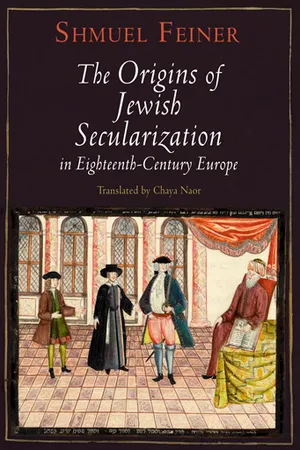
eBook - PDF
The Origins of Jewish Secularization in Eighteenth-Century Europe
- 347 pages
- English
- PDF
- Available on iOS & Android
eBook - PDF
The Origins of Jewish Secularization in Eighteenth-Century Europe
About this book
Information
Publisher
University of Pennsylvania PressYear
2011Print ISBN
9780812242737
9780812242737
eBook ISBN
9780812201895
Topic
Theology & ReligionSubtopic
European HistoryTable of contents
- Cover
- Contents
- Preface
- Introduction: Sins and Doubts
- PART I: LIBERTY AND HERESY, 1700–1760
- PART II: A NEW WORLD, 1760–80
- PART III: THE OVERTURNED WORLD, 1780–90
- PART IV: ANXIETIES AND CONFRONTATIONS, 1790–1800
- Notes
- Bibliography
- Index
- Acknowledgments
Trusted by 375,005 students
Access to over 1.5 million titles for a fair monthly price.
Study more efficiently using our study tools.
Frequently asked questions
Yes, you can cancel anytime from the Subscription tab in your account settings on the Perlego website. Your subscription will stay active until the end of your current billing period. Learn how to cancel your subscription
No, books cannot be downloaded as external files, such as PDFs, for use outside of Perlego. However, you can download books within the Perlego app for offline reading on mobile or tablet. Learn how to download books offline
Perlego offers two plans: Essential and Complete
- Essential is ideal for learners and professionals who enjoy exploring a wide range of subjects. Access the Essential Library with 800,000+ trusted titles and best-sellers across business, personal growth, and the humanities. Includes unlimited reading time and Standard Read Aloud voice.
- Complete: Perfect for advanced learners and researchers needing full, unrestricted access. Unlock 1.5M+ books across hundreds of subjects, including academic and specialized titles. The Complete Plan also includes advanced features like Premium Read Aloud and Research Assistant.
We are an online textbook subscription service, where you can get access to an entire online library for less than the price of a single book per month. With over 1.5 million books across 990+ topics, we’ve got you covered! Learn about our mission
Look out for the read-aloud symbol on your next book to see if you can listen to it. The read-aloud tool reads text aloud for you, highlighting the text as it is being read. You can pause it, speed it up and slow it down. Learn more about Read Aloud
Yes! You can use the Perlego app on both iOS and Android devices to read anytime, anywhere — even offline. Perfect for commutes or when you’re on the go.
Please note we cannot support devices running on iOS 13 and Android 7 or earlier. Learn more about using the app
Please note we cannot support devices running on iOS 13 and Android 7 or earlier. Learn more about using the app
Yes, you can access The Origins of Jewish Secularization in Eighteenth-Century Europe by Shmuel Feiner, Chaya Naor in PDF and/or ePUB format, as well as other popular books in Theology & Religion & European History. We have over 1.5 million books available in our catalogue for you to explore.