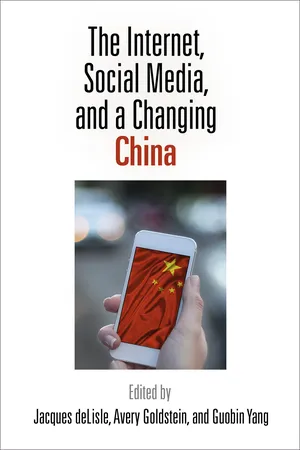
The Internet and social media are pervasive and transformative forces in contemporary China. Nearly half of China's 1.3 billion citizens use the Internet, and tens of millions use Sina Weibo, a platform similar to Twitter or Facebook. Recently, Weixin/Wechat has become another major form of social media. While these services have allowed regular people to share information and opinions as never before, they also have changed the ways in which the Chinese authorities communicate with the people they rule. China's party-state now invests heavily in speaking to Chinese citizens through the Internet and social media, as well as controlling the speech that occurs in that space. At the same time, those authorities are wary of the Internet's ability to undermine the ruling party's power, organize dissent, or foment disorder. Nevertheless, policy debates and public discourse in China now regularly occur online, to an extent unimaginable a decade or two ago, profoundly altering the fabric of China's civil society, legal affairs, internal politics, and foreign relations.
The Internet, Social Media, and a Changing China explores the changing relationship between China's cyberspace and its society, politics, legal system, and foreign relations. The chapters focus on three major policy areas—civil society, the roles of law, and the nationalist turn in Chinese foreign policy—and cover topics such as the Internet and authoritarianism, "uncivil society" online, empowerment through new media, civic engagement and digital activism, regulating speech in the age of the Internet, how the Internet affects public opinion, legal cases, and foreign policy, and how new media affects the relationship between Beijing and Chinese people abroad.
Contributors: Anne S. Y. Cheung, Rogier Creemers, Jacques deLisle, Avery Goldstein, Peter Gries, Min Jiang, Dalei Jie, Ya-Wen Lei, James Reilly, Zengzhi Shi, Derek Steiger, Marina Svensson, Wang Tao, Guobin Yang, Chuanjie Zhang, Daniel Xiaodan Zhou.
eBook - PDF
The Internet, Social Media, and a Changing China
- 292 pages
- English
- PDF
- Available on iOS & Android
eBook - PDF
The Internet, Social Media, and a Changing China
About this book
Information
Table of contents
- Cover
- Title
- Copyright
- Contents
- Introduction: The Internet, Social Media, and a Changing China
- Chapter 1: The Coevolution of the Internet, (Un)Civil Society, and Authoritarianism in China
- Chapter 2: Connectivity, Engagement, and Witnessing on China’s Weibo
- Chapter 3: New Media Empowerment and State-Society Relations in China
- Chapter 4: The Privilege of Speech and New Media: Conceptualizing China’s Communications Law in the Internet Age
- Chapter 5: Embedding Law into Politics in China’s Networked Public Sphere
- Chapter 6: Microbloggers’ Battle for Legal Justice in China
- Chapter 7: Public Opinion and Chinese Foreign Policy: New Media and Old Puzzles
- Chapter 8: Social Media, Nationalist Protests, and China’s Japan Policy: The Diaoyu Islands Controversy, 2012–13
- Chapter 9: Going Out and Texting Home: New Media and China’s Citizens Abroad
- Chapter 10: Images of the DPRK in China’s New Media: How Foreign Policy Attitudes Are Connected to Domestic Ideologies in China
- Notes
- List of Contributors
- Index
- Acknowledgments
Trusted by 375,005 students
Access to over 1.5 million titles for a fair monthly price.
Study more efficiently using our study tools.
Frequently asked questions
Yes, you can cancel anytime from the Subscription tab in your account settings on the Perlego website. Your subscription will stay active until the end of your current billing period. Learn how to cancel your subscription
No, books cannot be downloaded as external files, such as PDFs, for use outside of Perlego. However, you can download books within the Perlego app for offline reading on mobile or tablet. Learn how to download books offline
Perlego offers two plans: Essential and Complete
- Essential is ideal for learners and professionals who enjoy exploring a wide range of subjects. Access the Essential Library with 800,000+ trusted titles and best-sellers across business, personal growth, and the humanities. Includes unlimited reading time and Standard Read Aloud voice.
- Complete: Perfect for advanced learners and researchers needing full, unrestricted access. Unlock 1.5M+ books across hundreds of subjects, including academic and specialized titles. The Complete Plan also includes advanced features like Premium Read Aloud and Research Assistant.
We are an online textbook subscription service, where you can get access to an entire online library for less than the price of a single book per month. With over 1.5 million books across 990+ topics, we’ve got you covered! Learn about our mission
Look out for the read-aloud symbol on your next book to see if you can listen to it. The read-aloud tool reads text aloud for you, highlighting the text as it is being read. You can pause it, speed it up and slow it down. Learn more about Read Aloud
Yes! You can use the Perlego app on both iOS and Android devices to read anytime, anywhere — even offline. Perfect for commutes or when you’re on the go.
Please note we cannot support devices running on iOS 13 and Android 7 or earlier. Learn more about using the app
Please note we cannot support devices running on iOS 13 and Android 7 or earlier. Learn more about using the app
Yes, you can access The Internet, Social Media, and a Changing China by Jacques deLisle, Avery Goldstein, Guobin Yang, Jacques deLisle,Avery Goldstein,Guobin Yang in PDF and/or ePUB format, as well as other popular books in Politics & International Relations & Asian Politics. We have over 1.5 million books available in our catalogue for you to explore.