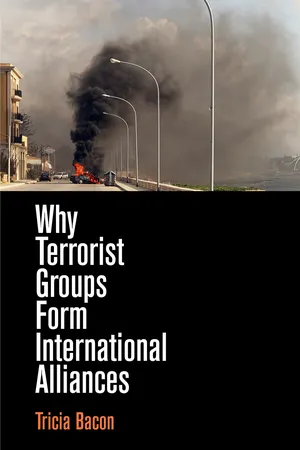
Terrorist groups with a shared enemy or ideology have ample reason to work together, even if they are primarily pursuing different causes. Although partnering with another terrorist organization has the potential to bolster operational effectiveness, efficiency, and prestige, international alliances may expose partners to infiltration, security breaches, or additional counterterrorism attention. Alliances between such organizations, which are suspicious and secretive by nature, must also overcome significant barriers to trust—the exposure to risk must be balanced by the promise of increased lethality, resiliency, and longevity.In Why Terrorist Groups Form International Alliances, Tricia Bacon argues that although it may seem natural for terrorist groups to ally, groups actually face substantial hurdles when attempting to ally and, when alliances do form, they are not evenly distributed across pairs. Instead, she demonstrates that when terrorist groups seek allies to obtain new skills, knowledge, or capacities for resource acquisition and mobilization, only a few groups have the ability to provide needed training, safe haven, infrastructure, or cachet. Consequently, these select few emerge as preferable partners and become hubs around which other groups cluster. According to Bacon, shared enemies and common ideologies do not cause alliances to form but create affinity to bind partners and guide partner selection.Bacon examines partnerships formed by the Popular Front for the Liberation of Palestine, Al-Qaida, and Egyptian jihadist groups, among others, in a series of case studies spanning the dawn of international terrorism in the 1960s to the present. Why Terrorist Groups Form International Alliances advances our understanding of the motivations of terrorist alliances and offers insights useful to counterterrorism efforts to disrupt these dangerous relationships.
- 352 pages
- English
- ePUB (mobile friendly)
- Available on iOS & Android
eBook - ePub
Why Terrorist Groups Form International Alliances
About this book
Trusted by 375,005 students
Access to over 1.5 million titles for a fair monthly price.
Study more efficiently using our study tools.
Information
Publisher
University of Pennsylvania PressYear
2018Print ISBN
9780812250169
9780812250169
eBook ISBN
9780812295023
Chapter 1

A Theory of Alliance Hubs and Alliance Formation
Al-Qaida and the Islamic State are locked in a competition for allies among Sunni jihadist groups. In terms of their ideology, enemies, and objectives, the two groups have more similarities than differences.1 Both groups adhere to a Sunni jihadist ideology that rejects the current international system, opposes the governments in it, and aims to reestablish the caliphate. They both promulgate the idea that Islam is under attack, which they argue creates an individual duty for Muslims everywhere to defend it. They employ a similar violent “defense,” which includes terrorist attacks in the West and efforts to provoke Western military interventions. They see the West and its system of democratic governance as antithetical to sharia law and hostile to the creation of “true” Islamic states. As Bruce Hoffman argued, “Their differences are rooted more in clashing egos and tone than substance.”2 Yet they have built competing alliance networks, and their rivalry has divided the Sunni jihadist milieu.
Their alliance behavior and the behavior of Sunni jihadist organizations raise two sets of questions, one about the allied groups and another about the hubs. First, why do numerous groups seek alliance with these two organizations? Once an alliance is initiated, what influences whether alliance formation is successful or not? Second, why have these two groups in particular opted to build alliance networks? Why have they been successful at building alliances? Given al-Qaida and the Islamic State’s similarities, their ideology and enemies alone cannot fully explain other Sunni jihadist groups’ alliance decisions nor can they explain the two groups’ ability and desire to become alliance hubs.
As the al-Qaida and Islamic State examples illustrate, the notion that hubs form or that groups cluster around hubs in response to ideological solidarity or common enemies is at best incomplete and underspecified, strongly suggesting that other causal mechanisms operate. The most glaring deficiency of conventional wisdom is its omission of the organizations themselves. If considered at all, organizational dynamics are relegated to having second-order influence.3 However, like all other organizations, terrorist groups seek to survive. Moreover, as exclusive organizations often living under threat or repression, organizational survival is a priority. Consequently, the need to secure the organization influences behavior and, I will argue, can lead to alliances with hubs. Therefore, terrorist groups’ actions, including their alliances, cannot be understood by looking solely at their ideology, political goals, and enemies.4
In this chapter, I lay out my argument that three mechanisms are jointly sufficient for alliance formation with hubs: organizational needs, identity affinity, and trust. First, groups are willing to or attempt to ally with hubs when they face organizational learning and adaptation needs that leave them misaligned with their environment and thereby endanger their viability. Alliances with hubs provide groups with a way to address shortcomings and secure organizational survival because hubs possess the ability and willingness to address common needs. Hubs are willing to do so because they are organizationally ambitious groups, a trait that generates perpetual organizational needs they endeavor to fulfill through alliances.
Second, the central role of organizational needs in alliances does not preclude that ideologies and enemies influence alliance behavior as well. The conventional wisdom that ideological solidarity and common enemies motivate alliances incorrectly specifies how shared ideologies and common enemies function in the alliance process. Instead, as identity characteristics, ideology and enemy framing shape and constrain groups’ partner choices. I argue that identity is not the primary motive for alliances, nor is it simply a construct that leaders or groups can manipulate at will for instrumental reasons. When seeking an ally to address organizational needs, groups choose partners with which they share identity features. To ally, they build shared identities, which engender cohesion and enhance commitment to cooperate. Hubs become preferred alliance partners among a subset of groups with shared identity features. They build alliance networks consisting of partners with common identity features in an effort to shape their identity community.
Third, alliances require trust. Like identity affinity, trust alone is insufficient to motivate or produce alliances, but alliances cannot form without it. Owing to their suspicious and illicit nature, terrorist groups struggle to forge and maintain trust. Mistrust can derail an alliance even when organizational needs and identity affinity exist. Several factors, namely, prior cooperation, the presence of brokers who forge interorganizational relationships, indirect ties, and reputations, encourage but do not guarantee trust. Hubs possess the ability to forge trust despite the obstacles.
This chapter elucidates these three causal mechanisms and the interactions between them, drawing from several literatures, including organizational theory, the business alliance theory, network theory, social movement theory, and constructivism. First, it explains the ways in which organizational theory applies to terrorist groups, including how organizational dynamics influence their receptivity to alliances. Then it delves into how organizational learning and adaptation needs precipitate alliances with hubs and how organizational need types and fit affect alliance formation. The next section examines how ideology and enemy framing underpin terrorist groups’ collective identity, limiting their partner options to those with shared identity characteristics and bolstering their willingness to cooperate with those that do share such characteristics. It then outlines how groups build shared identities to form alliances. Third, it explores the role of trust in the alliance process and posits characteristics that encourage trust. This includes identifying the loci of trust between groups to facilitate alliance formation. Finally, I conclude the chapter with a discussion of the methodology and case selection used to test the proposed mechanisms that produce alliance hubs and alliances with them.
The Primacy of the Organization
The behavior of terrorist groups is often conceived of as adhering to a strategic model in which these groups operate rationally based on a utility function of preferences derived from their ideology and political objectives.5 To some degree, the conventional wisdom about terrorist alliances stems from this framework. However, the strategic model is incomplete at best because it does not account for the organizations themselves. As Gordon McCormick explained, some of their behavior “can only be understood by looking inside the group itself. A terrorist organization is not a black box but a living system, subject to a range of influences that may be only tangentially related to its stated strategic objectives.”6
Fundamentally, like all organizations, terrorist groups seek to survive. Moreover, their tendency to be exclusive organizations—establishing membership criteria and accepting only those who share their beliefs and meet their standards—intensifies their commitment to organizational survival.7 Not only do terrorist groups limit who can join; they often pressure members to shed competing roles and identities while encouraging them to develop strong internal affective ties, which increases the emphasis on the organization and the corresponding identity.8 In addition, terrorist groups see themselves as the essential engine to accomplishing the political change they seek. Consequently, they conflate achieving their strategic goals with their organizational circumstances, particularly the viability of the group.
The cooperation and consultation offered through alliances can provide a way to repair organizational deficiencies, like a lack of knowledge, skills, or resource mobilization capability needed under the prevailing conditions. When a group recognizes its misalignment with the environment and cannot address the problem on its own, it may search for allies to address them, as long as this solution fits within its internal decision-making dynamics. An organization risks becoming misaligned owing to shifts in the environment or within the organization itself. Hubs are groups positioned to provide the requisite assistance to help others become aligned. They are partners able and willing to impart the knowledge, skills, or resource mobilization assistance that other groups need. Hubs are not simply altruistic. Their organizational aspirations produce perpetual organizational needs that alliances help address.
In this section, I begin by discussing why organizational imperatives shape terrorist groups’ behavior in general before delving into the two ways they specifically influence alliance behavior. First, organizational processes facilitate or hinder groups’ willingness to consider alliances as a solution to organizational problems. Second, organizational learning and adaptation needs precipitate alliance initiation with hubs. Third, I explore the role of organizational needs in shaping the success or failure of alliance formation. Fourth, I discuss how organizational aspirations motivate a small subset of groups to become alliance hubs and how their capability and resources determine their ability to do so.
Recognizing Organizational Imperatives
Terrorist groups balance their pursuit of strategic goals with the need to preserve and advance the organization.9 As entities that place a premium on in-group cohesion, organizational obligations and dynamics guide terrorist groups’ behavior.10 Terrorist groups’ perception that they are necessary to achieve political change, the conditions under which they operate, the nature of intragroup relationships, their biases toward action, and their tendency toward goal displacement all interact to create and reinforce a commitment to organizational survival.
Given their clandestine and violent characteristics, looking inside terrorist organizations poses challenges, which contributes to organizational dynamics being overlooked. Despite terrorist groups’ deliberate opaqueness about their inner workings, they share the same general goal as all organizations, namely, organizational survival.11 Moreover, terrorist organizations view their survival as vital because they see themselves as both under threat and responsible for an essential change. The status quo resists the change, and, therefore, accomplishing it may be a long-term or even an abstract endeavor. Members’ commitment to the group helps to maintain their dedication to strategic objectives that can seem unattainable in the foreseeable future. As a result, terrorist groups become committed to organizational survival, sometimes even at the expense of their political aims.
The isolation, hazards, and liabilities of being a clandestine, illicit, and violent entity solidify intragroup bonds and reinforce the emphasis on organizational survival.12 Terrorist groups are far more tight-knit than most organizations in part because of the dangers and costs of membership.13 Terrorist groups operate under conditions that require group solidarity, namely, engaging in clandestine and violent activities, often under repression or pursuit. Disunity and discord could cost lives and destroy the organization. Arrests, lapses, or defections leave the organization vulnerable. Thus, the need for terrorist groups to maintain secrecy increases the dependency of members on one another.
In addition, terrorist organizations foster a strong sense of in-group dependence to secure loyalty. As exclusive organizations, terrorist groups limit members’ external ties and demand their allegiance, which aids in the development of committed members and group cohesion. By limiting members’ outside ties, often through acts of “bridge burning,” groups neutralize countervailing influences or loyalties.14 They can engage in “spirals of encapsulation” whereby members cut off links to the external world as intragroup relations grow.15 Terrorist groups often encourage dependence on the group. The value of membership and the centrality of intragroup relationships increase over time, especially if the group operates underground.16 Eventually, members identify their needs and interests with those of the group. The emphasis on intragroup cohesion tends to engender a commensurately strong commitment to organizational viability and reinforce terrorist groups’ dedication to their own existence. Organizational failure means losing central relationships and the identity forged through being a member of the group.17
Terrorist groups also experience an internal tension that contributes to the weight given to organizational considerations: a bias toward action to satisfy and attract members.18 This preoccupation has merit, considering that nearly 60 percent of members in secular groups and 43 percent of religious group members interviewed by Jerrold Post and colleagues admitted to joining the most active terrorist organization.19 When a desire for action dominates, especially if action becomes necessary for internal satisfaction, a group’s activities become less connected to its political aims and more about ensuring organizational viability.20 Essentially, the means by which the organization seeks to achieve its goals—violence and the perpetuation of the group—become ends unto themselves, irrespective of either’s efficacy in achieving strategic aims.21 When this occurs, the need to preserve the group...
Table of contents
- Cover
- Half title
- Title
- Copyright
- Contents
- Introduction
- Chapter 1. A Theory of Alliance Hubs and Alliance Formation
- Chapter 2. The Popular Front for the Liberation of Palestine: Pioneering Partnerships
- Chapter 3. The Red Army Faction: Pursuing Palestinian Partners
- Chapter 4. Al-Qaida Before 9/11: Building Alliances One Dollar at a Time
- Chapter 5. Al-Qaida After 9/11: Calling in Debts and Capitalizing on Cachet
- Chapter 6. Egyptian Jihadist Groups: Divergent Solutions, Similar Problems
- Conclusion
- Notes
- Index
- Acknowledgments
Frequently asked questions
Yes, you can cancel anytime from the Subscription tab in your account settings on the Perlego website. Your subscription will stay active until the end of your current billing period. Learn how to cancel your subscription
No, books cannot be downloaded as external files, such as PDFs, for use outside of Perlego. However, you can download books within the Perlego app for offline reading on mobile or tablet. Learn how to download books offline
Perlego offers two plans: Essential and Complete
- Essential is ideal for learners and professionals who enjoy exploring a wide range of subjects. Access the Essential Library with 800,000+ trusted titles and best-sellers across business, personal growth, and the humanities. Includes unlimited reading time and Standard Read Aloud voice.
- Complete: Perfect for advanced learners and researchers needing full, unrestricted access. Unlock 1.5M+ books across hundreds of subjects, including academic and specialized titles. The Complete Plan also includes advanced features like Premium Read Aloud and Research Assistant.
We are an online textbook subscription service, where you can get access to an entire online library for less than the price of a single book per month. With over 1.5 million books across 990+ topics, we’ve got you covered! Learn about our mission
Look out for the read-aloud symbol on your next book to see if you can listen to it. The read-aloud tool reads text aloud for you, highlighting the text as it is being read. You can pause it, speed it up and slow it down. Learn more about Read Aloud
Yes! You can use the Perlego app on both iOS and Android devices to read anytime, anywhere — even offline. Perfect for commutes or when you’re on the go.
Please note we cannot support devices running on iOS 13 and Android 7 or earlier. Learn more about using the app
Please note we cannot support devices running on iOS 13 and Android 7 or earlier. Learn more about using the app
Yes, you can access Why Terrorist Groups Form International Alliances by Tricia Bacon in PDF and/or ePUB format, as well as other popular books in Politics & International Relations & National Security. We have over 1.5 million books available in our catalogue for you to explore.