During the bitter winter of 1786-87, Daniel Shays, a modest farmer and Revolutionary War veteran, and his compatriot Luke Day led an unsuccessful armed rebellion against the state of Massachusetts. Their desperate struggle was fueled by the injustice of a regressive tax system and a conservative state government that seemed no better than British colonial rule. But despite the immediate failure of this local call-to-arms in the Massachusetts countryside, the event fundamentally altered the course of American history. Shays and his army of four thousand rebels so shocked the young nation's governing elite—even drawing the retired General George Washington back into the service of his country—that ultimately the Articles of Confederation were discarded in favor of a new constitution, the very document that has guided the nation for more than two hundred years, and brought closure to the American Revolution.
The importance of Shays's Rebellion has never been fully appreciated, chiefly because Shays and his followers have always been viewed as a small group of poor farmers and debtors protesting local civil authority. In Shays's Rebellion: The American Revolution's Final Battle, Leonard Richards reveals that this perception is misleading, that the rebellion was much more widespread than previously thought, and that the participants and their supporters actually represented whole communities—the wealthy and the poor, the influential and the weak, even members of some of the best Massachusetts families.
Through careful examination of contemporary records, including a long-neglected but invaluable list of the participants, Richards provides a clear picture of the insurgency, capturing the spirit of the rebellion, the reasons for the revolt, and its long-term impact on the participants, the state of Massachusetts, and the nation as a whole. Shays's Rebellion, though seemingly a local affair, was the revolution that gave rise to modern American democracy.

- 216 pages
- English
- ePUB (mobile friendly)
- Available on iOS & Android
eBook - ePub
About this book
Information
1
DEFIANCE
THE CHAIN OF EVENTS THAT FRIGHTENED WASHINGTON out of retirement began the previous summer, two weeks after the tenth anniversary of the Declaration of Independence, July 18, 1786, an unseasonably cool day in much of western Massachusetts.
Worries about the weather, the cold fronts that swept down from Canada and the hot and humid air that came from the southwest, marked the entire region. It was farm country, with the bulk of the population—85 percent or more—eking out a living on small family farms. The state record keepers referred to the owners of these farmsteads as “yeomen,” and their adult male workers as “laborers,” but the latter was a misnomer. In most cases the laborers were actually the sons of the yeomen, and many in a year or two would come in possession of land themselves and be designated yeomen.
Most of these farm families tried to be self-sufficient but never quite achieved it. Every village thus had a blacksmith with a forge, and in most townships there were also well-traveled paths that led to the dwelling of the tanner who made buckskin out of deerskin, the wheelwright who fashioned carts and wagons, the cooper who combined staves into barrels, and the midwife who came at all hours of the night to help with childbirth.
One of these many specialists was Dr. Nehemiah Hines. In his hometown of Pelham, however, he was not regarded as just a medical man. In 1786 he was also a town leader, the town moderator, an office he had never held before but would hold many times in the coming years. He had been a selectman in the past.1 Together, the doctor and the selectmen were Pelham’s chief administrative officers, with a host of responsibilities, ranging from seeing that the town’s children were properly educated to laying out bridges and roads. They were also expected to protect the town against troubles from the outside world. They had been given these responsibilities earlier that spring by the annual town meeting.
In fact, however, they had been selected well before the annual meeting. Every year, at Conkey’s Tavern and other Pelham watering holes, men met and discussed who was best suited to run the town. Here most of the politicking took place, and here was where basic decisions were usually made. The annual town meeting, in most instances, just ratified the results. With no nominations, no speeches, no canvassing for votes, the moderator simply called for the secret ballots, and the men of the town stepped forth and gave theirs to the town clerk.
Virtually every town in western Massachusetts had a similar setup. It had been sanctioned long ago by the provincial government in Boston. It was also part of the much-heralded New England tradition which the original settlers had brought with them. In the case of Hines’s hometown, most of these founders had come from eastern Massachusetts. In the nearby towns, most had come out of Connecticut. Migrating up the Connecticut River, they had fanned out through the river valley and the surrounding hills, establishing thousands upon thousands of family farms, largely at the expense of the lush stands of oaks, chestnuts, maples, hemlocks, and white pines that had once dominated the region.
All these settlers, in turn, formed town governments that were essentially their own masters. Indeed, ignoring orders from Boston was commonplace. One Massachusetts statute, for example, decreed that all town elections were to be held in March. Some towns followed the rule; others met in February; still others waited until April. Similarly, according to the lawmakers in Boston, only men worth a certain amount of money—£20 in town elections, £40 and then £60 in Massachusetts elections—were eligible to vote. Nearly every town ignored this rule. Indeed, they not only allowed all male inhabitants to attend the annual town meeting and submit a ballot, but fined them if they did not do so. And many towns even elected men who, under the law, were ineligible to vote.
Had Dr. Hines been clairvoyant that July day, he might have stayed at home. Instead, he set off for an emergency meeting of the Pelham town selectmen. The road took him past the farm of Daniel and Abigail Shays.
Hines, at age forty, was one year older than his neighbor. Both men were Revolutionary veterans, Shays as a captain with five years’ service, Hines as a surgeon mate in the Massachusetts Line. Both had served in the same regiment, Woodbridge’s Massachusetts, at the outset of the war. Both had been “winter soldiers” who had fought during the “worst of times” as well as the best, the kind of men that Washington had desperately needed to become a national icon. Hines trusted Shays and had lent him money.2
Otherwise, the two men had little in common. Daniel and Abigail Shays were relative newcomers to the area, having moved into the adjacent town of Shutesbury just before the war, and their nearest kin lived in the town of Brookfield, many miles away. Daniel was active on the Pelham Committee of Safety, and Abigail was part of a movement to establish a second church. In contrast, the Hineses had deep roots in the community and more family connections. A dozen or so Hineses lived in Pelham and the neighboring town of Greenwich. Scarcely a year passed without one Hines or another being elected selectman or moderator.
The Hineses were also much wealthier than the Shayses. The latter were hardly at the bottom of the economic ladder, as some of their detractors would later claim. They had a farm of over one hundred acres. Only a small portion was in tillage, and they had just enough pasturage for one horse and one cow, but that was common among hill country farmers, who generally strove to be self-sufficient rather than produce bumper crops or livestock for an outside market. Even had the Shayses dreamed of the latter, they would not have had much luck in a place like Pelham. The land was too rocky and too far from navigable water. In this hardscrabble economy, the Shayses’ farm was ranked in the second 20 percent of town assessments. In contrast, Hines’s holdings put him in the top 5 percent. His economic worth was nearly three times that of Shays. He not only made a living from his medical practice. He also owned a farm and a tavern.3
The meeting that Hines attended that July day was triggered primarily by news from Boston. The legislature, ten days earlier, had decided that its work for the year was completed and adjourned until January 31, 1787.4 That decision, as far as Hines and the selectmen of Pelham were concerned, was the last straw. Once again, the legislature had flouted the will of the people. For the past four years, scores of small communities like Pelham and Greenwich had pleaded with the legislature to address their concerns, and once again the legislature had adjourned without doing so. The communities’ petitions had been polite, deferential, sometimes even groveling. But the message was clear: The backcountry economy was in bad shape, and the new state government was just making matters worse.
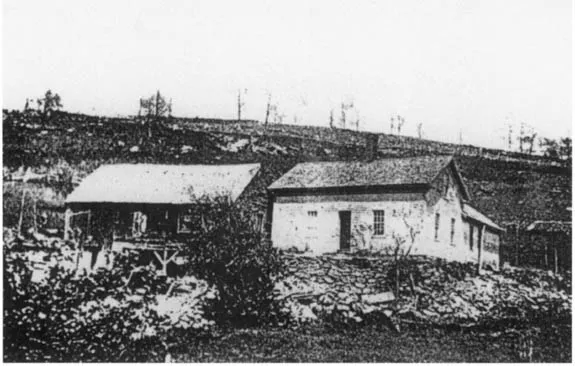
Daniel and Abigail Shays’s Pelham farmhouse, from an old photograph. Reprinted from C. O. Parmenter, History of Pelham (Amherst, Mass., 1898), 391. The house, built in the modest Cape style, was standard among hill country farmers. In 1787, it was portrayed as a “stye” by a government supporter who wanted everyone to believe that the former army officer was a “brute” unfit for leadership. Along with the house, Shays owned one hundred acres and was ranked in the top third of town taxpayers.
Woven into the petitions were dozens of tough questions. How, for example, were farmers to pay debts and taxes with hard money when no hard money was available? And why did honest men have to cope with so many layers in the court system? Was it just so well-connected lawyers and court officials could collect fees at every step of the way? And why was there a state senate? Was it not just an unnecessary waste of the taxpayers’ money? And did it not just provide another bastion of privilege for the Boston elite? And why was the government in Boston anyway? Why was it not more centrally located as in the other states? Was it so the mercantile elite could pass oppressive laws when distance and bad weather kept the people’s representatives from getting to Boston?
Such questions were rarely expressed so boldly, but they had sparked many a complaint about taxes, debts, the shortage of legal tender, and the structure of government. In addition, the legitimacy of the 1780 state constitution had frequently been questioned. So too had the legitimacy of the state’s rulers. Was it not the duty of government officials to protect the people rather than oppress them? Were most of the current rulers not just as corrupt as King George’s ministers? What then had the Revolution accomplished? Such thoughts clearly circulated in the west, and the town leaders had tried to politely convey the message. Yet, each year the legislature had ignored their complaints and only added to the misery.
The local newspapers out of Springfield and Northampton still counseled patience. So too did the Reverend David Parsons at the First Church in nearby Amherst. Hines and the Pelham selectmen, however, had had it. They had heard the old refrain of “wait until next year” many times before, and each year the legislature had met, ignored their pleas, and caused even more trouble. They decided to write a letter to the selectmen of Amherst, and to eleven other neighboring towns, calling for a meeting on July 31 at John Bruce’s inn, which in turn would call for a countywide convention. The goal was to get at the root of the problem, to find “some method” to change the state constitution and thus get a more responsive government.5
The town fathers of Pelham were not the only ones to call for countywide conventions that summer. Other towns also setup committees of correspondence and by the end of July several counties had plans for a convention. Bristol County met first at Taunton, on July 23. Then, a month later, Worcester, Hampshire, Middlesex, and Berkshire followed suit. The convention set in motion by the Pelham selectmen, however, was the largest. Held at the Hatfield home of Colonel Seth Murray on August 22, fifty Hampshire towns were represented. Among the delegates were John Hastings, Hatfield’s representative to the state legislature; Benjamin Ely, West Springfield’s former state representative; and William Pynchon, the eminent voice of Springfield’s most powerful family. The delegates, according to the diarist Sylvester Judd, all knew what was coming. That had been made clear to him when the town of Southampton met to select a delegate. The plan, noted Judd, was to set forth a list of grievances and then “break up the Court next Week.”6
The convention adopted twenty-one articles. Of these, seventeen were grievances, and at least six necessitated a radical change in the state government—indeed, a new state constitution. The delegates wanted the upper house of the state legislature to be abolished, the present mode of representation in the lower house to be radically revised, government officers to be elected annually by the lower house, the salaries of those officers to be determined annually by the lower house, the Courts of Common Pleas and General Sessions of the Peace to be abolished, and the state legislature to be moved out of Boston. The delegates also objected to the state’s tax system, the high costs of the state’s legal system, the scarcity of legal tender, and various forms of financial favoritism granted by the state to the Boston elite. Finally, they wanted the state legislature to be recalled immediately to address their grievances.7
One week later, on the last Tuesday of August, well before daybreak, Captain Joseph Hines led several hundred Greenwich and Pelham men toward Northampton, Massachusetts. A kinsman of the Pelham doctor, Joseph Hines was an old hand at leading men. He had been a captain in the Massachusetts Line during the Revolution. The town fathers of Pelham had wanted Daniel Shays to lead the Pelham men, but he had refused and the task had fallen to Deacon John Thompson, a fifty-year-old militia captain and former town selectman.8
At the bottom of Pelham hill, Hines and his men joined forces with a large Amherst contingent led by Captain Joel Billings. A thirty-nine-year-old farmer and the father of eight children, Billings was also an old hand at leading men. He too had commanded troops during the American Revolution. He also had been a town selectman, the same office his father had held for nearly twenty years. With him were many from east Amherst, including most of the large Dickinson clan.
As the men proceeded through the center of Amherst and through Hadley, only a few additional men joined them. Upon crossing the Connecticut River, however, they encountered hundreds of others who had converged on Northampton from the opposite direction, from the hill towns to the northwest and from West Springfield to the south. After daybreak, the combined forces assembled into military formation and with fifes and drums marched on the Northampton courthouse. Some carried muskets, swords, or bludgeons. Others were unarmed.
Several hours later, three justices in full-length black robes and gray wigs, with the sheriff leading them, approached the courthouse. They were blocked at the door. In a face-saving gesture, they decided to hold court at the house of Captain Samuel Clark, a local innkeeper, and to receive a six-man delegation. The delegation, which included Hines and Billings, demanded that the court adjourn without transacting business. The justices then decided to “continue all matters pending” until November and “adjourned without day.” They then packed up, untethered their horses, and returned home.9
ONCE MEN LIKE Hines and Billings began disrupting the courts, state authorities took notice. To them, it was obvious that the rebels were doing far more than just disrupting debt cases and harassing judges. They were attacking the most visible symbol of state authority in the west, the state judicial system that had been sanctioned by the Constitution of 1780, thus challenging the very legitimacy of the new state government, treating it as no more deserving of their respect than the old royal government. The authorities’ first instinct, therefore, was to suppress the rebellion.
At their beck and call, legally at least, were the local militias. Under the law, men in the militia had to respond in the state’s time of need. In 1786, over ninety thousand Massachusetts men had this obligation. Theoretically, all ninety thousand were men of substance with deep roots in the community since militia law rather systematically excluded the poor and the transient from service. These local men of property, in turn, were supposed to turn out in times of crisis, largely out of self-interest, to defend the common good. In practice, moreover, whenever the militia turned out in great numbers, it could be effective. That had been the case at Lexington and Concord in 1775, and also at the Battle of Saratoga in 1777, which many patriots regarded as the turning point in the Revolutionary ...
Table of contents
- Cover
- Half title
- Title
- Copyright
- Dedication
- Contents
- Preface
- Prologue
- 1. Defiance
- 2. Crackdown
- 3. Oath Takers and Leaders
- 4. The Revolutionary Government and Its Beneficiaries
- 5. Banner Towns and Core Families
- 6. Reverberations
- 7. Climax
- Notes
- Index
Trusted by 375,005 students
Access to over 1.5 million titles for a fair monthly price.
Study more efficiently using our study tools.
Frequently asked questions
Yes, you can cancel anytime from the Subscription tab in your account settings on the Perlego website. Your subscription will stay active until the end of your current billing period. Learn how to cancel your subscription
No, books cannot be downloaded as external files, such as PDFs, for use outside of Perlego. However, you can download books within the Perlego app for offline reading on mobile or tablet. Learn how to download books offline
Perlego offers two plans: Essential and Complete
- Essential is ideal for learners and professionals who enjoy exploring a wide range of subjects. Access the Essential Library with 800,000+ trusted titles and best-sellers across business, personal growth, and the humanities. Includes unlimited reading time and Standard Read Aloud voice.
- Complete: Perfect for advanced learners and researchers needing full, unrestricted access. Unlock 1.5M+ books across hundreds of subjects, including academic and specialized titles. The Complete Plan also includes advanced features like Premium Read Aloud and Research Assistant.
We are an online textbook subscription service, where you can get access to an entire online library for less than the price of a single book per month. With over 1.5 million books across 990+ topics, we’ve got you covered! Learn about our mission
Look out for the read-aloud symbol on your next book to see if you can listen to it. The read-aloud tool reads text aloud for you, highlighting the text as it is being read. You can pause it, speed it up and slow it down. Learn more about Read Aloud
Yes! You can use the Perlego app on both iOS and Android devices to read anytime, anywhere — even offline. Perfect for commutes or when you’re on the go.
Please note we cannot support devices running on iOS 13 and Android 7 or earlier. Learn more about using the app
Please note we cannot support devices running on iOS 13 and Android 7 or earlier. Learn more about using the app
Yes, you can access Shays's Rebellion by Leonard L. Richards in PDF and/or ePUB format, as well as other popular books in History & Early American History. We have over 1.5 million books available in our catalogue for you to explore.