As the geographic boundaries of early American history have expanded, so too have historians' attempts to explore the comparative dimensions of this history. At the same time, historians have struggled to find a conceptual framework flexible enough to incorporate the sweeping narratives of imperial history and the hidden narratives of social history into a broader, synthetic whole. No such paradigm that captures the two perspectives has yet emerged.
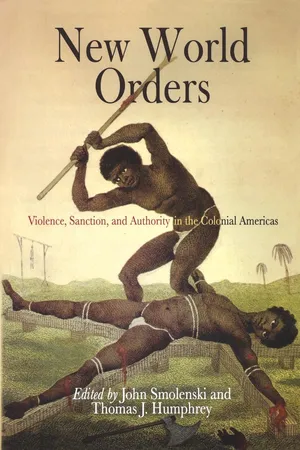
New World Orders addresses these broad conceptual issues by reexamining the relationships among violence, sanction, and authority in the early modern Americas. More specifically, the essays in this volume explore the wide variety of legal and extralegal means—from state-sponsored executions to unsanctioned crowd actions—by which social order was maintained, with a particular emphasis on how extralegal sanctions were defined and used; how such sanctions related to legal forms of maintaining order; and how these patterns of sanction, embedded within other forms of colonialism and culture, created cultural, legal, social, or imperial spaces in the early Americas.
With essays written by senior and junior scholars on the British, Spanish, Dutch, and French colonies, New World Orders presents one of the most comprehensive looks at the sweep of colonization in the Atlantic world. By juxtaposing case studies from Brazil, Venezuela, New York, California, Saint Domingue, and Louisiana with treatments of broader trends in Anglo-America or Spanish America more generally, the volume demonstrates the need to examine the questions of violence, sanction, and authority in hemispheric perspective.
eBook - ePub
New World Orders
Violence, Sanction, and Authority in the Colonial Americas
- 376 pages
- English
- ePUB (mobile friendly)
- Available on iOS & Android
eBook - ePub
New World Orders
Violence, Sanction, and Authority in the Colonial Americas
About this book
Information
Topic
HistoirePART I
Narrating Violence and Legality
It is by now commonplace for scholars to note that the formation of collective identities requires, as Benedict Anderson has shown, a curious process of remembering and forgetting. Nations, he notes, need narratives of identity replete with triumphs and sacrifices that must be remembered and traumas its members were ‘“obliged already to have forgotten.’”1 Violence, Anderson writes, plays a curious role in the construction of these stories—sometimes excised, sometimes exaggerated. In both cases, what matters is how storytellers employ incidents of violence to cultivate a common identity. “To serve the narrative purpose,” he argues, “these violent deaths must be remembered/forgotten as ‘our own.’”2 This recuperation of violence is, in turn, essential to history’s role in legitimating particular forms of authority. And if the process Anderson describes holds true in the creation of national narratives it also holds equally true in the construction of colonial histories. The chapters in Part I, entitled “Narrating Violence and Legality,” explore the stories that sanctioned colonial rule and their role in constructing American histories.
Christopher Tomlins uses Titus Andronicus as a lens through which to explore the literary, cartographic, and legal texts that provided the discursive frames for English colonization of the Americas. Tomlins argues that Andronicus embodied the process through which the early modern English created boundaries between territory and wasteland, civility and barbarism, and law and violence. Through the construction of these antimonies, he writes, the English not only justified their own appropriation of America, by positioning their actions as legal, they also allowed Anglo-Americans during the colonial and post-colonial periods to evade the violence inherent in English colonialism. Richard Price, meanwhile, examines “three emblematic moments of Caribbean rimland history, three linked narratives of death and creation.” Analyzing these instances of exemplary violence, Price demonstrates the centrality of stories of life and death in the creation of Saramakan histories—not simply in their relation of particular events, people, and places, but by shaping the meaning of that violence. Rejecting the notion that the past can be seen only as a historians’ discursive construct, he nonetheless shows that, to the extent that histories of colonial violence exercise legitimating force in the present, these narratives matter and must be examined with care.
Both Tomlins’s and Price’s chapters show that neither expressions of violence—especially at moments of cultural interaction or formation—nor the execution of legal authority can be understood outside of the histories that relate, and interpret, them. They exemplify Michel-Rolph Trouillot’s assessment of the relationship between power and history: “Power does not enter the story once and for all, but at different times and from different angles. It precedes the narrative proper, contributes to its creation and to its interpretation.”3 But through their identification and interrogation of particular examples of historical memory or forgetting in American history—moments in which the colonial authority was legitimated, contested, or silenced—these authors reveal the possibility and the necessity of developing alternative histories that address the violence of colonization directly.
Chapter 1
Law’s Wilderness: The Discourse of
English Colonizing, the Violence
of Intrusiony and the Failures of
American History
Prologue
Titus: Dost thou not perceive
That Rome is but a wilderness of tigers?
—William Shakespeare, Titus Andronicus, III.i.54 (c. 1591)
This chapter grapples with two subjects, one a subject in history, the other history itself. The first is the opening of North America to the violent intrusions of early occidental modernity; that is, the first century of transoceanic English colonizing of the North Atlantic seaboard. I investigate the terms on which colonizing created America by inquiring into conjoined discourses, literary and legal, in which the meanings of those terms were first put on display. The second is the failure, upon which modern American history’s liberal metanarrative is founded, to acknowledge the realities of origins. I argue that failure subordinates history to myth, making historical inquiry a means more to forgetfulness than critique.
The violence I address in this chapter is in its largest part textual, enduring in words spoken or written rather than in behavior. The texts are literary, legal, cartographic, and historical. I start with an attempt to characterize the relationship of texts to violence—how they authorize violence, narrate its display, and represent, or efface, its effects. Then I move to an examination of texts’ relationship to the English colonizing project, and to each other. I conclude by assessing how American history has dealt with its “origins” question, concentrating in particular on the founding metanarrative of modern American legal history.
Recent work by Joyce Chaplin and Karen Kupperman has addressed the origins of English North America by tracing the discursive processes by which colonists attempted to understand and eventually to claim “bodily and cultural superiority” over the indigenous population. Far from an enterprise grounded in foundational assumptions of ascendancy over a primitive “other,” their work suggests, English colonists “did not come to these confrontations with set, preconceived categories for describing others.” Confident ascendancy was produced only gradually, over the course of a century’s experiential interaction between colonists, Indians, and environment.1
The metropolitan texts discussed in this essay suggest that other discursive frames for success in colonizing existed than those generated by experience over time in America. From the outset, metropolitan law proved to be a technology of description and definition integral to the process of realizing colonization as a practice and colonists as its agents. English and European theories of rightful occupation, exclusive possession, sovereign authority, and just war fueled and expressed the colonizer’s violent ideology of possession, differentiation, and exclusion.
Violence and the Word
Enter Aron, Chiron and Demetrius at one door, and at the other door Young Lucius and another, with a bundle of weapons, and verses writ upon them.
—Titus Andronicus (stage direction, opening IV.ii.)
Titus Andronicus (c. 1591) was one of Shakespeare’s earliest plays.2 From its first performance until the closing of the theaters in 1642, it retained an extraordinary following. Throughout, it is suffused with elaborate discourses of legality and injustice, of innocence and evil, and of civility and barbarity. It is also grotesquely violent.
Titus Andronicus conforms broadly to the genre of revenge tragedy found in the classical Roman work of Seneca and reestablished in the later 1580s by Thomas Kyd. Revenge tragedy has a particular plot form: an introductory assertion of a prior foundational injustice, followed by unremitting and often fantastic violence in the service of injustice’s resolution.3 Once critics had wrested Shakespeare from audiences, Titus Andronicus’s excursion into the “rough theater” of revenge tragedy was thought reason enough to cast it out of the canon, and until the 1950s the play languished, mocked and reviled.4
Dismissing Titus Andronicus as mere youthful excess, critics failed to reflect upon the manner and media by which the violence they abhorred was narrated in the play, in particular the attention Shakespeare devoted to relationships among text, law, and violence. Legal and quasi-legal texts that do violence figure in the play’s most consequential moments. Aron the Moor, servant and lover of the Goth queen Tamora whom Titus has brought to Rome a captive, initiates Tamora’s cycle of vengeance upon the Andronici with a “fatal-plotted scroll”—a forged letter—that results immediately in the condemnation and subsequent execution of Quintus and Martius, two of Titus’s three surviving sons. Tamora gleefully calls the letter a “fatal writ,” which indeed it is, for on its dubious authority alone the emperor Saturninus (who has meantime made Tamora his empress) dispenses with trial, plea, and testimony: “Let them not speak a word; the guilt is plain.”5 In his turn, Titus makes texts the instrumentalities of his revenge. To Tamora’s sons Chiron and Demetrius, who at Aron’s instigation have raped and mutilated his daughter Lavinia, Titus sends an odd gift—“the goodliest weapons of his armory” wound about with words from the first verse of an ode from Horace: Integer vitae scelerisque purus / Non eget Mauri iaculis nec arcu [one of upright life and free of villainy needs no Moorish javelins nor bow]. The boys, dull-witted, shrug. But Aron understands Titus’ indictment: “the old man hath found their guilt, / And sends them weapons wrapped about with lines / That wound, beyond their feeling, to the quick.”6 In the next scene, apparently deranged, Titus has his kinsmen shoot arrows into the air wrapped in petitions that “will solicit heaven, and move the gods / To send down Justice for to wreak our wrongs.” His brother Marcus directs the others to aim at the palace of Saturninus to afflict not the emperor’s body but his pride with “scrolls to fly about the streets of Rome!” that, by “blazoning [his] unjustice,” will arouse the populace. Whether directed to gods or men, the petitions, not the arrows, are the point. Immediately thereafter, the Andronici hatch a third text that does violence: they trick a “clown” into delivering a “supplication,” wrapped around a knife, that accuses Saturninus of conspiring to procure the unlawful execution of Titus’s sons. Saturninus has the unwitting messenger hung. As with Aron’s letter, in each of these moves in Titus’s pattern of vengeance the text effects an outcome on its own, unmediated.7
Shakespeare parses the relationship of text to violence throughout the play. Titus tells Lavinia that her mutilated, silenced body—hands chopped off, tongue cut out—is a text that will allow him knowledge of the violence inflicted upon her. “Thou shalt not sigh, nor hold thy stumps to heaven, / Nor wink, nor nod, nor kneel, nor make a sign, / But I of these will wrest an alphabet / And by still practice learn to know thy meaning.” Her body becomes testimony as well as evidence, a means to abet the subsequent slaughter of her rapists.8 Lavinia herself creates texts to narrate her story. First, she draws Titus’s attention to Ovid’s account of the rape of Philomela in a handy copy of the Metamorphoses. Then she names her assailants and their crime by scratching words in a patch of sand. Finally, with Chiron and Demetrius gagged and their throats slit, their heads baked in a pie served to Tamora and Saturninus, Titus kills Lavinia in one more silent death decreed by a text—the customary law (“pattern, precedent, and lively warranf) that a Roman’s daughter shall not shame him by surviving her own shame.9
Although Titus Andronicus is an extraordinarily violent play, the actual weapons with which it is replete are subordinated in the parts they play to the texts that enclose them. Weapons are mute, just like their victims. Texts speak and deal the violence. The play also gives these texts legal connotations, naming them as writs, petitions and warrants and setting them in sequences of legal proceedings—accusations, trials, executions—that purport to deliver justice but never do. In a genre (revenge tragedy) whose narrative structure is linear—the bloody redress of a pre-existing injustice—Titus Andronicus is anything but. Instead, competing original injustices result in multiple feuding claims to legality. Far from imposing order on the play’s willful confusion, the legal texts and processes it repeatedly invokes are key participants in sustaining confusion itself.
Writing at the dawn of English modernity, Shakespeare calls to our attention intimacies of law and violence that render fanciful any notion of “the rule of law.” Four hundred years later, at the high tide of late modernity, we encounter a lawyer, Robert Cover, interrogating precisely the same intimacies. What, if anything, had changed?
Cover’s haunting soliloquy, “Violence and the Word,” is a late twentieth-century reflection on the achievements of liberal jurisprudence, the jurisprudence of modernity. Its beginning is not flattering. “Legal interpretation takes place in a field of pain and death.” It always had, “from John Winthrop through Warren Burger.” Its violence was “utterly real—a naïve but immediate reality, in need of no interpretation, no critic to reveal it.” That law could have violent consequences was not the issue; there was an “unseverable connection between legal interpretation and violence.” The observation denied liberalism’s fondest claim, that history told of legality’s relentless strangulation of violence and of the creation of a rule of law that celebrated civility’s ascendancy.10
Cover, however, hedged. “Connection” implied not seamless sameness but essential separation. Moreover, the connection Cover pursued was not one between violence and law per se but between legal interpretation undertaken by judges and the violence constituted in the “pyramid” atop which the judge sat—the bureaucracies and practices of social control; the state. Finding that law had a “violent side,” Cover blamed the irresponsible separations and lethal recombinations of word and deed that were created in the alchemy of bureaucratic hierarchy.11
In an earlier work, Cover had sought to cleanse “law” of its association with state violence by granting “all collective behavior entailing systematic understandings of our commitments to...
Table of contents
- Cover
- Title Page
- Copyright Page
- Contents
- Introduction: The Ordering of Authority in the Colonial Americas
- Part I. Narrating Violence and Legality
- Part II. Authority and Intimate Violence
- Part III. Colonial Space and Power
- Part IV. Race, Citizenship, and Colonial Identity
- Afterword
- Notes
- List of Contributors
- Index
- Acknowledgments
Trusted by 375,005 students
Access to over 1.5 million titles for a fair monthly price.
Study more efficiently using our study tools.
Frequently asked questions
Yes, you can cancel anytime from the Subscription tab in your account settings on the Perlego website. Your subscription will stay active until the end of your current billing period. Learn how to cancel your subscription
No, books cannot be downloaded as external files, such as PDFs, for use outside of Perlego. However, you can download books within the Perlego app for offline reading on mobile or tablet. Learn how to download books offline
Perlego offers two plans: Essential and Complete
- Essential is ideal for learners and professionals who enjoy exploring a wide range of subjects. Access the Essential Library with 800,000+ trusted titles and best-sellers across business, personal growth, and the humanities. Includes unlimited reading time and Standard Read Aloud voice.
- Complete: Perfect for advanced learners and researchers needing full, unrestricted access. Unlock 1.5M+ books across hundreds of subjects, including academic and specialized titles. The Complete Plan also includes advanced features like Premium Read Aloud and Research Assistant.
We are an online textbook subscription service, where you can get access to an entire online library for less than the price of a single book per month. With over 1.5 million books across 990+ topics, we’ve got you covered! Learn about our mission
Look out for the read-aloud symbol on your next book to see if you can listen to it. The read-aloud tool reads text aloud for you, highlighting the text as it is being read. You can pause it, speed it up and slow it down. Learn more about Read Aloud
Yes! You can use the Perlego app on both iOS and Android devices to read anytime, anywhere — even offline. Perfect for commutes or when you’re on the go.
Please note we cannot support devices running on iOS 13 and Android 7 or earlier. Learn more about using the app
Please note we cannot support devices running on iOS 13 and Android 7 or earlier. Learn more about using the app
Yes, you can access New World Orders by John Smolenski, Thomas J. Humphrey, John Smolenski,Thomas J. Humphrey in PDF and/or ePUB format, as well as other popular books in Histoire & Histoire des débuts de l'Amérique. We have over 1.5 million books available in our catalogue for you to explore.